Owning a home is a key part of the American Dream. Whether you fancy a suburban Cape Cod with a nice chimney, a log cabin in the middle of nowhere, or a downtown condo, there’s something wonderful about signing a deed instead of a lease.
However, the transition isn’t always easy or cheap. It’s difficult to save enough money for a down payment; not to mention that mortgage payments can also be a financial burden. Oh, and the maintenance costs! All of these are now ALL on your shoulders!
Luckily, Uncle Sam has a few tax breaks up his sleeve to lend you a hand. Whether you want to save money on home-related costs or buy a home, there are some tax tricks available that may save you several thousand dollars.
Some of them are limited, complicated, or come with several hoops you have to jump through. However, all the effort can be worth it if you qualify. And if you’re already on a tight budget, you may need some help.
This being said, here are 7 tax breaks that may help you buy your own house and prosper as a homeowner!

1. Using Your Retirement Nest Egg for a Down Payment
Saving enough money is a must if you want to become a homeowner. This can definitely be a long and demanding process, but there’s something that may help you. If you have a 401(k) or an IRA account, you may be able to use those retirement funds to help you buy a home.
Those who have a traditional IRA can withdraw up to $10,000 to build, rebuild, or buy a first house without paying the 10% early-withdrawal penalty. And yes, this tax break also works for folks younger than age 59½.
But that’s not all. If you’re married, both you and your spouse can make withdrawals from separate IRAs without paying the penalty (a first house means you and your spouse haven’t bought one in the past two years). Still, even if you avoid the penalty, you still have to pay tax on the money you withdraw.
When it comes to Roth IRA, you can use those retirement funds at any time and for any reason without paying a penalty or tax. You can also withdraw an amount of up to $10,000 before age 59½ to help buy your first house without facing the 10% early-withdrawal penalty (both you and your spouse can do this). Those who’ve had the account for at least five years won’t have to pay any taxes on the earnings.
There’s a tax break for those with 401(k) accounts as well. If you need money for a down payment, you can borrow from the plan. You can usually borrow up to half of your account balance and you won’t have to pay any taxes or penalties. There’s a threshold, though: you cannot take out more than $50,000.
In most cases, the amount borrowed from a 401(k) plan must be repaid (with interest) within 5 years. However, if the loan was used to purchase a main home, the repayment period can be extended. If you leave or lose your job, you must pay back the loan by the time your next time return is due. Otherwise, you’ll be facing a 10% early-withdrawal penalty and some taxes on the unpaid amount if you’re under the age of 55.

2. Mortgage Points Deduction
In most cases, you have to pay discount points to the lender when you get a mortgage. Well, those points are eligible for a tax break giving you the chance to write them off in the year you pay them.
Besides the main requirement — this tax break is only available if the loan is used to build, substantially improve, or buy your main home — there are other conditions too. Here’s one of them: the loan must be secured by your primary residence. Still, you normally don’t have to wait to write off those points paid for a standard mortgage.
This tax break won’t work if you intend to buy yourself a second home. However, you can deduct the loan points progressively over the life of the loan. For instance, if you take out a 30-year mortgage, you can write off 1/30th of the points each year. That would be $33 per year for each $1,000 of mortgage points you paid. Maybe it’s not much, but it’s your right to have that money back.
3. Mortgage Interest Deduction
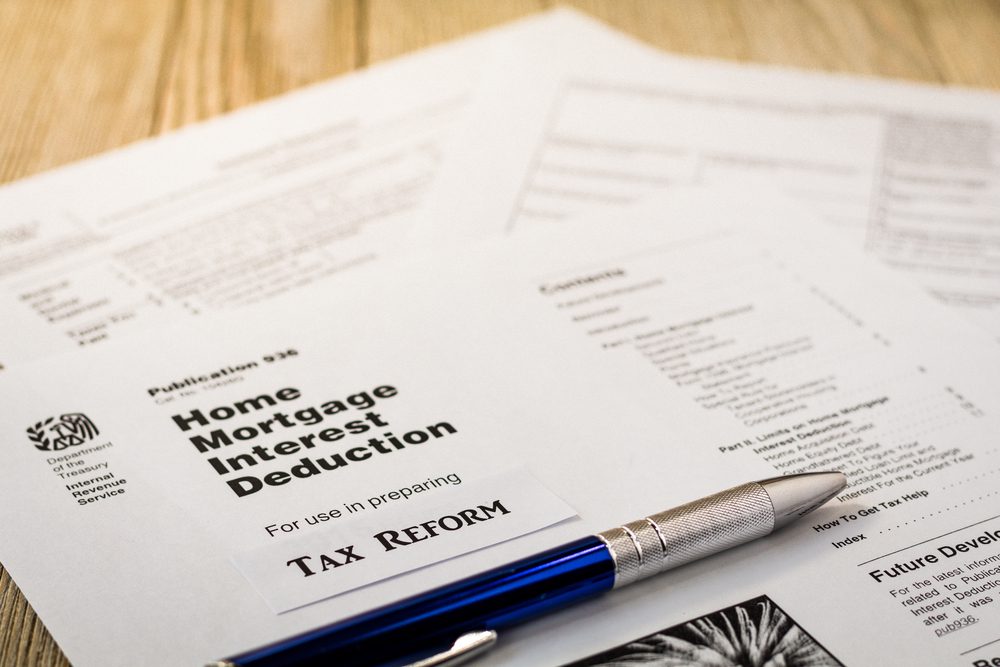
For most folks, the biggest tax break from having a house comes from deducting mortgage interest. You can write off interest on up to $750,000 of your debt ($375,000 if you and your spouse are filing separately) used to build, substantially improve, or buy your main residence or a single second residence (those who took out mortgages before 2018 can deduct interest on up to $1 million).
When it comes to home improvements, they qualify if they substantially add value to the house, adapt the place for new uses, or extend the house’s useful life. Basically, normal maintenance and repairs aren’t considered “significant”, but major renovations and additions are.
Every January, your lender will send you a Form 1098 stating the mortgage interest you paid the previous year. That amount is the one you can write off on Schedule A (Form 1040). If you recently bought a house, ensure that Form 1098 shows every interest you paid. This amount is also recorded on your settlement statement for the house purchase. You can write it off even if the lender doesn’t mention it on Form 1098.

4. Mortgage Interest Credit
Lower-income homeowners who received a Mortgage Credit Certificate (MCC) to help purchase a main home are also eligible for a mortgage interest tax credit. The credit ranges from 10% to 50% of the amount of mortgage interest paid over the year (the exact percentage is mentioned on the MCC you received).
If the credit rate exceeds 20%, the credit is limited to $2,000. Still, if your eligible credit is lowered as a result of the limit, you can carry forward the left portion of the credit for the next 3 years or until used.
To claim this tax break, fill out Form 8396 and attach it to your Form 1040. The credit amount must also be stated on Schedule 3 (Form 1040).
There are some special rules and restrictions for this credit. For example, you cannot double-dip. If you claim the mortgage interest credit, you must reduce your mortgage interest deduction by the credit amount.
Also, you’ll need a new MCC if you refinance your original loan — this way you’ll be able to calm the credit on the new loan, which means the credit amount may change. In addition, if you sell your house within 9 years, you may be required to pay back all or part of the MCC benefit.

5. Credits for Energy-Saving Improvements
The government offers a tax credit especially created to encourage people to power their homes with renewable energy sources. You’ll save up to 30% on eligible new systems that use wind, biomass, solar, geothermal, or fuel cell power to generate heat water, electricity, or regulate your home’s temperature.
The credit for fuel cell equipment has a limit of $500 per each half kilowatt of capacity (as of 2023, the credit won’t qualify for biomass systems, but it will qualify for battery storage technology).
For the 2022 tax year, folks going green can also save up to $500 by installing energy-efficient insulation, roofing, doors, air-conditioning and heating systems, water heaters, wood stoves, or the like. If you replace your old windows with new energy-efficient ones, you can claim a credit of up to $200.
Both credits are lifetime credit limits (for example, credit taken in the past count towards the limit). Other individual credit limits include one for certain boilers and furnaces ($150), one for advanced main air circulating fans ($50), and one for energy-efficient building property ($300).
Need more information? The IRS website has all the details.

6. Deduction of Rental Expenses
If you rent out a part of your house, such as the basement or a room, you’ll have to pay tax on your rental income. Even so, you can deduct your rental expenses. Potentially deductible expenses include general maintenance and repair costs, insurance, utilities, supplies, real estate taxes, and more.
You can also write off depreciation on any equipment or furniture you have in the rented space, as well as on the part of your home that is rented out. You don’t even have to itemize all the rental-space expenses to deduct them; you just have to claim them using Form 1040 reducing them by your rental income.
The tricky aspect is figuring out how much you can exactly write off if an expense covers the entire house, such as property taxes or an electric bill. In this case, you should divide the expense making sure to use a reasonable method.
For instance, if you rent a 250-square-foot room in a 2,500-square-foot house, you can deduct 10% of any whole-house expense as a rental expense. Also, if you renovate a room that you rent, the entire cost can be deducted as a rental expense.

7. Property Tax Deduction
As a homeowner, you get hit with lots of taxes. The good news is that some of them are deductible. These are the state and local property taxes that you pay on your federal tax return. Yet, to avoid spoiling the deduction, there are some necessary steps you must follow. First, you’ll have to itemize so you can write off real property taxes. Once you do this, you can deduct them using Form 1040.
There’s also a $10,000 threshold ($5,000 if you and your spouse file separate returns) on the combined amount of local and state income, property, and sales taxes you can deduct. What’s over $10,000 isn’t deductible. That affects especially those homeowners who live in states where income, property and/or sales taxes are higher.
Speaking of, here are 10 States With the Most Favorable Property Taxes.