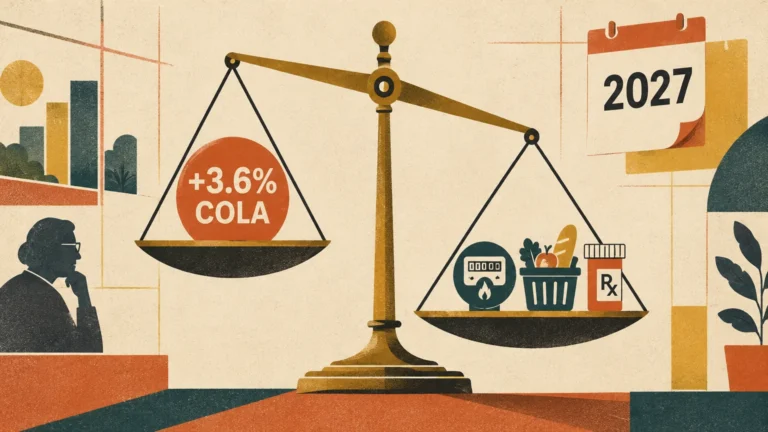
Living on Social Security as your primary income forces tough choices every month. While benefits adjust annually for inflation, core bills like housing, healthcare, and everyday groceries often climb much faster.
Understanding which expenses drain a fixed check quickest helps you protect your retirement budget before shortfalls happen. Below, you will see exact cost pressures for 2026 and 2027 alongside practical steps to keep more of each deposit.
Whether you rely on Social Security only income or pair it with modest savings, spotting these traps early makes every dollar work harder.
At a Glance
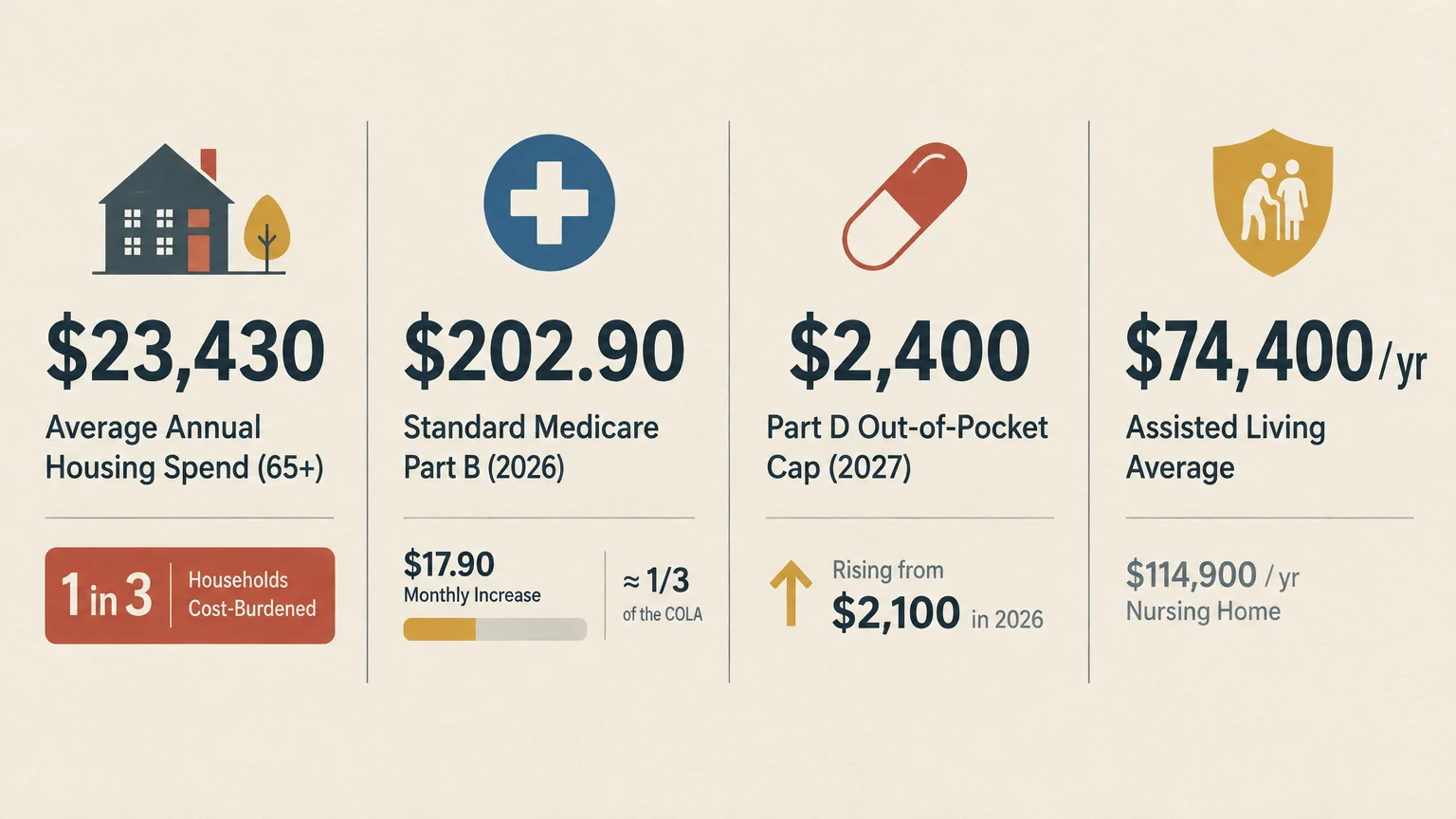
- Housing absorbs the biggest share: Adults 65 and older spent an average of $23,430 on housing in 2025, with over one in three older households facing housing cost burdens.
- Medicare premiums come off the top: The $17.90 jump in the standard 2026 Medicare Part B premium, to $202.90 per month, consumes roughly one-third of the average annual cost-of-living increase.
- Prescription drug caps are rising: The Medicare Part D out-of-pocket limit moves from $2,100 in 2026 to $2,400 in 2027, while stand-alone plan premiums face steep hikes.
- Long-term care sits outside Medicare: Assisted living averages $74,400 per year and nursing home care exceeds $114,900, leaving fixed-income retirees exposed without advance planning.
Why Social Security Checks Stretch Thin Fast
For millions of retirees, monthly benefits are the foundation of household cash flow. According to the Social Security Administration (SSA), the average retired worker received $2,092.17 per month in October 2026, while the average across all beneficiaries sat at $1,946.23.
Individual checks vary sharply based on your lifetime earnings and claiming age. Data from The Senior Citizens League shows 2026 monthly payments ranging from roughly $52 to $5,108.
A 2025 Transamerica Center for Retirement Studies survey found that 91% of retirees collect Social Security, and 53% depend on it as their main income source. Meanwhile, a 2026 Boston College analysis shows benefits supply 83% of total income for the lowest-income older households.
Roughly half of Americans aged 65 and older live in households where Social Security provides at least half of total income, per SSA research and the March 2025 Current Population Survey. About 24% report relying on benefits for 90% or more of their income.
Even with annual Cost-of-Living Adjustments (COLAs), purchasing power erodes over time. Benefits rose 2.8% in 2026, adding roughly $56 to $57 per month for the average retiree.
On October 14, 2026, the Social Security Administration announced a 3.6% COLA for 2027, payable starting in January 2027. That boost adds roughly $75 per month, lifting the average retired worker check from about $2,095 to $2,170.
The mismatch comes from how federal law calculates your raise. Under the Social Security Act, COLAs track the Consumer Price Index for Urban Wage Earners and Clerical Workers (CPI-W), which mirrors younger workers rather than retirees.
The Bureau of Labor Statistics (BLS) tracks an experimental index for adults aged 62 and older called the CPI-E, which weights housing and medical care more heavily. Between January 1985 and January 2025, the CPI-E jumped 221% compared with 197% for the CPI-W.
Your annual raise is priced around working-age expenses, while your actual retirement bills cluster in the fastest-inflating categories—shelter and healthcare.
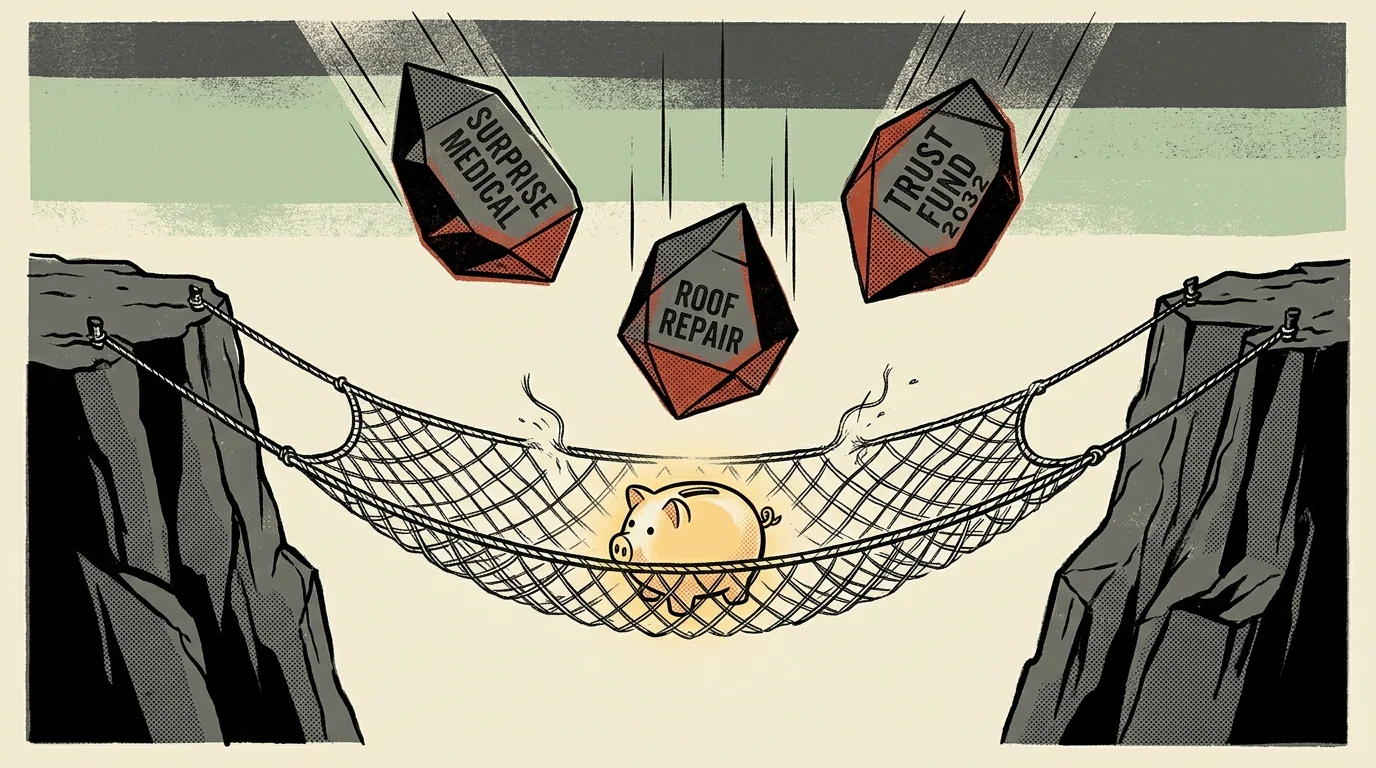
Long-term program funding also deserves a spot on your radar when building a multi-year plan. The 2026 Social Security Trustees Report projects that the Old-Age and Survivors Insurance trust fund will deplete its reserves in 2032.
If Congress does not act before 2032, incoming payroll taxes would only cover 78% of scheduled benefits. Keeping even a modest cash reserve gives you breathing room if benefit rules or future COLAs fall short.
Actionable Steps for Tighter Cash Flow
- Build your budget around net deposits: Plan around the exact dollar amount hitting your bank account after Medicare Part B and tax withholdings, rather than your gross benefit statement.
- Track personal inflation quarterly: Compare your actual utility, insurance, and grocery bills against last year’s statements so your retirement budget reflects real local prices rather than national headlines.
- Confirm benefit accuracy online: Review your earnings record and payment history through your personal account on SSA.gov before major life or tax changes.
Retiree Housing Costs: The Largest Threat to a Fixed Income
Shelter consumes more retirement cash than any other line item. According to the BLS Consumer Expenditure Survey for 2025, released in October 2026, households headed by someone aged 65 and older spent an average of $64,445 annually.
Housing accounted for $23,430 of that annual total. It absorbed 35% of all spending for households aged 65 to 74 and jumped to 39% for those aged 75 and older.
Over the long haul, retiree housing costs have outpaced broader living expenses by a wide margin. An Investopedia analysis of BLS figures shows inflation-adjusted spending for 65-plus households rose 41% between 1990 and 2025, and 52% for ages 75 and older.
Housing alone drove roughly 46% of that 35-year cost surge. Even if you paid off your mortgage decades ago, property taxes, homeowners insurance, utilities, and home repairs keep climbing.
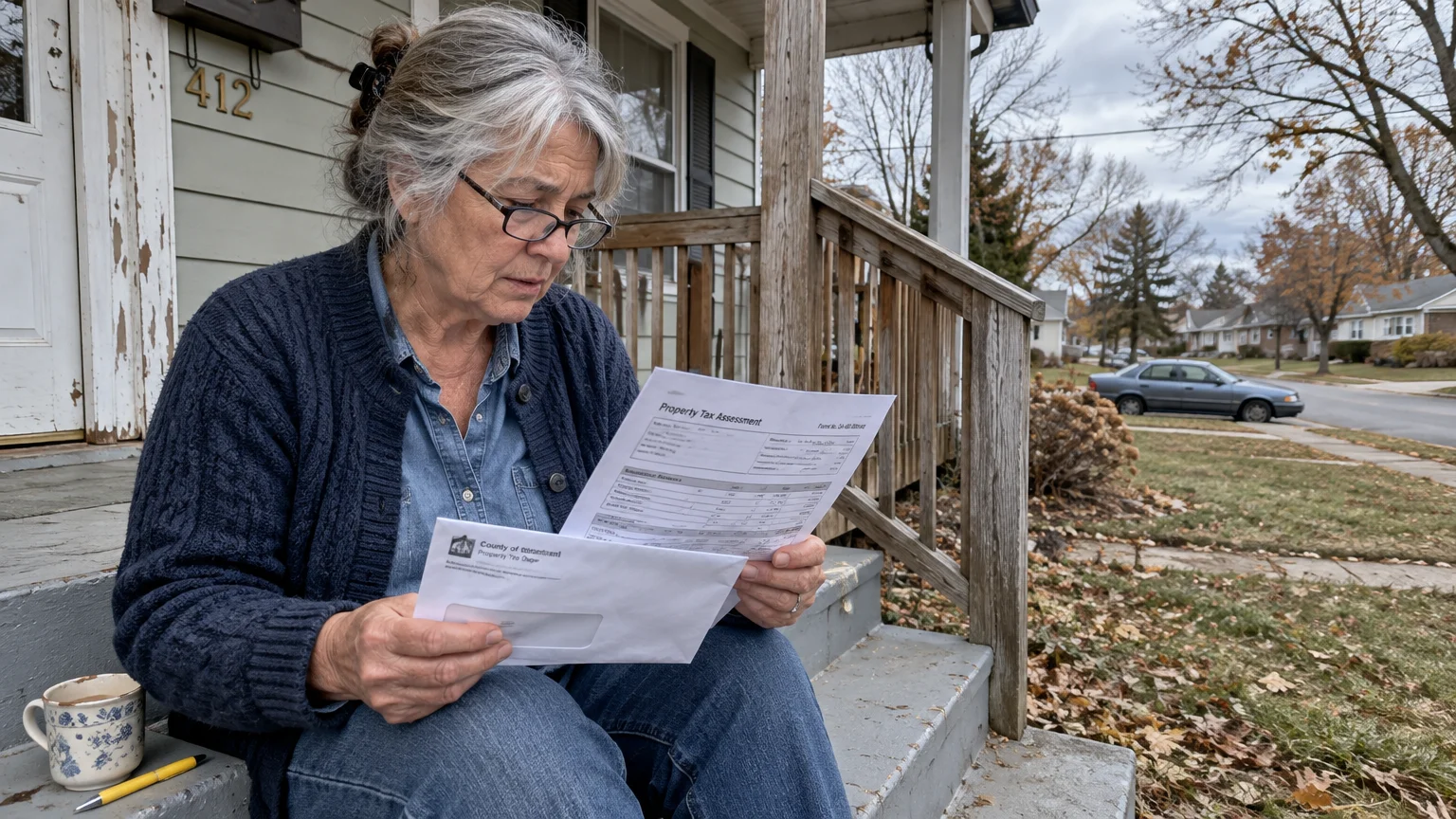
The Harvard Joint Center for Housing Studies (JCHS) reports in its 2025 housing assessment that 34% of households aged 65 and older—a record 12.4 million households—were cost burdened, spending over 30% of income on housing. Another 6.7 million spent more than half.
Renters and solo seniors face the sharpest squeeze. JCHS data shows 58% of older renters and nearly 28% of older homeowners carried housing cost burdens.
A May 2026 JCHS analysis of 2024 Census data highlights how hard single-income households get hit. Older female-headed households had a median income of $48,000, dropping to $36,000 past age 79 and $27,000 for female renters 65 and older.
Half of those older female renters faced housing cost burdens, rising to 66% among women renting alone. When an average Social Security check brings in roughly $25,100 a year, a $1,200 monthly rent leaves very little for anything else.
Ways to Lower Your Housing Burden
- Apply for state property tax relief: Most counties offer homestead exemptions, senior tax freezes, or circuit-breaker credits that cap property taxes based on age and income.
- Audit homeowners insurance every year: Raise your deductible if you hold an emergency fund, bundle policies, and ask about discounts for updated roofs or security systems.
- Explore federal and local housing aid: Visit the Department of Housing and Urban Development (HUD) to check eligibility for Section 202 supportive housing or local rental vouchers.
- Downsize before mobility forces the issue: Moving from a high-tax, high-maintenance home into a smaller unit can free equity and cut utility and repair bills permanently.
Healthcare Costs for Retirees and Direct Medicare Deductions
Medical expenses hit your budget twice—first through automatic paycheck deductions and again at the pharmacy or clinic. BLS 2025 data shows households aged 65 and older spent $7,986 out of pocket on healthcare, well above the $6,470 U.S. household average.
Your first deduction is the Medicare Part B premium, which covers doctor visits and outpatient care. In 2026, the Centers for Medicare & Medicaid Services (CMS) set the standard Part B monthly premium at $202.90, up 9.7% from $185 in 2025.
That $17.90 monthly jump absorbed nearly a third of the average retiree’s 2026 COLA increase. The annual Part B deductible also sits at $283 in 2026.
As of mid-November 2026, CMS had not yet released final 2027 Part A and Part B figures. However, the 2026 Medicare Trustees Report projects a 2027 Part B premium of $209.50 per month and a $292 annual deductible.
One vital safeguard helps protect Social Security only income from shrinking completely. Under the federal hold harmless rule, Part B premium hikes generally cannot reduce an eligible retiree’s net Social Security check from one year to the next.
Still, Original Medicare carries major coverage gaps. After you meet the Part B deductible, you generally owe 20% coinsurance on outpatient services with no annual out-of-pocket ceiling unless you carry Medigap or Medicare Advantage.
Hospital stays carry steep upfront charges too. While roughly 99% of enrollees pay zero premium for Medicare Part A, the 2026 inpatient hospital deductible is $1,736 per benefit period, projected to reach $1,788 in 2027.
Skilled nursing facility care beyond 20 days adds $217 per day in coinsurance during 2026. The Trustees Report projects that daily rate rising to $223.50 in 2027.
Prescription drug rules are also shifting for 2027 under finalized CMS rates. While the Part D out-of-pocket spending cap provides real protection, the annual ceiling increases from $2,100 in 2026 to $2,400 in 2027.
Maximum Part D deductibles also climb from $615 in 2026 to $700 in 2027, and the base beneficiary premium edges up from $38.99 to $41.33 per month. High-deductible Medigap Plans F, G, and J rise from $2,950 to $3,050.
Plan shopping matters more than ever before 2027 begins. An October 2026 KFF analysis estimates average enrollment-weighted monthly premiums for stand-alone Part D plans could jump 50%—from $34 in 2026 to $51 in 2027—if enrollees stay in existing plans.
By contrast, Medicare Advantage prescription plans average roughly $9 per month. Always compare total out-of-pocket drug costs alongside premiums on Medicare.gov during annual open enrollment.
| Medicare Cost Component | 2026 Amount | 2027 Amount / Projection |
|---|---|---|
| Part B Standard Monthly Premium | $202.90 | $209.50 (Trustees projection) |
| Part B Annual Deductible | $283 | $292 (Trustees projection) |
| Part A Inpatient Hospital Deductible | $1,736 per benefit period | $1,788 (Trustees projection) |
| Part A Skilled Nursing (Days 21–100) | $217/day | $223.50/day (Trustees projection) |
| Part D Out-of-Pocket Spending Cap | $2,100 | $2,400 (Finalized CMS) |
| Part D Maximum Annual Deductible | $615 | $700 (Finalized CMS) |
| High-Deductible Medigap (F, G, J) | $2,950 | $3,050 (Finalized CMS) |
Lifetime medical costs extend far beyond a single calendar year. A July 2026 Fidelity estimate projects a 65-year-old retiring in 2026 will need $185,500 in after-tax savings just for healthcare, up 7.5% from $172,500 in 2025.
For a 65-year-old couple, that estimate reaches $371,000. Fidelity attributes 48% of those costs to Medicare cost-sharing, 45% to Part B and Part D premiums, and 7% to drugs outside Part D.
Notably, that $185,500 figure excludes over-the-counter items, most routine dental care, and long-term care. If you rely heavily on Social Security, tapping state Medicare Savings Programs or Extra Help for prescriptions can prevent medical bills from wrecking your budget.
Long-Term Care: The Expense Medicare Does Not Cover
Few financial shocks derail a retirement budget faster than needing daily help with bathing, dressing, or memory care. Original Medicare covers short-term skilled rehabilitation, not ongoing custodial care.
According to CareScout, roughly seven in ten people will need long-term care at some point in their lives. When Social Security is your main income, paying out of pocket at national rates is nearly impossible.
The CareScout and Genworth 2025 Cost of Care Survey, released in March 2026, reveals staggering annual price tags across every care setting:
- In-home non-medical caregiver: $35 per hour, or $80,080 per year based on 44 hours per week, up 3% year-over-year.
- Assisted living community (private room): $6,200 per month, or $74,400 annually, representing a 5% annual increase.
- Nursing home (semi-private room): $114,975 per year, up 3% from the prior year.
- Nursing home (private room): $129,575 per year, up 1% year-over-year.
- Adult day health care: $95 per day, or $24,700 per year for five days a week, down 5% year-over-year.
Compare those bills against an average annual Social Security income near $25,100. Even adult day care—the most affordable option—equals almost an entire year’s benefits.
Because private long-term care insurance grows prohibitively expensive in your late 60s or 70s, low-income and modest-asset retirees often rely on Medicaid once savings spend down. Exploring community caregiver grants and family support plans early preserves more options.

Food, Transportation, and Everyday Inflation
After housing and healthcare, daily living expenses quietly chip away at what remains of your monthly check. BLS 2025 figures show transportation was the second-largest growth area for 65-plus households, reaching $11,092 per year.
Maintaining an aging vehicle involves rising auto insurance premiums, repairs, registration fees, and fuel. Dropping from two cars to one—or shifting to senior transit passes—can immediately free hundreds of dollars every month.
Food inflation also hits fixed incomes hard because groceries cannot be postponed. Across all U.S. households in 2025, food averaged 13.0% of total spending, or $10,633 annually, with meats, poultry, fish, and eggs climbing 11.7% in a single year.
You can blunt grocery inflation without sacrificing nutrition. Shop store brands, build weekly meals around seasonal produce and sales, and check whether your household qualifies for the Supplemental Nutrition Assistance Program (SNAP) through USA.gov Benefits.
Federal and State Taxes That Catch Retirees Off Guard
Many people assume Social Security benefits are always tax-free, yet federal formulas can turn modest extra income into an unexpected tax bill. The Internal Revenue Service (IRS) bases taxation on your combined—or provisional—income.
Provisional income equals your adjusted gross income (AGI), plus nontaxable interest, plus half of your annual Social Security benefits. Crucially, Congress has never indexed these statutory thresholds for inflation.
If you file as single or head of household, provisional income below $25,000 keeps benefits 100% federal-tax-free. Between $25,000 and $34,000, up to 50% becomes taxable, and above $34,000, up to 85% can be taxed.
For married couples filing jointly, thresholds sit at $32,000 for 0% taxation, $32,000 to $44,000 for up to 50%, and over $44,000 for up to 85%. Someone living solely on an average $25,100 check has roughly $12,550 in provisional income and owes zero federal tax.
However, part-time wages, pension checks, or taxable IRA withdrawals quickly push provisional income past those fixed lines. Fortunately, temporary federal relief now cushions many middle-income seniors.
Under Public Law 119-21, enacted in 2025, taxpayers aged 65 and older can claim an extra $6,000 Senior Deduction per person from tax years 2025 through 2028. Married couples filing jointly where both spouses are 65 or older receive $12,000.
You can claim this bonus whether you itemize or take the standard deduction, though it phases out above $75,000 MAGI for singles and $150,000 for joint filers. Industry estimates indicate this temporary rule drops the share of seniors owing federal tax on benefits to roughly 12% through 2028.
State taxes vary widely depending on where you live. Following West Virginia’s full phase-out in 2026—and earlier repeals in Kansas, Missouri, and Nebraska—only eight states still tax Social Security benefits in some form for 2026.
Those eight states are Colorado, Connecticut, Minnesota, Montana, New Mexico, Rhode Island, Utah, and Vermont. All 42 other states and Washington, D.C. exempt benefits entirely.
Even within the eight taxing states, lower- and middle-income seniors frequently qualify for broad exclusions. Colorado exempts federally taxed benefits at age 65 and older, while Connecticut exempts AGI below $75,000 single or $100,000 joint.
New Mexico exempts AGI up to $100,000 for single filers and $150,000 for joint filers, and Rhode Island is expanding its exemption in 2027. Always verify your state’s current rules before filing.
Watch out for withholding gaps too. Using IRS Form W-4V lets you withhold federal taxes from your check at flat rates of 7%, 10%, 12%, or 22%, but Form W-4V never withholds state income taxes.
What Can Go Wrong
Small administrative oversights can trigger permanent penalties or sudden cash crunches when living on Social Security. Watch out for these frequent errors:
- Auto-renewing Medicare Part D without checking premiums: Letting your current stand-alone drug plan roll into 2027 without comparing alternatives could expose you to steep premium hikes or dropped prescriptions.
- Delaying Part D without creditable drug coverage: Skipping Part D when you first become eligible adds a permanent 1%-per-month late enrollment penalty to your future premiums.
- Assuming Form W-4V covers state taxes: Electing federal withholding from Social Security leaves state income taxes unpaid if you live in one of the eight taxing states and have extra income.
- Ignoring non-mortgage housing costs: Failing to set aside monthly cash for rising property taxes, insurance renewals, or roof and appliance repairs creates high-interest credit card debt later.
- Taking unplanned IRA withdrawals: Pulling a lump sum from a traditional retirement account in December can push provisional income over federal thresholds and raise future Medicare premiums.
How to Protect Your Budget When Social Security Is Your Anchor
You cannot stop inflation or rewrite federal Medicare pricing, yet you control how your household absorbs those costs. Follow this practical sequence to strengthen your monthly cash flow:
- Calculate your true fixed baseline: List your rent or property taxes, utilities, insurance, groceries, and out-of-pocket medical costs alongside your net Social Security deposits.
- Screen for every benefit assistance program: Check eligibility for Medicare Savings Programs (which pay Part B premiums), Part D Extra Help, SNAP food assistance, and Low Income Home Energy Assistance (LIHEAP) via USA.gov.
- Shop Medicare coverage every autumn: Compare total annual costs—premiums, deductibles, and copays—across stand-alone Part D, Medigap, and Medicare Advantage plans before December deadlines.
- Coordinate income sources deliberately: Time part-time work or modest IRA withdrawals carefully so you stay under federal provisional income thresholds whenever possible.
- Set aside a dedicated home and health buffer: Even $50 to $100 transferred monthly into a high-yield savings account prevents surprise car repairs or deductibles from derailing your rent.

When to Consult a Professional
Free guidance from your State Health Insurance Assistance Program (SHIP) or a nonprofit counselor through the National Foundation for Credit Counseling covers basic budgeting. However, certain crossroads justify hiring a fiduciary financial planner, elder law attorney, or enrolled agent:
- Coordinating retirement withdrawals with Social Security: A tax professional helps sequence Roth vs. traditional IRA withdrawals around provisional income thresholds and the temporary 2025–2028 Senior Deduction.
- Planning for impending long-term care: An elder law attorney helps navigate Medicaid look-back rules, spousal asset protections, and local care options without violating strict eligibility laws.
- Choosing between Medigap and Medicare Advantage: An independent, licensed Medicare specialist can weigh your doctors, prescriptions, and travel habits before health changes restrict Medigap underwriting.
- Managing unsustainable housing debt: A HUD-approved housing counselor can walk you through reverse mortgage trade-offs, property tax deferral programs, or downsizing timelines without sales pressure.
Frequently Asked Questions
Can Social Security alone cover my living expenses in 2026?
With the average retired worker check at $2,092.17 per month in October 2026, covering expenses on Social Security alone depends heavily on your housing situation. Seniors with paid-off homes in low-tax areas manage far more easily than renters in high-cost cities.
Will the 2027 COLA cover rising Medicare costs?
The 3.6% COLA adds roughly $75 per month to the average retired worker check in 2027. While the projected $6.60 Part B increase leaves most of that raise intact, higher Part D premiums and drug deductibles can absorb a noticeable slice.
Do I owe federal income tax if Social Security is my only income?
Generally, no. If Social Security is your sole income source, your provisional income equals half of your benefits, keeping an average retiree well below the $25,000 single and $32,000 married thresholds.
Which costs are excluded from Medicare even if I pay Part B premiums?
Original Medicare does not cover ongoing custodial long-term care, most routine dental work, eyeglasses, or hearing aids. You also face 20% Part B coinsurance with no annual spending cap unless you add supplemental coverage.
Moving Forward With Confidence
When Social Security carries most of your household bills, protecting every net dollar starts with anticipating where prices rise fastest—shelter, Medicare cost-sharing, prescriptions, and future care needs. Review your housing aid options, shop Medicare plans before 2027 rates take hold, and monitor tax thresholds annually.
This is educational content based on general financial principles. Individual results vary based on your situation. Always verify current tax laws, investment rules, and benefit eligibility with official sources.
Last updated: November 2026. Financial regulations and rates change frequently—verify current details with official sources.