If you are age 65 or older, a temporary federal tax break can cut up to $6,000 from your taxable income—or $12,000 for qualifying married couples. You can claim this 6000 senior deduction whether you itemize or take the standard deduction.
Congress enacted this senior bonus deduction for tax years 2025 through 2028, making it a prime planning opportunity on your 2026 tax return. Knowing the exact age cutoffs, income phaseouts, and form lines helps you capture every dollar.
Below, you will find who qualifies, how the math works, and step-by-step instructions to claim it.
What Is the $6,000 Senior Bonus Deduction?
On July 4, 2025, Congress enacted the One Big Beautiful Bill Act (Public Law 119-21), creating IRC section 151(d)(5)(C) under Section 70103. The Internal Revenue Service (IRS) calls this tax break the Enhanced Deduction for Seniors under the Working Families Tax Cuts.
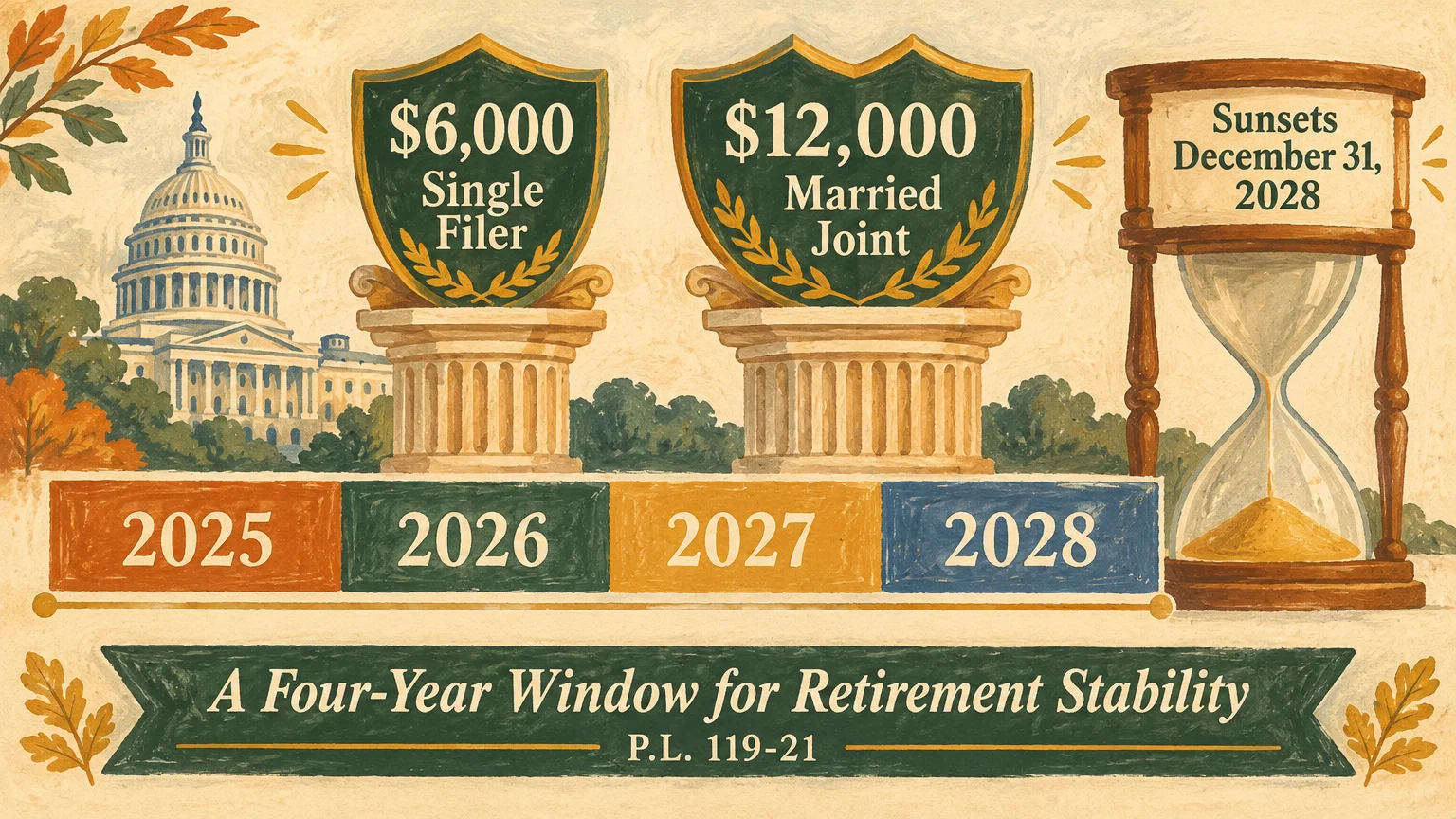
Each qualifying taxpayer age 65 or older can deduct up to $6,000 per year. Married couples filing jointly can deduct up to $12,000 if both spouses qualify, or up to $6,000 if only one spouse qualifies.
This provision applies strictly to tax years 2025 through 2028, covering returns filed in 2026 through 2029. Unless Congress passes an extension, the deduction expires for tax years beginning after December 31, 2028.
Unlike regular standard deductions, neither the $6,000 cap nor the income phaseout thresholds are indexed for inflation. Those dollar limits stay fixed across the entire four-year window from 2025 through 2028.
Because the window is temporary, planning across multiple tax years matters more than usual. Timing retirement withdrawals or capital gains around this four-year schedule can help you preserve the full deduction before it sunsets.
Who Qualifies for This Tax Deduction Over 65?
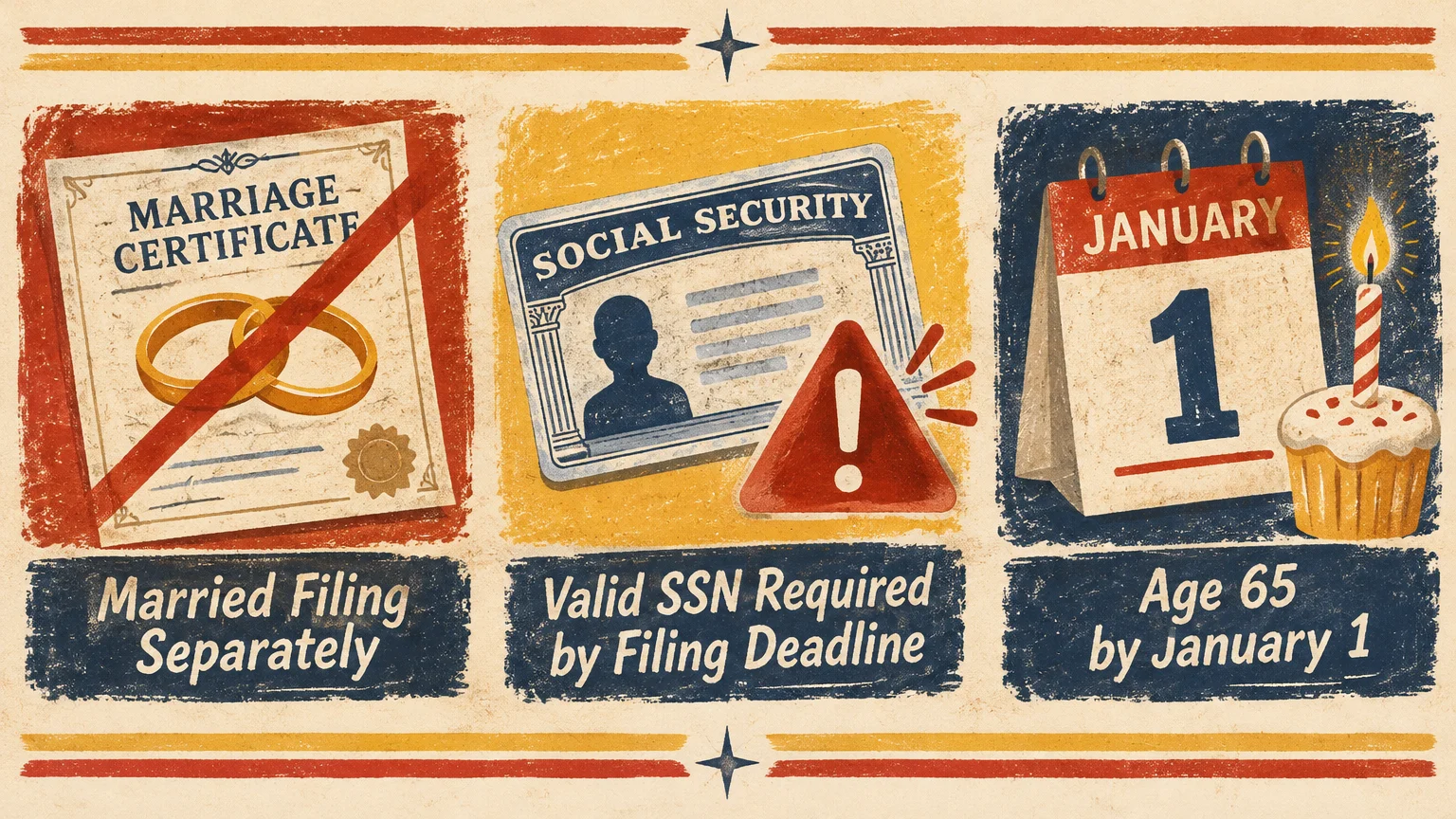
Meeting the age rule is the first gate for claiming a tax deduction over 65. You must be age 65 or older on or before December 31 of the tax year you are filing.
Under IRS rules, you officially reach age 65 on the day before your 65th birthday. For your 2025 tax return filed in 2026, you must have been born before January 2, 1961.
For your 2026 tax return filed in 2027, you must have been born before January 2, 1962. Even if your 65th birthday falls on January 1, 2027, the IRS treats you as age 65 at the end of 2026.
Age alone is not enough, however, because IRS Publication 6142 and Internal Revenue Manual 21.6.4 enforce strict filing and identification rules. Review every eligibility gate before you file:
- Valid Social Security number: Each qualifying individual must have a valid SSN listed on the return, issued on or before the return’s due date including extensions.
- Joint filing for married taxpayers: If you are married, you must file Married Filing Jointly to claim the deduction; filing Married Filing Separately disqualifies you completely.
- Deceased taxpayer rule: Per IRS Form 1040 Instructions and Publication 554, a taxpayer born before the January 2 cutoff who died during the year before turning 65 does not qualify on their final return.
- No retirement requirement: You do not need to be retired or collecting Social Security benefits to claim the deduction; working seniors age 65 and older qualify under the same income rules.
That final point surprises many older workers. If you earn wages or self-employment income past age 65, you remain fully eligible as long as your Modified Adjusted Gross Income stays below the phaseout ceiling.
One detail deserves extra attention for surviving spouses and executors. A deceased spouse born before the January 2 cutoff only qualifies for the $6,000 allowance if they actually reached age 65 prior to their date of death.
Income Limits and MAGI Phaseout Math
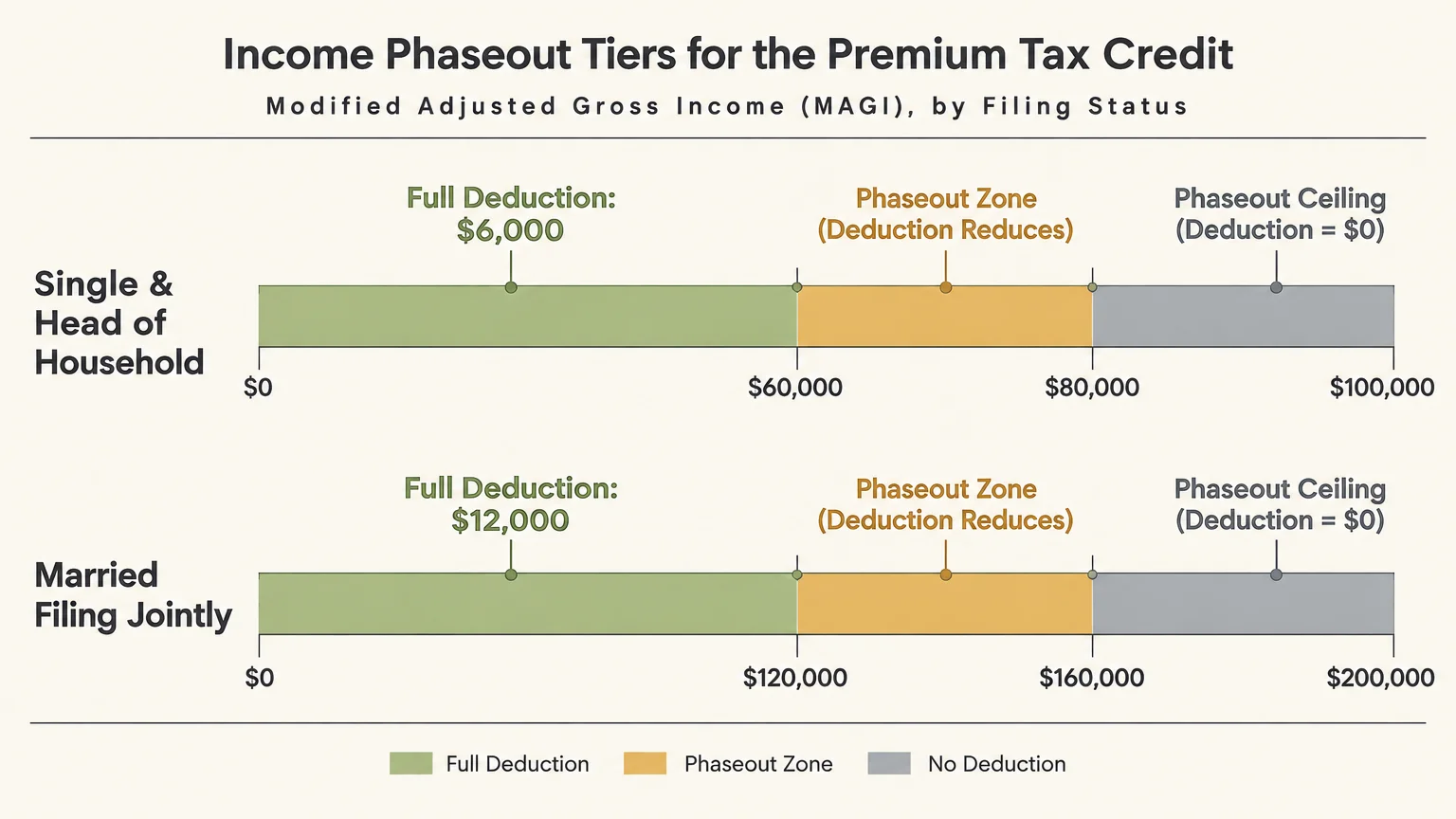
Higher-income households face a gradual phaseout based on Modified Adjusted Gross Income (MAGI). The deduction starts shrinking once your MAGI exceeds $75,000 as a non-joint filer or $150,000 as a Married Filing Jointly couple.
Per IRS Schedule 1-A, your deduction drops by 6%—or 6 cents per dollar—for every dollar of MAGI above your threshold. For non-joint filers, the $6,000 deduction disappears completely at $175,000 MAGI.
For Married Filing Jointly couples, each qualifying spouse’s $6,000 deduction is reduced separately by 6% of joint MAGI above $150,000. When both spouses claim $6,000 each, that creates an effective combined phaseout rate of 12%.
Because each $6,000 allowance drops at 6% over a $100,000 span, the deduction hits $0 at $250,000 MAGI for joint filers. That $250,000 zero-out point holds whether one spouse or both spouses qualify.
To find your exact MAGI, IRS Schedule 1-A Part I starts with your Adjusted Gross Income from Form 1040 line 11b. You then add back any excluded income from Puerto Rico, Form 2555 lines 45 and 50, and Form 4563 line 15.
For most domestic retirees without foreign or territory income exclusions, your MAGI equals your regular Adjusted Gross Income. Walking through concrete examples makes the phaseout math easy to verify.
Suppose you file as Single with $100,000 in MAGI. Your MAGI exceeds the $75,000 threshold by $25,000, so you multiply $25,000 by 6% to get a $1,500 reduction—leaving a $4,500 senior deduction.
Now consider a married couple filing jointly, both age 66, with $200,000 in MAGI. Their income exceeds $150,000 by $50,000, reducing each spouse’s $6,000 allowance by $3,000 and leaving $6,000 total instead of $12,000.
If only one spouse in that $200,000 joint household is age 65 or older, the math changes. That single $6,000 allowance drops by $3,000, leaving the couple with a $3,000 deduction.
| Filing Status | MAGI Level | Excess Over Threshold | Reduction Applied | Remaining Deduction |
|---|---|---|---|---|
| Single / Head of Household | $75,000 or less | $0 | $0 | $6,000 |
| Single / Head of Household | $100,000 | $25,000 | $1,500 (6%) | $4,500 |
| Single / Head of Household | $125,000 | $50,000 | $3,000 (6%) | $3,000 |
| Single / Head of Household | $175,000 or more | $100,000+ | $6,000 | $0 |
| Married Filing Jointly (One 65+) | $150,000 or less | $0 | $0 | $6,000 |
| Married Filing Jointly (One 65+) | $200,000 | $50,000 | $3,000 (6%) | $3,000 |
| Married Filing Jointly (Both 65+) | $150,000 or less | $0 | $0 | $12,000 |
| Married Filing Jointly (Both 65+) | $200,000 | $50,000 | $6,000 (12% combined) | $6,000 |
| Married Filing Jointly (One or Both 65+) | $250,000 or more | $100,000+ | Full allowance | $0 |
Remember that Married Filing Separately filers receive $0 at every income level. Always run a quick joint-versus-separate comparison before locking in your filing status.
How the $6,000 Bonus Stacks With Standard and Itemized Deductions
You do not have to choose between this bonus and your usual deduction method. Per IRS Tax Tip 2026-14 and IRS Publication 6142, you can claim the Enhanced Deduction for Seniors whether you itemize on Schedule A or take the standard deduction.
For standard-deduction filers, the $6,000 bonus stacks directly on top of two existing deductions. You still keep both your regular base standard deduction and the permanent age-65-or-older additional standard deduction.
For tax year 2025—covered by IRS Tax Tip 2026-12 and Topic No. 551—the base standard deduction is $15,750 for Single or Married Filing Separately filers, $23,625 for Head of Household, and $31,500 for Married Filing Jointly.
On top of those 2025 base figures, seniors receive an existing age-65+ add-on of $2,000 if unmarried and not a surviving spouse, or $1,600 per qualifying married or surviving spouse. Adding the $6,000 bonus brings a qualifying Single filer’s total deduction to $23,750 and a couple’s total to $46,700.
For tax year 2026—returns due in April 2027—inflation adjustments in IRS Publication 505 and Revenue Procedure 2025-32 push those totals even higher. The 2026 base standard deduction rises to $16,100 for Single filers, $24,150 for Head of Household, and $32,200 for Married Filing Jointly.
The permanent age-65+ add-on for 2026 increases to $2,050 for Single or Head of Household filers and $1,650 per qualifying spouse for joint returns. If you are both age 65 or older and legally blind, those existing permanent add-ons double.
Combined with the $6,000 bonus, a standard-deduction filer under the income phaseout can deduct up to $24,150 as a Single senior in 2026. A married couple with both spouses age 65 or older can deduct up to $47,500.
Looking ahead, IRS announcement IR-2026-133 and Revenue Procedure 2026-35 set even larger base standard deductions for tax year 2027. Base amounts climb to $16,600 for Single filers, $24,925 for Head of Household, and $33,200 for joint filers, with permanent age-65+ add-ons rising to $2,100 and $1,700.
| Deduction Component | Tax Year 2025 | Tax Year 2026 | Tax Year 2027 |
|---|---|---|---|
| Base Standard Deduction (Single) | $15,750 | $16,100 | $16,600 |
| Permanent Age 65+ Add-On (Single) | $2,000 | $2,050 | $2,100 |
| Enhanced Senior Deduction (Under $75,000 MAGI) | $6,000 | $6,000 | $6,000 |
| Total Standard Deduction (Single 65+) | $23,750 | $24,150 | $24,700 |
| Base Standard Deduction (Married Filing Jointly) | $31,500 | $32,200 | $33,200 |
| Permanent Age 65+ Add-On (MFJ, Both 65+) | $3,200 ($1,600 each) | $3,300 ($1,650 each) | $3,400 ($1,700 each) |
| Enhanced Senior Deduction (Under $150,000 MAGI) | $12,000 ($6,000 each) | $12,000 ($6,000 each) | $12,000 ($6,000 each) |
| Total Standard Deduction (MFJ, Both 65+) | $46,700 | $47,500 | $48,600 |
If you currently itemize medical expenses, mortgage interest, or charitable gifts on Schedule A, check your math again for 2026. The $6,000 bonus stacks onto itemized deductions too, so itemizing only pays off if Schedule A beats your base standard deduction plus the permanent 65+ add-on.
How This Deduction Affects Social Security Taxes and Medicare IRMAA
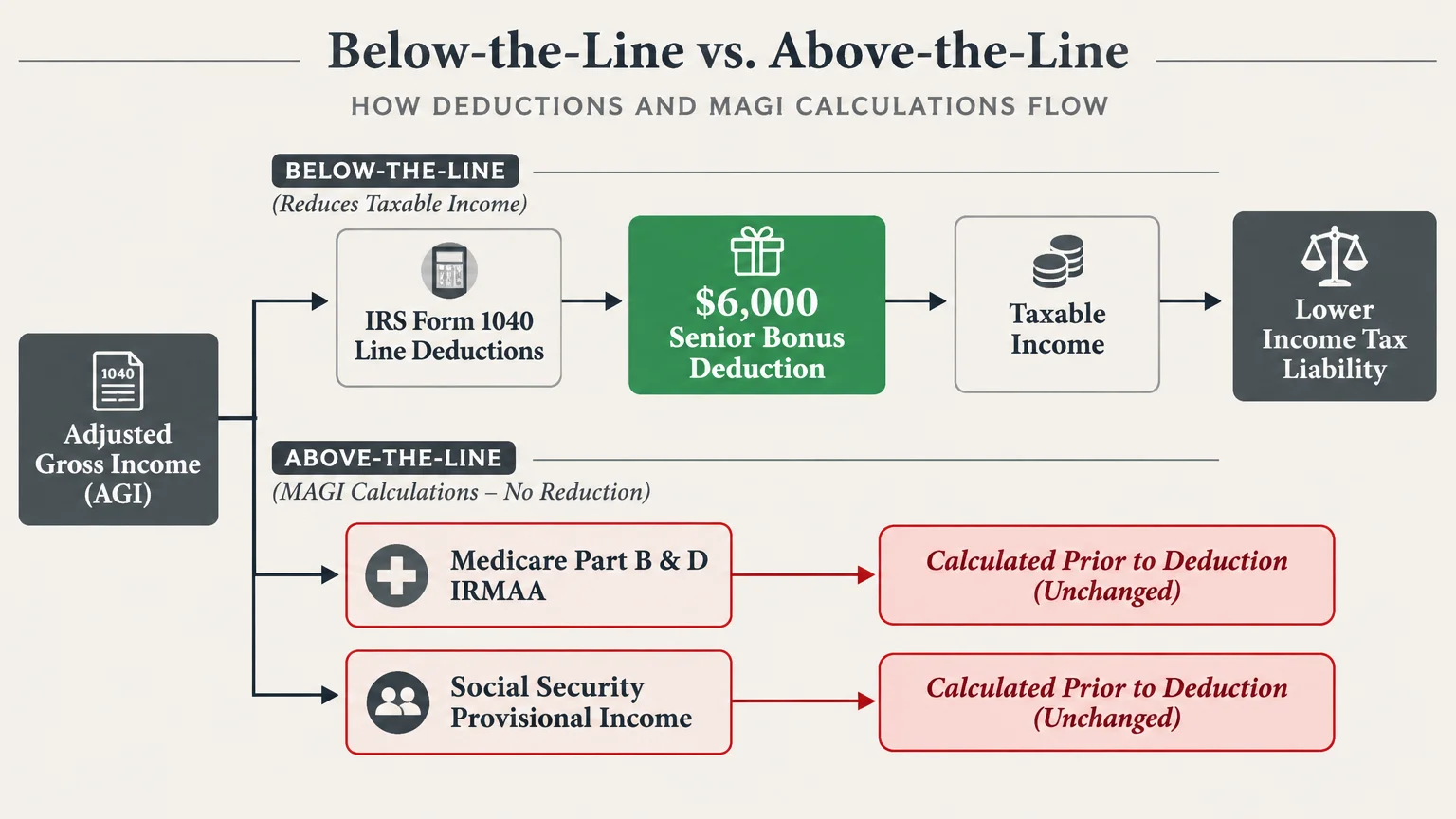
Understanding where the senior bonus deduction lands on your tax return prevents costly retirement planning surprises. Because it is a below-the-line deduction, the IRS subtracts it after calculating your Adjusted Gross Income.
That placement carries two very different consequences for your retirement budget. First, lowering your taxable income can reduce or completely offset federal income tax you would otherwise owe on taxable Social Security Administration (SSA) benefits.
Second, a below-the-line deduction does not shrink your Adjusted Gross Income or Modified Adjusted Gross Income. As a result, it never reduces the provisional income formula that determines how much of your Social Security benefits become taxable.
The same limitation applies to Medicare.gov Income-Related Monthly Adjustment Amount (IRMAA) surcharges. Medicare calculates Part B and Part D surcharges from your MAGI, so claiming the $6,000 senior deduction will not pull you down into a lower IRMAA tier.
Treat the $6,000 senior deduction as an end-of-return tax reducer, not an AGI shelter. Large Roth conversions, IRA withdrawals, or capital gains still raise your MAGI, which can simultaneously trigger Medicare IRMAA surcharges and erode your senior deduction at 6% or 12%.
Keep this rule in mind before executing year-end tax moves. If you plan a Roth conversion, calculate how the added AGI affects both your IRMAA bracket and your Schedule 1-A phaseout at the same time.
How to Claim the Senior Deduction on Your 2026 Tax Return
Claiming this benefit requires filing a dedicated schedule rather than relying on the standard deduction table alone. You must attach Schedule 1-A (Form 1040), titled Additional Deductions, to your federal return.
Per IRS FS-2026-04 and IR-2026-28, you can attach Schedule 1-A to Form 1040, Form 1040-SR, or Form 1040-NR. Form 1040-SR offers larger print and a standard-deduction chart tailored for filers age 65 and older, though both forms calculate the exact same tax.
Follow these steps to claim the senior deduction accurately:
- Verify eligibility details: Confirm your birth date meets the January 2 cutoff, verify valid Social Security numbers for everyone listed, and ensure married couples use Married Filing Jointly.
- Calculate MAGI in Part I: Complete Schedule 1-A, Part I by starting with your Form 1040 line 11b AGI and adding back any excluded Puerto Rico, foreign earned, or American Samoa income.
- Compute the deduction in Part V: Fill out Schedule 1-A, Part V, titled Enhanced Deduction for Seniors, to apply the $6,000 per-person cap and any 6% phaseout reduction.
- Transfer the total to your main form: Per IRS FS-2026-05, Schedule 1-A totals transfer to line 13b on 2025 Form 1040 and 1040-SR (or line 13c on 2025 Form 1040-NR); on draft 2026 Form 1040, 1040-SR, and 1040-NR, the Schedule 1-A total moves to line 13a.
- File before the deadline: Submit your 2026 federal tax return by April 15, 2027, or request an extension to file by October 15, 2027.
You do not have to pay steep preparation fees just to navigate a new IRS form. Per IRS Tax Tip 2026-14, two nationwide programs offer free, reputable tax preparation for older adults.
The Volunteer Income Tax Assistance (VITA) and Tax Counseling for the Elderly (TCE) programs serve taxpayers age 60 and older at no cost; call 800-906-9887 to locate a site. You can also contact AARP Foundation Tax-Aide at 888-227-7669 or visit AARP.org/TaxAide for free filing assistance.
Before visiting a preparer or opening tax software, gather your Social Security benefit statements (SSA-1099), retirement distribution forms (1099-R), and prior-year return. You can also explore federal senior benefit programs and financial tools at USA.gov Benefits.
Common Mistakes to Avoid
Because Schedule 1-A is a newer addition to the Form 1040 packet, small filing oversights can cost you thousands in lost deductions. Watch out for these frequent errors:
- Choosing Married Filing Separately out of habit: Married couples who file separately forfeit the entire $6,000 or $12,000 deduction even if their individual incomes sit well below $75,000.
- Skipping Schedule 1-A when taking the standard deduction: Your tax return does not award the $6,000 bonus automatically based on your birthday; you or your software must complete Schedule 1-A Part V and carry it to line 13a on 2026 returns.
- Assuming itemizers are excluded: Some taxpayers skip the form because they itemize on Schedule A, leaving up to $12,000 on the table even though itemizers fully qualify.
- Misreading the January 1 birthday rule: Filers born on January 1, 1962 often wait until 2027 to claim the 2026 deduction, unaware that the IRS considers them age 65 on December 31, 2026.
- Overlooking one-time income spikes: Selling appreciated property, taking a large IRA withdrawal, or converting to a Roth IRA can push MAGI past $75,000 or $150,000 and quietly trigger the 6% or 12% phaseout.
Double-checking your return summary before clicking submit prevents most of these errors. Always verify that line 13a on your 2026 Form 1040 or 1040-SR reflects your Schedule 1-A total.
Professional vs. Self-Guided
Many older adults can claim the Enhanced Deduction for Seniors smoothly using reputable tax software or free TCE and AARP Tax-Aide volunteers. Still, specific tax situations justify hiring a Certified Public Accountant (CPA) or Enrolled Agent.
Use these four scenarios to decide which route fits your 2026 return:
- Self-guided filing fits straightforward retirement income: If your income comes mainly from Social Security, pensions, dividends, and routine IRA distributions below $75,000 (single) or $150,000 (joint), DIY software or free TCE/Tax-Aide prep handles Schedule 1-A easily.
- Hire a pro when managing phaseouts and Roth conversions: If your MAGI sits between $75,000 and $175,000 (single) or $150,000 and $250,000 (joint), a CPA or financial planner can model how Roth conversions or capital gains interact with the 6% or 12% phaseout and Medicare IRMAA.
- Seek professional review before filing separately: Couples who normally file Married Filing Separately for liability, medical-deduction, or student-loan reasons should pay a tax pro to compare separate tax savings against losing up to $12,000 in deductions.
- Use a CPA for final returns and foreign exclusions: Preparing a final return for a spouse who died near age 65—or calculating MAGI add-backs on Form 2555 or Form 4563—carries technical compliance rules where professional preparation protects you from IRS notices.
For guidance on finding vetted financial and tax professionals, you can also review consumer resources from the Consumer Financial Protection Bureau (CFPB). Choosing the right level of support ensures you never pay for advice you do not need—or skip help when complex rules put thousands at stake.
Frequently Asked Questions
Can I claim the $6,000 senior deduction if I am still working?
Yes, working seniors age 65 and older qualify under the exact same rules as retirees. You must simply meet the age cutoff, have a valid Social Security number, file jointly if married, and stay below the MAGI phaseout limits.
Do I have to receive Social Security to claim the senior bonus deduction?
No, delaying or not receiving Social Security benefits does not disqualify you. Your eligibility depends on reaching age 65 by December 31, meeting SSN and filing status requirements, and keeping MAGI below the phaseout ceiling.
Does the $6,000 senior deduction expire?
Yes, under current law the deduction applies only to tax years 2025 through 2028. It is scheduled to expire for tax years beginning after December 31, 2028, unless Congress passes new legislation extending it.
Can I claim the $6,000 senior deduction if I itemize deductions on Schedule A?
Yes, both itemizers and standard-deduction filers can claim the deduction on Schedule 1-A. Because the bonus adds to either method, compare your Schedule A total against your base standard deduction plus the permanent age-65+ add-on before choosing.
Why did my $12,000 couple deduction shrink faster than expected above $150,000 MAGI?
IRS Schedule 1-A reduces each qualifying spouse’s $6,000 allowance separately by 6% of joint MAGI above $150,000. Combining two 6% reductions creates an effective 12% phaseout rate, reducing a couple’s $12,000 deduction to $0 at $250,000 MAGI.

Next Steps for Your 2026 Tax Return
Check your birth date, review your projected 2026 MAGI, and look at your latest Form 1040 or 1040-SR draft lines before the year ends. If you sit near the $75,000 or $150,000 phaseout line, timing discretionary IRA withdrawals or capital gains across the 2025–2028 window can protect thousands in deductions.
This article provides general financial education and information only. Everyone’s financial situation is unique—what works for others may not work for you. For personalized advice, consider consulting a qualified financial professional such as a CFP or CPA.
Last updated: November 2026. Financial regulations and rates change frequently—verify current details with official sources.