If you are 65 or older, substantial changes to the federal tax code could significantly reduce your annual IRS bill. A landmark tax provision now delivers thousands of dollars in extra deductions directly to qualifying older Americans.
Navigating these changes allows you to shield far more retirement income from taxation. The new rules introduce a massive bonus deduction that stacks directly on top of existing senior tax relief.
Whether you live on Social Security, retirement account withdrawals, or pension payments, knowing these numbers ensures you keep more money in your wallet. Here is everything you need to claim your full deduction.
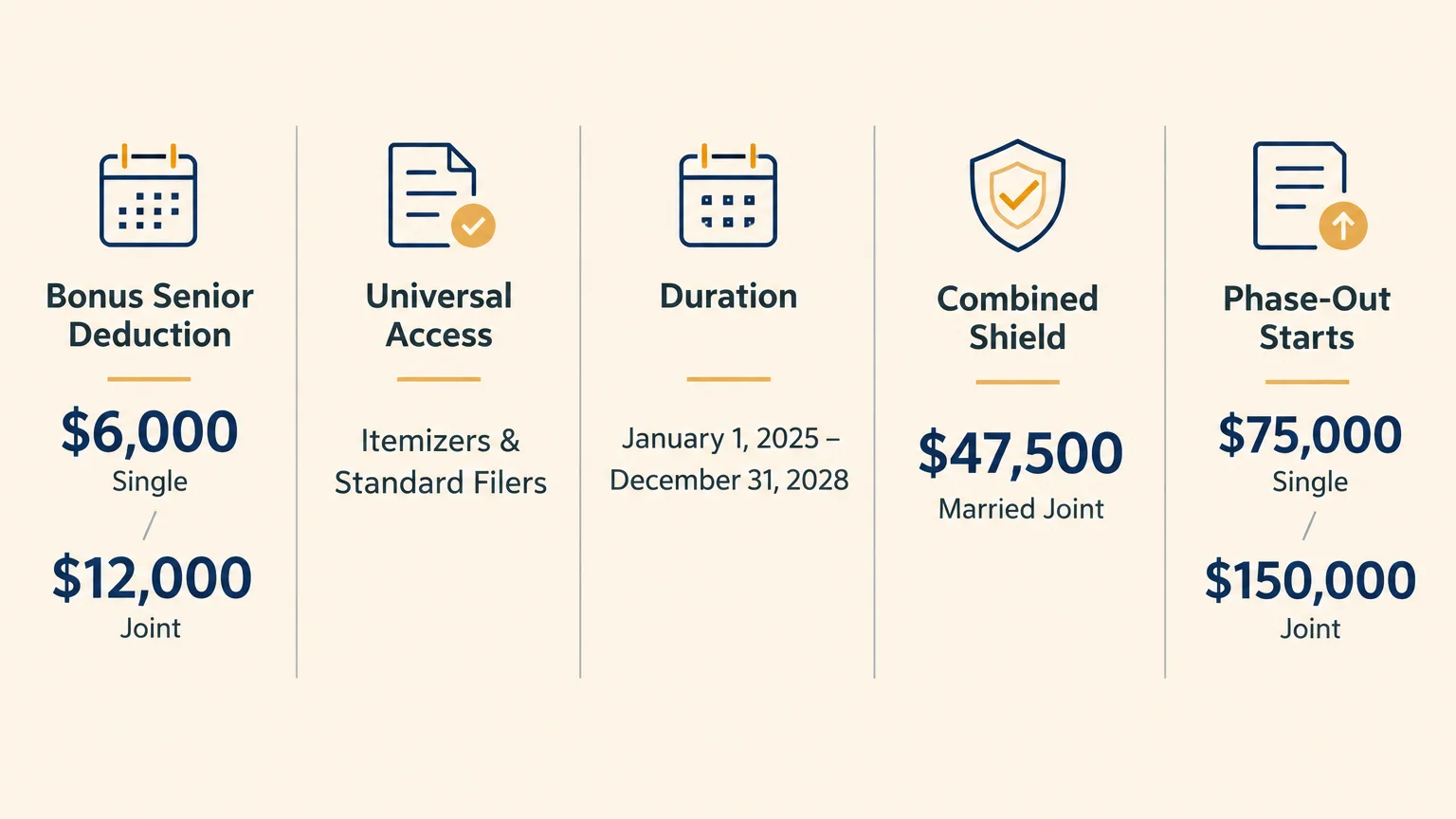
At a Glance: The 2026 Senior Tax Relief Package
Major tax legislation has reshaped how older Americans calculate their taxable income. Under the One Big Beautiful Bill Act—designated by the IRS as the Working Families Tax Cuts—qualifying taxpayers benefit from an unprecedented relief package.
This temporary relief remains in place for four consecutive tax years, spanning January 1, 2025, through December 31, 2028. Understanding how these elements connect helps you maximize your annual tax savings.
- The $6,000 Senior Deduction: An extra deduction of up to $6,000 per qualifying individual, providing up to $12,000 for married couples filing jointly.
- Universal Availability: You can claim the new bonus deduction whether you claim the standard deduction or itemize your expenses.
- Higher Baseline Deductions: Regular standard deductions have risen to adjust for inflation across all tax filing statuses.
- The Traditional Senior Add-on: The existing age-based standard deduction increase remains fully intact and stacks on top of the new credit.
- Income Limits: The new deduction begins phasing out above $75,000 for single filers and $150,000 for married couples filing jointly.
Together, these provisions allow a qualifying married couple who are both 65 or older to shield up to $47,500 from federal income tax in 2026.

Understanding the New $6,000 Senior Bonus Deduction
The centerpiece of recent tax changes for older adults is the senior bonus deduction. This provision grants an additional below-the-line deduction designed to alleviate inflationary pressures for retirees.
Eligible individuals can deduct up to $6,000 from their taxable income. If you are married filing jointly and both you and your spouse are 65 or older, your household deduction reaches $12,000.
To qualify, you must reach age 65 on or before the final day of the calendar year. For the 2026 tax year, you satisfy this requirement if your 65th birthday occurs on or before December 31, 2026.
Unlike many historical tax breaks, this new deduction is not restricted to standard deduction filers. You can claim it even if you write off mortgage interest, state taxes, and medical expenses on Schedule A.
However, the law establishes strict filing status requirements. The deduction is completely unavailable to married individuals who choose to file separate returns.
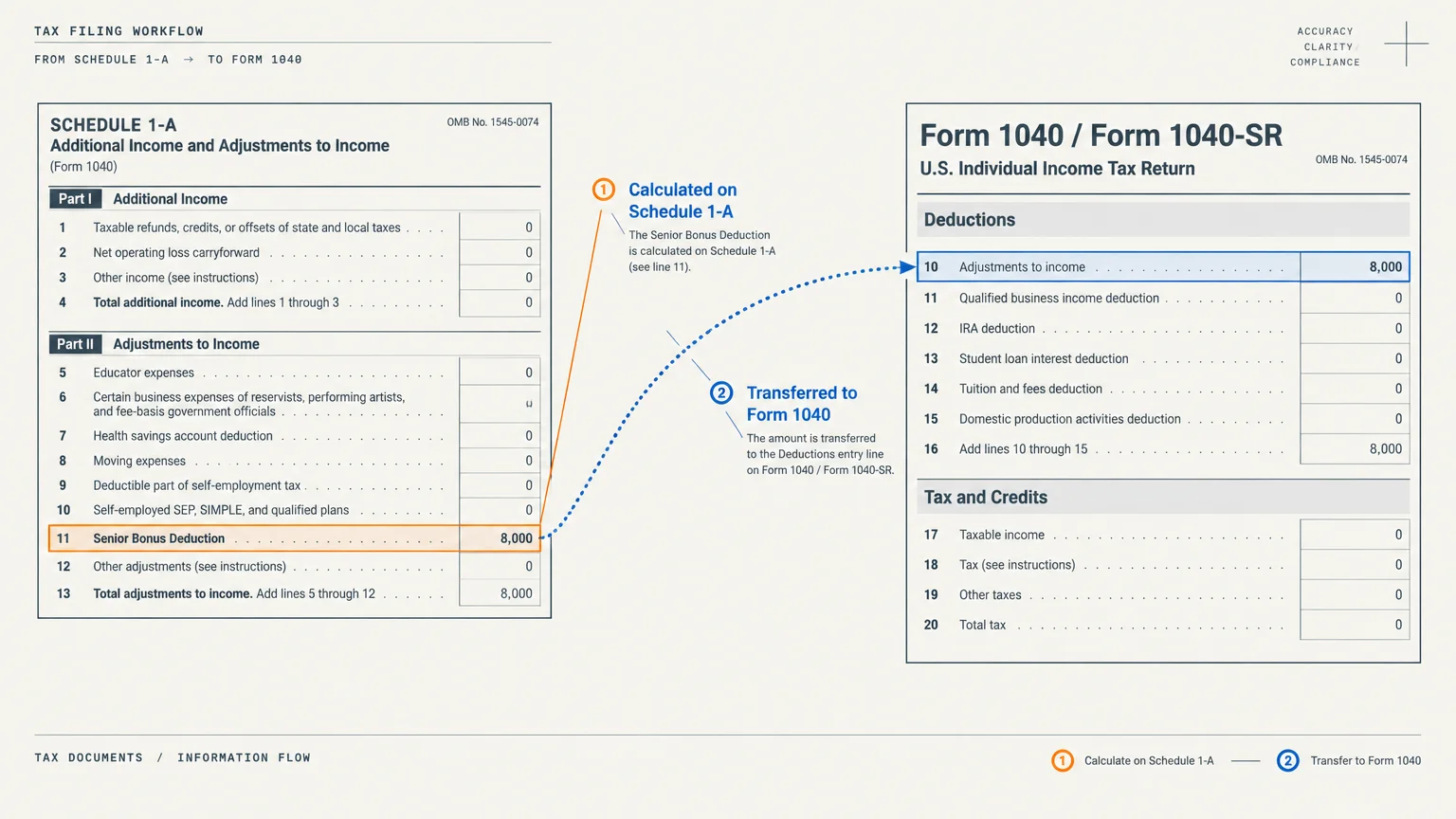
The Internal Revenue Service requires taxpayers to claim this benefit using Schedule 1-A attached to their regular Form 1040 or Form 1040-SR.
“A great retirement plan is not just about what you save; it is about how much of your money you keep away from unnecessary taxes.” — Suze Orman, Personal Finance Author
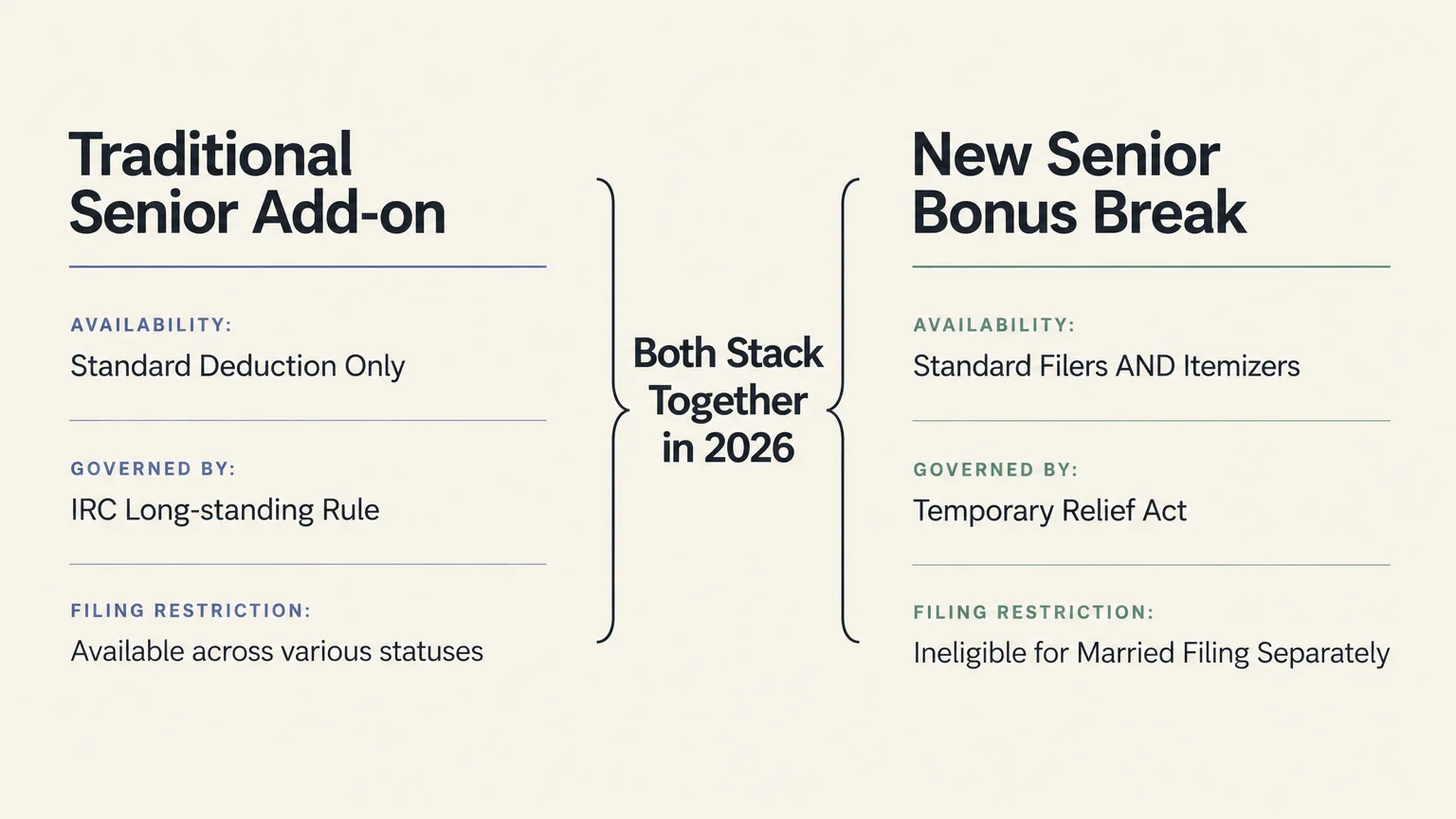
Traditional Additional Standard Deduction vs. The New Bonus Break
Many filers confuse the new tax break with the long-standing extra deduction for age 65 and older. These are two completely distinct tax benefits governed by separate rules.
The traditional standard deduction over 65 has existed for decades under the Internal Revenue Code. It increases your base standard deduction by an extra fixed dollar amount depending on your filing status.
For the 2026 tax year, this traditional bump provides an additional $2,050 for unmarried filers, including single taxpayers and heads of household. For married couples, the bump adds $1,650 per qualifying spouse.
Crucially, the traditional senior add-on has no income phase-out thresholds. High earners qualify for the full traditional increase as long as they do not itemize deductions.
In contrast, the new tax break for seniors includes strict income limits but allows both itemizers and non-itemizers to participate. Understanding this distinction prevents costly filing errors.
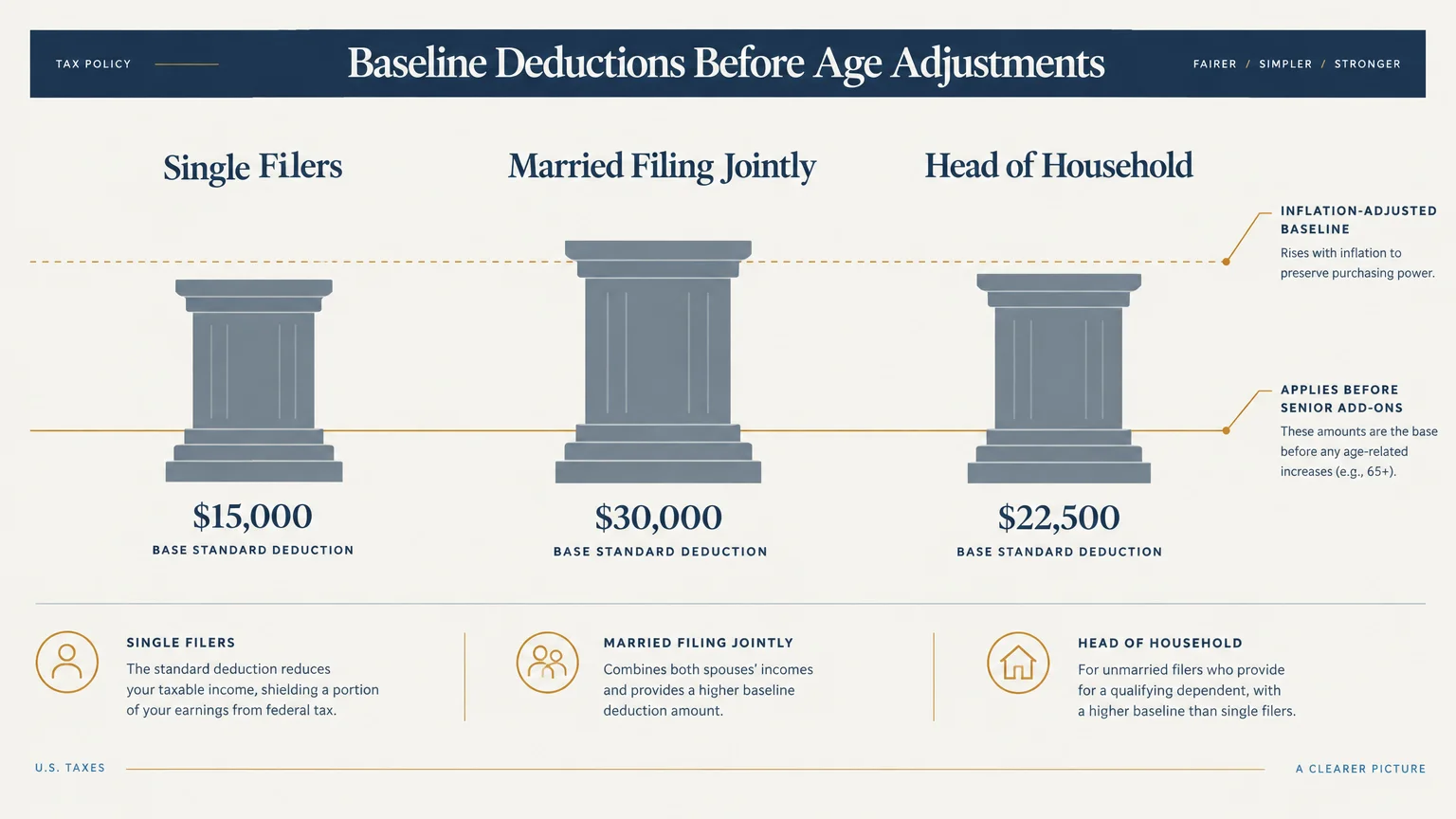
2026 Base Standard Deductions for All Filers
To see how your overall deductions assemble, you must first review the baseline standard deduction numbers. The IRS adjusts standard deduction amounts annually to counteract the effects of inflation.
Under IRS Revenue Procedure 2025-32, the base standard deduction for 2026 sits at $16,100 for single taxpayers and married individuals filing separately. Head of household filers receive a base deduction of $24,150.
For married couples filing jointly or qualifying surviving spouses, the baseline standard deduction rises to $32,200. These baseline values apply to taxpayers of all ages before adding senior relief.
Reviewing comprehensive tax education on Investopedia illustrates how baseline deductions form the foundational floor of your overall tax strategy.
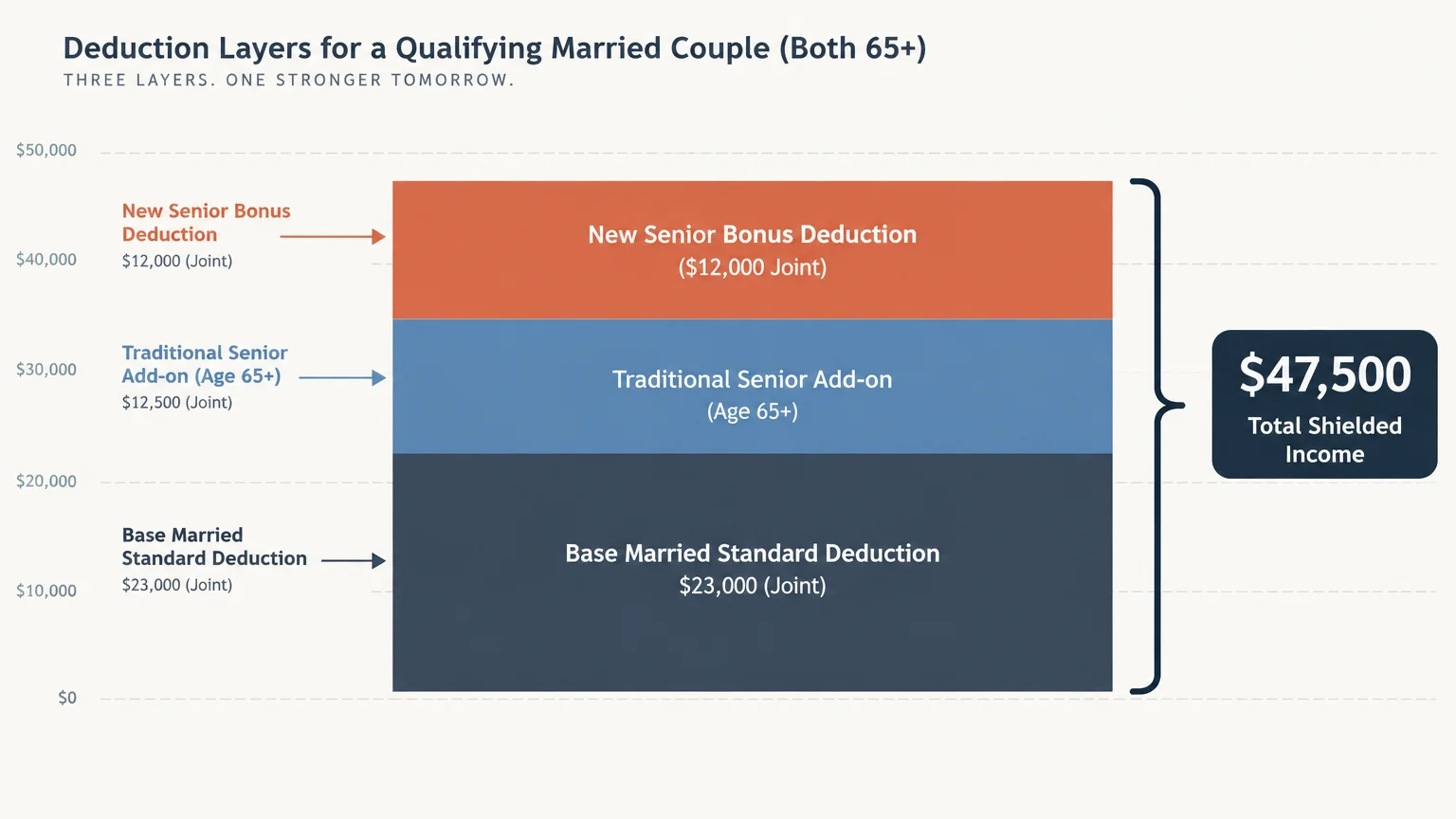
Stacking Your Deductions in 2026: The Math Broken Down
When you combine these separate tax provisions, the resulting write-off creates dramatic tax savings. Eligible taxpayers can stack all three layers together into a single, massive tax shield.
Consider a single retiree who is 67 years old with an income below the phase-out limit. This filer claims the $16,100 base standard deduction, the $2,050 traditional senior bump, and the $6,000 new deduction.
Combined, this single taxpayer deducts $24,150 from gross income before calculating federal tax liability. That write-off protects a major portion of retirement income from taxation.
The math proves even more advantageous for married retirees. Consider a married couple filing jointly where both spouses are age 66, earning beneath the phase-out range.
They start with a baseline standard deduction of $32,200. Next, they add two traditional senior bumps of $1,650 each, totaling $3,300 in standard senior adjustments.
Finally, they attach two new senior bonus amounts of $6,000 each, adding another $12,000 in deductions. Their total combined deduction reaches an impressive $47,500.
| Filing Status & Age Profile | 2025 Maximum Combined Deduction | 2026 Maximum Combined Deduction | Total Year-over-Year Increase |
|---|---|---|---|
| Single (Under Age 65) | $15,750 | $16,100 | +$350 |
| Single (Age 65 or Older) | $23,750 | $24,150 | +$400 |
| Married Joint (Both Under Age 65) | $31,500 | $32,200 | +$700 |
| Married Joint (One Spouse 65+) | $39,100 | $39,850 | +$750 |
| Married Joint (Both Spouses 65+) | $46,700 | $47,500 | +$800 |
| Head of Household (Age 65+) | $31,625 | $32,200 | +$575 |
These combined totals represent the highest deduction thresholds available in modern tax history for older taxpayers. Taking full advantage of them requires active income management.
Income Phase-Outs and the 6% Reduction Rule
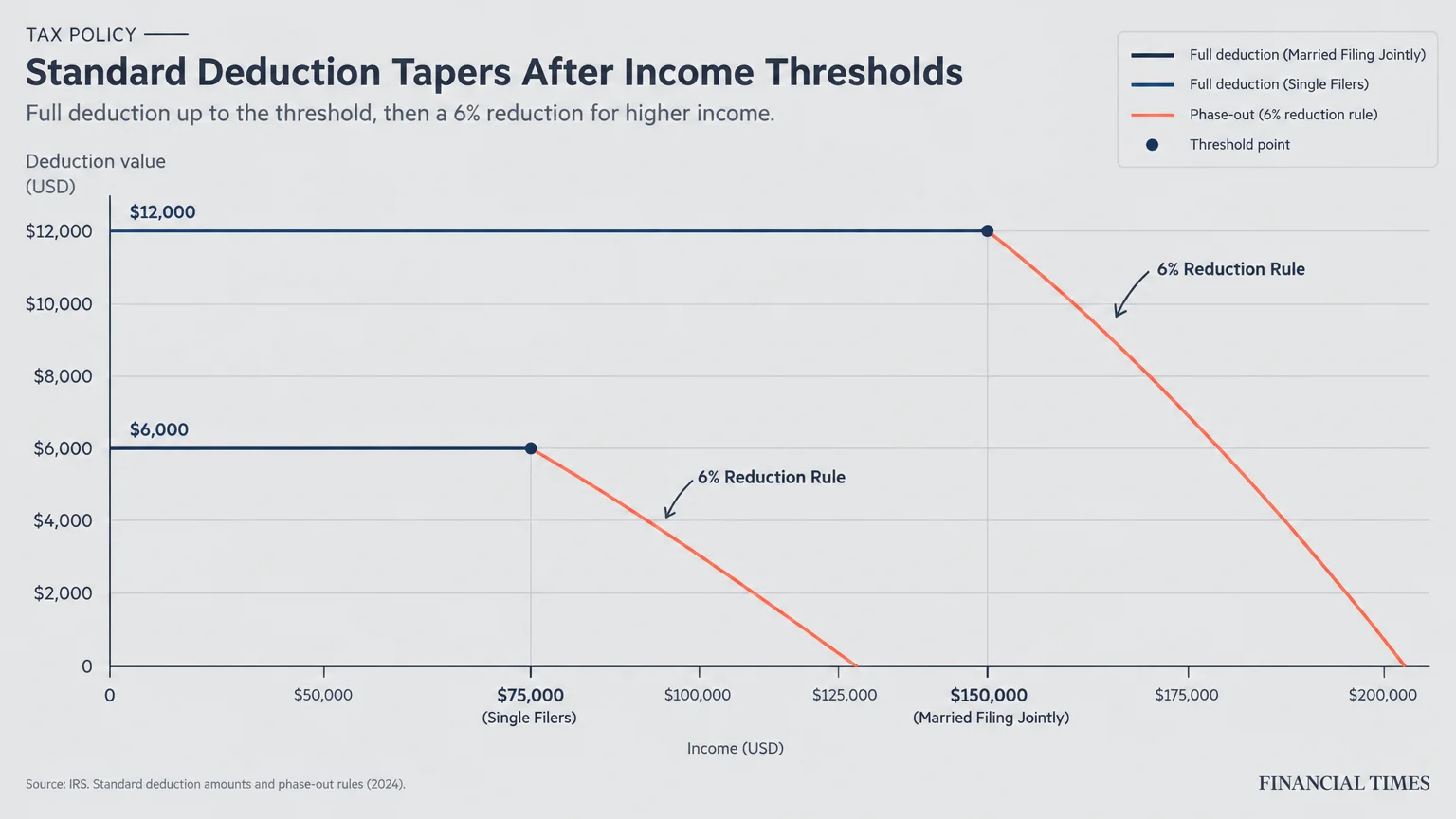
While the traditional senior bump has no income ceilings, the $6000 senior deduction features clear phase-out limits. High-income seniors will see their deduction diminished or eliminated entirely.
For single filers and heads of household, the phase-out starts at a Modified Adjusted Gross Income (MAGI) of $75,000. The deduction phases out completely once your MAGI reaches $175,000.
For married couples filing jointly, the phase-out range begins at $150,000 of MAGI. It phases out entirely when joint income crosses $250,000.
The deduction reduces by exactly 6% of the income you earn above your applicable threshold. In plain terms, you lose 6 cents of your deduction for every dollar of excess income.
For example, assume a single filer reports a MAGI of $85,000. That income exceeds the $75,000 starting threshold by exactly $10,000.
Multiplying that $10,000 excess by 6% results in a $600 deduction reduction. Subtracting $600 from the full $6,000 amount leaves this filer with a $5,400 bonus deduction.
On joint returns, the 6% rate applies per qualifying individual. If both spouses qualify, each spouse’s deduction diminishes as household income traverses the $150,000 to $250,000 window.
Distinguishing Between 2025 and 2026 Tax Rules
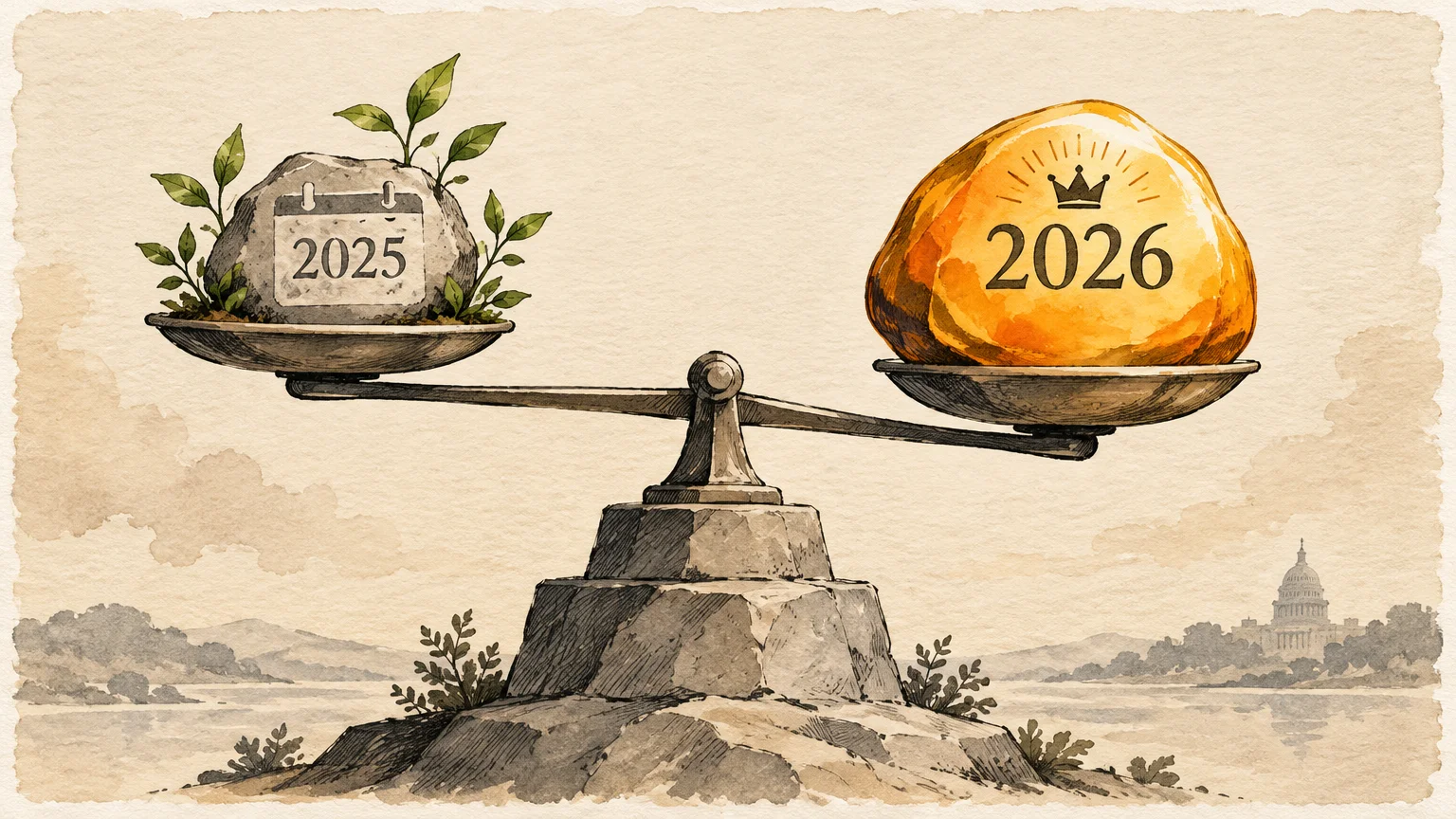
Taxpayers frequently confuse tax years with the calendar years in which they file their returns. You will file your 2025 tax return during the early months of 2026.
When completing returns in early 2026, you must utilize the 2025 deduction limits. The base standard deduction for 2025 was $15,750 for singles and $31,500 for married couples filing jointly.
The traditional age-65 addition for 2025 stood at $2,000 for single taxpayers and $1,600 per qualifying spouse. Combined with the $6,000 bonus, single seniors deducted up to $23,750 on 2025 returns.
The higher 2026 amounts apply to income earned between January 1 and December 31, 2026. You will report those figures when filing returns in early 2027.
Clear financial reporting from sources like Kiplinger underscores why separating these two tax periods prevents costly reporting errors on Schedule 1-A.

Tax Planning Strategies to Protect Your Deduction
Because the new senior deduction phases out, proactive income planning can preserve thousands of dollars in deductions. Managing your MAGI ensures you stay below the reduction thresholds.
First, evaluate the timing of distributions from traditional retirement accounts. Large traditional IRA or 401(k) withdrawals count directly toward MAGI and can push you into phase-out territory.
If you are subject to Required Minimum Distributions (RMDs), consider utilizing Qualified Charitable Distributions (QCDs). A QCD transfers money directly from an IRA to an eligible charity without increasing MAGI.
According to the Social Security Administration, managing your gross taxable income also limits the portion of Social Security benefits subject to federal tax. This generates a double tax benefit.
Second, review the sequencing of taxable capital gains. Harvesting major capital gains in a single tax year can temporarily push your income above the $75,000 or $150,000 cutoffs.
Spreading asset sales across multiple calendar years helps keep your adjusted income within the safe zone. This disciplined approach safeguards both your lower tax bracket and your full deduction.
How to Claim the Senior Deduction on Form 1040
Claiming your senior deductions requires careful completion of standard IRS documentation. Missing a check box or schedule can cause the IRS computer system to reject your claim.
To begin, select either the standard Form 1040 or Form 1040-SR, which features larger print tailored for seniors. Indicate your age qualification by marking the designated age check boxes on page one.
Marking these boxes automatically secures your traditional additional standard deduction. If your spouse is also 65 or older, check both boxes on a joint filing.
Next, download and complete IRS Schedule 1-A to calculate your senior bonus deduction. This schedule verifies your filing status and calculates any applicable 6% income phase-out reductions.
The final amount calculated on Schedule 1-A flows directly to the deduction lines on your main Form 1040. Always retain your age-verification records and distribution statements with your tax files.
What Can Go Wrong: Critical Mistakes to Avoid
Even seasoned taxpayers can run into unexpected complications under the updated tax code. Avoiding common pitfalls protects your refund and prevents administrative processing delays.
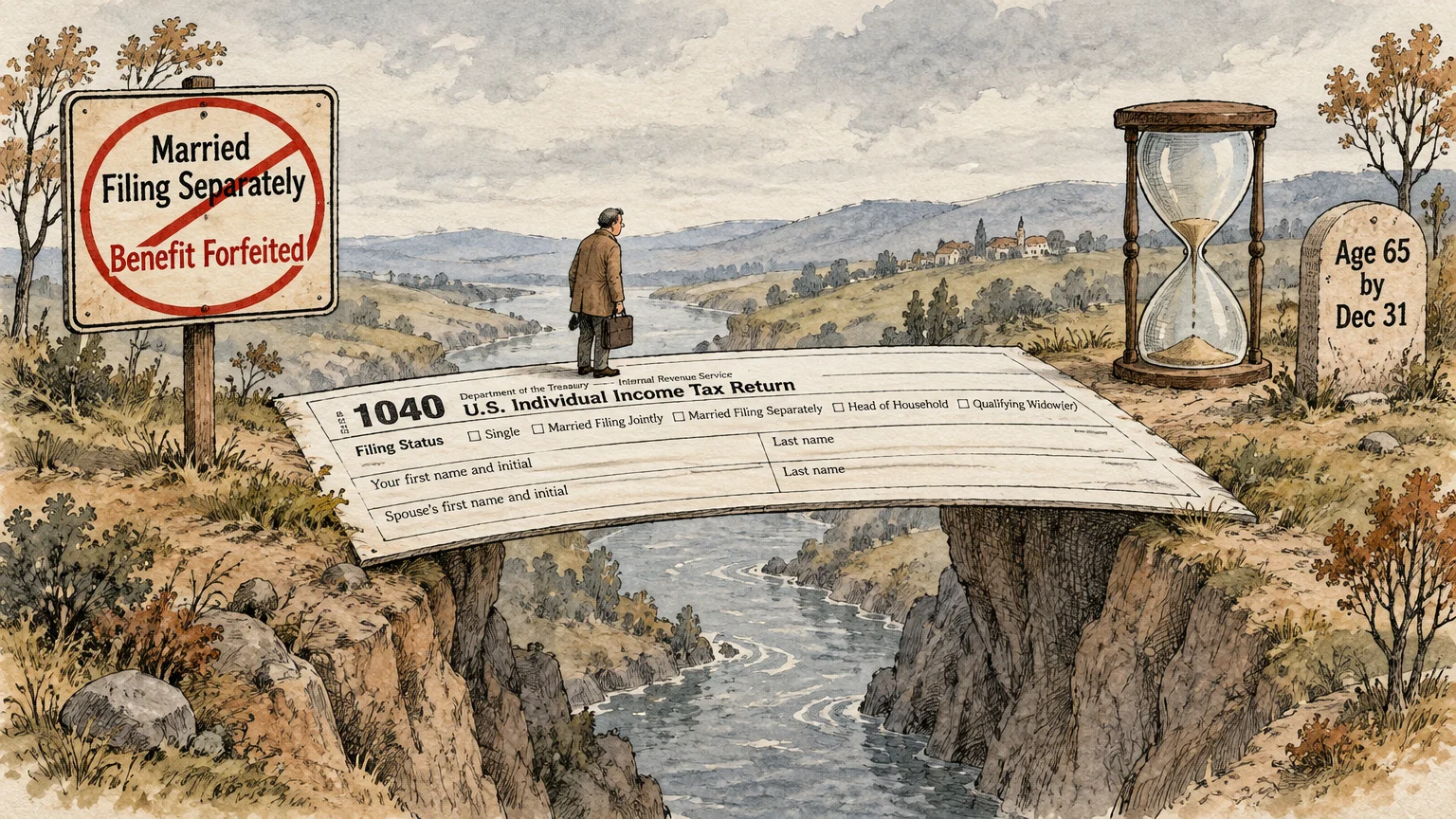
One devastating error is electing the Married Filing Separately status. The legislation explicitly bars separate married filers from taking any portion of the new senior deduction.
Another common mistake involves miscalculating the age threshold. If you turn 65 on January 1, 2027, the IRS considers you to be 65 on December 31, 2026, allowing you to qualify.
However, if your 65th birthday occurs on January 2, 2027, you cannot claim the senior deduction on your 2026 return. Claiming it prematurely triggers automated deficiency notices.
Filers also frequently forget that itemizing does not forfeit the new bonus deduction. Many seniors needlessly restrict themselves to the standard deduction, ignoring valid itemized medical expenses.
Remember that while the traditional add-on requires taking the standard deduction, the $6,000 bonus can sit on Schedule A. Always run both calculations before submitting your return.

When to Consult a Professional
While software handles straightforward returns effectively, complex financial scenarios warrant professional advice. Enlisting an expert ensures you capitalize on every overlapping tax law.
You should consider scheduling time with a certified public accountant (CPA) or Enrolled Agent (EA) under the following circumstances:
- Phase-Out Borderlines: Your anticipated MAGI hovers right around $75,000 for single filers or $150,000 for joint filers, requiring precise withdrawal orchestration.
- Substantial Medical Expenses: Your unreimbursed healthcare costs exceed 7.5% of adjusted gross income, making the choice between itemizing and standard deductions complex.
- Business or Rental Income: You own pass-through business entities or real estate properties that generate depreciation recapture and complicated adjusted gross income calculations.
- State Tax Disparities: You reside in a state that does not conform to federal tax changes, creating divergent state and federal deduction thresholds.
A qualified tax professional analyzes how these variables interact across both state and federal filings. Professional oversight prevents expensive oversights on complicated returns.
Frequently Asked Questions
Can I claim the $6,000 bonus deduction if I itemize my deductions?
Yes, you can claim the new senior bonus deduction even if you itemize on Schedule A. Unlike the traditional senior standard deduction addition, the new break is available to itemizers.
What happens if only one spouse is age 65 or older on a joint return?
If only one spouse satisfies the age requirement, your household receives one $6,000 bonus deduction. You also receive one traditional married addition of $1,650 on your joint 2026 return.
Does Social Security income count toward the phase-out limit?
Only the taxable portion of your Social Security benefits counts toward Modified Adjusted Gross Income. Non-taxable Social Security proceeds do not trigger the 6% phase-out reduction.
Is the new senior tax break permanent?
No, the deduction is temporary under current legislation. The law authorizes the bonus deduction for four tax years, spanning from January 1, 2025, through December 31, 2028.
Next Steps for Your Retirement Tax Plan
Now is the time to review your retirement income streams and project your annual tax liability. Check your birth dates, track your distributions, and estimate your 2026 adjusted gross income.
Staying mindful of the phase-out ranges lets you adjust retirement distributions before year-end deadlines. By claiming every deduction available to you, you secure your hard-earned financial resources throughout retirement.
This is educational content based on general financial principles. Individual results vary based on your situation. Always verify current tax laws, investment rules, and benefit eligibility with official sources.
Last updated: October 2026. Financial regulations and rates change frequently—verify current details with official sources.