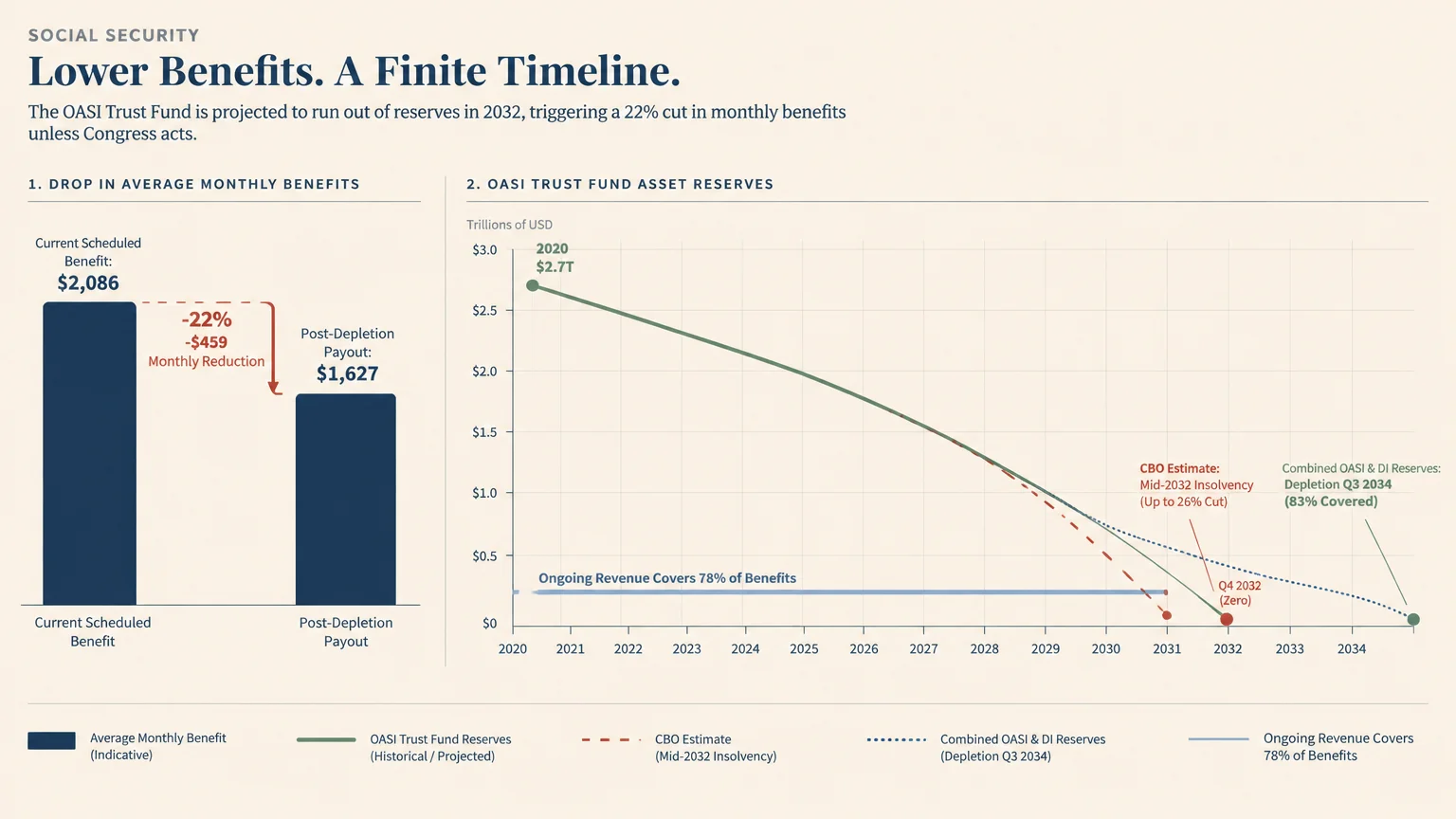
If you rely on Social Security or plan to retire soon, your future monthly income faces an imminent financial hurdle. A projected funding cliff in 2032 could shrink scheduled benefit payments by 22% without legislative action.
For a retiree receiving the average monthly benefit of $2,086, that reduction strips away $459 every month. Your monthly check would drop to roughly $1,627 overnight.
Understanding why this shortfall exists gives you the leverage to adapt your personal savings strategy now. You can take concrete financial steps today to protect your household cash flow before lawmakers finalize any reform package.
The 2032 Cliff: How the Social Security Trust Fund Math Breaks Down
Social Security relies on dedicated trust funds to finance monthly benefits for millions of American families. When revenue from payroll taxes falls short of annual payouts, the program draws down its accumulated reserves.
According to the Social Security Board of Trustees report released on June 9, 2026, the primary retirement reserve faces rapid depletion. The Old-Age and Survivors Insurance (OASI) Trust Fund will exhaust its asset reserves during the fourth quarter of 2032.
This projected exhaustion date arrived one quarter earlier than trustees estimated in their previous 2025 assessment. That three-month acceleration leaves lawmakers and workers with a narrower window to implement lasting structural reforms.
Once the OASI reserve hits zero, the program can only distribute the cash it actively collects from current workers. The Social Security Administration estimates that ongoing payroll tax receipts will cover just 78% of scheduled benefits in late 2032.
Under current statutory guidelines, this 22% revenue deficit triggers an automatic, across-the-board benefit reduction. The system cannot legally borrow money from the federal government’s general fund or issue debt to cover the difference.
Independent analysts at the Congressional Budget Office (CBO) paint an even tighter timeline for retirees. The CBO projects OASI insolvency by mid-2032, warning that automatic cuts could climb as high as 26%.
The program maintains a separate reserve called the Disability Insurance (DI) Trust Fund. This fund remains financially healthy, with actuaries projecting it can pay 100% of scheduled disability benefits through at least 2100.
If Congress passes legislation to combine the OASI and DI reserves, the depletion date extends into the third quarter of 2034. A combined fund would initially cover 83% of benefits, cushioning the immediate reduction to 17%.
However, combined reserves dropped by $160 billion in 2025 alone, leaving total program assets at $2.56 trillion. Without congressional action to merge or replenish these reserves, the OASI fund stands alone on its 2032 trajectory.
Why the Depletion Date Arrived Faster Than Expected
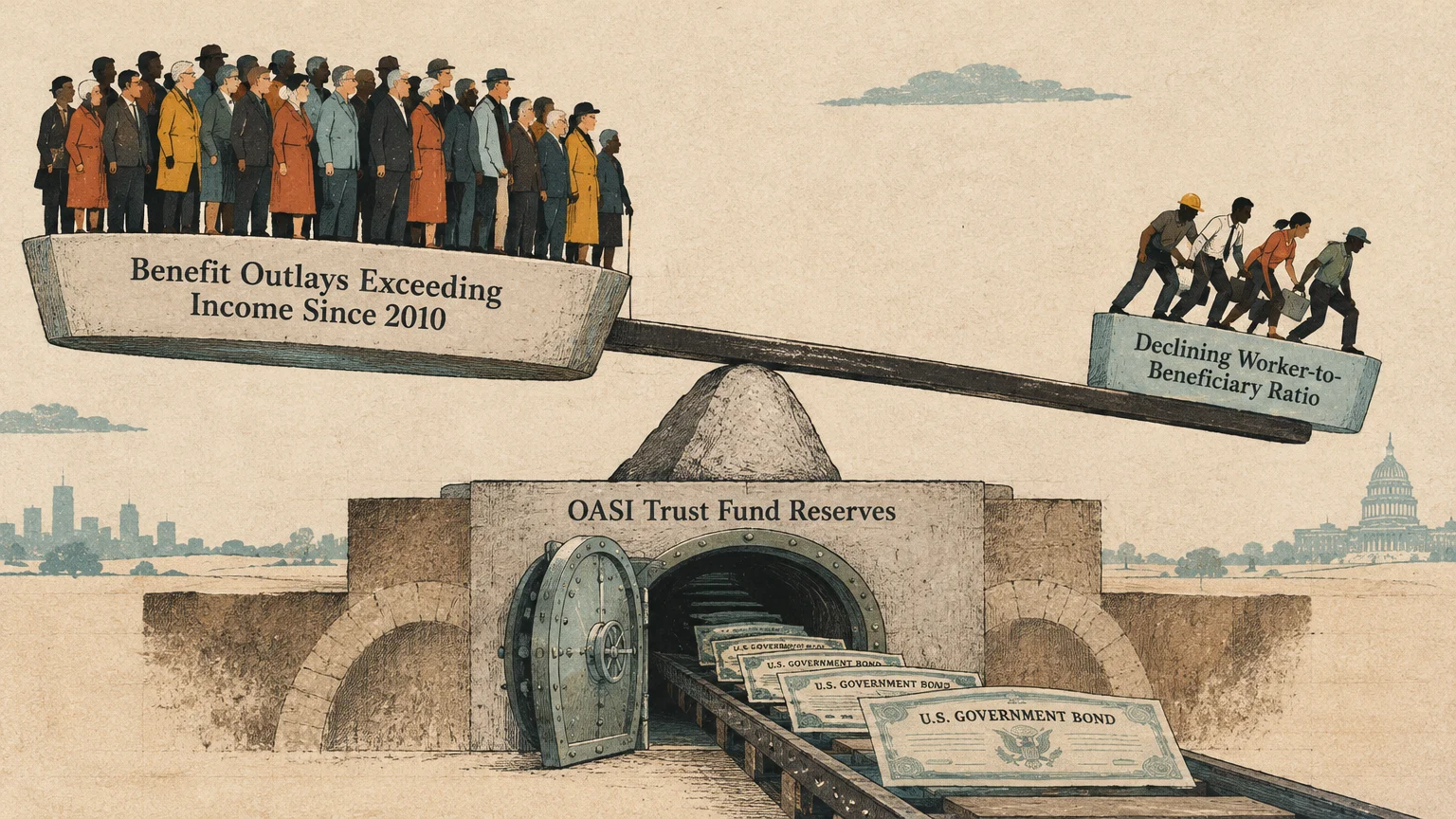
The financial pressure on Social Security stems largely from fundamental demographic shifts across the American workforce. As the large baby boomer generation reaches retirement age, the ratio of covered workers to beneficiaries continues to shrink.
Sustained lower birth rates among younger generations mean fewer new workers enter the labor force each year. Consequently, total benefit outlays have exceeded the program’s non-interest income every year since 2010.
By 2021, program expenditures began outpacing total income, including the annual interest earned on Treasury securities held in the reserves. This ongoing deficit forces the trust fund to redeem tens of billions of dollars in government bonds annually.
Recent policy changes and federal legislation have also accelerated reserve depletion. The One Big Beautiful Bill Act (OBBBA) introduced an enhanced senior deduction between 2025 and 2028, altering how benefit taxation revenues flow back into the system.
Furthermore, the Social Security Fairness Act increased total benefit distributions across the nation. This legislation repealed the Windfall Elimination Provision (WEP) and the Government Pension Offset (GPO), boosting checks for hundreds of thousands of public-sector retirees.
Broader macroeconomic forces have compounded these structural deficits. Changes in immigration patterns reduced projected payroll tax receipts, while shifts in wage growth concentrated higher earnings beyond the taxable threshold.
Data from the Federal Reserve indicates that evolving workforce dynamics continue to reshape aggregate wage distribution. When wage gains accrue heavily to top earners, a smaller proportion of national payroll income remains subject to Social Security taxation.

What a 22% Benefit Cut Means for Household Finances
A 22% benefit reduction would disrupt monthly household budgets for tens of millions of older Americans. For the typical retiree receiving $2,086 per month, losing $459 drops available income to $1,627.
Over a full calendar year, that reduction represents an annual income loss of $5,508. For a retired couple who both receive average retirement benefits, the household stands to lose more than $11,000 every year.
The Committee for a Responsible Federal Budget (CRFB) published a state-by-state analysis highlighting regional differences in benefit cuts. Their June 2026 findings reveal that higher-earning states will experience the steepest dollar drops under trust fund exhaustion.
Average monthly losses across states range from $459 to $556, depending on regional wage histories. Beneficiaries in northeastern states with higher historical earnings will experience the largest absolute dollar decreases in their checks.
- Connecticut: Projected average monthly benefit cut of $556 ($6,672 annually)
- New Jersey: Projected average monthly benefit cut of $554 ($6,648 annually)
- New Hampshire: Projected average monthly benefit cut of $553 ($6,636 annually)
- Delaware: Projected average monthly benefit cut of $549 ($6,588 annually)
- Maryland: Projected average monthly benefit cut of $541 ($6,492 annually)
These cuts would arrive at a time when older adults already face rising living costs. Essential household expenses—such as groceries, property taxes, and home maintenance—routinely consume large shares of fixed retirement checks.
Healthcare expenditures create an even greater strain on household cash flow. Out-of-pocket medical bills and Medicare premiums compound the impact of any reduction in baseline monthly income.
“You must gain control over your money or the lack of it will forever control you.” — Dave Ramsey, Personal Finance Author
Congressional Reform: The Four Paths Lawmakers Can Take
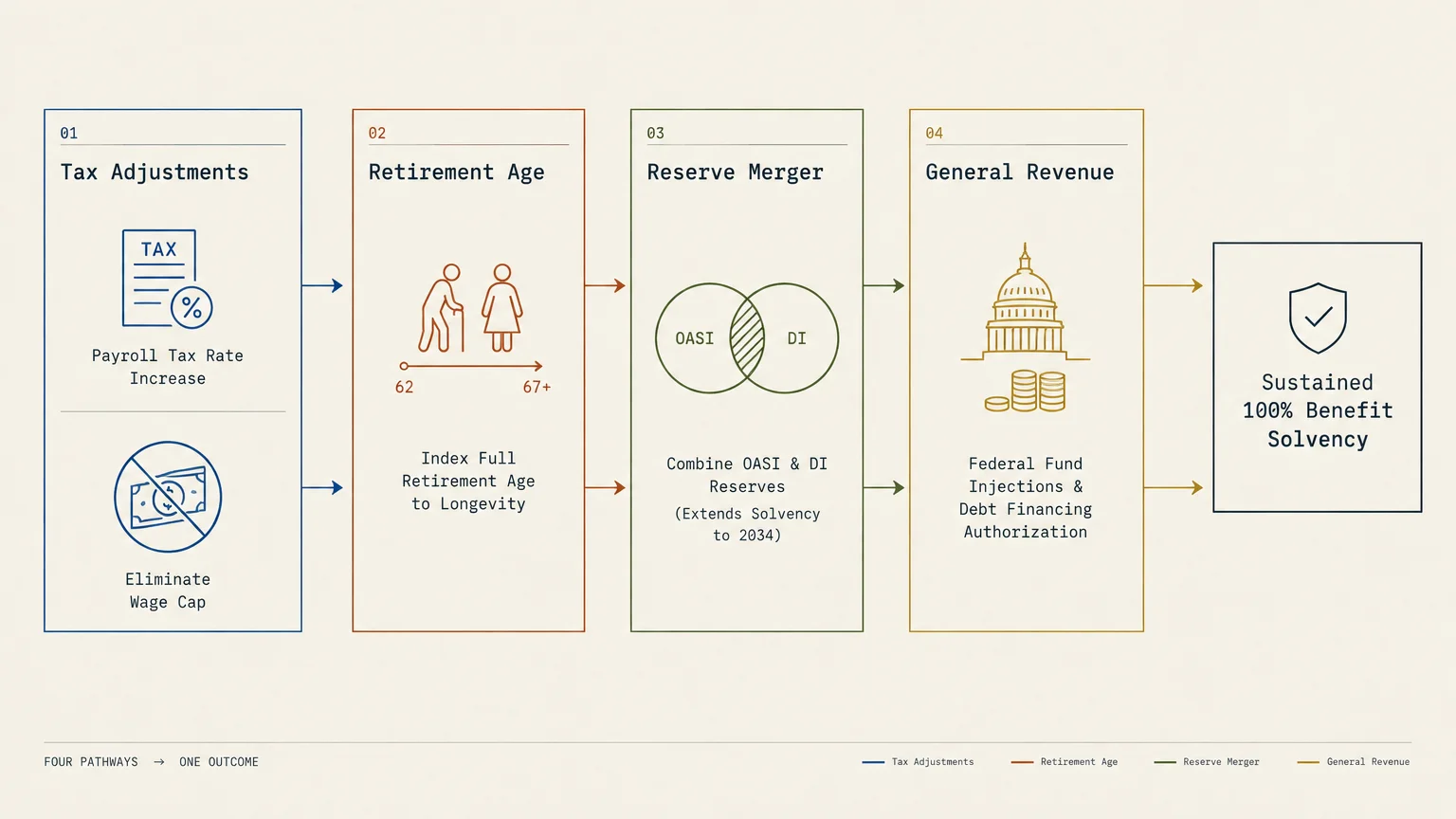
Congress has successfully resolved trust fund shortfalls in the past, most notably through comprehensive bipartisan reforms enacted in 1983. Lawmakers face similar policy decisions today as the 2032 deadline approaches.
The current Social Security payroll tax rate sits at 12.4%, split evenly between employees and employers at 6.2% each. Self-employed individuals pay the full 12.4% rate through self-employment taxes.
However, this tax only applies to wages up to an established statutory threshold. The taxable wage cap is set at $184,500 in 2026, and increases to $192,300 in 2027 based on national wage indexing.
Any earnings you generate above that cap remain completely exempt from Social Security payroll taxes. Raising or removing that cap represents one of the primary legislative tools lawmakers routinely consider.
Another major reform avenue involves altering the Full Retirement Age (FRA). The 1983 reform package gradually raised the FRA to age 67 for workers born in 1960 or later, creating a blueprint for future age adjustments.
Legislative proposals like the PROMISE Act (S. 4979), introduced in July 2026, have sparked debate in the Senate Finance Committee. Lawmakers are weighing several core policy options to stabilize the trust funds over a 75-year horizon.
| Reform Option | Mechanism | Projected Solvency Impact | Household Trade-Off |
|---|---|---|---|
| Raise Payroll Tax Rate | Increase the combined 12.4% rate to 14.4% or higher over several years | Closes roughly 50% to 70% of the long-term funding gap | Reduces take-home pay for all covered workers across every income tier |
| Eliminate the Wage Cap | Apply the 12.4% tax to all earnings above $184,500/$192,300 | Closes up to 60% to 75% of the projected trust fund shortfall | Increases marginal tax rates substantially on high-earning professionals |
| Increase Full Retirement Age | Gradually raise the retirement age from 67 to 68 or 69 for younger workers | Reduces long-term program liabilities by 20% to 35% | Delays full benefits for future retirees, cutting lifetime payouts |
| Combine OASI and DI Reserves | Legally merge the healthy disability fund with the depleted retirement fund | Extends solvency from late 2032 into the third quarter of 2034 | Buys less than two years of time without fixing the root imbalance |
Lawmakers will likely combine elements from several options rather than relying on a single dramatic change. A hybrid package could pair modest revenue increases with targeted benefit adjustments for future generations.

Strategic Adjustments for Current Beneficiaries
If you currently receive Social Security benefits, you cannot afford to wait passively for Congress to strike a deal. Implementing practical defensive measures today shields your household from potential cash flow shocks in 2032.
Begin by conducting a comprehensive audit of your fixed monthly commitments versus your discretionary spending. Categorize housing, utility bills, insurance premiums, and groceries as non-negotiable living expenses.
Next, identify non-essential expenditures that you could trim quickly if your monthly check drops by several hundred dollars. Reviewing subscription services, travel allocations, and dining budgets helps you build an immediate spending buffer.
You should also evaluate how your Medicare premiums impact your net Social Security check. Part B premiums deduct directly from your monthly payment, shrinking your take-home benefit before it reaches your checking account.
Consult guidelines from the Consumer Financial Protection Bureau to evaluate your outstanding debt obligations. Eliminating high-interest consumer credit cards or personal loans frees up critical monthly cash flow for basic necessities.
Current beneficiaries should also review how state taxes affect their total retirement distributions. While many states exempt Social Security entirely, a minority still tax benefits above specific income thresholds.
Structuring your supplemental withdrawals to stay below those state thresholds prevents unnecessary tax friction. Every dollar you save on state taxes offsets potential federal benefit reductions.

Smart Moves for Workers 5 to 10 Years from Retirement
Workers approaching retirement have a distinct advantage: time to modify their accumulation and claiming strategies. Taking deliberate steps over the next decade can insulate your lifestyle from program shortfalls.
First, reassess your planned claiming age. While you become eligible for retirement benefits at age 62, claiming early locks in a permanent 30% reduction compared to your Full Retirement Age.
Conversely, delaying your claim past age 67 earns delayed retirement credits of 8% per year up to age 70. Maximizing your baseline benefit provides a substantially larger foundation, softening the impact of any across-the-board percentage cut.
You can verify your projected benefits at various claiming ages by downloading your official statement from the Social Security Administration. Reviewing your earnings history ensures your benefit calculation accurately reflects your lifelong contributions.
Second, accelerate your contributions to tax-advantaged retirement accounts like 401(k) plans and individual retirement accounts (IRAs). Workers aged 50 and older can utilize catch-up contribution limits to accumulate larger personal reserves.
Directing additional savings into diversified index funds builds an independent financial engine. Review educational resources at Investor.gov to ensure your asset allocation aligns with your retirement timeline and risk tolerance.
Third, build a non-retirement bridge account using a standard taxable brokerage account. Having liquid capital accessible before age 59½ allows you to fund early retirement years while delaying your Social Security claim.
Finally, fund a Health Savings Account (HSA) if you participate in a high-deductible health plan. HSA balances grow tax-free and allow completely tax-free withdrawals for qualified medical expenses in retirement.
Sheltering your healthcare dollars inside an HSA prevents you from dipping into your regular retirement accounts to cover medical deductibles. This medical reserve directly safeguards your daily living budget.

Pitfalls to Watch For
Uncertainty surrounding trust fund solvency often causes workers to make emotional financial decisions. Avoiding common strategic errors helps you maintain long-term capital preservation.
Do not rush to claim benefits at age 62 purely out of fear that the system will go bankrupt. Even if the trust fund depletes in 2032, the system will still collect payroll taxes and pay the majority of benefits.
Claiming early locks in an immediate, permanent reduction of up to 30% against your full benefit. If Congress enacts a legislative fix, you remain permanently stuck with that reduced monthly baseline.
Another common mistake involves ignoring the tax consequences of taking increased withdrawals from traditional retirement accounts. According to the Internal Revenue Service, distributions from standard 401(k)s and traditional IRAs count as ordinary taxable income.
Pulling extra cash from traditional accounts to replace lost Social Security income could push you into a higher federal income tax bracket. It can also trigger the Medicare Income-Related Monthly Adjustment Amount (IRMAA), raising your healthcare premiums.
Do not assume Congress will ignore the problem entirely. Social Security represents the primary financial lifeline for tens of millions of active voters, making complete legislative inaction politically catastrophic.
Finally, avoid treating Social Security as your sole guaranteed source of retirement funding. Over-relying on a single public entitlement leaves your retirement lifestyle vulnerable to external legislative compromises.

Getting Expert Help
Navigating the interaction between Social Security rules, tax legislation, and portfolio management can become complex. Professional financial planners can model custom scenarios to protect your assets against future benefit cuts.
Consider seeking professional guidance in the following specific scenarios:
- Coordinating Spousal Claiming Decisions: If you and your spouse have unequal earnings histories, an advisor can determine optimal claiming sequences to maximize lifetime survivor benefits.
- Managing Required Minimum Distributions (RMDs): A tax professional can help you balance mandatory IRA withdrawals alongside Social Security income to prevent bracket creep and minimize Medicare surcharges.
- Stress-Testing Portfolio Withdrawal Rates: A certified planner can run Monte Carlo simulations modeling a 22% benefit cut in 2032 to verify whether your personal savings can support your current spending.
- Navigating Public Pension Offsets: If you worked in a state or local government role with a non-covered pension, an expert can evaluate how recent legislative changes impact your eligibility.
Frequently Asked Questions
Will Social Security stop sending checks entirely in late 2032?
No, Social Security will not stop sending monthly checks when the trust fund depletes. Even without congressional reform, dedicated payroll tax receipts will continue flowing into the program, covering roughly 78% of scheduled benefit payments.
Can Congress use general tax revenue to fix the shortfall?
Under current law, the Social Security trust funds operate independently and cannot draw money directly from the federal government’s general fund. Congress must pass explicit legislation to authorize general fund transfers or allow the program to borrow money.
Should I claim benefits early at age 62 before 2032 cuts happen?
Claiming early at age 62 permanently reduces your monthly check by up to 30% compared to your Full Retirement Age. If you claim early out of fear and Congress subsequently stabilizes the program, you remain locked into that permanently reduced monthly payout.
How would raising the taxable wage cap affect high earners?
The taxable wage cap is set at $184,500 in 2026 and rises to $192,300 in 2027. If lawmakers eliminate the cap, high earners would pay the 6.2% employee payroll tax on all income above those levels, increasing their annual tax liabilities.
Taking Control of Your Retirement Outlook
The projected 2032 Social Security shortfall presents a clear challenge, but it is not an insurmountable barrier to a comfortable retirement. By understanding the underlying mechanics of the trust funds, you can make informed decisions rather than reacting to headlines.
Focus your energy on the financial variables within your personal control: increasing your personal savings rate, optimizing debt, and delaying your claiming age if practical. Establishing multiple income streams shields your household from shifting legislative timelines and ensures your financial independence.
The information in this guide is meant for educational purposes. Your specific circumstances—including income, debt, tax situation, and goals—may require different approaches. When in doubt, consult a licensed professional.
Last updated: November 2026. Financial regulations and rates change frequently—verify current details with official sources.