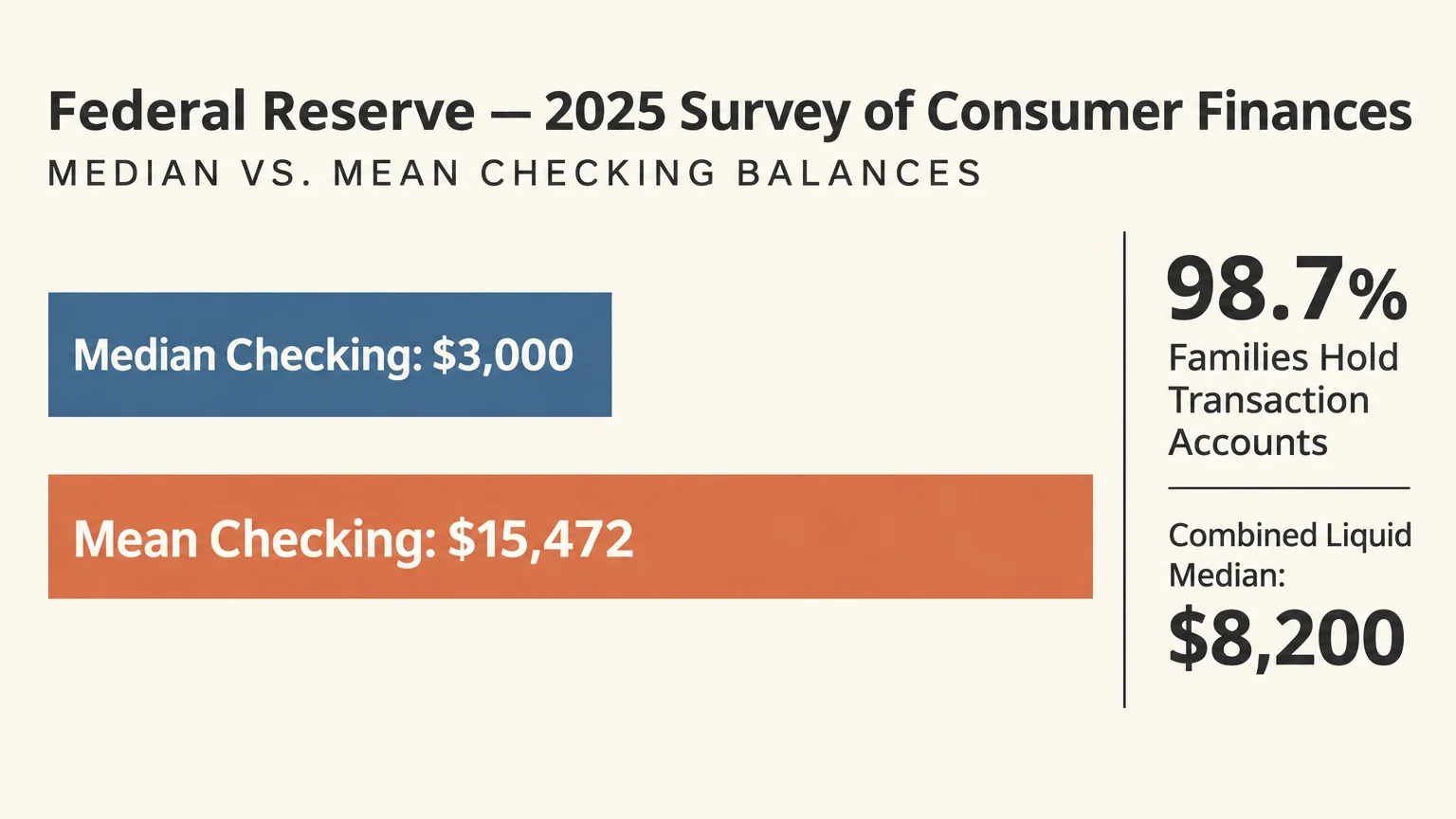
According to the Federal Reserve’s 2025 Survey of Consumer Finances, the median U.S. checking balance is $3,000, while the national average reaches $15,472. Keeping too much cash in checking silently costs you hundreds of dollars in lost interest every year.
That $3,000 figure is not a rigid ceiling for every household. However, holding excess money in a standard checking account erodes your purchasing power and increases your exposure if debit card fraud hits.
You can fix this cash drag in under an hour. Below, you will learn how to size your personal checking cushion, shield your money from fees and fraud, and move surplus dollars into higher-earning accounts.
Where the $3,000 Checking Account Rule Comes From
The $3,000 benchmark starts with real national household data rather than an arbitrary financial rule. In October 2026, the Federal Reserve released its 2025 Survey of Consumer Finances showing that half of U.S. households hold $3,000 or less in checking.
A Motley Fool Money analysis of that same 2025 survey found an average checking balance of $15,472. High-income and cash-heavy households pull that average sharply upward, masking how much money many savers leave sitting idle.
Across all liquid transaction accounts—including checking, savings, money market, call accounts, and prepaid debit cards—98.7% of U.S. families held at least one account in 2025. The Federal Reserve Board reported a conditional median combined balance of $8,200, down 6% from 2022.
The conditional mean across those combined accounts stood at $62,900, down 8% from 2022. That gap between median and mean shows a clear split between households stretching every dollar and households parking excessive cash in low-yield accounts.
Financial planners and major banks—including Citi, Regions Bank, City National Bank, Sunward Credit Union, and CNBC Select—rarely prescribe $3,000 as a universal cap. Instead, they anchor your ideal checking balance to your monthly living expenses.
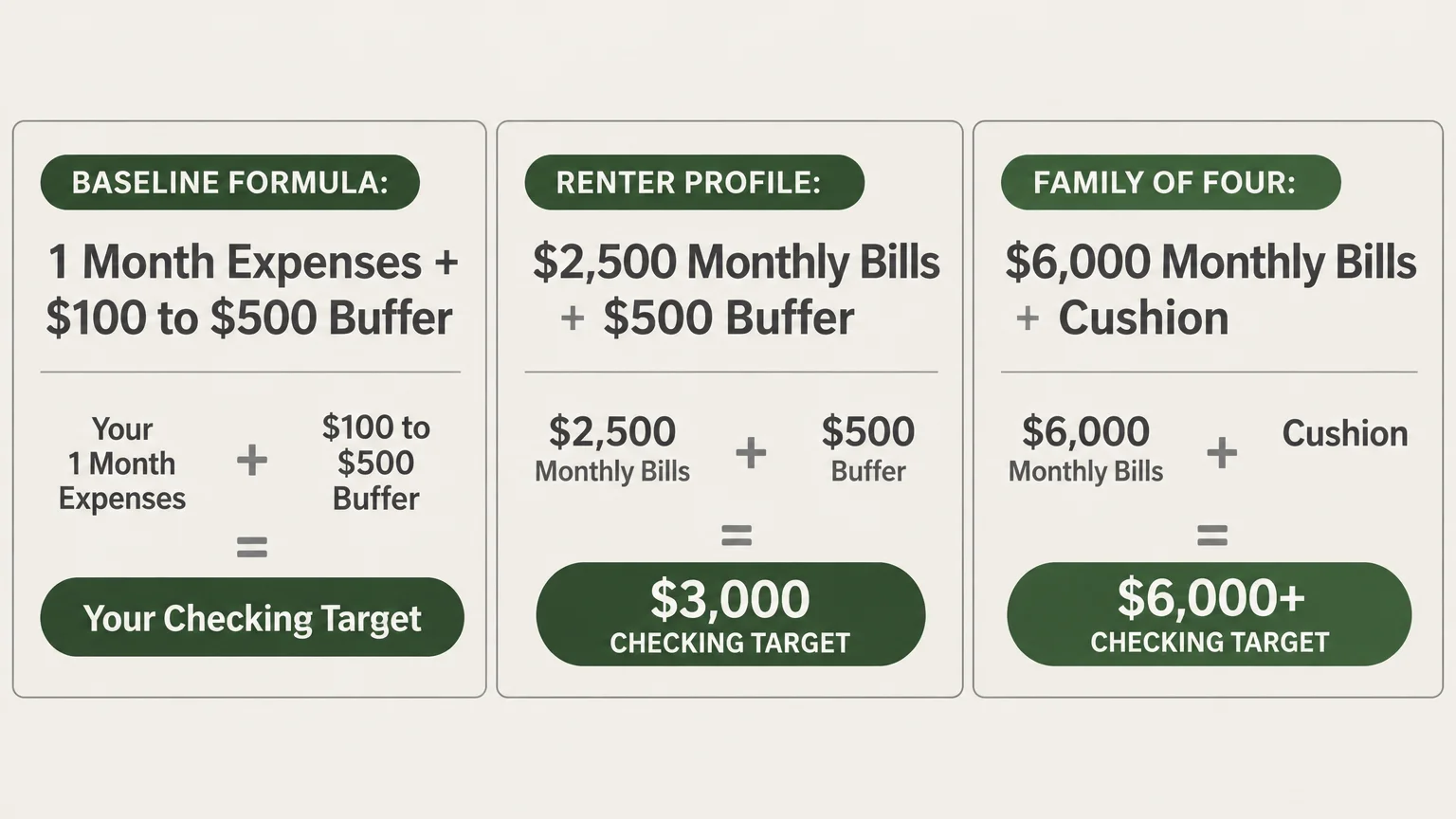
- One-month baseline plus a buffer: Citi recommends holding one month of regular expenses plus a $100 to $500 cushion to absorb unexpected bill spikes.
- Paycheck-based cushion: Regions Bank suggests keeping one to two weeks of take-home pay above your regular monthly obligations.
- Extended expense buffer: Some planners quoted by CNBC Select and City National Bank advise holding one to two months of living expenses, or adding a 30% buffer for variable bills.
For a single renter spending $2,500 a month, one month of bills plus a $500 buffer equals exactly $3,000. For a family of four paying $6,000 a month for housing, groceries, and childcare, keeping only $3,000 in checking would invite bounced payments.
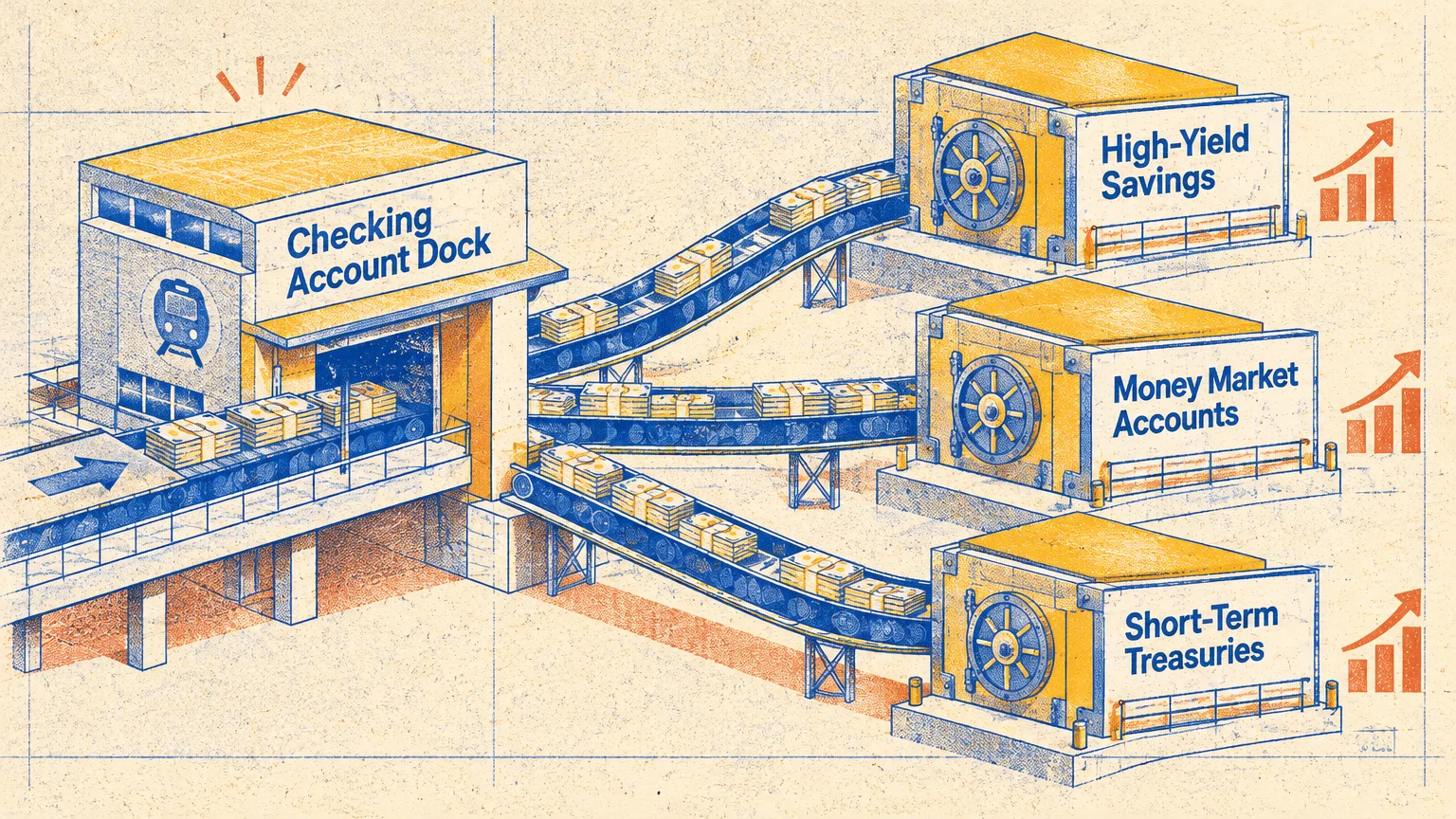
Think of checking as your financial loading dock rather than your warehouse. Money should flow in from your paycheck, cover immediate bills, and leave promptly for accounts that work harder for you.
The Real Cost of Holding Extra Cash in Checking
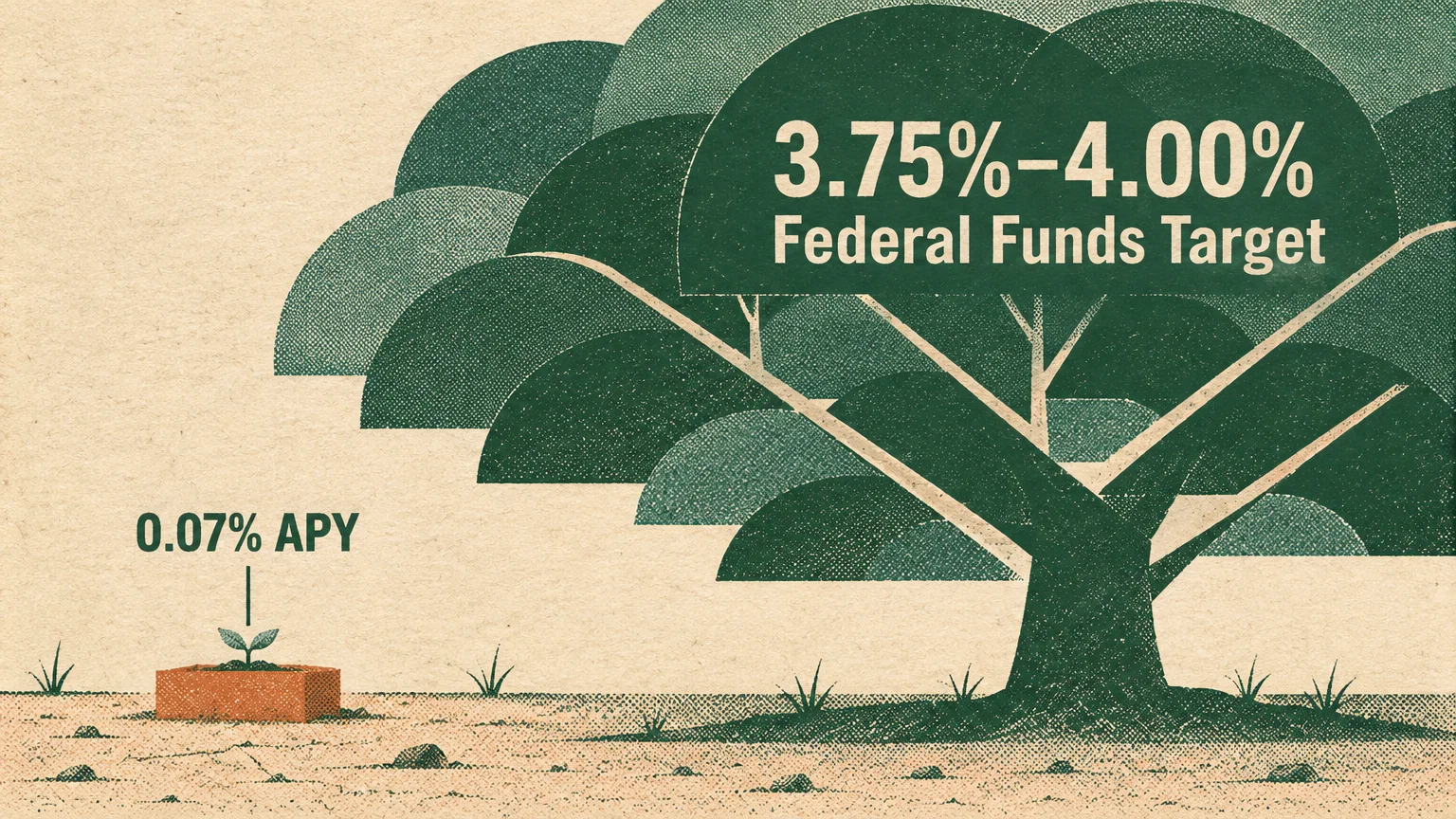
Most checking accounts pay little or nothing to hold your money. According to FDIC National Rates and Rate Caps data from September and October 2026, interest-bearing checking accounts averaged just 0.07% APY nationwide.
Traditional brick-and-mortar savings accounts barely beat that pace. The FDIC reported a national average savings rate of 0.38% APY in October 2026 and 0.39% APY in November 2026, while Bankrate tracked a November 2026 national average of 0.57% APY.
Meanwhile, short-term interest rates across the broader economy remain elevated. The Federal Reserve raised its target range for the federal funds rate to 3.75%–4.00% in September 2026 and held it there at its late October 2026 meeting.
Online banks have passed much of that rate environment along to savers. As of late November 2026, top FDIC-insured high-yield savings accounts (HYSAs) offered 4.27% to 4.70% APY on standard accounts, including 4.27% APY at Peak Bank and 4.40% APY at Vio Bank.
Some institutions push even higher for savers willing to meet extra requirements. Axos Bank offered a promotional rate up to 5.00% APY for six months in November 2026, subject to linked checking accounts and minimum deposit rules.
To see the real-world gap, look at the $15,472 national average checking balance from the 2025 Federal Reserve data. Leaving that full amount in an account paying 0.07% APY generates roughly $10.83 in annual interest.
Suppose you keep $3,000 in checking for monthly bills and move the remaining $12,472 into a high-yield savings account earning 4.40% APY. That surplus alone generates roughly $548.77 in simple annual interest—over $540 more per year without taking investment risk.
Inflation makes that gap even more urgent. U.S. Bureau of Labor Statistics (BLS) data showed headline CPI-U inflation reached 3.7% year-over-year in September 2026, up from 3.4% in August 2026, with October 2026 prices rising another 0.4% month-over-month.
Over the five years ending October 2026, overall U.S. consumer prices climbed 22.0%, according to BLS figures released in November 2026. Cash sitting at 0.00% to 0.07% APY loses real buying power every single month inflation stays elevated.
Your checking account exists to clear bills smoothly, not to store long-term wealth; every dollar above your monthly cash buffer deserves a real return that defends your purchasing power against inflation.
Even if inflation cools, leaving thousands of idle dollars in checking gives up guaranteed, liquid yield. You do not need to lock your money into risky stocks to capture that 4% spread—you simply need the right deposit account.
How Debit Card Fraud Rules Put Large Checking Balances at Risk
Lost interest is only half the problem when your checking balance balloons past $3,000. Your checking account connects directly to your debit card, ATM card, payment apps, and automated clearing house (ACH) routing numbers.
If criminals compromise your debit card or drain your account via unauthorized electronic transfers, your personal cash disappears immediately. Unlike a credit card dispute where you withhold payment to the card issuer, debit fraud drains money straight from your rent and grocery pool.
Federal law protects checking customers under the Electronic Fund Transfer Act, implemented through Regulation E and enforced by the Consumer Financial Protection Bureau (CFPB). However, your out-of-pocket liability depends heavily on how quickly you spot and report the theft.
- $0 liability: You owe nothing if you report a lost or stolen debit card before any unauthorized transfer occurs, or if only your card number is stolen and you report it within 60 days of your statement.
- Up to $50 liability: If you lose your physical debit card and report it within two business days of discovering the loss, your maximum loss is capped at $50.
- Up to $500 liability: If you wait more than two business days to report a lost physical card—but still report within 60 days of your bank statement—you can lose up to $500.
- Unlimited liability: If you fail to report unauthorized transfers within 60 days after your statement is sent, you can face unlimited losses on transfers occurring after that 60-day window.
Even when you catch fraud within minutes and owe zero dollars, getting your cash back takes time. Under Regulation E, banks generally have 10 business days to investigate an error, or 20 business days for accounts open under 30 days.
If the bank needs more time, it can extend the investigation up to 45 days—or 90 days for new accounts—provided it issues provisional credit (minus up to $50) within that initial window. Once confirmed, the bank must correct errors within one business day.
Ten business days without access to $15,000 can wreck your monthly cash flow if your mortgage and utility payments bounce in the meantime. Limiting your checking balance to $3,000—or strictly one month of expenses—caps the cash tied up in a dispute.
Keep in mind what Regulation E does and does not cover. In January 2025, the CFPB clarified that Regulation E still protects consumers when scammers steal login credentials or trick people into granting account access.
However, Regulation E does not cover paper checks or traditional wire transfers. Meanwhile, credit cards fall under Regulation Z, which offers stronger federal protections and keeps your checking balance untouched during a dispute.
How to Calculate Your Ideal Checking Account Balance
Instead of guessing whether $3,000 fits your life, calculate your exact checking target using your last two months of bank statements. Your goal is to cover every scheduled payment smoothly without keeping surplus cash idle.
- Total your fixed monthly bills: Add your rent or mortgage, utilities, car payment, insurance premiums, debt minimums, and recurring subscriptions.
- Add your variable checking outflow: Include groceries, gas, dining, and ATM cash withdrawals that clear directly through checking rather than a credit card.
- Layer on a timing buffer: Add a cushion of $100 to $500—or 10% to 30% of your monthly expenses—to handle paychecks arriving a day late or higher seasonal utility bills.
- Check your account’s minimum requirement: Verify whether your bank requires a higher balance to waive monthly maintenance fees, and switch accounts if that threshold forces you to hoard excess cash.
Suppose your fixed and variable checking expenses total $2,600 a month. Adding a $400 buffer gives you an exact target of $3,000—meaning anything above $3,000 on payday can leave immediately for savings.
If your monthly bills total $5,200, a $3,000 checking balance is too tight unless you fund the account twice a month in precise alignment with paychecks. In that scenario, a $5,700 target—one month of expenses plus a $500 cushion—protects you from accidental overdrafts.
Paycheck timing changes the math too. If you receive income once a month, your checking balance naturally peaks right after payday and drops toward your buffer right before the next deposit.
If you get paid biweekly, every six months brings a “bonus” third paycheck that sits cleanly outside your regular monthly budget. Sweeping that third paycheck straight out of checking prevents lifestyle creep and accelerates your savings.
For households holding larger cash reserves across multiple accounts, remember federal insurance limits. Standard FDIC coverage protects up to $250,000 per depositor, per FDIC-insured bank, per ownership category.
Where to Move Your Excess Cash Instead
Once you cap your checking account at one month of expenses plus a modest cushion, your surplus dollars need a smarter home. Matching each dollar to the right account boosts yield while keeping your money accessible.
| Account Type | Typical Yield (Late 2026) | Access & Liquidity | Tax Treatment | Best Financial Role |
|---|---|---|---|---|
| Standard Checking | 0.00% to 0.07% APY | Instant via debit, ACH, ATM, or check | Interest taxed as ordinary federal and state income | One month of bills plus a $100 to $500 buffer |
| High-Yield Savings (HYSA) | 4.27% to 4.70% APY (promos up to 5.00%) | 1 to 3 business days via ACH transfer | Interest taxed as ordinary federal and state income | 3 to 6 months of essential emergency savings |
| U.S. Treasury Bills | Tracks short-term federal interest rates | Liquid via brokerage or maturity ladder (4 to 52 weeks) | Federal income tax applies; exempt from state and local tax | Surplus cash beyond your core emergency fund |
Your first destination for cash leaving checking should be a separate high-yield savings account dedicated to emergencies. Financial planners and institutions such as Bankrate and City National Bank generally recommend saving three to six months of essential living expenses there.
Building that separate emergency bucket puts you well ahead of national averages. According to the Federal Reserve’s May 2026 Survey of Household Economics and Decisionmaking, 63% of U.S. adults could cover an unexpected $400 emergency with cash or its equivalent.
Larger emergencies expose deeper cash gaps. Bankrate’s 2026 Annual Emergency Savings Report found that only 47% of U.S. adults had enough savings to cover a $1,000 emergency, while 25% would finance it on a credit card.
That same Bankrate report revealed that 24% of U.S. adults hold zero emergency savings, and 54% say inflation is causing them to save less. Moving excess cash out of checking into an HYSA makes your emergency fund visible, intentional, and harder to spend accidentally.
When comparing HYSAs, verify FDIC insurance and look for zero monthly fees alongside competitive APYs. You can review unbiased rate comparisons through resources like NerdWallet before opening an account.
If your emergency fund already covers six months of core expenses and you live in a high-tax state, consider U.S. Treasury bills for extra short-term cash. Under IRS Topic No. 403, interest from U.S. Treasury bills, notes, and bonds is subject to federal income tax but exempt from all state and local income taxes.
Keep tax rules in mind whenever your cash starts earning meaningful yield. Interest from checking accounts, HYSAs, money market accounts, and certificates of deposit is taxed as ordinary income at your federal bracket—and in most states—during the year it becomes available to withdraw.
Banks must issue Form 1099-INT whenever they pay $10 or more in interest during a calendar year, including bank opening bonuses treated as interest. Even if an account earns under $10 and no form arrives, the IRS still requires you to report all taxable interest on your return.
Pitfalls to Watch For When Trimming Your Checking Balance
Lowering your checking balance saves money only if you avoid bank fees in the process. Trimming your cushion too aggressively without checking account rules can cost far more than the interest you gain.
- Expensive overdraft fees: Bankrate’s Checking Account and ATM Fee Study found an average overdraft fee of $26.77, and 94% of surveyed accounts still charge one.
- No federal fee cap: Congress repealed a planned $5 CFPB overdraft cap in May 2025, leaving banks free to set steep penalties.
- Minimum balance penalties: Checking monthly maintenance fees averaged $13.95 in the 2026 MoneyRates survey, while interest-checking accounts below minimum balances averaged $15.65 a month in Bankrate’s 2025 study.
- Out-of-network ATM charges: Using an out-of-network ATM averaged a record $4.86 per withdrawal ($3.22 operator surcharge plus $1.64 own-bank fee), per Bankrate.
- Slow external transfers: Standard ACH transfers between separate banks often take one to three business days to settle, risking a bounced autopay if you transfer too late.
Overdrafts hit millions of families every year. According to the National Consumer Law Center, banks collected over $12 billion in overdraft and nonsufficient funds (NSF) fees in 2025, affecting roughly 26.5% of U.S. households, per Citi.
Two $26.77 overdraft fees wipe out nearly a full year of extra interest on a $1,200 savings transfer. Always verify that your checking buffer covers your single largest monthly bill—such as rent or a mortgage draft—before sweeping cash elsewhere.
Watch out for hidden checking fee triggers as well. While 47% of non-interest checking accounts charge no monthly fee and 46% waive fees via direct deposit, per Bankrate, some legacy banks still demand high minimum daily balances.
If your current bank penalizes you for keeping a lean $2,000 to $3,000 balance, do not hoard extra cash just to dodge a $13.95 fee. Switch to a no-fee checking account with direct-deposit waivers instead.
Finally, read the fine print on eye-catching promotional HYSA offers. A 5.00% APY headline rate might drop sharply after six months or penalize you if you miss monthly direct-deposit thresholds on a linked checking account.
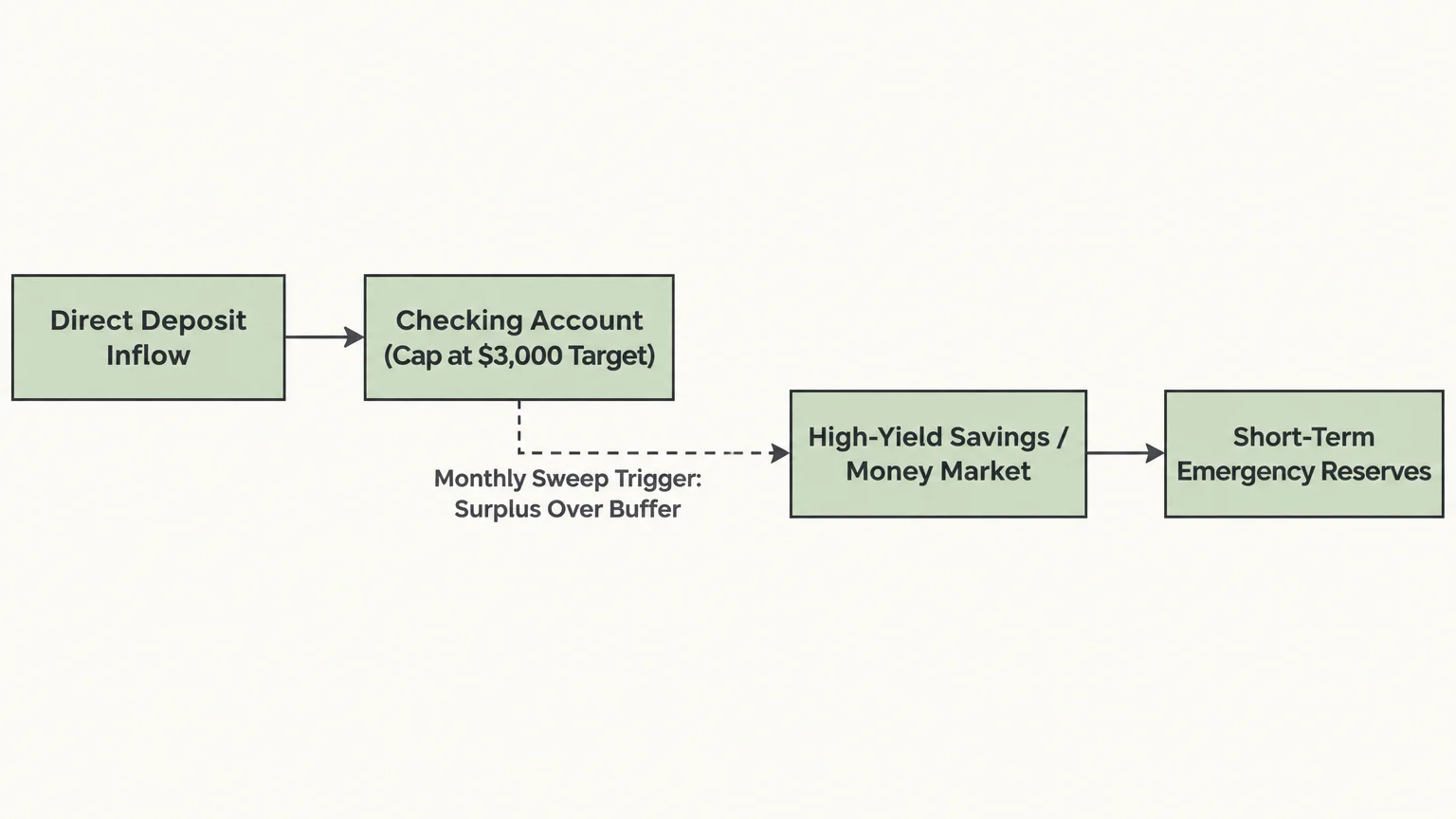
A Practical Cash-Sweep System You Can Set Up Today
You do not need spreadsheets or daily bank logins to keep your checking balance in its sweet spot. A simple automated cash-sweep routine handles bill timing while putting surplus dollars to work.
- Audit 60 days of cash flow: Pull your last two checking statements, mark every recurring bill date, and identify your true monthly outflow plus a $100 to $500 cushion.
- Separate checking and savings cleanly: Keep daily spending in a no-fee checking account and park your 3-to-6-month emergency fund in an FDIC-insured HYSA earning 4.27% to 4.70% APY.
- Automate payday splits: Ask your payroll department to split direct deposits—routing your exact monthly bill budget to checking and sending the rest straight to high-yield savings.
- Link overdraft protection wisely: Connect your savings account for free or low-cost overdraft transfers if your bank offers them, or opt out of debit overdraft coverage so point-of-sale purchases simply decline instead of triggering a $26.77 fee.
- Run a quarterly balance check: Every three months, sweep any checking balance exceeding your target cap into your HYSA, U.S. Treasury bills, or long-term investments through reputable platforms like Investor.gov to learn your options.
If your employer does not allow split direct deposits, set an automated recurring transfer from checking to savings two business days after payday. Waiting two days ensures your paycheck clears completely before surplus cash leaves.
You can also cluster your autopay due dates around payday. Calling your utility, phone, and credit card companies to move due dates to the 3rd or 18th of the month minimizes timing gaps and lowers your required checking cushion.
If you worry about short-term emergencies, keep your HYSA linked electronically to your checking account for quick transfers. A two-day ACH wait is rarely an issue when you can put an immediate car repair on a credit card and pay the statement off in full using transferred HYSA cash.
Frequently Asked Questions About Checking Account Balances
Is $3,000 enough to keep in a checking account?
Yes, $3,000 is enough if your monthly bills and debit spending total around $2,500 to $2,800. If your regular monthly expenses exceed $3,000, keep one full month of expenses plus a $100 to $500 buffer instead.
How can I lower my checking balance without triggering overdraft fees?
Align your autopay due dates just after payday, keep a $100 to $500 cushion, and link your savings account for overdraft transfers. You can also opt out of debit card overdraft programs so transactions decline rather than incurring an average $26.77 fee.
Will moving money out of checking affect my monthly maintenance fee?
It depends on your bank’s fee waiver rules. Roughly 47% of non-interest checking accounts charge no monthly fee and 46% waive fees with direct deposit, so check your account terms before dropping below any stated minimum balance.
Do I have to pay taxes on interest if I move money to a high-yield savings account?
Yes, checking and HYSA interest are both taxed as ordinary federal and state income in the year earned. Banks issue Form 1099-INT for $10 or more in annual interest, though you must report all taxable interest even below $10.

Take Control of Your Idle Cash
Checking accounts are built for smooth bill payments, not wealth building. Sizing your balance to one month of expenses plus a modest buffer protects you from overdrafts while shielding larger sums from fraud delays and inflation drag.
Open your banking app today, check your current balance against your true monthly bills, and schedule a transfer for every surplus dollar into a high-yield savings account. This article provides general financial education and information only. Everyone’s financial situation is unique—what works for others may not work for you. For personalized advice, consider consulting a qualified financial professional such as a CFP or CPA.
Last updated: November 2026. Financial regulations and rates change frequently—verify current details with official sources.