The Centers for Medicare & Medicaid Services (CMS) announced on November 17, 2026, that the standard 2027 Medicare Part B premium will climb to $209.40 per month. You will also face a higher $292 annual deductible for outpatient care.
Planning for this increase now protects your monthly retirement budget before January arrives. Your exact bill depends on your 2025 tax return, your Social Security check, and your plan choices.
Use the breakdowns below to calculate your net income for 2027 and spot ways to trim next year’s healthcare costs.
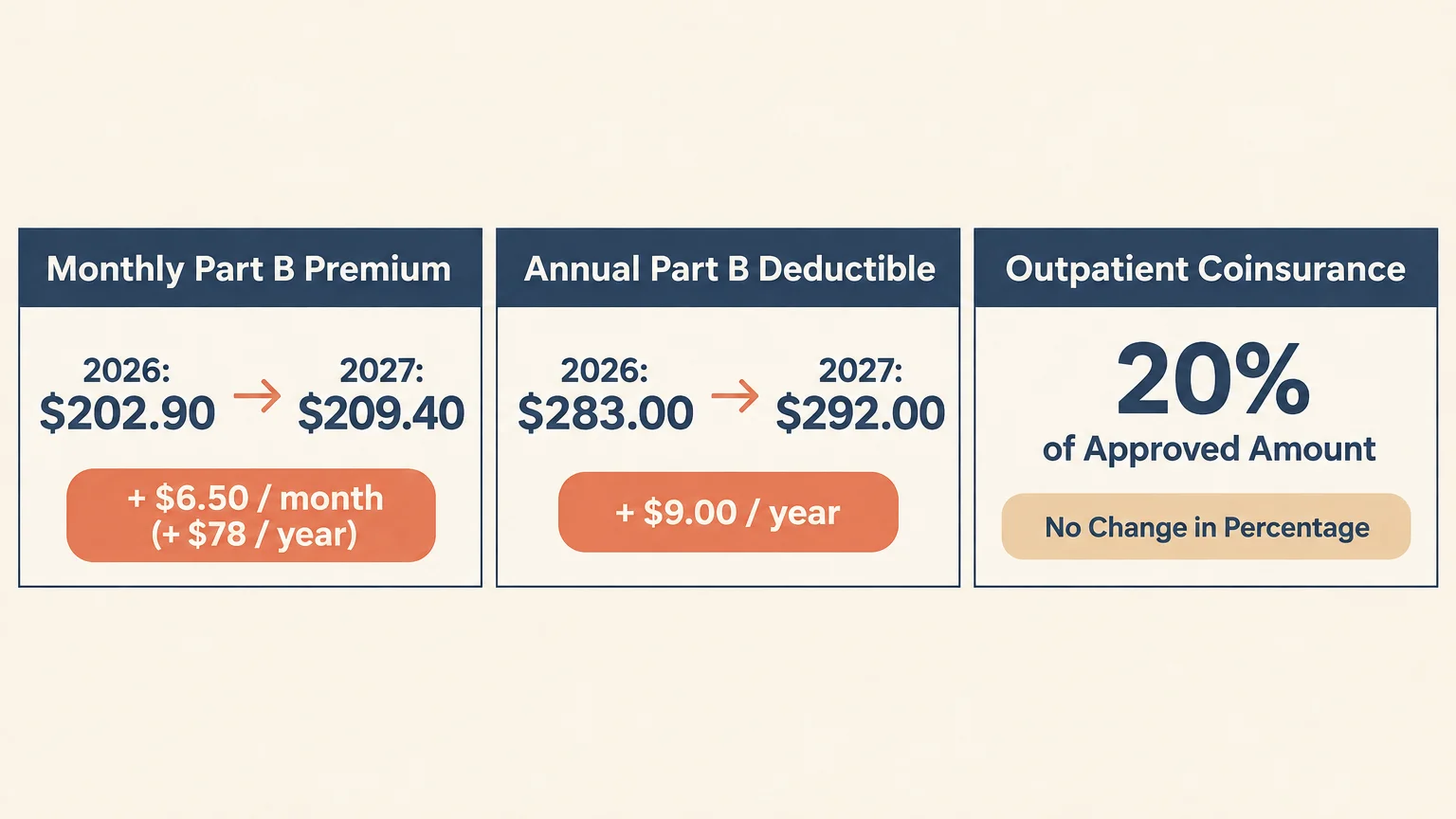
2027 Medicare Part B Premium and Deductible Breakdown
Most enrollees pay the standard rate for medical insurance, which covers doctor visits, outpatient hospital care, durable medical equipment, and preventive services. For 2027, the standard 2027 Medicare Part B premium increases by $6.50 per month.
That 3.2% bump adds $78 per year compared to the 2026 rate of $202.90 per month. According to CMS, projected increases in healthcare spending are the primary driver behind next year’s higher cost.
While any Medicare premium increase pinches a fixed budget, next year’s adjustment is noticeably gentler than the prior year’s jump. In 2026, standard premiums rose $17.90 per month—a 9.7% leap from the $185.00 rate in 2025.
Monthly premiums are only part of your outpatient budget. The annual Part B deductible 2027 sets before coverage begins rises to $292, which is $9 higher than the $283 deductible in 2026.
Once you satisfy that $292 deductible, Original Medicare generally charges 20% coinsurance on the Medicare-approved amount for covered services and doctor appointments. Without supplemental coverage, that 20% share carries no annual out-of-pocket cap.
You can review your current benefit details and coverage rules directly through Medicare.gov. Below is a side-by-side look at standard Part B costs for 2026 and 2027.
| Medicare Part B Cost Category | 2026 Standard Rate | 2027 Standard Rate | Dollar Change |
|---|---|---|---|
| Monthly Part B Premium | $202.90 | $209.40 | +$6.50 per month (+$78/year) |
| Annual Part B Deductible | $283.00 | $292.00 | +$9.00 per year |
| Standard Outpatient Coinsurance | 20% of approved amount | 20% of approved amount | No change in percentage |
Why the October 2026 Rebate Does Not Lower 2027 Bills
If you received a $90 credit in October 2026, do not expect a repeat discount in 2027. CMS issued a one-time $90 “Medicare Improvement Fund Premium Rebate” in October 2026 to roughly 20.8 million Original Medicare Part B beneficiaries.
That payment excluded Medicare Advantage enrollees, people receiving Medicaid premium assistance, and high-income surcharge payers. Per CMS, the rebate only offset October 2026 premiums and has no effect on 2027 monthly Part B rates.
How the 2027 Medicare Premium Increase Hits Your Social Security Deduction
Most retirees never write a check to Medicare because their monthly premium comes straight out of their Social Security benefit. Understanding how this Social Security deduction interacts with next year’s Cost-of-Living Adjustment (COLA) shows what you will actually take home.
On October 14, 2026, the Social Security Administration (SSA) announced a 3.6% COLA for 2027, up from 2.8% in 2026. The raise takes effect in January 2027 for nearly 72 million Social Security beneficiaries and on December 31, 2026, for roughly 7.3 million Supplemental Security Income recipients.
According to SSA estimates, the 3.6% COLA adds about $75 to $76 per month to an average retired worker’s check. That brings the average monthly benefit from $2,094 to $2,170 before Medicare deductions.
For an average retired worker and aged spouse combined, the 2027 COLA adds $117 per month, raising their joint average from $3,237 to $3,354. When you subtract the $6.50 monthly Part B increase from a $75 COLA gain, Medicare absorbs roughly 8.6% to 8.7% of the raise.
That leaves the average retiree with about $68.50 to $69.50 per month—or roughly $822 to $834 for the full year—in net COLA gains before taxes or other deductions. If you receive Medicare without claiming Social Security yet, CMS bills you directly instead.
How the Hold Harmless Rule Protects Certain Checks
Federal hold harmless rules prevent a Part B premium hike from reducing your net Social Security payment below the prior year’s dollar amount. To qualify, you must have Part B premiums deducted directly from your Social Security benefit and meet federal eligibility criteria.
Because the 2027 COLA adds roughly $75 on average while standard Part B rises $6.50, most beneficiaries will still see higher net deposits. However, the hold harmless rule does not protect everyone on Medicare:
- New Medicare enrollees: Beneficiaries entering Part B for the first time in 2027 do not qualify for hold harmless protection.
- High-income surcharge payers: Anyone subject to an income-related surcharge pays the full increase regardless of their Social Security benefit size.
- Medicare Savings Program enrollees: Individuals whose state Medicaid program pays their Part B premium are excluded from this provision.
To check your exact deposit before January, log into your personal account at the Social Security Administration website. SSA posts 2027 benefit and Medicare deduction notices online in late November 2026 for users who enrolled in paperless notices by November 18, 2026.
If you prefer physical mail, watch your mailbox during December 2026 for your personalized paper COLA statement. Saving that document helps you update your household budget for the new year.
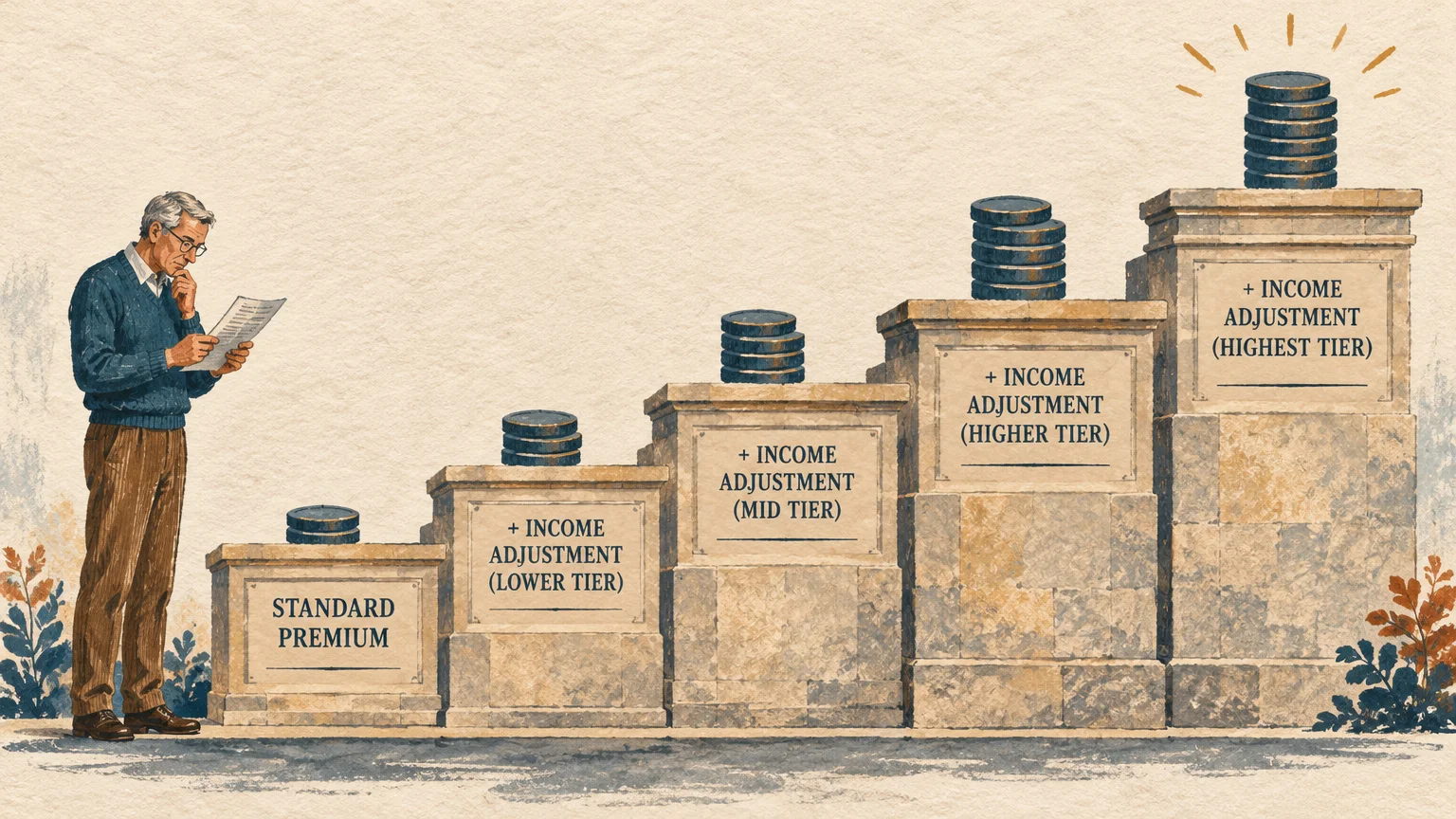
2027 High-Earner Surcharges: Check Your IRMAA Bracket
Not everyone pays the $209.40 standard premium. Higher earners pay an Income-Related Monthly Adjustment Amount (IRMAA) on top of standard Part B and Part D premiums.
Under CMS rules, your 2027 IRMAA bracket relies on a two-year lookback at your 2025 Modified Adjusted Gross Income (MAGI). That figure comes directly from the 2025 federal income tax return you filed with the Internal Revenue Service (IRS).
For 2027, CMS raised the base income thresholds so single filers earning $112,000 or less and joint filers earning $224,000 or less avoid surcharges. Those starting thresholds are up from $109,000 and $218,000 in 2026.
Every dollar matters because IRMAA uses strict cliffs rather than gradual phase-ins. Exceeding an income bracket by just $1 triggers the entire monthly surcharge for that tier.
Married couples who are both enrolled in Medicare pay those surcharges separately—meaning the surcharge doubles for the household. Review the full 2027 single and joint brackets below to see where your 2025 income places you.
| 2025 MAGI (Single) | 2025 MAGI (Married Filing Jointly) | Total 2027 Monthly Part B Premium | Part B Surcharge Included | Additional Monthly Part D IRMAA |
|---|---|---|---|---|
| $112,000 or less | $224,000 or less | $209.40 | $0.00 | $0.00 |
| Over $112,000 to $141,000 | Over $224,000 to $282,000 | $293.10 | +$83.70 | +$15.40 |
| Over $141,000 to $177,000 | Over $282,000 to $354,000 | $418.80 | +$209.40 | +$39.70 |
| Over $177,000 to $212,000 | Over $354,000 to $424,000 | $544.40 | +$335.00 | +$64.00 |
| Over $212,000 to under $500,000 | Over $424,000 to under $750,000 | $670.00 | +$460.60 | +$88.30 |
| $500,000 or more | $750,000 or more | $711.80 | +$502.40 | +$96.40 |
At the highest bracket, combined Part B premiums along with Part B and Part D surcharges reach $9,698.40 per year for one person. A married couple both on Medicare in that top tier pays $19,396.80 annually before paying a single medical claim.
Rules for Married Filing Separately
If you filed married filing separately in 2025 and lived with your spouse at any time during that year, IRMAA brackets compress sharply. You pay $209.40 per month with a 2025 MAGI of $112,000 or less.
Earning between $112,001 and $387,999 pushes your monthly Part B bill to $670.00 plus $88.30 in Part D IRMAA. Income of $388,000 or more triggers the top $711.80 Part B rate plus $96.40 for Part D.
How to Appeal IRMAA with Form SSA-44
You do not have to accept a surcharge if your 2025 income spiked due to a career you have since left behind. SSA allows beneficiaries to request a lower tier using Form SSA-44 when a qualifying life-changing event cuts their income.
Qualifying events include full retirement, reduced work hours, divorce, or the death of a spouse. You simply submit Form SSA-44 along with documentation proving the event and an estimate of your lower current-year income.
Keep in mind that one-time capital gains from selling a vacation home or converting a traditional IRA generally do not qualify for an appeal. Those non-qualifying spikes fall off after one year unless your income remains elevated.
Other 2027 Medicare Costs for Seniors to Budget For
Outpatient Part B bills represent just one piece of total Medicare costs for seniors in 2027. Hospital care, prescription drugs, and supplemental Medigap deductibles are also climbing next year.
Treat your Part B premium as only the baseline of your annual healthcare budget—higher hospital, prescription, and Medigap deductibles mean keeping an accessible emergency reserve is just as important as tracking your monthly Social Security deduction.
Medicare Part A Hospital Costs
Roughly 99% of Medicare beneficiaries pay $0 per month for Part A hospital insurance because they or a spouse accumulated at least 40 quarters of Medicare-covered employment. Those who need to buy Part A face higher monthly rates in 2027.
Beneficiaries with 30 to 39 quarters of work history will pay $328 per month in 2027, up from $311 in 2026. Anyone with fewer than 30 quarters will pay $597 per month, compared to $565 in 2026.
Even with $0 monthly Part A premiums, inpatient hospital stays carry steep cost-sharing in 2027:
- Inpatient hospital deductible: You pay $1,776 per benefit period, an increase of $40 over the $1,736 deductible in 2026.
- Hospital days 61 through 90: Daily coinsurance increases to $444 per day, up from $434 in 2026.
- Lifetime reserve days: Beyond day 90, daily coinsurance rises to $888 per day, compared to $868 in 2026.
- Skilled nursing facility care: For days 21 through 100 in a benefit period, coinsurance climbs to $222 per day, up from $217 in 2026.
Part D Prescription Limits and High-Deductible Medigap
Prescription drug plans under Medicare Part D also carry higher statutory limits in 2027. The maximum Part D deductible increases to $700, up sharply from $615 in 2026.
At the same time, the annual Part D out-of-pocket spending cap rises to $2,400 in 2027, up from $2,100 in 2026. If you take expensive brand-name medications, check how that $300 cap increase impacts your pharmacy budget.
If you carry Original Medicare paired with a high-deductible Medigap Plan F or Plan G, your out-of-pocket threshold is rising too. Those plans require you to meet a $3,050 deductible in 2027 before supplemental coverage kicks in, up from $2,950 in 2026.
How Medicare Advantage Plans Handle Part B
Roughly 51% of all Medicare beneficiaries now choose private Medicare Advantage (Part C) plans, according to the 2026 Medicare Trustees Report. Many enrollees mistakenly assume joining a zero-premium Advantage plan eliminates their Part B obligation.
In reality, Medicare Advantage members must still pay the $209.40 standard Part B premium—plus any applicable IRMAA surcharge—each month. The only exception is if your specific Advantage plan includes a Part B premium giveback credit that reduces your deduction.

Actionable Steps Before Medicare Open Enrollment Ends
Medicare Annual Open Enrollment for 2027 plans runs through December 7, 2026. Taking a structured approach before that deadline helps you offset higher premiums and deductibles.
- Compare Part D and Advantage plans on Medicare.gov: Enter your current prescriptions and preferred doctors to verify whether your 2027 plan raised deductibles, copays, or drug tiers.
- Check for legitimate Part B giveback benefits: If you use Medicare Advantage, see whether competing local plans offer a Part B premium reduction without sacrificing your doctor network.
- Verify your 2027 Social Security notice: Log into your SSA account in late November or review your December mailed statement to confirm your net deposit and tax withholding.
- File Form SSA-44 if you retired recently: Gather proof of your retirement or reduced work hours if your 2025 tax return triggered an IRMAA tier you no longer belong in.
- Screen for state Medicare Savings Programs: If you have limited income and assets, check eligibility tools at USA.gov Benefits to see if state programs can pay your $209.40 monthly premium and $292 deductible.
Common Mistakes to Avoid
Small oversights during enrollment or tax planning can lock you into higher Medicare costs for years. Watch out for these costly errors as 2027 approaches.
- Missing your initial Part B window: If you skip Part B when first eligible around age 65 without qualifying employer coverage, Medicare adds a 10% late enrollment penalty for every full 12-month delay—and that penalty usually lasts for life.
- Triggering the $1 IRMAA cliff: Taking a large traditional IRA withdrawal, selling appreciated stock, or completing a Roth conversion near a 2025 or future MAGI boundary by even $1 adds hundreds or thousands to annual premiums.
- Counting on October’s $90 rebate in 2027: Treating the one-time 2026 Medicare Improvement Fund Premium Rebate as a permanent discount will leave your 2027 cash-flow plan short.
- Ignoring Part D formulary changes: Assuming your 2026 drug plan stays the cheapest option can expose you to the full $700 deductible and $2,400 out-of-pocket cap unnecessarily.
- Assuming Medicare Advantage covers Part B premiums automatically: Budget for the $209.40 monthly deduction unless your plan summary explicitly confirms a Part B giveback benefit.

Professional vs. Self-Guided
Deciding whether to handle Medicare adjustments yourself or hire help depends on your income sources and health needs. Consider these four common scenarios.
- Standard retiree on fixed income (Self-Guided): If your 2025 MAGI sits comfortably below $112,000 single or $224,000 joint, use Medicare.gov and SSA.gov directly to compare plans and verify your COLA notice at no cost.
- Recent retiree facing an IRMAA bill (Self-Guided or Tax Preparer): Filing Form SSA-44 after stopping work is straightforward on your own, though a tax preparer can help calculate an accurate current-year MAGI estimate.
- High-income household managing investments (Professional): Working with a Certified Financial Planner or CPA helps you time Roth conversions, required minimum distributions, and capital gains so you avoid stepping over a $1 IRMAA cliff two years later.
- Beneficiary with complex medical or budget needs (Licensed Advisor or SHIP): If you juggle multiple chronic conditions or qualify for low-income assistance, consult an independent licensed Medicare broker or your state’s free State Health Insurance Assistance Program.
Frequently Asked Questions About 2027 Medicare Costs
How much is the 2027 Medicare Part B premium and deductible?
The standard 2027 Medicare Part B premium is $209.40 per month, up $6.50 from $202.90 in 2026. The annual Part B deductible rises by $9 to $292 in 2027, up from $283 in 2026.
Will the 2027 Medicare premium increase wipe out my Social Security COLA?
No, the 3.6% COLA in 2027 adds roughly $75 to $76 per month to an average retired worker’s benefit. After deducting the $6.50 Part B increase, the average retiree still nets roughly $68.50 to $69.50 more per month before other deductions.
Can I lower my 2027 Part B premium if my income dropped since 2025?
Yes, if your income fell due to a qualifying life-changing event—such as retirement, reduced work hours, divorce, or death of a spouse—you can appeal your IRMAA surcharge. Submit Form SSA-44 to the Social Security Administration with proof of your lower income.
Do Medicare Advantage members still pay the $209.40 Part B premium?
Yes, Medicare Advantage enrollees must continue paying the standard $209.40 Part B premium—plus any applicable IRMAA surcharge—each month. You only pay less if you choose an Advantage plan that explicitly provides a Part B premium giveback credit.
Take twenty minutes this week to verify your *my Social Security* statement and review your 2027 Part D or Advantage options before the December 7, 2026 enrollment deadline closes. Locking in the right coverage now keeps more of next year’s 3.6% COLA working for your household.
The information in this guide is meant for educational purposes. Your specific circumstances—including income, debt, tax situation, and goals—may require different approaches. When in doubt, consult a licensed professional.
Last updated: November 2026. Financial regulations and rates change frequently—verify current details with official sources.