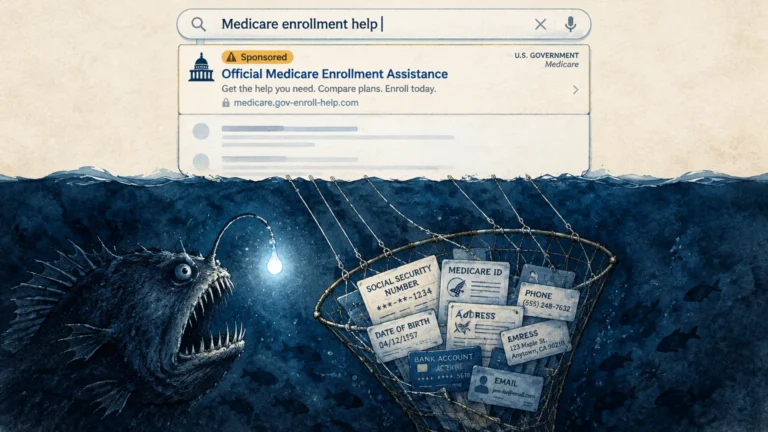
Millions of Americans change jobs without moving their workplace retirement accounts, leaving behind a staggering pool of unclaimed money. While headlines often cite $1.7 trillion in forgotten 401(k) funds, recent estimates put the total above $2.1 trillion.
Your share of that money could easily total tens of thousands of dollars. Even a modest balance left behind in an early-career job can quietly shrink under avoidable fees and idle cash allocations.
Fortunately, new federal tools and free public registries make tracking down your lost 401(k) straightforward. Follow this step-by-step search process to locate old accounts, reclaim your savings, and avoid costly tax traps.
At a Glance: Key Numbers Behind Forgotten 401(k) Accounts
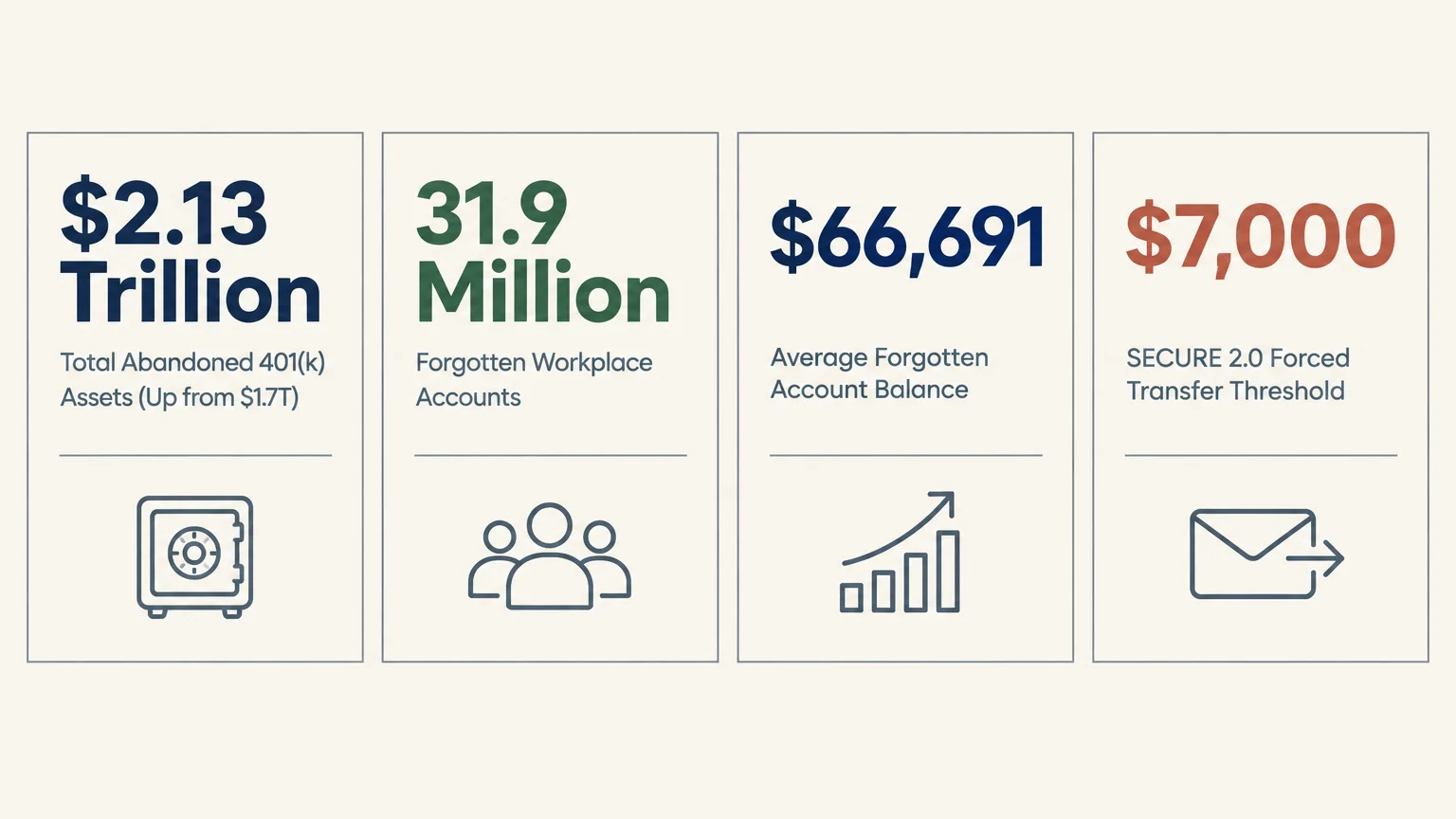
Understanding the scale of unclaimed retirement money helps explain why old workplace plans slip through the cracks. Here are the essential figures you need to know before starting your search:
- From $1.7 trillion to $2.13 trillion: A May 2023 Capitalize report estimated 29.2 million forgotten 401(k) accounts holding $1.65 trillion (widely rounded to $1.7 trillion), while a September 2025 Capitalize and Center for Retirement Research (CRR) at Boston College study found the total climbed nearly 30% to 31.9 million accounts holding $2.13 trillion by July 2025.
- Average account size: Per the September 2025 Capitalize and CRR report, the average forgotten 401(k) holds $66,691, up from $56,616 in 2023.
- New federal search tool: The U.S. Department of Labor (DOL) launched a free Retirement Savings Lost and Found Database at lostandfound.dol.gov on December 29, 2024.
- Higher small-balance limits: Under Section 304 of the SECURE 2.0 Act, employers can force balances of $7,000 or less out of a plan without your permission, up from the previous $5,000 ceiling.
Why Forgotten 401(k)s Cost More Than You Think
Switching employers several times over a career makes losing track of at least one retirement plan surprisingly common. U.S. Bureau of Labor Statistics (BLS) longitudinal data shows baby boomers born between 1957 and 1964 held an average of 12.7 jobs between ages 18 and 56.
Those job changes add up quickly across the entire workforce. A 2018 U.S. Government Accountability Office (GAO) study found that more than 25 million workplace plan participants left at least one account behind between 2004 and 2013.
That trend has only accelerated in recent years. Capitalize estimated that 4.2 million 401(k) accounts would be left behind in 2025 alone, rising from 4.0 million in 2024 and 3.5 million in 2023.
Federal employees face similar tracking headaches when moving between government and private-sector roles. Capitalize projected nearly 3 million left-behind federal Thrift Savings Plan (TSP) accounts by the end of 2025.
All together, those forgotten 401(k) assets represent nearly one-quarter of the $9.3 trillion held across all 401(k) plans as of June 2025. Leaving your portion unattended exposes your money to two silent drags on long-term wealth.
First, former employers rarely subsidize administrative expenses for departed workers. According to the Investment Company Institute (ICI) and ISS Market Intelligence in March 2026, the average total 401(k) plan cost across the market stood at 0.74% based on 2023 data.
Second, small balances rolled out without your consent often sit in low-yielding cash or money market funds rather than diversified investments. Over decades, weak returns combined with higher fees drain compounding power.
Capitalize’s 2025 scenario analysis illustrates how steep that penalty becomes over a full career. Leaving an average $66,600 forgotten account earning 1% to 2% with 0.85% fees—instead of 7% to 9% diversified returns at roughly 0.40% total fees—can cost over $500,000 in foregone retirement savings.
What Happens to a Left-Behind 401(k) After You Leave a Job
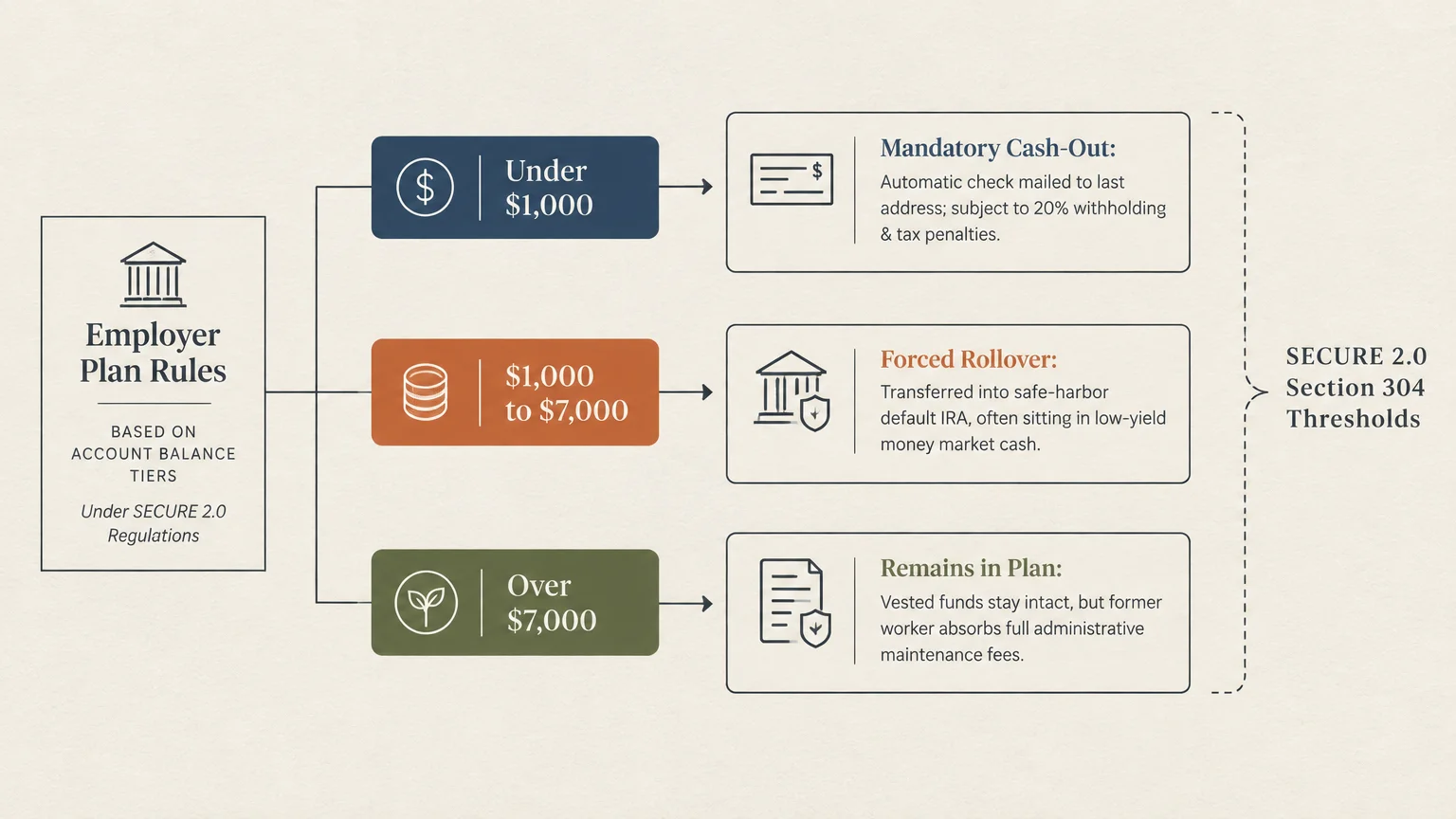
Your account balance at the time you leave an employer determines what your former plan administrator can legally do with your money. Federal rules divide left-behind balances into three distinct tiers.
Under Section 304 of the SECURE 2.0 Act of 2022, employers gained the option to raise their involuntary cash-out threshold from $5,000 to $7,000 for distributions after December 31, 2023. Under IRS Notice 2024-2, most private plans have until December 31, 2026 to adopt formal plan amendments reflecting that change.
| Account Balance Tier | What Your Former Employer Can Do | What Happens to Your Money |
|---|---|---|
| $1,000 or less | Issue an involuntary lump-sum cash-out check | You receive a check minus 20% mandatory tax withholding unless you roll it over within 60 days, or it may escheat to your state if uncashed. |
| Over $1,000 up to $7,000 (or $5,000 if plan limit was not raised) | Transfer your balance to a Safe Harbor IRA or auto-portability network if you do not respond to notices | Funds often sit in conservative money market accounts under DOL Regulation 2550.404a-2 while incurring ongoing IRA maintenance fees. |
| Over $7,000 (or $5,000 if limit was not raised) | Keep your money in the former employer’s 401(k) plan | Your account stays invested with the original plan recordkeeper unless the employer terminates the plan or changes providers. |
Knowing which tier your old balance falls into tells you where your money likely went. If you left behind $12,000, your former plan administrator cannot force your money out without your written consent.
However, if your balance was $4,500 and you ignored mail sent to an old address, the administrator may have moved your money into a Safe Harbor IRA. In that case, your former recordkeeper can tell you which IRA custodian now holds the funds.
A newer system called auto-portability is also reshaping how small balances move between jobs. Launched in November 2023 by Retirement Clearinghouse (RCH), the Portability Services Network (PSN) connects major recordkeepers including Alight, Empower, Fidelity, Principal, TIAA, and Vanguard.
PSN automatically matches and transfers small balances of $7,000 or less from an old plan or Safe Harbor IRA into a worker’s new employer 401(k). By July 2026, more than 22,000 plans covering over 6.8 million participants had adopted the network.
Still, auto-portability does not catch every small account yet. An October 2026 Vanguard study noted that because employer adoption remains incomplete, most transferred balances still land in interim IRAs rather than matching directly to a new 401(k), with participant fees up to $30 applying per RCH disclosures.
Step-by-Step Guide to Finding Your Lost 401(k)
Finding an old 401(k) works best when you follow a structured search order rather than guessing at recordkeeper websites. Start with your own paper trail before moving into federal and private unclaimed retirement databases.
Step 1: Gather Your Old Employment Records
Before logging into any search portal, assemble basic details for every past job where you may have contributed to a retirement plan. You do not need your old account number to begin.
- Old W-2 forms: Check Box b for your former employer’s Employer Identification Number (EIN) and Box 12 for retirement contribution codes.
- Former legal company names: Mergers and acquisitions happen frequently, so note both the brand name you worked under and any parent company.
- Previous names and addresses: Write down any maiden names, hyphenated names, and mailing addresses you used while employed there.
Even if you have thrown away old W-2s, you can still search using your Social Security number and former employer name. Having the EIN simply speeds up recordkeeper lookups if a business changed names or shut down.
Step 2: Search the DOL Retirement Savings Lost and Found Database
Your first digital stop should be the federal Retirement Savings Lost and Found Database operated by the DOL’s Employee Benefits Security Administration (EBSA). Mandated by Section 303 of the SECURE 2.0 Act, this free tool went live on December 29, 2024.
To protect your sensitive data, you must sign in through an ID-proofed Login.gov account. Verification requires your legal name, date of birth, Social Security number, a mobile phone, and photos of your driver’s license, with alternative options if you lack a mobile device.
Once authenticated, the database matches your Social Security number against private-sector employer and union retirement plans. When it finds a match, it gives you the contact details for the current plan administrator so you can claim your funds directly.
Keep two important limits in mind when using this portal. First, it is an information directory only—it never shows your account balance or sends you a payout.
Second, it excludes IRAs, government plans, and church plans. Because federal tax privacy laws prevented the IRS from directly sharing Form 8955-SSA records, the DOL relies on voluntary plan uploads that began in November 2024 and initially focused on separated workers aged 65 and older.
A blank result on the DOL portal does not prove you have no lost 401(k). Stay alert for fraud as well: the DOL states it will never call, text, or email to ask for your Login.gov password or one-time passcode.
Step 3: Check DOL Form 5500 Filings and the Abandoned Plan Search
If your former employer does not appear in the Lost and Found Database, look up the company’s annual Form 5500 through the DOL’s free EFAST2 portal. Most private-sector retirement plans must file this public report every year.
Search using the employer’s legal name or the EIN from Box b of your old W-2. Look at the most recent filing to see which financial institution currently serves as the plan’s recordkeeper and who to contact inside the company.
If your former employer went bankrupt or closed permanently, switch to the DOL’s Abandoned Plan Search tool. That database identifies the qualified financial institution appointed to wind down an orphaned plan and distribute remaining participant balances.
Step 4: Search the PBGC Missing Participants Program
When a private-sector company terminates its retirement plan and cannot locate former workers, it may hand those unpaid benefits over to the Pension Benefit Guaranty Corporation (PBGC). Visit pbgc.gov and open its Find Unclaimed Retirement Benefits search tool.
You only need your last name and the last four digits of your Social Security number to run a search. PBGC updates the database quarterly, with the most recent update posted on November 3, 2026.
While PBGC is best known for traditional pensions, its expanded program has also accepted unclaimed balances from some terminated 401(k) plans since 2018. Money held by PBGC earns interest at the Federal mid-term rate with no ongoing maintenance fees.
Claiming your balance through PBGC is inexpensive compared with commercial Safe Harbor IRAs. The agency charges only a single $35 administrative fee when transferring unclaimed 401(k) balances over $250.
Step 5: Check Private Registries and State Unclaimed Property
Not every terminated or Safe Harbor account moves to PBGC. Many plan sponsors submit missing-participant records to the National Registry of Unclaimed Retirement Benefits (NRURB), a free database run by PenChecks Trust at unclaimedretirementbenefits.com.
You can search NRURB at no cost using your Social Security number or your former employer’s name. If your account appears, the registry provides instructions for verifying your identity and claiming your funds.
You should also check state unclaimed property databases through MissingMoney.com, endorsed by the National Association of Unclaimed Property Administrators (NAUPA), along with your state treasurer’s official portal. If an employer mailed an involuntary cash-out check of $1,000 or less to an old address and it went uncashed, the money often escheats to the state.
Step 6: Request Your Social Security Administration Record
The Social Security Administration (SSA) serves as a valuable backup for older workplace plans. When you apply for Social Security benefits—or upon special request—the agency can provide a Notice of Potential Private Retirement Benefit Information.
That document lists private-sector retirement plans and administrators previously reported to the IRS under your Social Security number. Remember that listing a plan does not guarantee money remains inside it if you already rolled it over or cashed out years ago, so verify the status directly with the named administrator.
| Search Resource | Best Used For | Information Required | Key Limitation |
|---|---|---|---|
| DOL Lost and Found | Active or transferred private-sector 401(k) and union plans | ID-proofed Login.gov account (name, DOB, SSN, photo ID) | Voluntary plan uploads; excludes IRAs, government, and church plans |
| DOL EFAST2 / Abandoned Plan | Finding current recordkeepers or closed employers | Employer legal name or EIN | Shows plan contacts rather than individual participant records |
| PBGC Missing Participants | Terminated pensions and participating terminated 401(k)s | Last name and last four digits of SSN | Covers only plans that opted to transfer funds to PBGC |
| NRURB (PenChecks) | Unclaimed balances from private participating sponsors | SSN or former employer name | Limited to employers and custodians that registered with PenChecks |
| MissingMoney.com / States | Uncashed force-out checks and escheated Safe Harbor IRAs | Name and current or past states of residence | Holds cash value only; missed investment growth cannot be restored |
| SSA Potential Benefit Notice | Older plans reported historically to the IRS | SSA account or benefit application request | Lists plans where you once had vested rights, even if later paid out |
How to Reclaim and Move Your Unclaimed Retirement Money
Once a plan administrator confirms your balance, you usually have up to four ways to handle the money. Comparing fees, investment choices, and tax consequences before signing distribution paperwork keeps your savings intact.
You can review standard rollover mechanics on Investor.gov and check tax rules directly at IRS.gov before initiating any transfer. Under IRS Publication 575, plan administrators must send you a written rollover notice 30 to 90 days before processing a distribution.
- Roll over into an IRA: Opening or using an existing Individual Retirement Account gives you broad fund choices, low-cost index options, and full control under one roof.
- Roll over into your current employer’s 401(k): Consolidating into your active workplace plan simplifies tracking and lets you delay Required Minimum Distributions (RMDs) past age 73 if you are still working there.
- Leave the balance where it is: If your old employer’s plan has institutional low-cost funds and allows departed workers to stay, keeping it there can make sense—as long as you update your contact details and beneficiaries.
- Take a cash payout: Cashing out before retirement should be your last resort because taxes and penalties immediately erode your balance.
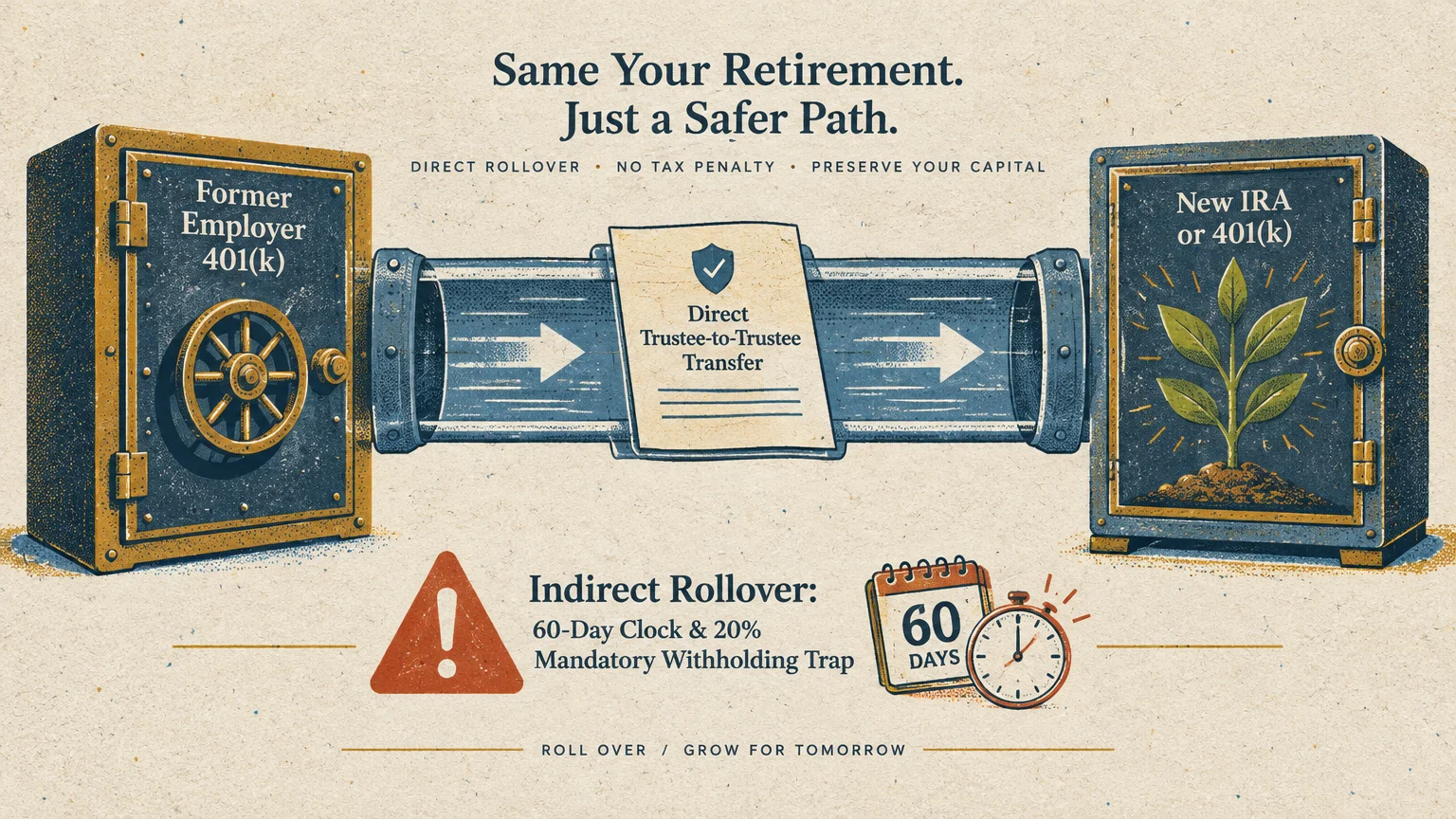
When moving money to an IRA or current 401(k), always instruct the old custodian to process a direct rollover. With a direct rollover, the check or electronic wire is made payable to your new custodian for your benefit, triggering 0% federal tax withholding.
By contrast, asking for a check payable to you personally creates an indirect rollover. Your old plan must withhold 20% for federal income taxes right away, leaving you only 60 days from receipt to deposit the full original distribution—including replacing that missing 20% out of pocket—into an eligible retirement account.
If you fail to replace the withheld 20% or miss the 60-day deadline, the IRS treats the unrolled amount as a taxable distribution. On pre-tax money, you will owe ordinary income tax plus a 10% early withdrawal penalty if you are under age 59½ unless an IRS exception applies.
Transfer paperwork may soon become much easier across recordkeepers. In IRS Notice 2026-49, issued in 2026, the IRS and Treasury signaled upcoming guidance aimed at simplifying rollovers by potentially eliminating hurdles such as Medallion Signature Guarantees.
Avoiding Common Errors When Searching and Rolling Over Funds
Even savers who track down an old account can lose substantial money during the recovery process. Watching out for five frequent mistakes keeps more of your retirement nest egg working for you.
1. Ignoring Required Minimum Distributions on old accounts: Under SECURE 2.0, RMDs for traditional 401(k)s and IRAs start at age 73, rising to age 75 in 2033. Your first RMD is due by April 1 of the following year, with subsequent withdrawals due by December 31 each year.
Many older workers assume they can skip withdrawals from every 401(k) while still employed. However, the IRS still-working delay applies only to your current employer’s plan—not forgotten 401(k)s from previous jobs.
Missing an RMD on a forgotten traditional 401(k) triggers a 25% IRS excise tax on the shortfall. You can reduce that penalty to 10% if you withdraw the missed amount and file Form 5329 within two years (note that Roth 401(k) accounts are exempt from lifetime RMDs as of 2024).
2. Searching only under your current legal name: Recordkeepers and state unclaimed property portals often index old accounts under the exact name on your original payroll file. Always run separate queries using maiden names, prior married names, and middle initials.
3. Paying third-party search services for free public lookups: Commercial finder firms sometimes charge steep percentage fees to locate unclaimed property you can claim yourself for zero dollars. Stick to official government portals and free registries listed above.
4. Sharing login codes with unsolicited callers: Scammers monitor headlines about the federal Lost and Found database to trick people into handing over Login.gov credentials. Never share your password or two-factor authentication codes with anyone who calls, texts, or emails you.
5. Forgetting to update beneficiary designations after reclaiming funds: Consolidating an old 401(k) into an IRA or current workplace plan does not carry over your previous beneficiary elections. Confirm your primary and contingent beneficiaries immediately once your rollover settles.
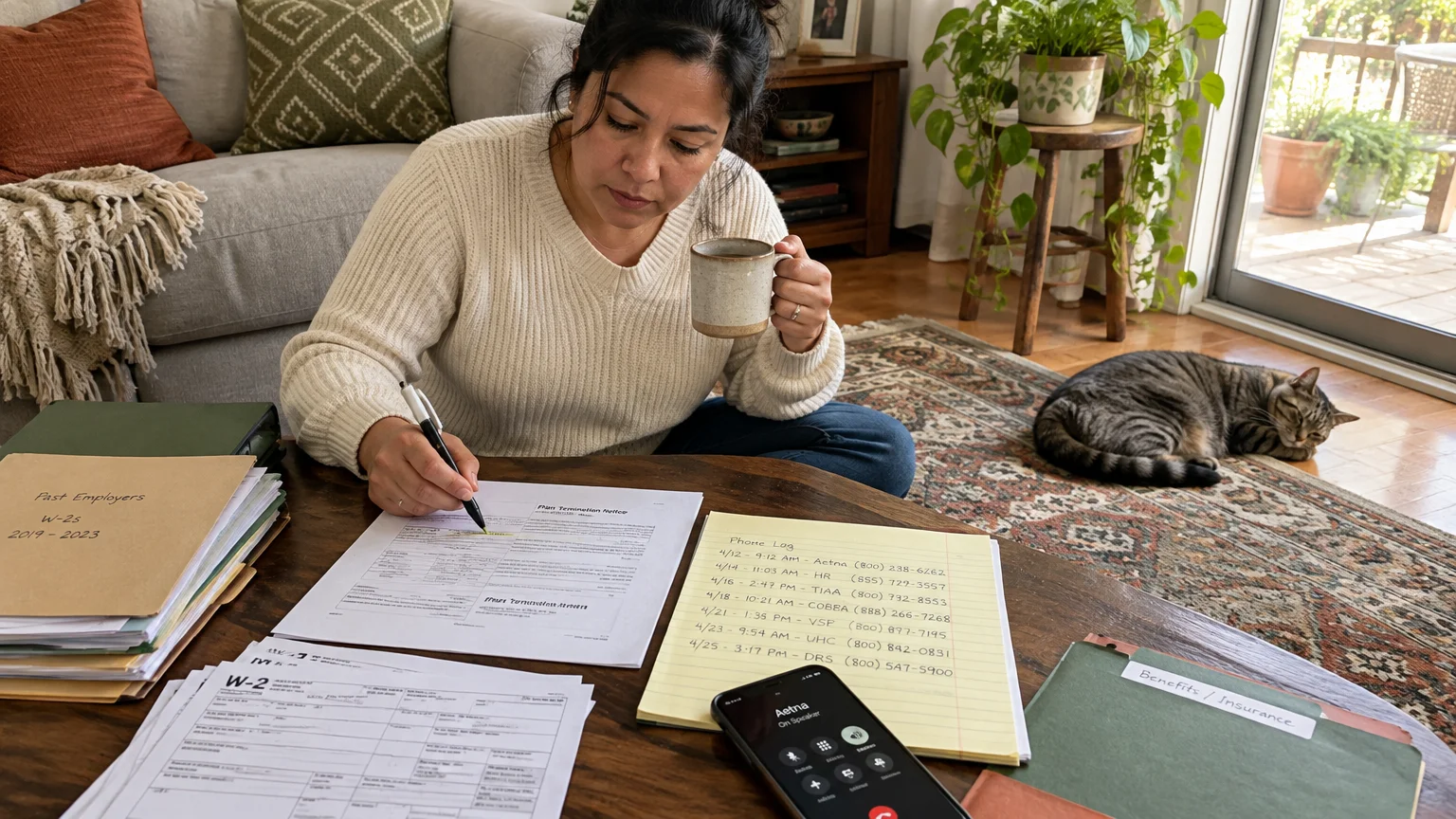
When DIY Isn’t Enough
Most people can locate and roll over a lost 401(k) on their own in a few afternoons. Still, certain legal and tax situations justify bringing in a Certified Financial Planner (CFP), Certified Public Accountant (CPA), or ERISA attorney.
- Your former employer vanished and left no clear recordkeeper: When Form 5500 filings stop abruptly without an Abandoned Plan entry or PBGC transfer, an ERISA specialist can trace corporate successors or bankruptcy trustees.
- You missed multiple years of Required Minimum Distributions: If you are over age 73 and discover an old traditional 401(k) with years of unpaid RMDs, a CPA can calculate exact shortfalls and request penalty waivers on Form 5329.
- Your old account involves a divorce split or QDRO: Dividing or reclaiming a forgotten workplace plan tied to a past divorce decree requires careful review of Qualified Domestic Relations Order rules before moving funds.
- Your old 401(k) holds appreciated employer stock: Moving company stock directly into an IRA can forfeit special Net Unrealized Appreciation tax treatment, so consult a tax professional before initiating a rollover.
Frequently Asked Questions About Finding Old 401(k)s
Does the DOL Lost and Found Database show how much money is in my old 401(k)?
No, the federal database at lostandfound.dol.gov is an informational directory only. It gives you the contact details of the plan administrator holding your records so you can verify your balance directly with them.
Can I lose my 401(k) forever if my former employer goes out of business?
No, federal law requires workplace retirement assets to be held in trust separate from a company’s operating funds. When an employer shuts down, the plan is either wound down through an independent institution, transferred to a Safe Harbor IRA, or handed over to PBGC.
How long does a 401(k) rollover take once I find my account?
Direct rollovers typically take one to three weeks after you submit completed distribution forms to your old plan administrator. Electronic transfers between major custodians often settle faster than paper rollover checks mailed between institutions.
Will checking for unclaimed retirement money hurt my credit score?
No, searching federal databases, PBGC records, private registries, or state unclaimed property sites never triggers a credit inquiry. Even verifying your identity through Login.gov leaves your credit report completely untouched.
Take Action on Your Forgotten Accounts Today
Tracking down a forgotten 401(k) takes far less effort than rebuilding those savings from scratch. Set aside 30 minutes this week to list your past employers, log into the DOL Lost and Found Database, and run quick searches on PBGC and MissingMoney.com.
Once you reclaim your funds through a direct rollover, put your money back into low-cost diversified investments and update your beneficiary records. For help weighing whether an IRA or your current workplace plan offers lower fees, review educational guides from the Consumer Financial Protection Bureau.
This article provides general financial education and information only. Everyone’s financial situation is unique—what works for others may not work for you. For personalized advice, consider consulting a qualified financial professional such as a CFP or CPA.
Last updated: November 2026. Financial regulations and rates change frequently—verify current details with official sources.