Buying a home in Florida can cost less per month than signing a new lease, depending on where you look. While statewide asking rents average $2,300 to $2,500, several inland and metro markets still offer lower monthly mortgage principal and interest.
Mortgage rates at 7.11% and steep coastal insurance bills complicate the math. You also face major property tax shifts after voters passed Amendment 3 in November 2026.
Knowing which cities favor buyers—and which hidden carrying costs erase those savings—helps you make a smart move with your money.
How the Florida Own vs. Rent Math Works Right Now
Evaluating Florida own vs. rent options starts with separating headline mortgage payments from your full monthly housing bill. Early-2026 affordability studies looked much friendlier to buyers than late-2026 rate quotes do.
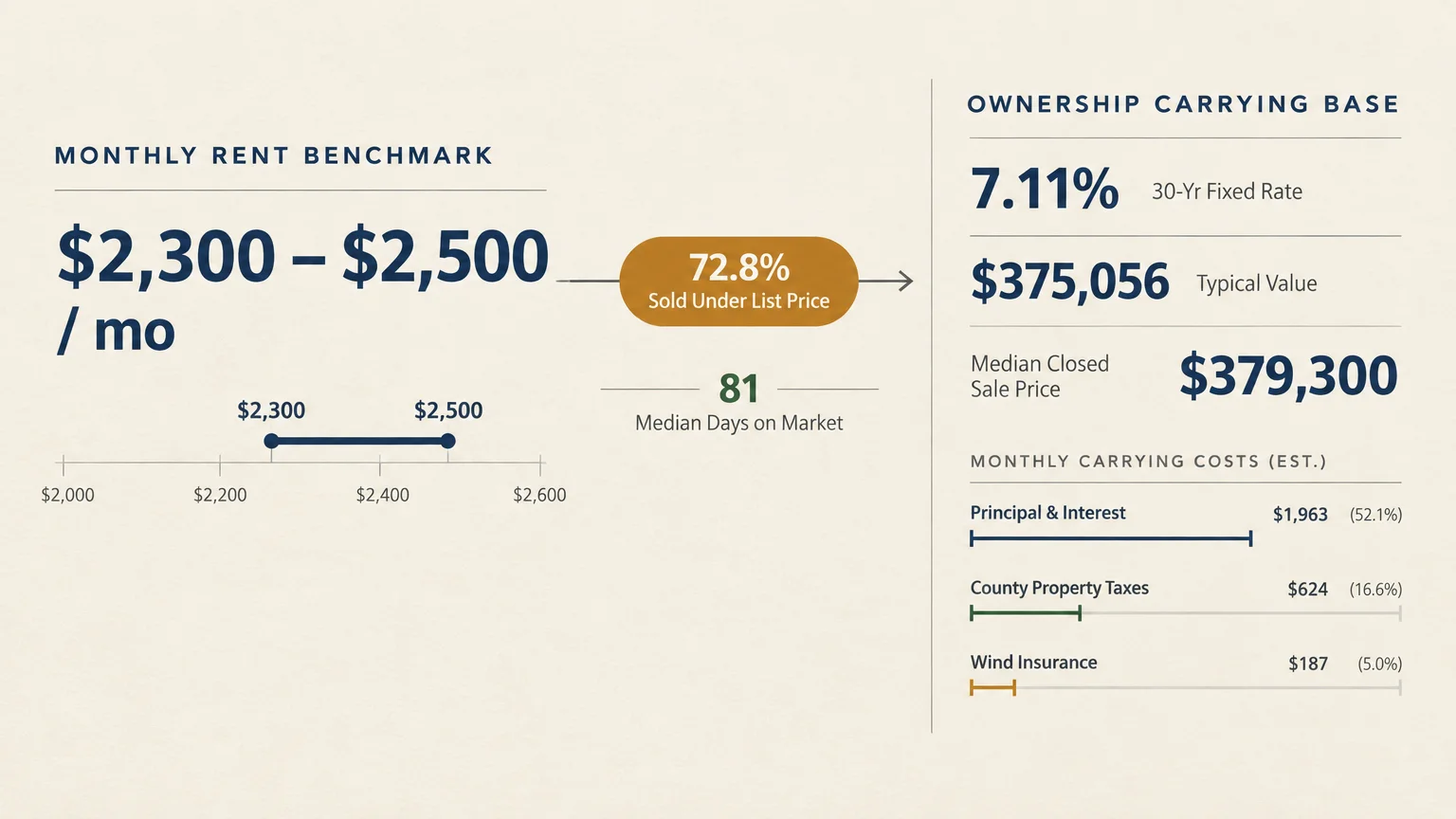
According to Freddie Mac, the average 30-year fixed mortgage rate stood at 7.11% on November 12, 2026, while 15-year fixed loans averaged 6.45%. Rates had dipped near 6.0% in February and March 2026 before rebounding above 7%, and the Federal Reserve raised its target range to 3.75%–4.00% in September 2026.
Even with higher borrowing costs, Florida housing prices have softened enough to give buyers real leverage. Zillow data as of October 31, 2026, put Florida’s typical home value at $375,056, down 0.5% year-over-year and just 2.9% above the $364,288 national typical value.
Seller concessions are widespread across the state right now. Zillow reported a September 2026 median sale price of $379,300, with 72.8% of homes selling under list price.
Realtor.com data from October 2026 shows 281,500 active listings statewide, a median listing price of $409,950, and 81 median days on market. On average, Florida homes closed 2.67% below asking price.
Renters have seen only modest relief by comparison. Zillow Rentals reported Florida’s average rent across all property types at $2,300 per month on November 9, 2026, while Realtor.com placed the October 2026 median rent at $2,500.
Nationally, Realtor.com reported a $1,673 median asking rent across the 50 largest metros in April 2026, while typical U.S. mortgage payments reached $2,005 in late 2025. Florida flips that script in cities where rents stay elevated while home prices sit below the statewide median.
A lower principal-and-interest payment never guarantees lower housing costs in Florida. Always add post-sale property taxes, county-specific wind insurance, and mandatory condo reserves before deciding to buy.
You can run your own break-even math using the NerdWallet rent-versus-buy calculator and check weekly rate shifts on Bankrate. Doing both before touring homes keeps your budget grounded in current numbers.
9 Florida Cities Where Owning Can Cost Less Than Renting
Not every affordable Florida market works the same way for buyers. Some major metros beat local rents on monthly loan principal and interest, while smaller inland cities offer low purchase prices and dramatically cheaper wind insurance.
1. Jacksonville
Jacksonville stands out as one of the clearest large-city wins when buying a home in Florida. A&D Mortgage’s 2026 10-Year Rent vs. Buy Wealth Study identified Jacksonville among U.S. cities where owning costs less than renting on a monthly basis.
Reported 2026 local figures put Jacksonville’s median home price around $318,000, well below the $379,300 statewide median sale price. Meanwhile, average one-bedroom rents sit near $1,350, and larger family rentals climb quickly toward the statewide average.
Insurance costs also stay manageable compared to South Florida. Florida Office of Insurance Regulation (OIR) data as of March 31, 2026, lists Duval County’s average homeowners premium at $2,786 per year.
Because purchase prices and wind premiums remain moderate, your total monthly payment has a strong chance of beating multi-bedroom lease renewals. Focusing on neighborhoods outside coastal flood zones protects that monthly edge.
2. Tampa
Tampa remains a rare coastal metro where monthly loan payments can still undercut local apartment leases. An Empower analysis of January 2026 Zillow figures—calculated when 30-year rates hovered near 6%—found Tampa buyers paid $1,693 in monthly principal and interest versus $1,986 in median rent.
That $293 monthly advantage shrinks at November 2026 rates of 7.11%, so your down payment and credit score matter heavily here. Putting more cash down or negotiating seller rate buydowns can restore that monthly gap.
You also need to budget carefully for Hillsborough County homeowners insurance. Florida OIR data shows an average annual premium of $3,525 in Hillsborough County, compared to $4,063 next door in Pinellas County.
If you plan to stay at least five years, buying a single-family home in inland Hillsborough neighborhoods can shield you from steep rent hikes. Just watch out for older roofs that trigger surcharges from private carriers.
3. Miami
Miami shows how high local rents can make ownership look cheaper on paper—and why you must read the fine print. The same January 2026 Empower analysis found Miami’s monthly principal and interest averaged $2,244 compared to $2,645 in median rent, a $401 gap.
Rental pressure in South Florida remains intense. Zillow Research’s October 2026 Rent Report ranked Miami as the second least affordable U.S. rental market, with renters spending 36.5% of median household income on rent—well above the 25.3% pre-pandemic U.S. norm.
Zillow’s median rent across all Miami property types sits at $3,100 per month. Paying that much to a landlord builds zero equity while exposing you to annual renewal increases.
Still, Miami carries heavy carrying costs that can erase a loan-only advantage. Florida OIR lists Miami-Dade County’s average homeowners insurance at $5,975 per year, and high condo fees frequently push total ownership costs well above rent.
Buying in Miami beats renting mainly when you lock in a reasonable fixed rate, avoid high-assessment older condos, and claim homestead tax protections. Otherwise, renting can remain cheaper on a pure cash-flow basis.
4. Ocala
Ocala is one of the strongest Florida retirement cities and budget-conscious buyer markets in the state. Florida Realtors reported Marion County’s September 2026 median single-family sale price at $280,640—roughly $134,000 below the statewide single-family median of $415,000.
Lower home prices pair with the lowest homeowners insurance cost among major counties tracked in state data. Florida OIR lists Marion County’s average annual premium at just $2,191, less than half the cost in Collier, Miami-Dade, Broward, or Palm Beach counties.
When you finance a home around $280,640 instead of paying Florida’s $2,300 to $2,500 average rent, your monthly housing math tilts toward ownership fast. You also avoid coastal hurricane deductibles that strain fixed retirement budgets.
Before signing a contract in Ocala, check whether a community carries separate HOA or amenity fees. Keeping those monthly dues low preserves your cash-flow savings over renting.
5. Spring Hill
Spring Hill sits north of Tampa along Florida’s Nature Coast and draws commuters priced out of Hillsborough and Pinellas counties. Zillow’s October 2026 home value index placed Spring Hill’s typical home value at $302,740.
That price point sits more than $72,000 below Florida’s typical statewide home value of $375,056. Because nearby Tampa Bay rental rates remain high, buyers willing to drive slightly farther often lock in lower monthly housing costs by purchasing here.
Neighboring Pasco County averages $2,756 per year for homeowners insurance per Florida OIR data, giving you a rough sense of inland-bordering West Central Florida premiums. Always request property-specific wind and flood quotes, as coastal pockets of Hernando County carry higher rates than inland subdivisions.
Spring Hill also offers newer single-family inventory compared to older inner-ring suburbs. Buying a home with a newer roof can unlock substantial insurance credits.
6. Brooksville
Just inland from Spring Hill, Brooksville offers another Hernando County path where ownership beats typical regional rents. Zillow reported Brooksville’s October 2026 typical home value at $304,386.
Sitting farther from the Gulf Coast helps many Brooksville properties avoid coastal surge zones. Lower purchase prices keep required down payments and closing costs realistic for first-time buyers and relocating retirees alike.
Compared to renting a three-bedroom single-family home near Florida’s $2,300 average rent, financing a moderately priced home in Brooksville keeps your base payment predictable. Every principal payment also goes toward your own net worth rather than a landlord’s.
Check local well, septic, and commute expenses before finalizing your budget. Those everyday operating costs deserve a line in your rent-versus-buy comparison.
7. Pensacola
Pensacola delivers Gulf Coast access without South Florida price tags. Local 2026 market figures place Pensacola’s median home price near $309,000—roughly $70,000 under Florida’s September 2026 median sale price of $379,300.
Steady military and healthcare employment keeps rental demand brisk across the western Panhandle. When single-family leases climb toward state averages, buying near $309,000 can turn ownership into the cheaper option over a multi-year stay.
Location within the metro area determines how well those savings hold up. Homes closer to Pensacola Bay or barrier islands face steeper windstorm coverage than inland neighborhoods north of Interstate 10.
Ask your lender to estimate taxes using the purchase price rather than the seller’s old bill. That single step prevents payment shock in your second year of ownership.
8. Gainesville
Gainesville benefits from steady university and medical-center rental demand that keeps lease prices firm year-round. Meanwhile, its inland North Central Florida location keeps insurance costs much lower than coastal metros.
Florida OIR data shows Alachua County’s average homeowners insurance premium at $2,525 per year—second lowest among the counties in state summaries, behind only Marion County. That saves roughly $3,450 per year compared to Miami-Dade County’s $5,975 average.
Low annual insurance bills free up more of your monthly budget for mortgage principal and maintenance. If you plan to stay beyond graduation or a multi-year hospital contract, buying a single-family home or townhome can outpace repeated lease hikes.
Stick to primary residences or properties with strong long-term resale appeal. Campus-adjacent condos can carry strict HOA budgets that tighten your monthly margin.
9. Orlando
Orlando’s rapid job and population growth has kept apartment and single-family rents elevated across Central Florida. Buying here requires careful neighborhood selection, because home prices and property taxes vary sharply across Orange and neighboring Osceola counties.
Insurance costs in Central Florida remain significantly lower than along the Southeast coast. Florida OIR reports Orange County’s average homeowners premium at $3,610 per year and nearby Osceola County at $2,940 per year, compared to $6,323 in Palm Beach County.
Because Florida buyers currently close 2.67% below asking price on average and 72.8% of homes sell under list, Orlando buyers have room to negotiate price cuts or seller-paid closing credits. Pairing a negotiated discount with an inland insurance bill helps monthly ownership costs compete with rising suburban rents.
Watch local toll costs and HOA dues closely when comparing suburbs. Those fixed monthly expenses can tip the scale between renting downtown and buying farther out.
Side-by-Side Florida Housing Costs Across Key Markets
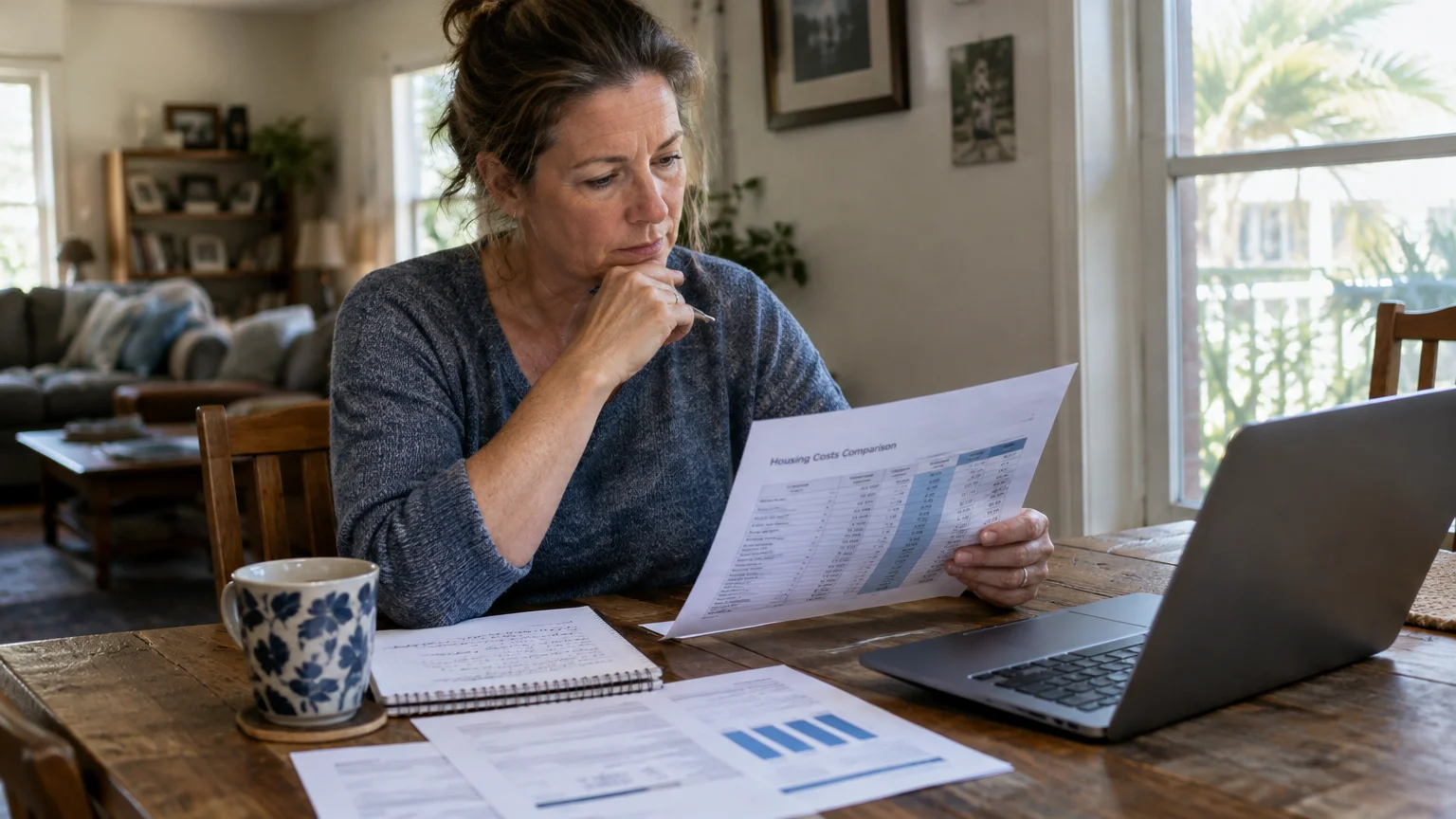
Comparing Florida housing costs across regions reveals why county lines matter as much as purchase prices. Two homes with identical mortgages can differ by thousands of dollars a year in insurance alone.
| City / County | Verified 2026 Home Price or Value | Verified 2026 Rent or Payment Benchmark | Average Annual Insurance (Florida OIR, March 2026) |
|---|---|---|---|
| Jacksonville (Duval) | ~$318,000 median home | $1,350 avg. 1BR rent; cheaper to buy than rent monthly (A&D study) | $2,786 |
| Tampa (Hillsborough) | Varies by neighborhood | $1,693 P&I vs. $1,986 median rent (Jan. 2026 at ~6% rate) | $3,525 |
| Miami (Miami-Dade) | Varies by neighborhood | $2,244 P&I vs. $2,645 rent (Jan. 2026); $3,100 all-types median rent | $5,975 |
| Ocala (Marion) | $280,640 SFH median sale (Sept. 2026) | Compared against $2,300–$2,500 statewide rents | $2,191 |
| Spring Hill (Hernando) | $302,740 Zillow ZHVI (Oct. 2026) | Compared against $2,300–$2,500 statewide rents | Not listed separately in OIR sample |
| Brooksville (Hernando) | $304,386 Zillow ZHVI (Oct. 2026) | Compared against $2,300–$2,500 statewide rents | Not listed separately in OIR sample |
| Pensacola (Escambia) | ~$309,000 median home | Compared against $2,300–$2,500 statewide rents | Not listed separately in OIR sample |
| Gainesville (Alachua) | Inland market below coastal highs | Steady campus/medical rental market | $2,525 |
| Orlando (Orange) | Inland Central Florida market | Compared against $2,300–$2,500 statewide rents | $3,610 |
By contrast, high-risk coastal counties carry steep insurance burdens that make ownership much harder to justify on monthly cash flow. Florida OIR reports average annual premiums of $4,063 in Pinellas, $5,534 in Collier, $6,136 in Broward, and $6,323 in Palm Beach.
When a home costs less than $320,000 and sits in a county with sub-$3,000 insurance, owning beats renting much sooner. High-cost coastal counties require larger down payments and longer holding periods to break even.
Why Amendment 3 Changes the Rent vs. Buy Equation in 2027
Florida’s property tax rules just underwent a major overhaul that directly affects whether it is cheaper to buy than rent. On November 3, 2026, Florida voters passed Amendment 3 with 62% approval, clearing the 60% threshold.
Under current 2026 rules, a primary-residence homestead exemption shields $25,000 across all property taxes plus an inflation-adjusted $26,411 from non-school taxes, totaling up to $51,411. Income-eligible seniors age 65 and older can also qualify for up to $50,000 in additional relief under Florida Statute 196.202.
Once you establish a homestead, Florida’s Save Our Homes cap limits annual assessed-value increases to 3% or the Consumer Price Index, whichever is lower. For 2026, the Florida Department of Revenue set that cap at 2.7%, down from 2.9% in 2025.
Amendment 3 takes effect January 1, 2027, and sharply expands tax breaks for qualifying homeowners:
- Larger non-school exemptions: The non-school homestead exemption jumps to $150,000 in 2027 and $250,000 in 2028, then adjusts for inflation starting in 2029, while the $25,000 school-tax exemption stays unchanged.
- Five-year newcomer wait: Buyers who were not permanent Florida residents on December 31, 2026, face a five-year waiting period before receiving the expanded exemption, getting only the existing inflation-adjusted ~$50,000 shield until year five.
- Tighter rental assessment caps: Amendment 3 cuts the annual assessment-increase cap on non-homestead properties—including rentals and second homes—from 10% to 5%.
- Potential rent pressure: State economists project roughly $12 billion in annual local tax revenue reductions, and the Tax Foundation and county officials warn cities may raise local fees or shift tax burdens onto non-homesteaded rentals.
If local governments pass higher fees or tax rates onto landlords, rents could rise faster over the next several years. Long-term Florida residents who buy a homesteaded home lock in far greater protection against those local budget shifts.
Before filing federal returns, check the Internal Revenue Service (IRS) guidelines on deducting mortgage interest and state property taxes. Most buyers using the standard deduction will see their main tax savings at the county level through Florida’s homestead rules.
Insurance, Condo Reserves, and Financing Programs That Tip the Balance
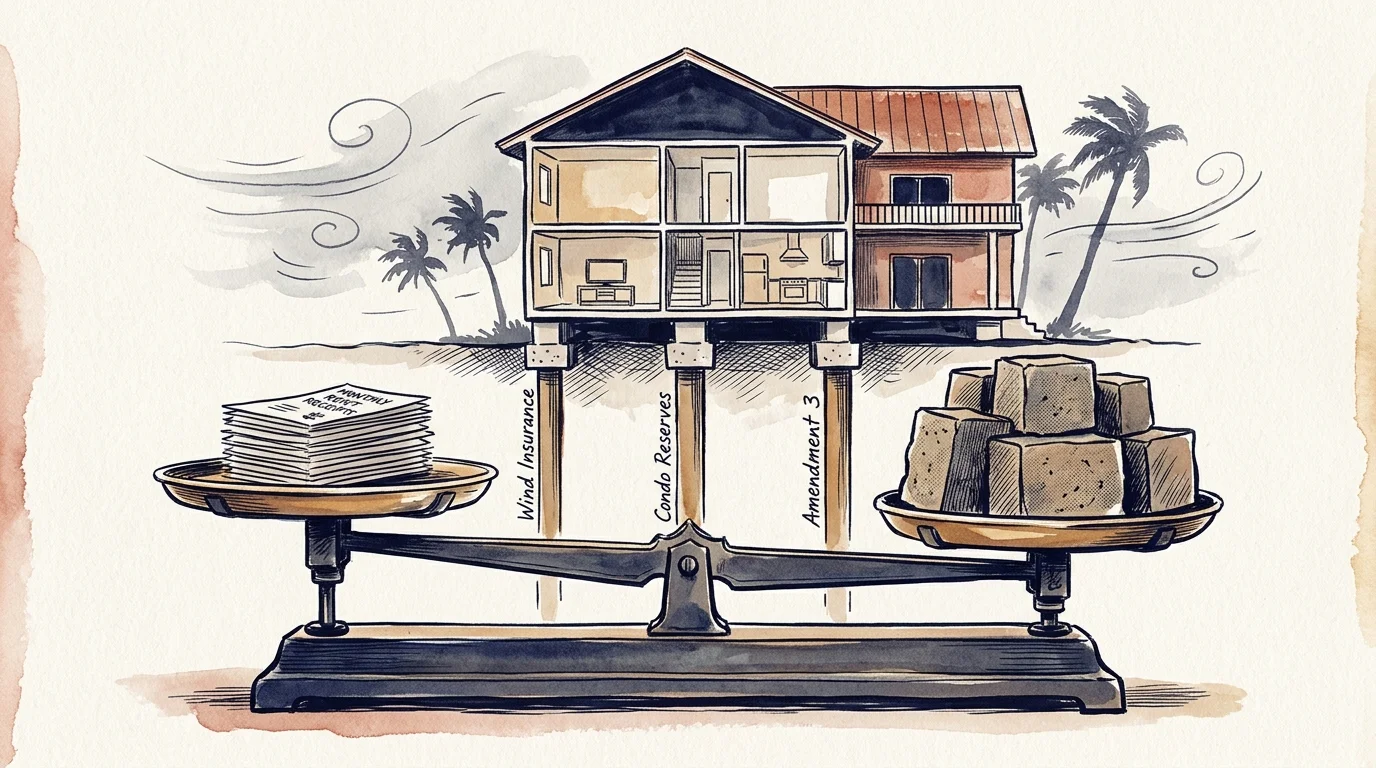
Three practical market shifts in 2026 can help you lower your monthly ownership payment—or warn you away from the wrong property type. Pay close attention to insurance rate cuts, condo reserve mandates, and state down payment aid.
Stabilizing Homeowners Insurance Rates
After years of steep increases, Florida’s property insurance market has started cooling down. State-backed Citizens Property Insurance Corp. shrank to 336,000 policies by March 2026, down 76% from its 1.41 million peak in October 2023.
Regulators approved Citizens’ first rate reduction since 2015 effective July 1, 2026, cutting homeowners multiperil policies by an average of 8.8% and wind-only policies by 5.5% across 66 of 67 counties. On September 22, 2026, Florida Insurance Commissioner Mike Yaworsky approved another wave of private-insurer rate cuts averaging 7% across more than 62,000 policies.
Since January 2024, 48 insurers have filed for rate decreases and 53 filed for 0% changes. That relief matters because ICE Mortgage Technology reported that homeowners insurance accounted for nearly 10% of typical U.S. mortgage payments in the second quarter of 2026.
Condo Reserve Rules Under House Bill 913
Condo prices look tempting on listing sites, but mandatory reserve rules can wreck your monthly budget. Florida Realtors reported in September 2026 that the median condo or townhouse sale price fell 1.8% year-over-year to $293,500, with 7.7 months of inventory.
Compare that to single-family homes, which sat at a $415,000 median price and just 4.4 months of supply—below the 5.5-month balanced-market benchmark. Many condos sit unsold because buyers fear special assessments triggered by Florida House Bill 913.
Effective July 1, 2025, HB 913 requires condo and co-op buildings of three or more habitable stories to undergo Milestone Inspections every 10 years starting at age 30, or age 25 near coastlines, alongside a Structural Integrity Reserve Study every 10 years. Under Florida Statute 718.112(2)(g), associations cannot waive reserve funding for eight critical structural components on budgets adopted on or after December 31, 2024.
Before buying any condo, review the most recent reserve study and board minutes. A low mortgage payment does not help if monthly HOA dues jump or a five-figure structural assessment lands in your mailbox.
Down Payment Assistance and Loan Limits
Coming up with upfront cash is often the biggest hurdle when moving from renting to owning. Eligible full-time Florida workers meeting income limits can tap the Florida Housing Finance Corporation’s Hometown Heroes Program.
Hometown Heroes provides up to 5% of your loan amount—at least $10,000 and capped at $35,000—toward your down payment and closing costs. The aid comes as a 0% interest, non-amortizing 30-year deferred second mortgage, and the program has helped over 30,000 buyers since June 2022.
For buyers borrowing more, the 2026 baseline conforming loan limit sits at $832,750 in most Florida counties. Staying within conforming limits typically secures cleaner underwriting and better rate pricing than jumbo loans.
You can compare official Loan Estimates using tools from the Consumer Financial Protection Bureau (CFPB) to spot hidden lender fees. Shopping at least three lenders keeps origination charges and interest rates competitive.
Pitfalls to Watch For
Even in cities where buying looks cheaper than renting, avoidable miscalculations can turn an affordable home into a budget strain. Watch out for these five traps before making an offer.
- Using the seller’s current tax bill: When a homesteaded home sells, the seller’s Save Our Homes cap resets to full market value on the following January 1, causing your tax bill to jump sharply unless you port up to $500,000 in existing Florida homestead savings.
- Relying on outdated 6% rate studies: Early-2026 studies showing huge buyer savings assumed rates near 6%, whereas November 2026 30-year rates at 7.11% add hundreds of dollars to monthly principal and interest.
- Ignoring the December 31, 2026 residency cutoff: Moving to Florida after December 31, 2026, triggers Amendment 3’s five-year wait for the expanded $150,000 and $250,000 non-school exemptions, leaving newcomers on the ~$50,000 exemption initially.
- Skipping condo structural audits: Buying an older three-story or taller condo without verifying full funding for all eight mandatory reserve components risks unexpected HOA fee hikes under HB 913.
- Underestimating roof age and flood zones: An older roof or coastal flood designation can push your insurance bill far above the county average, wiping out any monthly advantage over renting.
Getting Expert Help
Florida’s shifting tax rules, insurance underwriting, and condo regulations reward buyers who verify the details early. Consider consulting licensed professionals in these four scenarios.
- Reviewing first-time buyer programs: Speak with a U.S. Department of Housing and Urban Development (HUD)-approved housing counselor to test your eligibility for Hometown Heroes funds and compare FHA versus conventional loan costs.
- Planning a move or retirement relocation: Consult a Florida CPA or tax advisor before closing if you are porting Save Our Homes savings or timing permanent residency around Amendment 3’s December 31, 2026 deadline.
- Inspecting condo budgets and assessments: Hire a Florida real estate attorney to review Milestone Inspection reports, Structural Integrity Reserve Studies, and pending special assessments before your inspection contingency expires.
- Pricing wind and flood coverage: Work with an independent Florida insurance broker during your inspection window to quote multiple admitted carriers and confirm whether wind-mitigation credits lower your premium.
Frequently Asked Questions
Is it really cheaper to buy than rent in Florida in late 2026?
It depends on your target city, property type, and down payment. Inland markets like Ocala, Jacksonville, Spring Hill, Brooksville, and Gainesville offer purchase prices and insurance bills low enough to compete with Florida’s $2,300 to $2,500 average rents, while high-insurance coastal counties require longer stays to break even.
How does Amendment 3 affect homebuyers moving to Florida in 2027?
Buyers who were not permanent Florida residents on December 31, 2026, must wait five years before receiving Amendment 3’s expanded $150,000 and $250,000 non-school homestead exemptions. During those first five years, newcomers receive only the existing inflation-adjusted ~$50,000 homestead exemption.
Why do property taxes jump after buying a home in Florida?
Florida’s Save Our Homes cap limits annual assessed-value increases to 2.7% in 2026 for existing homesteaders, keeping long-time owners’ tax bills artificially low. When a home sells, the county resets its assessed value to full market value on January 1, resetting the tax base for the new buyer.
Are Florida condos cheaper to own than single-family homes right now?
Condo purchase prices are lower—averaging a $293,500 median sale price in September 2026 compared to $415,000 for single-family homes—but monthly ownership costs can be deceptive. Mandatory structural reserve funding under HB 913 has driven up HOA dues and special assessments across older multi-story buildings.
What down payment help is available for Florida buyers?
Eligible full-time Florida workers meeting income limits can use the Hometown Heroes Program for up to 5% of their loan amount, capped at $35,000 with a $10,000 minimum. It is structured as a 0% interest, non-amortizing 30-year deferred second mortgage.
Next Steps Before You Choose
Start by pulling a county property appraiser tax estimate—not the seller’s old tax bill—and gathering live insurance quotes alongside your lender’s Loan Estimate. Comparing your true all-in monthly housing cost against local lease renewals over a five-year horizon will show you which side of the math wins.
The information in this guide is meant for educational purposes. Your specific circumstances—including income, debt, tax situation, and goals—may require different approaches, so consult a licensed professional when in doubt.
Last updated: November 2026. Financial regulations and rates change frequently—verify current details with official sources.