Landing a six-figure salary provides genuine financial breathing room; however, high compensation means little if technological disruption eliminates your role. Building durable wealth requires targeting high paying careers that pair substantial earnings with resilient, long-term employment growth.
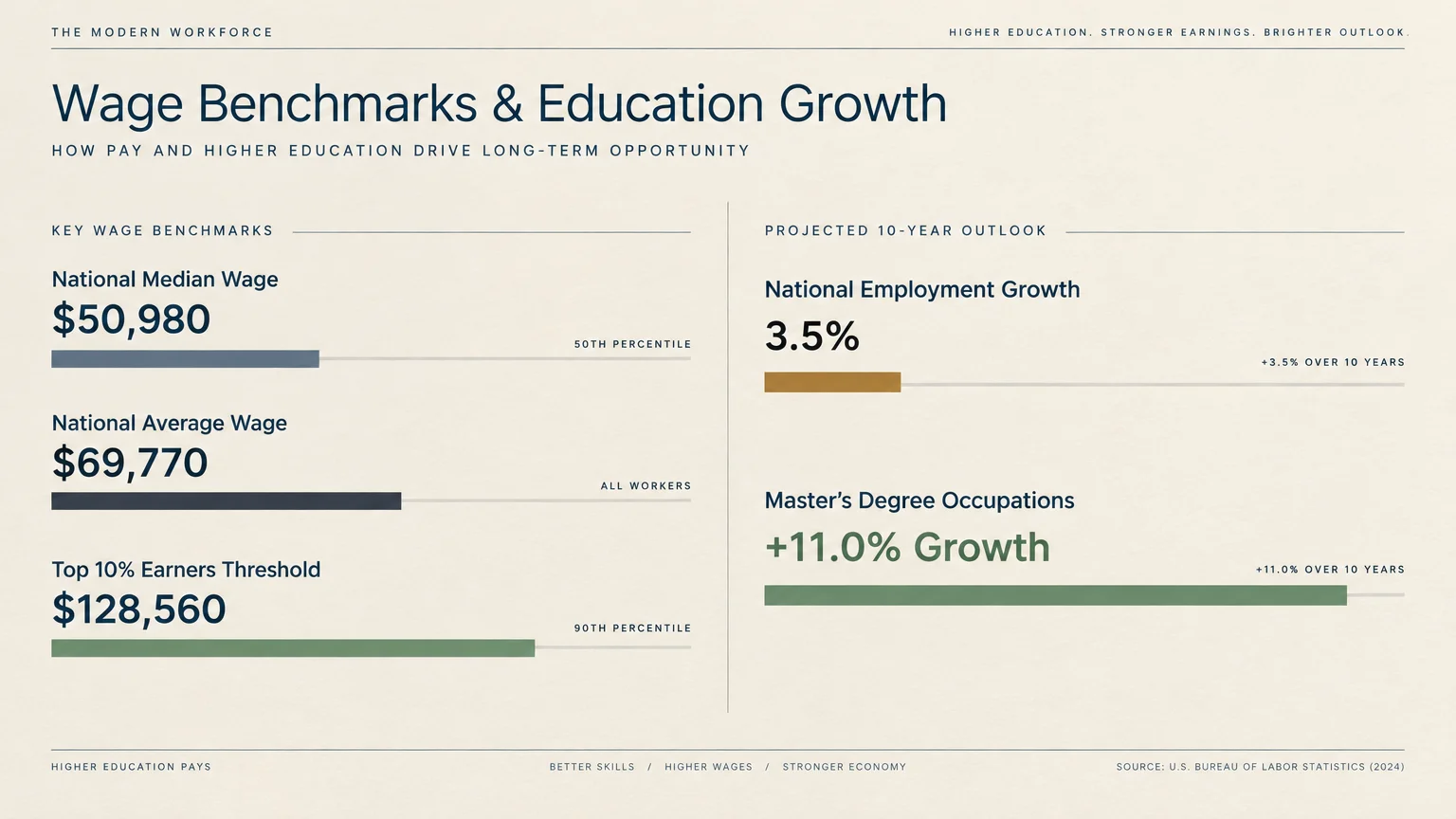
According to the U.S. Bureau of Labor Statistics (BLS), overall national employment will grow just 3.5% from 2025 through 2035. Targeting future proof jobs protects your household balance sheet against broader economic shifts and corporate downsizing.
This guide examines ten exceptional jobs paying 100000 or more that significantly outpace national economic expansion. You will discover their educational pathways, compensation benchmarks, and actionable strategies to maximize your take-home pay.
The Anatomy of a Future-Proof Six-Figure Career
A high salary alone does not guarantee long-term financial security. If an occupation faces technological displacement or market saturation, earning power can erode rapidly.
According to BLS wage benchmarks released in May 2026, the national median annual wage across all occupations stands at $50,980. The average annual wage sits at $69,770, while the top 10% of American earners make $128,560 or more.
Crossing the six-figure threshold places you well into the upper tier of domestic earners. Achieving longevity at that income level requires choosing fields supported by powerful macroeconomic tailwinds.
Healthcare expansion and digital infrastructure modernization represent the two strongest economic drivers over the coming decade. An aging population creates non-negotiable demand for clinical care and healthcare management.
Simultaneously, enterprise reliance on artificial intelligence, data architecture, and cybersecurity fuels intense demand for specialized technical talent. Roles requiring advanced human judgment and clinical expertise remain insulated from automated displacement.
Education also plays a defining role in career resilience. BLS projections indicate that occupations requiring a master’s degree will grow by 11.0% through 2035, the fastest rate of any education tier.
When you evaluate six figure jobs, look beyond entry-level compensation. Examine projected job openings, regulatory barriers to entry, and the fundamental necessity of the work during economic downturns.
Top 10 High-Growth Careers Topping $100,000
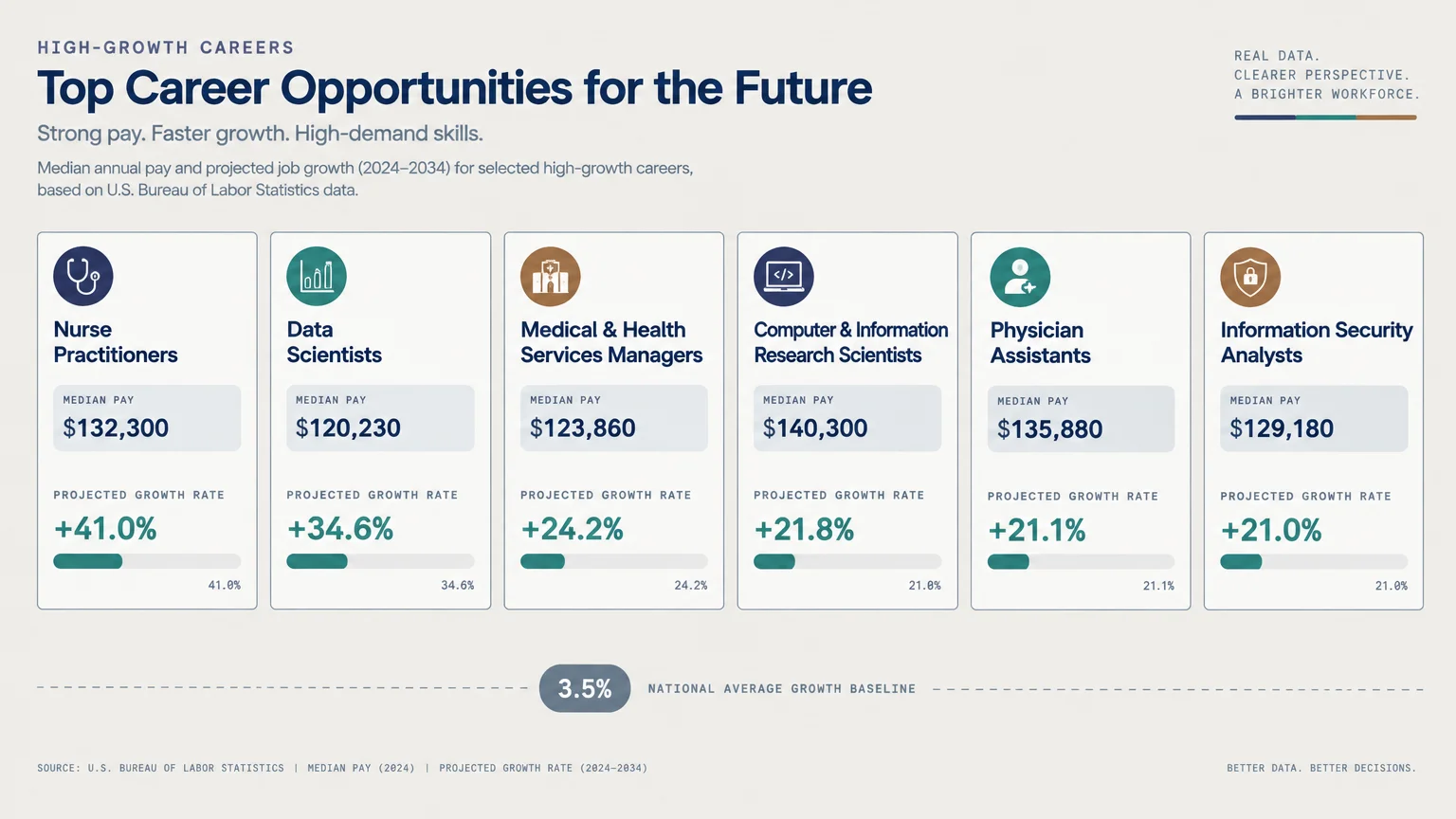
The following occupations all offer median compensation exceeding $100,000 alongside projected ten-year job growth well above the 3.5% national average. Data reflects official projections and wage statistics from the U.S. Bureau of Labor Statistics.
| Career Title | 2025 Median Pay | Projected Growth (2025–2035) | Typical Entry Education |
|---|---|---|---|
| Nurse Practitioners | $132,300 | +41.0% | Master’s degree |
| Data Scientists | $120,230 | +34.6% | Bachelor’s degree |
| Medical and Health Services Managers | $123,860 | +24.2% | Bachelor’s degree |
| Computer and Information Research Scientists | $140,300 | +21.8% | Master’s degree |
| Physician Assistants | $135,880 | +21.1% | Master’s degree |
| Information Security Analysts | $129,180 | +21.0% | Bachelor’s degree |
| Health Specialties Teachers, Postsecondary | $107,310 | +17.9% | Doctoral or professional degree |
| Computer and Information Systems Managers | $175,140 | +15.8% | Bachelor’s degree + 5+ years experience |
| Occupational Therapists | $100,330 | +14.8% | Master’s degree |
| Software Developers | $135,980 | +10.2% | Bachelor’s degree |
In-Depth Breakdown: 10 Careers That Pay Well and Endure
1. Nurse Practitioners
Nurse practitioners (NPs) serve as primary and specialty healthcare providers, diagnosing conditions, prescribing medications, and managing acute and chronic illnesses. They blend clinical expertise with patient-centered preventive care.
With a 2025 median wage of $132,300 and a 41.0% projected growth rate, NPs represent the single fastest-growing occupation in the United States. The sector will add approximately 137,800 net new positions through 2035.
A systemic shortage of primary care physicians drives this historic expansion. Many states now grant nurse practitioners full practice authority, allowing them to operate independent clinical practices.
To enter this field, you must earn a Bachelor of Science in Nursing (BSN), maintain active registered nurse licensure, and complete an accredited graduate nursing program. The credential requires focused academic commitment, but the employment returns remain unmatched.
2. Data Scientists
Data scientists translate raw corporate data into actionable business models, machine learning algorithms, and predictive intelligence. They enable organizations to optimize complex supply chains, personalize financial services, and automate workflows.
The occupation delivers a median salary of $120,230 and is projected to expand by 34.6% by 2035. Employers across all sectors will generate roughly 95,400 new jobs over that period.
While automated software handles basic data dashboards, human data scientists are essential for framing high-stakes strategic inquiries and validating algorithmic fairness. Their insight turns algorithmic computation into commercial profitability.
A bachelor’s degree in computer science, statistics, or mathematics opens the door to entry-level positions. Candidates who demonstrate practical proficiency with Python, SQL, and predictive statistical modeling regularly capture lucrative signing bonuses and equity packages.
3. Medical and Health Services Managers
Medical and health services managers—frequently called healthcare executives or administrators—plan, coordinate, and supervise operational delivery across hospitals, clinic networks, and public health systems.
This career offers a median salary of $123,860 and an impressive projected growth rate of 24.2%. Over 155,100 additional supervisory and executive openings will materialize through 2035.
Modern healthcare systems grapple with shifting regulatory frameworks, cybersecurity requirements, and integrated digital health records. Talented operational leaders ensure medical facilities remain financially solvent while maintaining rigorous care standards.
A bachelor’s degree in health administration, business, or nursing satisfies minimum qualifications for early leadership roles. Mid-career professionals often leverage Master of Health Administration (MHA) degrees to secure senior executive positions.
4. Computer and Information Research Scientists
Computer and information research scientists invent novel operational computing paradigms, advanced machine learning architectures, and breakthrough algorithmic structures. They push the frontier of what computing hardware and software can achieve.
Commanding a median annual salary of $140,300, this specialized field is projected to grow by 21.8% over the coming decade. While total employment remains concentrated, approximately 8,400 new research roles will open.
These scientists tackle theoretical challenges that commercial software engineers cannot address, such as quantum computational limits and artificial neural networking. As frontier technology reshapes commerce, private research laboratories and federal agencies compete aggressively for their expertise.
Most employers mandate a master’s degree or Ph.D. in computer science, computer engineering, or related computational disciplines. Strong backgrounds in discrete mathematics and logic provide foundational preparation for these research tracks.
5. Physician Assistants
Physician assistants (PAs) examine patients, prescribe pharmaceutical therapies, assist in surgical operations, and develop comprehensive clinical treatment protocols. They practice across family medicine, emergency departments, and specialized surgical environments.
The occupation commands a median annual wage of $135,880 alongside an estimated ten-year growth rate of 21.1%. Approximately 35,700 new positions will be created across American healthcare networks.
Physician assistants deliver critical diagnostic and therapeutic services at manageable costs for healthcare systems. Their rigorous training model enables rapid clinical redeployment across diverse medical specialties without requiring a secondary residency.
Practicing as a PA requires completing an intensive, accredited master’s degree program that includes thousands of clinical rotation hours. Candidates must pass the Physician Assistant National Certifying Examination (PANCE) before securing state medical board licensure.
6. Information Security Analysts
Information security analysts design defense perimeters, monitor network activity for intrusions, and remediate vulnerabilities across corporate and governmental digital infrastructure. They protect critical data assets from nation-state actors and cybercriminal syndicates.
The BLS reports a 2025 median salary of $129,180 for security analysts, coupled with a 21.0% growth trajectory. The industry expects to add roughly 40,600 dedicated cybersecurity roles through 2035.
With data breaches routinely inflicting tens of millions of dollars in damages, proactive digital defense is now a primary boardroom concern. Ransomware attacks on municipal systems and healthcare organizations ensure sustained demand for security personnel.
A bachelor’s degree in cybersecurity, information technology, or computer science provides standard entry. Industry certifications—such as CISSP, CEH, or CompTIA Security+—substantially enhance your hiring leverage and starting compensation.
7. Health Specialties Teachers, Postsecondary
Health specialties postsecondary educators teach clinical medicine, pharmacology, dentistry, and nursing to undergraduate and graduate students. They combine clinical instructional duties with scholarly medical research and laboratory oversight.
This specialized academic path features a median annual pay of $107,310 and a projected 17.9% growth rate. American academic institutions will add nearly 49,900 new faculty roles through 2035.
Because nursing and medical training programs face record applicant numbers, universities urgently require qualified clinical educators to train incoming generations. Without certified instructors, healthcare training pipelines bottleneck rapidly.
Entry into postsecondary health education typically requires a doctoral or professional medical degree, such as an MD, DNP, or Ph.D. Many practicing clinicians transition into faculty positions later in their careers to maintain balanced professional schedules.
8. Computer and Information Systems Managers
Often holding titles like IT Director or Chief Technology Officer, computer and information systems managers direct all digital initiatives within an enterprise. They evaluate software infrastructure, enforce information architecture budgets, and coordinate engineering departments.
This leadership track provides a median compensation of $175,140, with employment projected to expand by 15.8% through 2035. It represents the highest-paying career on this list.
Every commercial enterprise depends entirely on reliable cloud storage, proprietary software operations, and enterprise communication systems. IT managers bridge the communication gap between operational executives and technical engineering personnel.
Securing these roles requires a bachelor’s degree in computer science or management information systems paired with at least five years of demonstrated technical leadership. Many senior managers also hold Master of Business Administration (MBA) degrees.
9. Occupational Therapists
Occupational therapists (OTs) treat injured, ill, or disabled patients through therapeutic everyday activities. They help individuals recover, develop, and maintain the fundamental motor skills needed for independent personal living and daily employment.
Occupational therapists earn a median annual income of $100,330, with employment projected to expand by 14.8% by 2035. The economy will generate approximately 25,200 new therapist positions.
Unlike surgical procedures or diagnostic imaging, occupational therapy requires intimate human observation, physical empathy, and personalized adaptation. This hands-on clinical care cannot be duplicated by automated systems or remote artificial intelligence models.
Practicing requires an accredited master’s degree in occupational therapy, supervised clinical field work, and passage of the National Board for Certification in Occupational Therapy (NBCOT) exam. The role offers strong geographic flexibility and multiple work environments.
10. Software Developers
Software developers write code, engineer cloud applications, and maintain the software architecture that powers smartphones, financial networks, and global web services. They build the digital framework supporting the modern economy.
The occupation delivers a median annual pay of $135,980 and a projected growth rate of 10.2% through 2035. It will add 174,700 net new positions, representing the largest absolute job increase among high-paying fields.
While artificial intelligence coding assistants speed up syntax generation, experienced human developers remain necessary for complex architectural design, system security, and legacy integration. Organizations need engineers who can define system behavior under real-world operating constraints.
A bachelor’s degree in computer science, software engineering, or a related discipline is standard; however, self-directed developers with proven software portfolios often secure competitive roles. Continuous self-education remains essential to maintain high technical value.
Managing a Six-Figure Income: Taxes, Deductions, and True Take-Home Pay
Crossing into a six-figure income represents an exciting personal milestone; however, gross income rarely matches your immediate spendable capital. Understanding current tax liabilities ensures your budget reflects reality rather than wishful thinking.
The federal income tax structure relies on progressive marginal brackets. Moving into a higher bracket never taxes your entire income at that elevated rate—only the earnings above each bracket threshold face higher percentages.
According to the Internal Revenue Service, the 2026 federal standard deduction is $16,100 for single filers and $32,200 for married couples filing jointly. Per IRS Revenue Procedure 2026-35, these deductions rise to $16,600 and $33,200 respectively for tax year 2027.
Consider a single earner grossing $120,000 in 2026. Claiming the $16,100 standard deduction reduces their taxable income to $103,900.
For single filers in 2026, the 22% marginal tax bracket spans taxable income between $50,401 and $105,700. Income between $105,701 and $201,775 faces the 24% marginal rate.
Because this earner’s taxable income sits at $103,900, their final dollar remains within the 22% bracket. Their effective federal tax rate ends up significantly lower than their top marginal bracket.
Married couples filing jointly experience wider tax bands. In 2026, their 12% marginal bracket extends up to $100,800 in taxable income, while the 22% bracket covers taxable earnings from $100,801 to $211,400.
You must also account for state income taxes, local taxes, and mandatory payroll deductions. FICA taxes claim 6.2% for Social Security (up to annual wage limits) and 1.45% for Medicare on all earned income.
Geographic cost of living also dramatically alters what a six-figure salary can purchase. Earning $120,000 in the Midwest affords an entirely different lifestyle than earning the same amount in an expensive coastal metro.
An August 2026 SmartAsset cost of living study evaluated metro expenses nationwide. The findings revealed that a single adult living in Massachusetts, Hawaii, or California requires between $126,000 and $129,000 annually just to achieve a comfortable 50/30/20 budget.
In those expensive states, half of your after-tax income quickly disappears into housing, utilities, and daily necessities. Evaluating nominal salary without adjusting for local price indexes can lead to dangerous budgetary miscalculations.

Actionable Strategies to Transition into High-Demand Careers
Pivoting toward an in-demand, resilient profession requires systematic career planning. You can optimize your professional transition by following structured financial and educational steps.
- Conduct a target skill-gap audit: Review dozens of active job listings for your target occupation to catalog must-have certifications and software proficiencies.
- Target employer tuition assistance: Many healthcare networks and Fortune 500 corporations offer comprehensive tuition reimbursement programs for employees earning master’s degrees.
- Leverage stepping-stone roles: Transition into adjacent corporate positions, such as moving from entry-level business analysis into specialized data science tracks.
- Preserve cash reserves before retraining: Accumulate six to nine months of living expenses before taking unpaid clinical rotations or embarking on rigorous graduate studies.
- Negotiate comprehensive total compensation: High-earning roles frequently include equity incentives, signing bonuses, and generous retirement matches that dramatically boost your overall net worth.
Review independent wage comparisons and benefits benchmarks on Investopedia and NerdWallet to identify regional pay variations before accepting a job offer.
What Can Go Wrong: Traps That Erode High Salaries
Earning an upper-tier income does not automatically insulate you from chronic financial distress. Without intentional budgeting rules, higher salaries often invite expensive behavioral pitfalls.
Lifestyle creep represents the most prevalent threat to high-income earners. As compensation rises, individuals frequently inflate their recurring expenditures on housing, luxury vehicles, and lifestyle conveniences at an identical pace.
When expenditures match rising paychecks, your personal savings rate remains stagnant. If a temporary contract gap or industry downturn occurs, high fixed overhead costs create severe cash-flow emergencies.
Another dangerous trap involves over-borrowing for career credentials. Accumulating $200,000 in high-interest student debt to enter a career paying $110,000 median compensation can handicap your wealth-building ability for decades.
Always weigh the total cost of career acquisition against projected after-tax returns. Choose in-state universities, employer-subsidized programs, or online graduate formats to limit debt exposure.
“The best investment by far is anything that develops yourself, and it doesn’t get taxed at all.” — Warren Buffett, Chairman and CEO of Berkshire Hathaway
Finally, avoid professional complacency. High compensation attracts intense market competition, making regular skill upgrades mandatory throughout your career trajectory.

When to Consult a Professional
Managing six-figure earnings introduces complex financial decisions that benefit from certified professional guidance. You should consider working with a licensed financial planner or tax advisor under specific circumstances:
First, seek guidance when transitioning between independent contracting and W-2 employment. Self-employed clinicians and technical consultants face distinct quarterly estimated tax obligations and solo 401(k) structuring decisions.
Second, consult an expert when optimizing complex equity compensation packages. If your employer grants incentive stock options (ISOs) or restricted stock units (RSUs), miscalculating tax timing can trigger massive Alternative Minimum Tax liabilities.
Third, consult a professional if your household income disqualifies you from standard Roth IRA contribution limits. A licensed advisor can help you execute compliant Backdoor Roth IRA conversions without violating IRS pro-rata regulations.
Check the Consumer Financial Protection Bureau for consumer toolkits on managing significant credit transitions, major mortgages, and personal assets.
Frequently Asked Questions
Can I transition into a six-figure technical career without a computer science degree?
Yes, many professionals successfully transition into software development and data science through intensive self-study, accredited bootcamps, and professional certifications. You must build an exceptional public portfolio demonstrating production-ready applications to prove your capability to hiring managers.
Are healthcare careers more future-proof than technology careers?
Healthcare roles that involve direct clinical contact face negligible risk of technological displacement. While technical fields face rapid shifts in programming languages and tools, both sectors offer immense job stability when you consistently update your skill set.
How much of a $100,000 salary should go toward retirement savings?
Aim to save at least 15% to 20% of your gross annual salary across employer-sponsored 401(k)s, individual retirement accounts, and health savings accounts. Earning six figures gives you the cash flow needed to max out tax-advantaged accounts early in the calendar year.
What is the quickest path among these options to earn over $100,000?
Software development and information security analysis offer the fastest entry timelines because entry-level jobs typically require only a four-year bachelor’s degree or demonstrated competency. Advanced clinical roles like nurse practitioner or physician assistant require graduate degrees and extensive supervised clinical hours.
Next Steps for Your Career and Finances
Achieving a durable six-figure income requires aligning your daily efforts with long-term macroeconomic demand. Select an occupation that matches your natural intellectual strengths, evaluate the training costs honestly, and build an intentional educational roadmap.
As your earnings climb, commit to maintaining low personal overhead while systematically investing your surplus capital into diversified assets. Strategic career choices combined with disciplined personal budgeting create lasting financial freedom.
The information in this guide is meant for educational purposes. Your specific circumstances—including income, debt, tax situation, and goals—may require different approaches. When in doubt, consult a licensed professional.
Last updated: November 2026. Financial regulations and rates change frequently—verify current details with official sources.