Automatic Social Security cuts loom on the horizon, but you can build a resilient defense before the 2032 deadline hits. Taking deliberate action today shields your household income from potential benefit shortfalls.
The Social Security Administration projects reserves will run short by late 2032, triggering a potential 22% across-the-board reduction. Waiting for Congress creates unnecessary risk for your daily lifestyle.
You can secure your finances by optimizing existing accounts, managing taxable income, and diversifying your cash flow. Here are five practical moves to protect your retirement immediately.
Understanding the 2032 Social Security Insolvency Timeline
The financial foundation supporting American retirees faces an impending structural test. According to the Social Security Administration 2026 Trustees Report, reserves face depletion sooner than many expect.
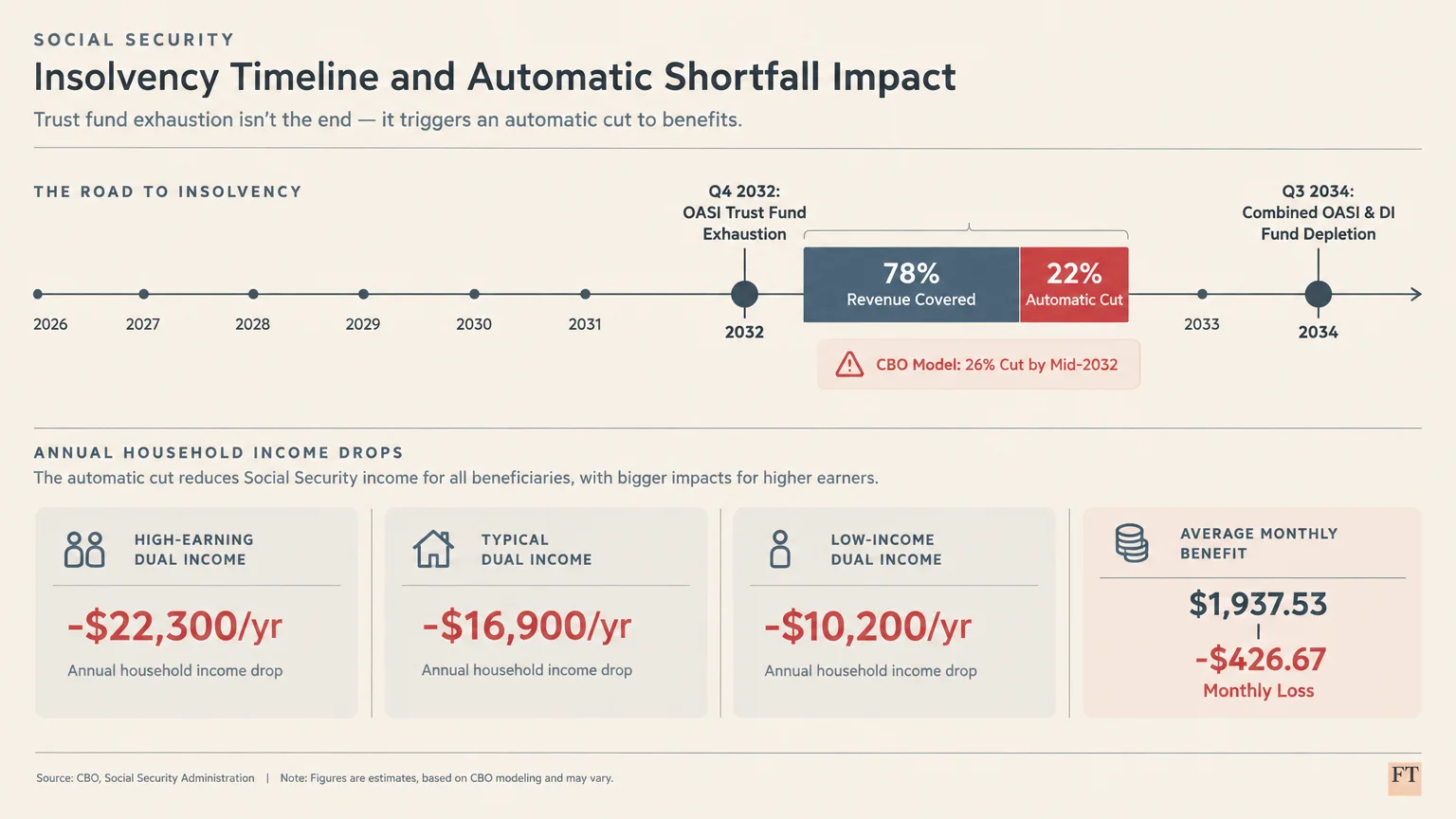
The Old-Age and Survivors Insurance (OASI) Trust Fund will exhaust its asset reserves in the fourth quarter of 2032. Once depleted, incoming payroll tax revenues will cover only 78% of scheduled retirement payments.
Without legislative intervention, this shortfall triggers an automatic 22% benefit cut across the board. Independent modeling reveals an even tighter squeeze for future retirees.
The Congressional Budget Office estimated in September 2026 that insolvency could arrive by mid-2032. Under their economic models, required benefit cuts could reach 26%.
If lawmakers combine the OASI fund with the Disability Insurance fund, insolvency shifts to the third quarter of 2034. That combined scenario still forces an immediate 17% payment reduction.
The dollar figures behind these percentages represent substantial real-world losses. Research from the Committee for a Responsible Federal Budget shows a typical newly retired dual-income couple stands to lose roughly $16,900 annually.
High-earning dual-income households face an estimated annual drop of $22,300. Even low-income dual-earning couples will absorb a painful $10,200 annual reduction.
For an individual receiving an average monthly benefit of $1,937.53, a 22% cut slashes $426.67 every month. That represents money meant for prescription drugs, groceries, and utility bills.
Recent policy changes contributed directly to this accelerated depletion date. The Social Security Fairness Act and the One Big Beautiful Bill Act both altered revenue dynamics.
The new senior tax deduction—offering up to $6,000 for individuals aged 65 and older—reduced federal income tax receipts. Because those tax dollars partly fund the trust reserves, exhaustion moved forward.
Relying solely on Washington to pass a timely compromise leaves your future vulnerable. You can take concrete steps right now to protect your retirement income from potential benefit reductions.
1. Recalibrate Your Portfolio Withdrawal Strategy
Traditional retirement advice often relies on fixed distribution models. The classic four percent rule assumes steady economic conditions and predictable external income sources.
When external benefits like Social Security face downward pressure, rigid withdrawal percentages fail. You need a flexible distribution plan that adapts dynamically to market swings and benefit changes.
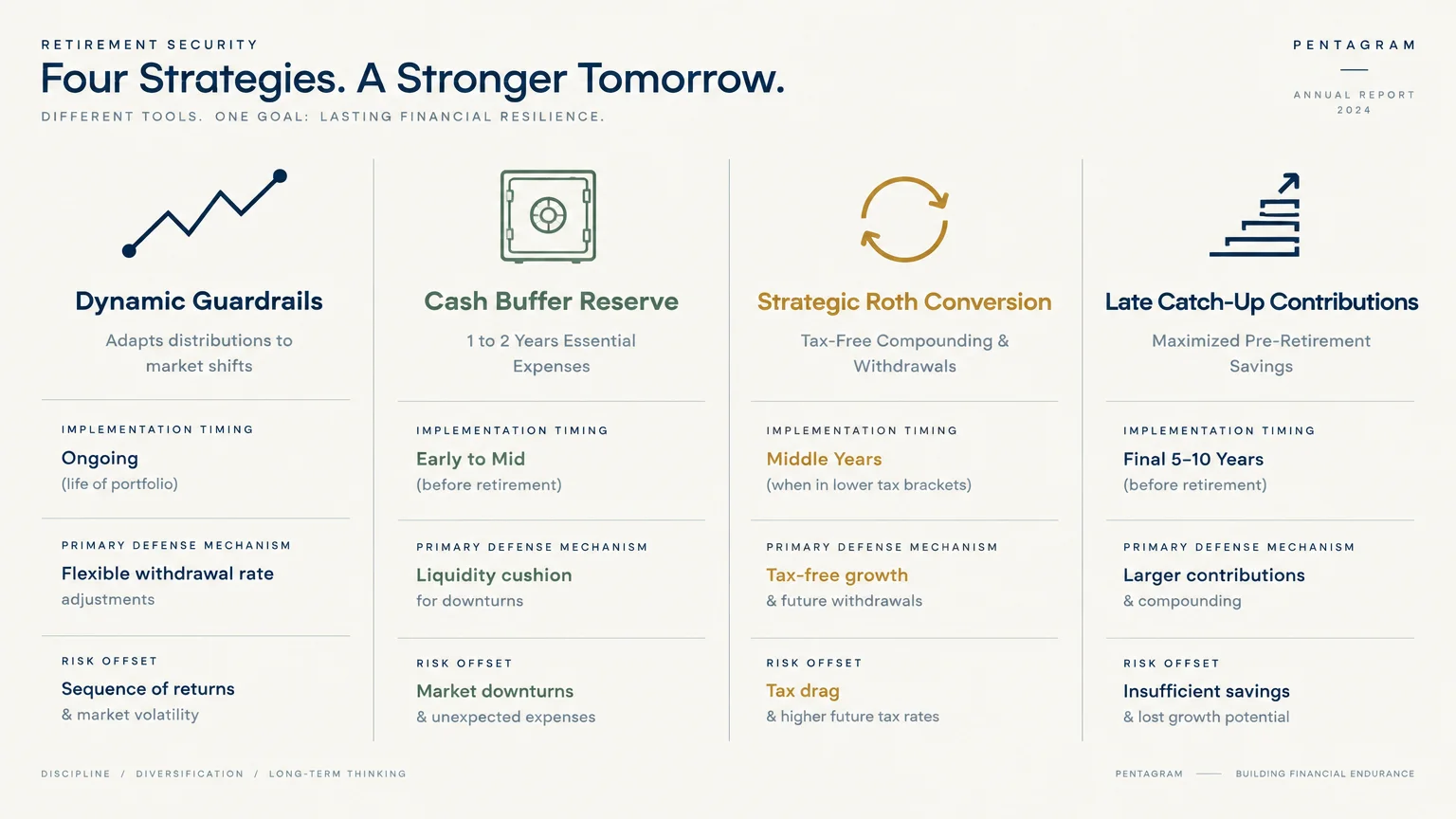
Adopt a dynamic withdrawal approach such as guardrail distribution rules. Under this framework, you adjust annual portfolio distributions based on portfolio performance and external cash inflows.
If benefit cuts arrive in 2032, dynamic guardrails allow temporary spending adjustments without liquidating core capital during market downturns. This preservation tactic prevents portfolio depletion early in retirement.
Next, build a dedicated cash-buffer reserve to insulate your daily budget. Keep between one and two years of essential living expenses in liquid, low-risk accounts.
High-yield savings accounts, short-term Treasury bills, and conservative money market funds provide steady yields without price volatility. This cash buffer prevents forced asset sales during broader economic slumps.
Structuring your assets into distinct temporal buckets establishes long-term psychological and financial security. The first bucket covers immediate spending for the next two years.
The second bucket holds intermediate fixed-income instruments covering years three through seven. The final bucket remains invested in diversified equities designed to outpace inflation over decades.
“The essence of investment management is the management of risks, not the management of returns.” — Benjamin Graham, Author and Economist
Separating short-term needs from long-term capital ensures unexpected cuts will not disrupt daily living. You maintain control over portfolio sales rather than reacting to government benefit adjustments.

2. Leverage Strategic Roth Conversions Before Tax Rates Shift
Taxes represent one of your largest controllable retirement expenses. Moving pre-tax retirement assets into Roth accounts shields your future cash flow from unexpected legislative changes.
Traditional 401(k) and IRA distributions count as ordinary taxable income upon withdrawal. They also increase your provisional income, which can trigger taxes on up to 85% of your Social Security benefits.
Executing partial Roth conversions today allows you to pay taxes on your assets at known, current rates. Once assets settle into a Roth IRA, future qualified distributions remain completely tax-free.
Roth withdrawals do not factor into provisional income calculations for Social Security benefit taxation. They also do not increase your modified adjusted gross income for Medicare Part B and Part D surcharges.
You can execute these conversions systematically over several tax years. Fill your current marginal tax bracket up to the top limit without bumping yourself into a higher tier.
Take advantage of the senior deduction introduced in recent tax legislation. Individuals aged 65 and older can deduct up to $6,000 from taxable earnings, offsetting a portion of conversion income.
Eliminating future Required Minimum Distributions (RMDs) gives you complete flexibility over taxable distributions. Starting at age 73 or 75, traditional accounts force mandatory taxable distributions whether you need cash or not.
Roth IRAs carry no lifetime RMD obligations for the original owner. You dictate exactly when and how much you withdraw, keeping taxable income low when trust fund cuts hit.
Visit the official guidelines published by the Internal Revenue Service to calculate your specific tax bracket limits before converting funds. Careful planning ensures you avoid accidental tax bracket creep.
3. Optimize Benefit Claiming Ages and Spousal Coordination
Your claiming age remains the single most impactful lever you control. Claiming benefits at age 62 locks in a permanent reduction of up to 30% compared to your Full Retirement Age.
If automatic trust fund cuts arrive later, taking an early reduction compounds your financial loss. A 22% cut applied to an already diminished benefit creates severe income compression.
In 2026, the maximum monthly benefit at Full Retirement Age is $4,152, increasing to $4,188 in 2027. Delaying past your Full Retirement Age earns you delayed retirement credits of 8% per year until age 70.
A higher initial monthly benefit creates a wider defensive moat. Even if an across-the-board reduction occurs, 78% of an elevated benefit provides vastly more income than 78% of a discounted check.
If you continue working while claiming benefits before reaching your Full Retirement Age, monitor the retirement earnings test thresholds closely. Earning too much results in temporary benefit withholdings.
In 2026, the earnings limit for workers under Full Retirement Age all year is $24,480 ($2,040 monthly), rising to $25,560 ($2,130 monthly) in 2027. The government withholds $1 for every $2 earned above those caps.
During the year you reach Full Retirement Age, the limit expands to $65,160 in 2026 and $67,920 in 2027. In that transition year, the system withholds $1 for every $3 earned above the threshold.
Once you reach Full Retirement Age, the earnings test disappears entirely. Working past this milestone allows you to collect your full benefit while generating active income to offset potential future reductions.
Spouses should coordinate their claiming timelines strategically to maximize lifetime survivor protections. The higher-earning spouse should delay benefits as long as possible, ideally until age 70.
When one spouse passes away, the surviving partner inherits the higher of the two monthly payments. Maximizing that primary benefit guarantees a stronger lifetime floor for whichever spouse lives longer.
Annual cost-of-living adjustments (COLA) also build upon that larger base figure over time. Social Security benefits grew by 2.8% in 2026 and expand by 3.6% starting in January 2027.
Compounding adjustments on a delayed, maximized benefit produces substantial cash flow growth. That recurring inflation protection softens the blow of any eventual congressional adjustment.

4. Maximize Late-Career and Catch-Up Contributions
If you are still working or balancing phased retirement, exploit updated contribution limits to fortify your reserves. Aggressive saving during your final working years creates an essential capital buffer.
Under IRS Notice 2026-66, employee contribution limits for workplace retirement plans provide powerful accumulation tools. The standard elective deferral limit for 401(k), 403(b), and most 457 plans is $24,500 in 2026, rising to $25,500 in 2027.
Workers aged 50 and older can make additional catch-up contributions. The standard catch-up allowance is $8,000 in 2026 (for a $32,500 total limit), expanding to $8,500 in 2027 (reaching a $34,000 maximum).
Workers aged 60 through 63 receive an even larger savings window. Under SECURE 2.0 super catch-up provisions, individuals in this age bracket can contribute up to $11,250 in 2026, increasing to $11,750 in 2027.
This raises the maximum 401(k) contribution for eligible 60-to-63-year-olds to $35,750 in 2026 and $37,250 in 2027. Harnessing this provision across four peak earning years accelerates portfolio growth substantially.
Review the mandatory Roth catch-up rule before making these contributions. If your prior-year FICA wages exceeded $150,000 (for 2026 deposits) or $155,000 (for 2027 deposits), workplace catch-ups must go to Roth accounts.
Traditional and Roth IRA parameters also offer reliable savings space. The standard annual IRA contribution cap stands at $7,500 for both 2026 and 2027.
The age-50 catch-up contribution remains constant at $1,100, permitting a total annual deposit of $8,600 across both years. Contributing consistently to these accounts compounds resources away from potential Social Security shortfalls.
High earners should also note the maximum taxable earnings wage cap. Payroll taxes apply to earnings up to $184,500 in 2026, increasing to $192,300 in 2027.
Earnings above those caps avoid the 6.2% employee OASDI payroll deduction. Channel those surplus payroll dollars directly into taxable brokerage accounts to establish independent dividend and bond streams.
5. Build Alternative Guaranteed Income Streams
Relying on Social Security as your sole guaranteed lifetime income creates dangerous single-point vulnerability. Building independent income channels protects your standard of living against systemic benefit reductions.
Consider dedicating a calculated portion of your portfolio to fixed annuities. A Single Premium Immediate Annuity (SPIA) converts a lump sum into a permanent monthly payment backed by an insurance carrier.
This contractual income functions like a private pension that operates independently of federal trust funds. Matching guaranteed annuity payouts to your baseline nondiscretionary expenses ensures housing and food costs remain covered.
Treasury Inflation-Protected Securities (TIPS) ladders offer another dependable income alternative. You can purchase TIPS bonds through institutional brokers or directly through the government.
A TIPS ladder provides maturity payouts that adjust directly with inflation metrics. Spreading maturities over a ten-to-fifteen-year window guarantees predictable real purchasing power throughout the projected insolvency period.
Examine tools and investor guides from Investor.gov to understand how different fixed-income vehicles protect capital. Independent verification helps you avoid products burdened by high commissions.
Your primary home also holds significant untapped equity that can fortify retirement cash flow. Downsizing to a smaller property frees up tied-up equity for liquid investment generation.
Relocating to a region with lower property and state income taxes permanently reduces your monthly baseline expenditure. Lower overhead means a smaller Social Security payment will not compromise your security.
Alternatively, explore a Home Equity Conversion Mortgage (HECM) line of credit while your health and home value remain strong. Research safety parameters detailed by the Consumer Financial Protection Bureau before proceeding.
An unused HECM line of credit grows independently over time, unaffected by housing market downturns. You can draw on this credit line tax-free during periods of reduced Social Security cash flow.
Comparing Your Protection Strategies
Every defensive maneuver carries distinct setup requirements, timeframes, and specific benefits. Evaluating your options side by side clarifies where to direct your focus first.
| Strategy | Implementation Window | Upfront Effort | Primary Risk Mitigated | Cash Flow Impact |
|---|---|---|---|---|
| Dynamic Withdrawals | Immediate (Any age) | Low to Moderate | Premature portfolio depletion | Preserves core principal during market downturns |
| Strategic Roth Conversions | Pre-2032 window | Moderate to High | Future tax increases & RMD spikes | Generates tax-free income; prevents benefit taxation |
| Delaying Claiming Age | Ages 62 through 70 | Low | Permanently diminished income floor | Expands monthly checks by 8% per year past FRA |
| Super Catch-Up Savings | Ages 60 through 63 | Moderate | Late-career capital deficits | Adds up to $37,250 annually into tax-sheltered accounts |
| Guaranteed Income Ladders | 1–5 years before retirement | Moderate | Systemic trust fund benefit cuts | Establishes contractual private pension floors |
Combining several compatible tactics creates comprehensive protection. A retiree who delays claiming, converts selective funds to Roth, and holds a two-year cash buffer effectively neutralizes insolvency risks.
Avoiding Common Errors
Navigating benefit uncertainty requires patience and discipline. Many workers react instinctively to headlines about insolvency, making costly mistakes that undermine long-term stability.
Avoid claiming Social Security early out of fear that the program will run out of money completely. Insolvency does not mean checks stop; tax revenue continues supporting the majority of scheduled payments.
Claiming at 62 permanently locks in an early-claiming penalty. If Congress subsequently passes a compromise solution, you remain permanently locked into that deeply discounted baseline benefit.
Do not execute massive Roth conversions in a single calendar year without analyzing tax brackets. Converting excessive sums at once can push you into higher federal income tax brackets.
Sudden spikes in adjusted gross income also trigger Medicare Income-Related Monthly Adjustment Amounts (IRMAA). That surcharge substantially increases your monthly Medicare Part B and Part D premiums two years later.
Avoid holding an overly conservative portfolio in an attempt to protect savings. Abandoning equities entirely exposes your retirement portfolio to purchasing power erosion caused by ongoing inflation.
Keep a balanced mix of growth assets alongside conservative reserves. Equities provide the capital expansion needed to generate compounding returns across decades of retirement.

When DIY Isn’t Enough
While self-directed planning works for basic household budgeting, certain complex scenarios demand credentialed expertise. Recognizing when your situation outgrows standard rules prevents expensive missteps.
Seek guidance from a fee-only Certified Financial Planner or CPA in the following situations:
- Blended spousal claiming scenarios: When spouses share large age differences or disparate lifetime earnings histories, coordinating claiming requires specialized actuarial calculations.
- Multi-year Roth conversion modeling: Calculating exact annual conversion amounts while balancing IRMAA thresholds, standard deductions, and capital gains requires precision software.
- Illiquid business or real estate holdings: Transitioning from illiquid assets into regular income distributions while managing depreciation recapture requires structured legal and tax planning.
- Significant non-mortgage debt loads: Carrying high-interest liabilities into retirement while facing benefit uncertainty demands a structured debt restructuring plan.
A qualified fiduciary professional evaluates your unique tax return, legacy objectives, and risk tolerance. Professional modeling replaces guesswork with concrete probability analysis.
Frequently Asked Questions
Will Social Security stop sending checks if the trust fund runs out in 2032?
No, Social Security will not stop sending checks. Dedicated payroll taxes continue flowing into the system from active workers, covering approximately 78% of scheduled benefits without legislative fixes.
Can Congress prevent the 2032 benefit cuts before they happen?
Yes, lawmakers can enact adjustments to secure solvency. Potential solutions include raising the payroll tax rate, elevating or eliminating the wage cap, adjusting Full Retirement Ages, or altering indexing formulas.
How does working past Full Retirement Age impact my monthly payment?
Once you reach Full Retirement Age, the earnings test ceases entirely. You can earn unlimited income from wages without forfeiting any monthly benefits, while ongoing earnings can replace lower-earning historical years.
Are Roth IRA withdrawals counted as income when calculating taxes on Social Security?
No, qualified distributions from a Roth IRA do not count toward your provisional income. Utilizing Roth accounts keeps your adjusted gross income lower, reducing the taxable portion of your Social Security checks.
Next Steps for Your Retirement Plan
Protecting your retirement against projected Social Security shortfalls requires proactive decisions today rather than passive hope for future political compromises. Review your latest earnings statement on the Social Security website to verify your baseline estimates.
Calculate your current monthly budget, assess your emergency cash reserves, and determine how much additional savings you can direct into catch-up contributions this year. Taking ownership of your financial plan ensures you maintain independence and peace of mind no matter what changes occur.
The information in this guide is meant for educational purposes. Your specific circumstances—including income, debt, tax situation, and goals—may require different approaches. When in doubt, consult a licensed professional.
Last updated: November 2026. Financial regulations and rates change frequently—verify current details with official sources.