The IRS officially increased the maximum Child Tax Credit to $2,300 per qualifying child for the 2027 tax year. This annual inflation adjustment puts more cash back into parents’ pockets starting with the returns you file in 2028.
Low- and middle-income families will also benefit from an expanded refundable portion worth up to $1,800 per dependent. If you claim children on your taxes, these updated figures directly affect your household budget.
Here is how the new amounts work, who qualifies for the full payout, and how to maximize your family’s overall tax savings.
The Official 2027 IRS Adjustments: What Changed?
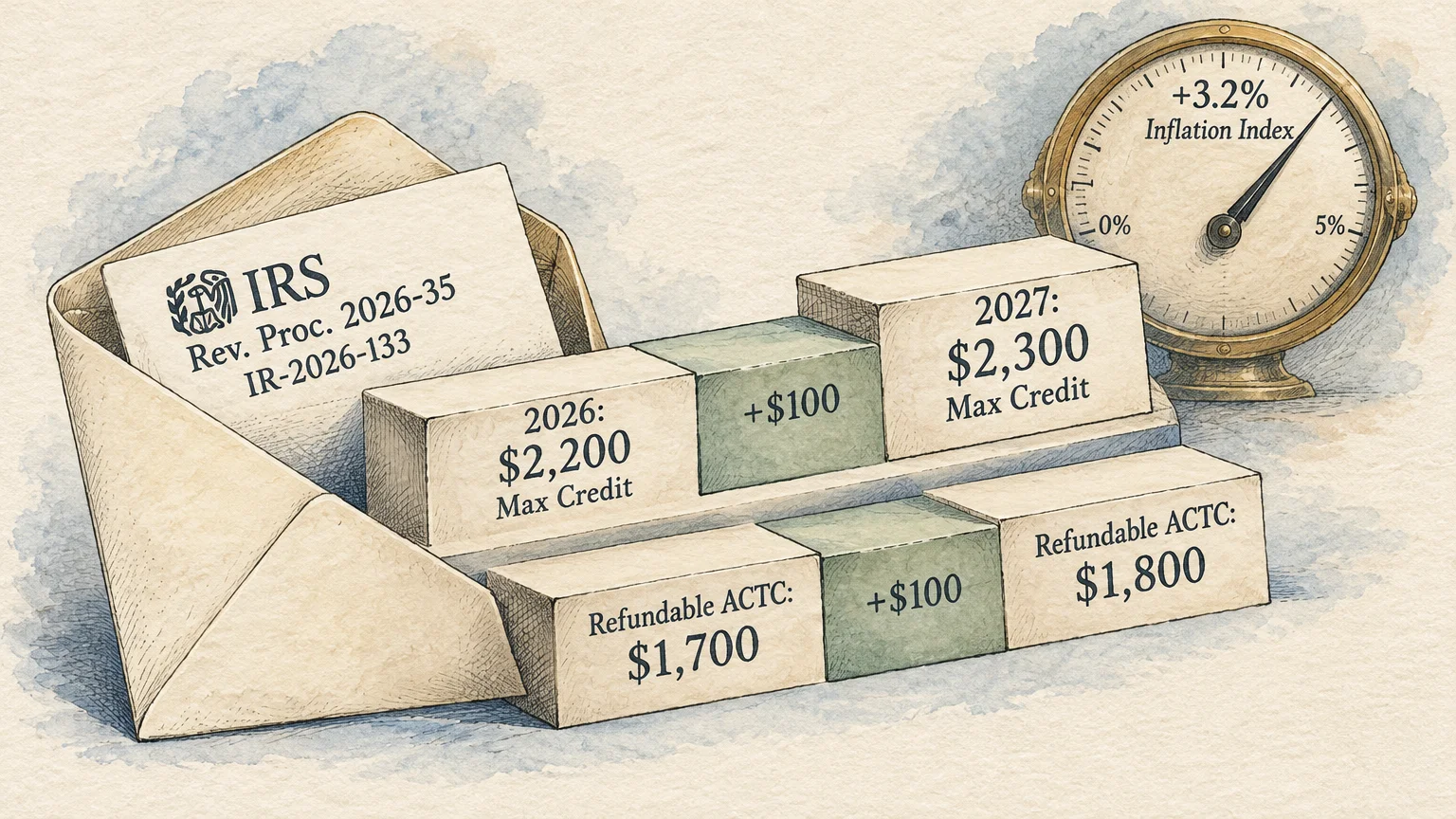
The Internal Revenue Service released the annual cost-of-living adjustments on November 5, 2026. These updates appear in news release IR-2026-133 and technical guidance under Revenue Procedure 2026-35.
The changes reflect an inflation increase of roughly 3.2% across multiple federal tax provisions. This inflation adjustment provides meaningful relief for households navigating higher grocery, healthcare, and utility costs.
The headline change raises the maximum Child Tax Credit from $2,200 to $2,300 per eligible child. That gives qualifying parents an extra $100 per child compared to the previous year.
At the same time, the refundable portion—known as the Additional Child Tax Credit—climbs from $1,700 to $1,800 per child. This bump ensures that lower-income families with limited tax liability receive higher direct cash refunds.
This update marks the first automatic inflation adjustment triggered under the Working Families Tax Cuts enacted in 2025. That law reset the baseline credit to $2,200 and mandated permanent inflation indexing starting in 2027.
You will claim these new amounts on the federal tax return you file in early 2028. Do not confuse this with the return you file in early 2027, which still uses the 2026 limit of $2,200.
To follow administrative tax updates directly, check the official releases posted on the Internal Revenue Service website.
2026 vs. 2027 Family Tax Numbers at a Glance
Tracking the year-over-year adjustments helps you forecast your family’s tax liability and optimize your monthly budget. Multiple core deductions and credits shifted upward alongside the Child Tax Credit.
The table below summarizes the key tax changes affecting parents between the 2026 and 2027 tax years.
| Tax Provision | Tax Year 2026 | Tax Year 2027 | Net Change |
|---|---|---|---|
| Maximum Child Tax Credit (per child) | $2,200 | $2,300 | +$100 |
| Maximum Refundable Portion (ACTC) | $1,700 | $1,800 | +$100 |
| Credit for Other Dependents (ODC) | $500 | $500 | $0 (Unchanged) |
| Standard Deduction: Married Filing Jointly | $32,200 | $33,200 | +$1,000 |
| Standard Deduction: Head of Household | $24,150 | $24,925 | +$775 |
| Standard Deduction: Single Filers | $16,100 | $16,600 | +$500 |
| Earned Income Tax Credit (Max: 3+ kids) | $8,231 | $8,496 | +$265 |
| Earned Income Tax Credit (Max: 2 kids) | $7,316 | $7,552 | +$236 |
| Earned Income Tax Credit (Max: 1 kid) | $4,428 | $4,573 | +$145 |
| Maximum Adoption Tax Credit | $17,670 | $18,250 | +$580 |
| Healthcare FSA Contribution Limit | $3,400 | $3,500 | +$100 |
| Phaseout Threshold: Married Filing Jointly | $400,000 | $400,000 | $0 (Frozen) |
| Phaseout Threshold: Single / Head of Household | $200,000 | $200,000 | $0 (Frozen) |
While maximum credit caps increased, note that the income phaseout thresholds remained frozen. This freeze means that as your wages rise with inflation, you move closer to the credit reduction boundary.
Understanding the Additional Child Tax Credit and Refundability
Many taxpayers confuse non-refundable credits with refundable tax credits. Understanding the distinction ensures you do not overestimate your anticipated refund check.
A non-refundable tax credit can only reduce your tax liability to zero; it cannot generate an excess payout. If you owe $1,000 in income tax and hold a $2,300 non-refundable credit, the IRS eliminates your $1,000 bill but cancels the remaining $1,300.
The Additional Child Tax Credit (ACTC) solves this problem by providing a refundable refund component. For 2027, the refundable portion caps at $1,800 per child.
This means up to $1,800 of the total $2,300 credit can trigger a direct refund check even if you owe nothing in federal income tax. The remaining $500 serves purely as a non-refundable tax offset.
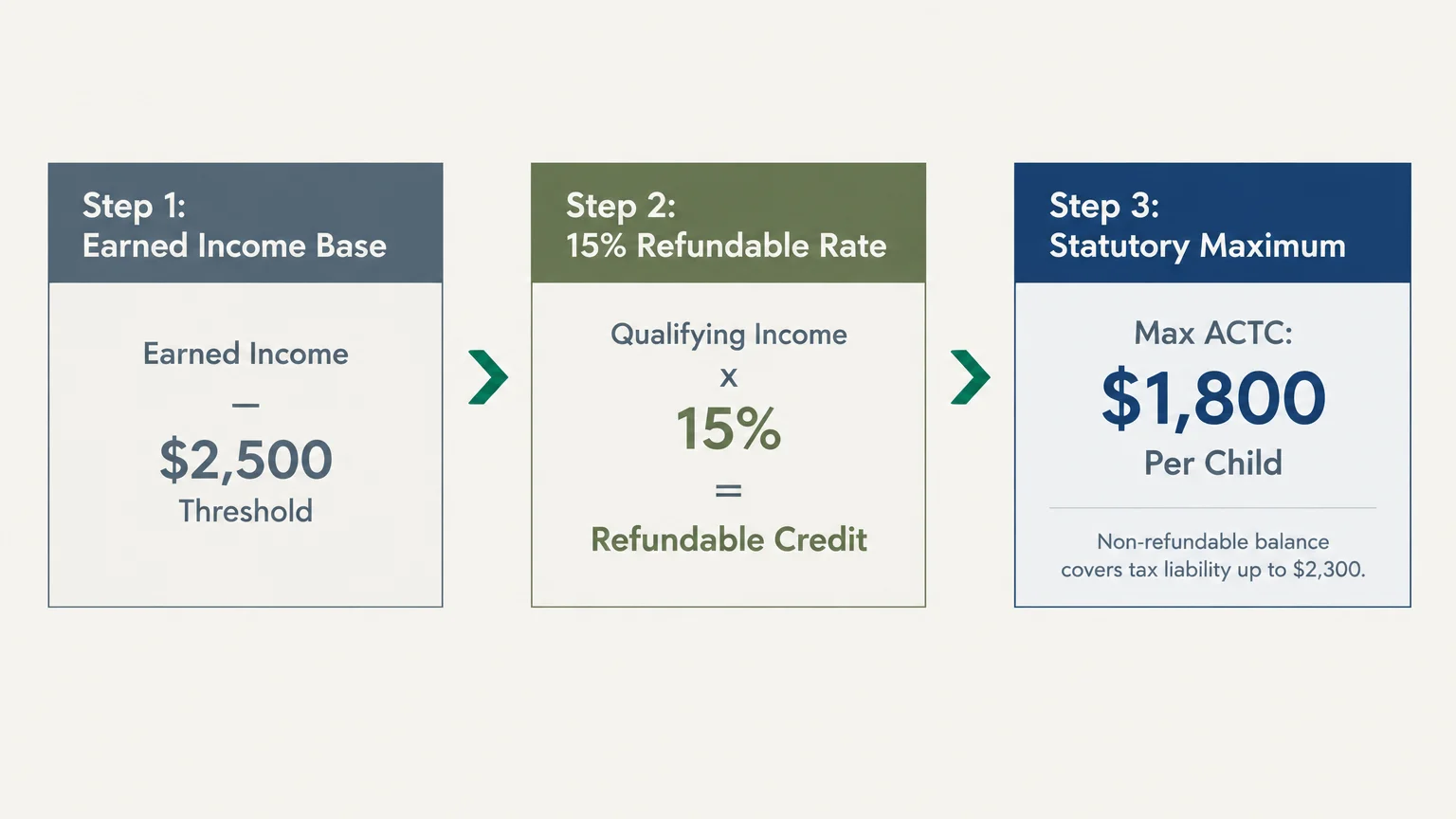
To unlock the refundable ACTC, your household must generate at least $2,500 in earned income. Unearned revenue—such as stock dividends, pensions, or child support payments—does not count toward this earnings requirement.
The refundable credit phases in at a rate of 15% on earned income above that $2,500 threshold. The more earned income you report above the floor, the larger your refundable payout becomes up to the $1,800 per-child ceiling.
Step-by-Step: How to Calculate Your Refundable Credit
Calculating your refundable credit involves straightforward arithmetic once you isolate your earned income. Following the official formula helps you project your exact tax outcome.
First, tally all qualifying wages, salaries, tips, and net self-employment earnings for the 2027 tax year. Then, subtract the $2,500 statutory earnings floor from that total.
Next, multiply that remaining amount by 15% (0.15). The resulting figure represents your tentative refundable credit.
Finally, compare that result against your maximum allowable refundable cap, which equals $1,800 multiplied by your number of eligible children. You receive whichever number is lower.
Consider a working parent who earns $14,500 in 2027 and claims two qualifying children. Subtracting the $2,500 floor leaves $12,000 in eligible earnings.
Multiplying $12,000 by 15% yields $1,800. Although two children provide an allowable refundable ceiling of $3,600 ($1,800 each), the parent receives $1,800 because of their earnings level.
Now consider that same parent earning $26,500. Subtracting the $2,500 floor leaves $24,000; multiplying $24,000 by 15% yields $3,600.
In this second scenario, the parent unlocks the full $3,600 refundable credit for their two children. For additional educational breakdowns of tax mechanics, explore personal finance resources on Investopedia.
Detailed Eligibility Rules for the 2027 Credit
Qualifying for the $2,300 Child Tax Credit requires meeting seven strict IRS dependency tests. A dependent must pass every single requirement during the 2027 calendar year.
- Age Test: The child must be 16 years old or younger on December 31, 2027. A child who celebrates their 17th birthday on or before December 31 fails this test immediately.
- Relationship Test: The child must be your daughter, son, stepchild, eligible foster child, brother, sister, stepbrother, stepsister, or a direct descendant of any of them (such as a grandchild or nephew).
- Support Test: The child cannot provide more than half of their own financial support during the tax year.
- Dependent Status: You must properly claim the child as a dependent on your 2027 federal tax return.
- Citizenship Test: The child must be a U.S. citizen, U.S. national, or U.S. resident alien.
- Residency Test: The child must live with you for more than half of the 2027 tax year, aside from temporary absences for school, medical care, or military service.
- Identification Test: The child must have a valid Social Security Number (SSN) issued before the due date of your tax return.
The identification rule catches many parents off guard. An Individual Taxpayer Identification Number (ITIN) does not qualify a child for the $2,300 Child Tax Credit.
Furthermore, you—or your spouse if filing jointly—must also possess a valid Social Security Number or ITIN to claim the benefit. Missing either identification requirement voids the credit entirely.
The Credit for Other Dependents: Rules for Older Kids and Relatives
Parents often experience a sudden drop in tax benefits when their children turn 17. The tax code removes 17-year-olds from the primary Child Tax Credit, regardless of whether they still attend high school.
To soften this financial cliff, the IRS offers the Credit for Other Dependents (ODC). This benefit provides a non-refundable credit worth up to $500 per dependent.
The ODC remains fixed at $500 for the 2027 tax year because Congress did not index it to inflation. Unlike the Child Tax Credit, this credit never produces a refundable payout.
You can claim this $500 credit for dependent children ages 17 and 18. You can also claim it for full-time college students ages 19 through 23 whom you support financially.
The ODC also extends to adult dependents who rely on you for their living expenses. This includes aging parents, disabled adult children, or qualifying extended family members.
To qualify for the ODC, dependents can use an ITIN rather than an SSN. This makes the credit accessible to non-citizen dependents who reside legally in your household.
Remember that the $500 credit can only offset your federal tax liability down to zero. Any unused portion evaporates rather than returning to you as a refund check.
Income Phaseouts: Where the Credit Starts to Disappear
The Child Tax Credit provides significant relief for middle-income households, but high earners face sharp phaseouts. These statutory phaseout limits did not increase with the 2027 inflation adjustments.
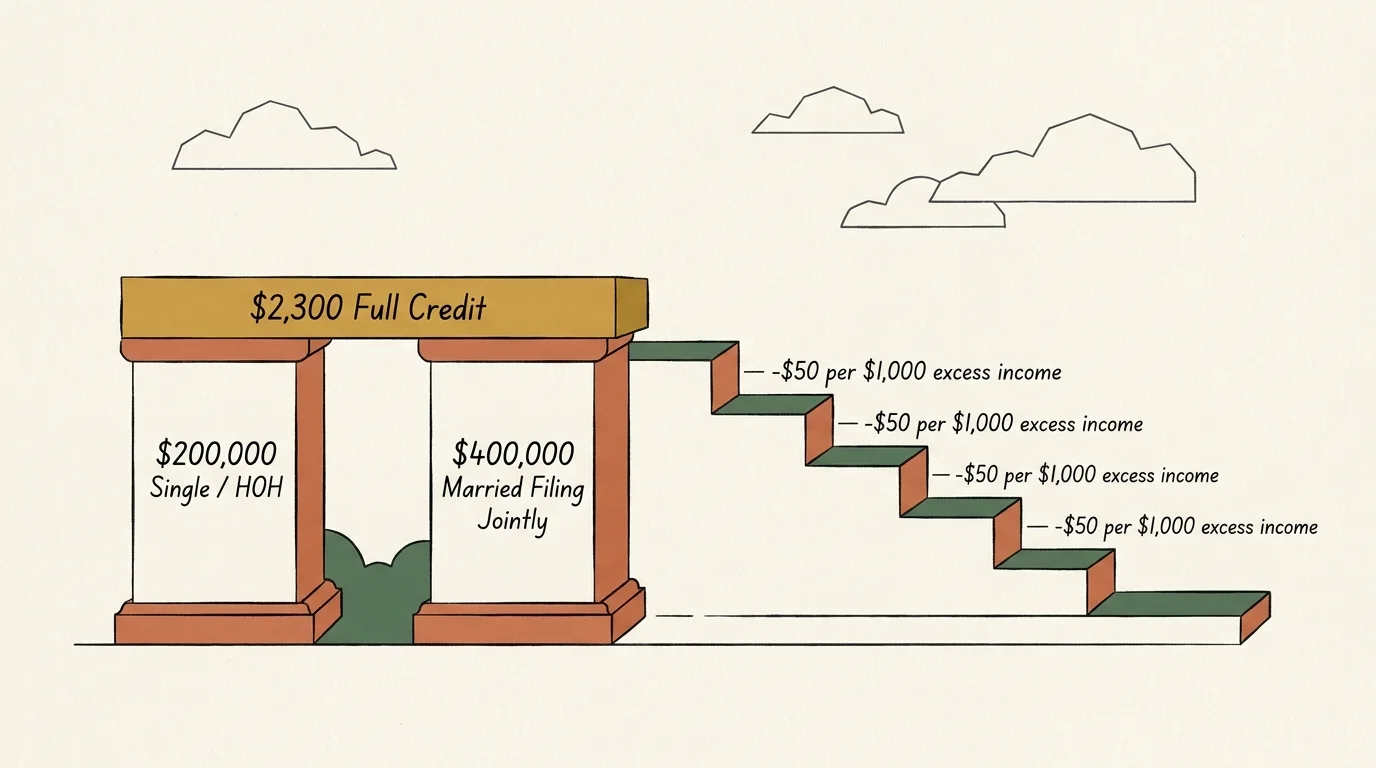
The phaseout threshold remains fixed at $200,000 of Modified Adjusted Gross Income (MAGI) for single filers and heads of household. For married couples filing jointly, the phaseout begins at $400,000.
Once your income crosses these markers, your credit drops by $50 for every $1,000 (or fraction thereof) above the threshold. This reduction applies across your total credit pool rather than per child.
Consider a married couple with one qualifying child who earns $410,000 in MAGI. Their income exceeds the $400,000 threshold by $10,000.
Dividing that $10,000 excess by $1,000 yields 10 phaseout increments. Multiplying 10 by $50 creates a total credit reduction of $500.
Subtracting $500 from their original $2,300 credit leaves this couple with a final credit of $1,800. If that same married couple earns $446,000, their single-child credit disappears completely.
Having multiple children extends the income range where you can still claim partial credits. A married couple with two children starts with $4,600 in total credits, which fully phases out at $492,000.
If your household income hovers near these boundaries, targeted tax planning can preserve your credit eligibility. Reducing your MAGI keeps more of your credit intact.
Stacking Family Tax Credits for Maximum Cash Back
The Child Tax Credit works most effectively when you combine it with complementary family tax programs. Layering multiple credits creates substantial tax savings for growing households.
The Earned Income Tax Credit (EITC) stands out as the most powerful companion benefit for working parents. The IRS raised the maximum EITC amounts for 2027 across all household sizes.
For 2027, families with three or more qualifying children can receive a maximum EITC of $8,496. Families with two children qualify for up to $7,552, while parents with one child can claim up to $4,573.
The EITC is fully refundable, meaning you receive the entire amount even if your income tax bill equals zero. Combining the maximum EITC with the refundable ACTC generates thousands of dollars in direct tax refunds.
Parents paying for daycare or after-school supervision should also review the Child and Dependent Care Credit. Under the Working Families Tax Cuts framework, eligible families can claim up to 50% of qualifying care expenses.
You can claim up to $3,000 in care expenses for one child (yielding up to a $1,500 credit) or $6,000 for two or more children (yielding up to a $3,000 credit). This credit directly offsets care costs while parents work or search for employment.
Families expanding through adoption gain access to the expanded 2027 Adoption Tax Credit. The maximum adoption credit increases to $18,250 per eligible child, with up to $5,280 available as a refundable payout.
Finally, employer-sponsored Health Flexible Spending Accounts (FSAs) allow parents to pay medical costs with pre-tax dollars. The IRS capped employee FSA contributions at $3,500 for the 2027 tax year.

State-Level Child Tax Credits: Extra Money in 17 States
Federal tax relief is only one half of the equation for American families. State governments increasingly offer separate, state-level child tax credits to support resident households.
As of late 2026, 17 states and the District of Columbia maintain their own child tax credit programs. These state credits sit on top of your federal Child Tax Credit payout.
States offering dedicated child tax credits include California, Colorado, Maryland, Massachusetts, Minnesota, New Jersey, New Mexico, New York, Oregon, and Vermont. Several other states offer targeted dependent exemptions or child care credits.
Benefit structures vary widely depending on where you reside. Minnesota, for instance, provides up to $1,750 per child under age 18, while Massachusetts offers flat per-dependent credits regardless of age.
Most state-level child tax credits are fully refundable. Even if you owe zero state income tax, your state revenue department will issue a refund check for the credit amount.
To claim state credits, you must file a state income tax return. Many low-income families skip filing state returns because their earnings fall below standard filing thresholds, accidentally leaving thousands of dollars behind.
Check with your state department of revenue or a local tax professional to confirm local eligibility thresholds, residency mandates, and application deadlines.
Practical Strategies to Maximize Your Family Tax Refund
Maximizing your family’s tax outcome requires deliberate planning throughout the year rather than scrambling in April. Simple adjustments to your financial habits yield significant tax savings.
First, update your Form W-4 with your employer. If your family qualifies for multiple child credits, adjusting your withholding allowances prevents excessive tax withholding from your monthly paychecks.
Bringing more money home each pay period strengthens your monthly cash flow. You can direct those funds into high-yield savings or debt reduction instead of waiting on an IRS refund check.
Second, manage your Modified Adjusted Gross Income to stay below the $200,000 or $400,000 phaseout ceilings. Pre-tax contributions provide the most straightforward path to lower your taxable income.
Increasing your contributions to a traditional 401(k), 403(b), or 457 plan reduces your MAGI dollar for dollar. Contributing to a Health Savings Account (HSA) or traditional IRA achieves the exact same tax-lowering benefit.
For independent comparison tools on savings accounts and debt reduction strategies, review consumer finance guides on Bankrate.
“A big tax refund isn’t a gift from the government; it’s your money that you overpaid throughout the year.” — Dave Ramsey, Personal Finance Author
Treat your tax credits as strategic tools within your broader financial plan. Channeling tax refunds into emergency reserves, retirement funds, or college 529 plans builds long-term household stability.
Pitfalls to Watch For
Filing errors on child tax credit claims frequently delay tax refunds for months. The IRS subjects dependent credits to stringent automated fraud filters and compliance checks.
Avoiding common filing mistakes protects your refund timeline and prevents IRS audit inquiries.
- The 17th Birthday Trap: Claiming the full $2,300 credit for a teen who turned 17 during 2027. You must claim the $500 Credit for Other Dependents instead.
- Social Security Delays: Filing before receiving an official Social Security card for a newborn. The IRS immediately disallows credits for children lacking a valid SSN at the time of filing.
- Divorce and Separation Disputes: Claiming a child without a signed IRS Form 8332. Noncustodial parents must attach this signed release to claim the child credit legally.
- Filing Status Errors: Filing as Head of Household without meeting residency or financial maintenance rules. You must pay more than half the cost of maintaining the home to qualify.
- Earned Income Confusion: Expecting a refundable ACTC check without generating at least $2,500 in earned income. Disability, investment gains, and child support do not qualify.
- Phaseout Miscalculations: Failing to account for annual bonuses or stock vesting that push your MAGI over the $200,000 or $400,000 phaseout lines.
- Skipping State Returns: Failing to submit state returns when your federal income is low, thereby forfeiting refundable state child credits.
Double-check all names and Social Security numbers against official government cards before submitting your return. Even a minor typographical error will reject an electronically filed tax return.
For official guidance on consumer protections and resolving credit discrepancies, visit the Consumer Financial Protection Bureau.

Getting Expert Help
While standard tax software handles straightforward returns effectively, complex family arrangements benefit from professional guidance. Licensed tax professionals understand the nuances of dependent deductions and credits.
Consider consulting a Certified Public Accountant (CPA) or Enrolled Agent (EA) if your household encounters any of these four scenarios:
Complex Custody Agreements: Shared custody arrangements frequently trigger duplicate dependent claims. A professional ensures proper Form 8332 execution, preventing IRS notices and delayed refund checks.
Phaseout Borderlines: If household earnings sit between $195,000 and $215,000 (or $395,000 and $415,000 for couples), an advisor can arrange deductions to preserve your credits.
Adoption Finalization: Navigating the $18,250 adoption credit involves multi-year documentation rules. Professional assistance guarantees that you capture both the non-refundable and refundable portions correctly.
Self-Employment Income: Freelancers and business owners must navigate complex net earnings calculations. An accountant calculates your ACTC phase-in while optimizing your quarterly estimated tax payments.
Professional tax planning prevents costly penalties and ensures you extract every dollar allowed under current tax regulations.
Frequently Asked Questions
When will I actually receive the new $2,300 Child Tax Credit?
You will claim the $2,300 amount on your 2027 federal tax return, which you file in early 2028. The tax return you submit in early 2027 covers the 2026 tax year, which uses the $2,200 limit.
The IRS generally begins issuing refunds that include refundable child credits in late February. Federal law requires the IRS to hold refunds containing the ACTC until mid-February to verify wage documentation.
Can I get the full $2,300 if I owe zero federal income tax?
No, you cannot receive the entire $2,300 as a direct cash refund if you have zero tax liability. The maximum refundable amount is capped at $1,800 per child under the Additional Child Tax Credit.
The remaining $500 operates solely as a non-refundable credit. It can wipe out taxes you owe, but it cannot create an additional cash refund.
What happens if my child turns 17 in December 2027?
If your child turns 17 on or before December 31, 2027, they do not qualify for the $2,300 Child Tax Credit. Age eligibility is strictly determined by your child’s age on the final day of the calendar year.
However, you can still claim the $500 Credit for Other Dependents for that child. This provides a partial tax benefit as long as you provide more than half of their financial support.
Do state child tax credits reduce my federal credit amount?
No, state child tax credits operate completely independently of federal tax provisions. Receiving a state credit does not diminish your federal Child Tax Credit payout.
You can claim both benefits simultaneously if you satisfy the respective federal and state eligibility criteria. This dual eligibility provides vital extra cash for households in participating states.
Taking Control of Your 2027 Tax Plan
The increase in the 2027 Child Tax Credit provides welcomed relief for millions of American families. Understanding the interplay between income phaseouts, refundability rules, and supporting credits ensures you keep more of your hard-earned income.
Review your payroll withholdings today, verify your dependents’ identification documents, and structure your pre-tax accounts to protect your full credit value.
The information in this guide is meant for educational purposes. Your specific circumstances—including income, debt, tax situation, and goals—may require different approaches. When in doubt, consult a licensed professional.
Last updated: November 2026. Financial regulations and rates change frequently—verify current details with official sources.