You could see your full Social Security benefits continue for two extra years beyond current danger forecasts. Congress has a viable short-term legislative maneuver that can postpone mandatory benefit cuts until late 2034.
Without policy intervention, retirement trust fund reserves run dry in late 2032, forcing an automatic twenty-two percent reduction across monthly checks. Shifting funds from disability reserves buys temporary breathing room.
However, kicking this financial crisis down the road carries severe long-term costs for your wallet and the national debt. Here is what a two-year delay truly costs and how you should prepare.
The 2032 Social Security Cliff Explained
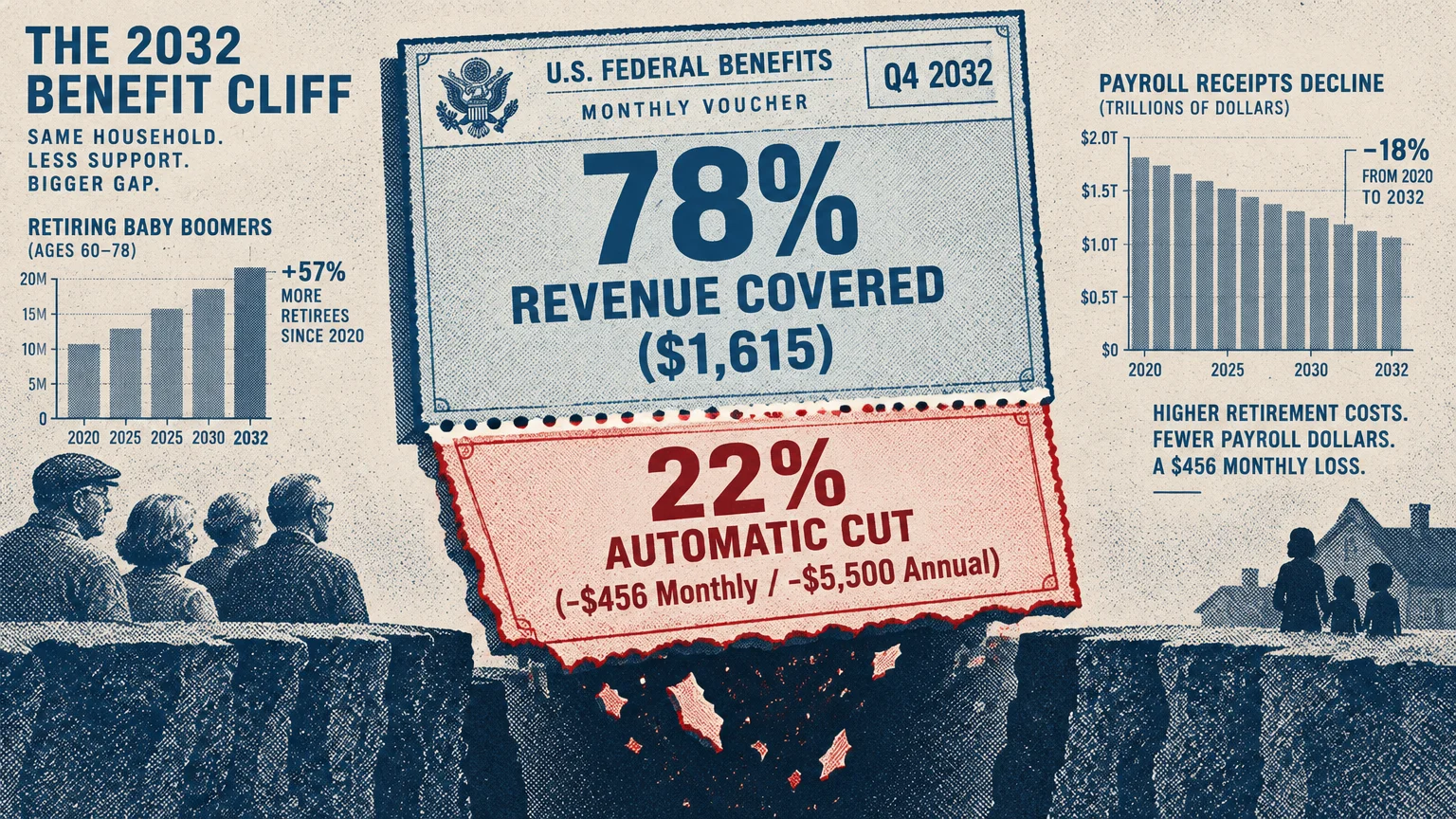
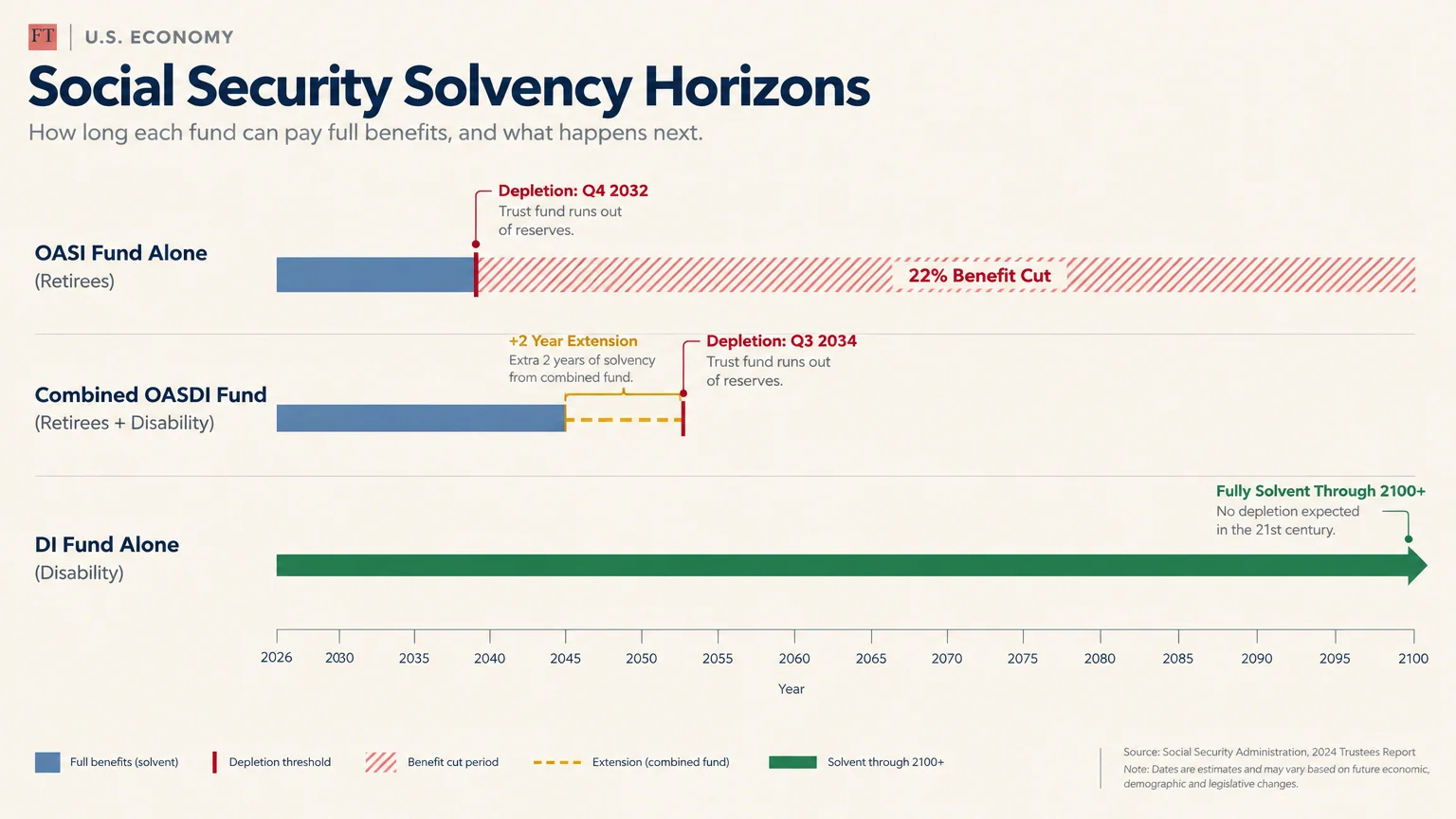
According to the 2026 Social Security Trustees Report released on June 9, 2026, the retirement reserve faces imminent exhaustion. The Old-Age and Survivors Insurance (OASI) Trust Fund will run out of asset reserves in the fourth quarter of 2032.
This timeline arrived one quarter earlier than trustees projected in previous forecasts. Decades of demographic shifts and retiring baby boomers have increased payouts beyond incoming payroll tax receipts.
When asset reserves drop to zero, the law prohibits the program from borrowing money or deficit-spending to pay claims. Benefit payouts become strictly capped by incoming dedicated payroll tax revenues.
The Trustees report indicates incoming taxes will cover only 78 percent of scheduled retirement benefits in late 2032. Consequently, the program must execute an automatic 22 percent cut across all recipient checks.
This reduction is not an abstract statistical adjustment. It represents an immediate, dramatic drop in monthly household income for tens of millions of American seniors.
Based on an average monthly retirement benefit of $2,071, a 22 percent reduction slashes $456 from your check each month. That reduction strips nearly $5,500 out of your annual retirement budget.
If you rely on your monthly benefit for basic necessities like housing and food, an immediate cut of that scale proves catastrophic. You can monitor your personalized benefit estimates directly through the Social Security Administration.
How Congress Can Delay Benefit Cuts by Two Years
Lawmakers possess an established statutory mechanism to push the insolvency cliff further into the future. That mechanism involves combining the retirement fund with the disability fund.
The Social Security system actually maintains two distinct trust funds under federal law. The OASI fund covers retirees and surviving dependents, while the Disability Insurance (DI) Trust Fund pays disabled workers.
Unlike the struggling retirement fund, the disability reserve is in excellent financial health. The Trustees confirm the DI Trust Fund will remain fully solvent through at least 2100.
Congress can pass legislation to merge OASI and DI into a unified fund, known as the combined OASDI Trust Fund. Alternatively, lawmakers can reallocate payroll tax revenue between the two programs.
Reallocation has precedent in modern fiscal history. Lawmakers last executed a temporary payroll tax reallocation in 2015 to prevent immediate benefit cuts to the disability system.
By blending the healthy disability reserves with the depleted retirement reserves, full benefit checks can continue two years longer. Solvency extends from late 2032 to the third quarter of 2034.
This two-year window provides temporary relief for current retirees. However, merging separate reserves requires formal legislative action from Congress; it does not occur automatically.
The Catch: What Happens When the Combined Funds Run Dry in 2034?
While a two-year delay grants immediate political relief to lawmakers, it does not solve the program’s structural deficit. It merely postpones the inevitable reckoning until late 2034.
When the combined OASDI fund exhausts its reserves in the third quarter of 2034, incoming payroll revenues will cover 83 percent of scheduled payments. That triggers an automatic 17 percent benefit cut.
A 17 percent cut is mathematically smaller than the 22 percent reduction scheduled for 2032. Even so, it extracts hundreds of dollars from fixed-income seniors each month.
On an average $2,071 monthly benefit check, a 17 percent reduction eliminates approximately $352 every month. That represents an annual loss of roughly $4,224 per retiree.
The maneuver also exposes vulnerable Americans who currently face no risk of benefit cuts. Under current standalone rules, disability beneficiaries enjoy guaranteed full payments through the end of the century.
Merging the accounts ropes disability recipients directly into the solvency crisis. In 2034, disabled workers would suffer an automatic 17 percent benefit slash alongside retirees.
Relying on accounting maneuvers to delay insolvency simply shifts the financial burden across programs without generating any new revenue. It purchases two years of time at the expense of long-term stability.
Comparing Solvency Timelines and Benefit Cut Projections
Projecting retirement finances requires evaluating both the Trustees’ official numbers and independent economic assessments. The Congressional Budget Office (CBO) offers an even more cautious outlook.
In its September 2026 economic update, the CBO projected the standalone OASI trust fund will deplete reserves by mid-2032. The CBO estimated an immediate 26 percent cut upon depletion.
If lawmakers combine the funds under CBO projections, exhaustion arrives in 2033 with an automatic 23 percent cut. Comparing these scenarios highlights the urgency of structural reform.
| Solvency Scenario | Reserve Depletion Date | Payable Benefit Rate | Automatic Benefit Cut | Monthly Loss ($2,071 Benefit) | Annual Income Loss |
|---|---|---|---|---|---|
| OASI Standalone (Trustees 2026) | Q4 2032 | 78% | 22% | $456 | $5,472 |
| Combined OASDI (2-Year Delay) | Q3 2034 | 83% | 17% | $352 | $4,224 |
| CBO Alternative Baseline (Sept 2026) | Mid-2032 | 74% | 26% | $538 | $6,456 |
| CBO Combined Funds (Sept 2026) | Late 2033 | 77% | 23% | $476 | $5,712 |
Regardless of whether the deadline arrives in 2032, 2033, or 2034, every scenario ends in statutory benefit reductions. Delaying action merely compounds the eventual adjustment required from workers.
The Price Tag: What Delay Costs Workers and Employers
Postponing fundamental program reform carries a massive compounding cost. The longer Congress waits to balance program books, the steeper the required tax increases become.
According to the Trustees, fixing the 75-year shortfall immediately using only payroll taxes requires raising the current rate by 4.25 percentage points. The combined tax would jump from 12.4% to 16.65%.
Federal law splits payroll taxes equally between employees and employers. An immediate fix raises each party’s individual tax burden by 2.125 percentage points.
For a worker earning $100,000 annually, an immediate rate increase demands an extra $2,125 per year in payroll withholding. The employer must match that exact amount, raising business operating costs.
If Congress merges the funds to delay action until 2034, the financial penalty climbs dramatically. Delaying structural tax adjustments until 2034 forces the required combined payroll rate up to 17.30%.
That waiting penalty forces you and your employer to surrender substantially higher portions of future wages. You lose thousands of dollars in lifetime earnings simply because lawmakers postponed the decision.
Review your personal withholding and income history regularly with the Internal Revenue Service to understand how payroll deductions impact your take-home pay.
The Dangerous Alternative: General Fund Borrowing
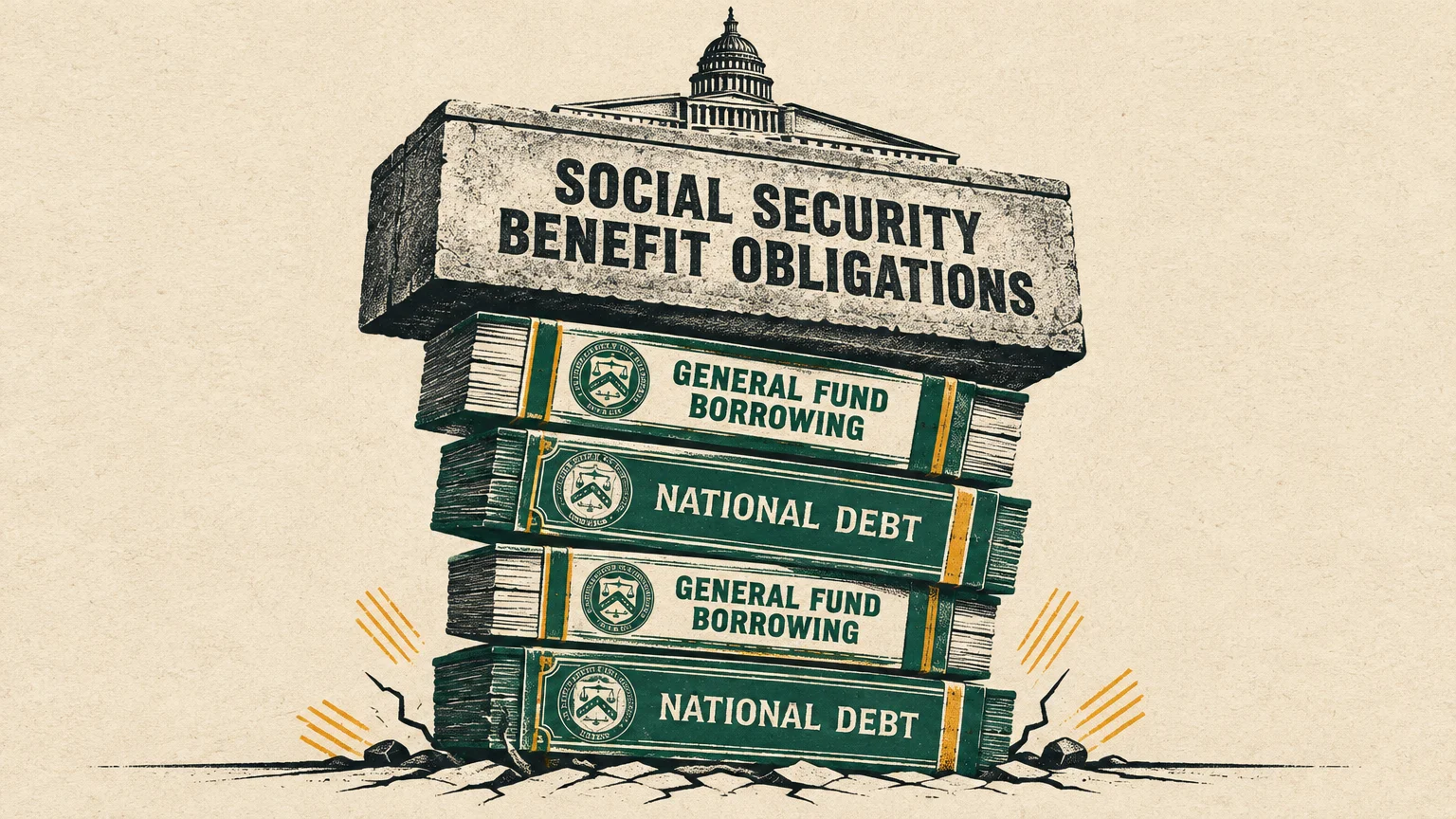
Some lawmakers propose avoiding tax hikes and benefit cuts by transferring general federal revenues into Social Security. However, the federal government runs substantial annual budget deficits.
Funding Social Security through general revenue transfers requires massive additional federal borrowing. The Trustees estimate plugging the shortfall in the first year of insolvency alone requires $680 billion.
Over the full projection window through 2056, borrowing to cover promised benefits adds roughly $46 trillion to the national debt. That level of borrowing carries severe economic risks.
According to historical research by the Federal Reserve, massive debt expansions elevate inflation risks and push long-term borrowing rates higher across the economy. That creates indirect costs for all consumers.
Higher sovereign debt levels force mortgage rates, auto loan rates, and credit card interest upward. You end up paying for the delay through elevated living expenses rather than visible payroll taxes.
Active Reform Proposals Debated in Congress
Lawmakers have filed numerous competing legislative measures to shore up program reserves without triggering automatic cuts. Most proposals balance tax increases on high earners against changes in the benefit calculation.
In June 2026, Representatives Tom Cole and Tom Suozzi introduced the Bipartisan Social Security Commission Act. This legislation establishes a panel tasked with developing binding long-term solvency proposals.
Beyond commission proposals, specific policy ideas receive regular attention from budget analysts and lawmakers. Common reform options include the following legislative actions:
- Adjusting the Taxable Wage Cap: In 2026, payroll taxes apply only to earnings up to $184,500. This threshold captures roughly 83 percent of total national wages, down from 87 percent in 1984. Lifting or eliminating this cap generates substantial new tax revenue from higher earners.
- Raising the Full Retirement Age: The CBO estimates that gradually increasing the full retirement age from 67 to 70 saves $150 billion over 10 years. This single change eliminates roughly 35 percent of the long-term solvency gap.
- Modifying the Primary Insurance Amount Formula: CBO modeling shows that slowing the growth rate of initial benefits for top earners saves $280 billion over a decade. That reform closes 40 percent of the overall financial deficit.
- Recalibrating Cost-of-Living Adjustments: Switching to a chained measure of inflation slows annual benefit bumps. This change prevents benefit payments from outpacing baseline economic productivity.
Any comprehensive compromise will likely blend several of these measures. You must anticipate changes that could alter your expected claiming age or post-tax net income.
Expert Perspectives on Retirement Security
Financial planners emphasize that trusting political timelines is the most dangerous retirement strategy you can pursue. Building independent financial reserves insulates your household from shifting statutory formulas.
“A budget is not about deprivation; it is about making choices that align with your true priorities and future security.” — Suze Orman, Personal Finance Author and Host
Taking ownership of your cash flow lets you prepare for multiple retirement scenarios without panic. Independent personal savings provide stability when public programs face fiscal adjustments.
“Do not save what is left after spending, but spend what is left after saving.” — Warren Buffett, Chairman and CEO of Berkshire Hathaway
Prioritizing automated retirement contributions creates an immediate buffer against potential benefit cuts. Even an aggressive 17 to 22 percent cut harms you less when Social Security represents only one slice of your income.

Actionable Steps to Protect Your Retirement Budget Today
You cannot control congressional votes, but you exercise complete control over your personal financial habits. Take proactive steps today to insulate your lifestyle against any future benefit reductions.
First, stress-test your household budget against an immediate 20 percent drop in projected Social Security payments. Log into your government account, check your monthly benefit estimate, and multiply that figure by 0.80.
Identify whether your planned housing, grocery, and healthcare costs fit within that adjusted number. If a 20 percent cut exposes a deficit, begin restructuring your fixed recurring expenses now.
Second, increase your automated contributions to personal retirement plans like 401(k) accounts and individual retirement accounts. Research investment fundamentals and cost controls through Investor.gov.
Third, reconsider your intended claiming age. Delaying benefit collection past your full retirement age toward age 70 permanently raises your baseline monthly check by 8 percent per year.
That permanent increase helps offset any general statutory cuts enacted by Congress later. A higher baseline check ensures you retain strong purchasing power even under reduced payment percentages.
Finally, eliminate high-interest revolving consumer debt well before you leave the workforce. Entering retirement with zero credit card balances or auto loans dramatically lowers your monthly income requirements.
What Can Go Wrong: Strategic Mistakes to Avoid
Public discussions around program insolvency generate fear and prompt poor financial decisions. You must avoid emotional overreactions that permanently harm your wealth.
The most common error involves claiming benefits as early as possible at age 62 out of panic. Claiming at 62 permanently locks in an automatic 30 percent reduction compared to waiting for full retirement age.
If you take an early 30 percent reduction and Congress later enacts benefit trims, your check suffers compounded losses. Claiming early to beat a deadline often produces the exact outcome you feared.
Another dangerous mistake is assuming Social Security benefits will disappear entirely. Insolvency means reserve exhaustion, not program termination; dedicated payroll taxes continue pouring in each month.
Worst-case statutory forecasts still project incoming taxes covering at least 74 to 83 percent of scheduled benefits. Never base your financial plan on the incorrect assumption that payments drop to zero.
Finally, do not neglect spousal and survivor benefit coordination. Making hasty claiming decisions without evaluating how your timeline impacts your spouse’s lifetime income creates severe long-term poverty risks.

When to Consult a Professional
While general retirement principles apply to everyone, complex individual scenarios demand personalized analysis. Seek out a fee-only fiduciary financial advisor when facing high-stakes decisions.
You should consider professional guidance under several specific financial circumstances:
- Approaching Retirement Within Five to Ten Years: When you enter the critical pre-retirement transition zone, you must stress-test your withdrawal sequencing against potential legislative benefit haircuts.
- Managing Substantial Age Differences with Your Spouse: Navigating dual-earner claiming strategies requires sophisticated modeling to maximize surviving spouse benefits across unequal lifespans.
- Balancing Significant Taxable and Pre-Tax Assets: Coordinating retirement account withdrawals with Social Security requires careful tax-bracket management to avoid the dreaded tax torpedo on benefits.
- Receiving Public Disability or Survivor Benefits: Disabled individuals and survivors face unique program rules that demand expert legal and financial navigation before fund mergers occur.
Professional advisors help you run dynamic cash flow simulations across multiple political and market environments. Learn how to verify professional credentials and avoid conflicts of interest via the Consumer Financial Protection Bureau.
Frequently Asked Questions About the Social Security Solvency Delay
Can Congress merge the trust funds without cutting benefits?
Yes, Congress can merge the OASI and DI trust funds through standard legislation. Doing so extends full benefit payments for both programs until the third quarter of 2034 without immediate benefit trims.
Will disability benefits be reduced if the trust funds combine?
Under current law, the disability fund remains solvent past 2100 with zero benefit cuts. However, merging the funds exposes disability recipients to automatic 17 percent cuts once combined reserves deplete in 2034.
Does delaying cuts increase the eventual tax burden on workers?
Yes, delaying necessary reforms substantially increases future tax requirements. The Trustees project the required payroll tax hike climbs from 4.25 percentage points today to 4.90 percentage points if lawmakers wait until 2034.
How does the 2026 taxable wage cap impact program solvency?
In 2026, Social Security taxes apply only to wages up to $184,500. Raising or eliminating this wage cap represents one of the primary legislative tools lawmakers debate to generate fresh program revenue.
Taking Control of Your Financial Future
A two-year delay in Social Security cuts provides temporary peace of mind, but it does not fix structural deficits. Lawmakers will eventually face difficult choices between tax hikes, delayed retirement ages, and benefit adjustments.
Your best defense against legislative uncertainty is personal financial preparation. Run your numbers, optimize your savings rate, and build a diversified retirement strategy that withstands changing federal policies.
This is educational content based on general financial principles. Individual results vary based on your situation. Always verify current tax laws, investment rules, and benefit eligibility with official sources.
Last updated: November 2026. Financial regulations and rates change frequently—verify current details with official sources.