Building substantial wealth requires shifting your capital from depreciating lifestyle expenses into productive, compounding assets. Understanding how the wealthy invest allows you to adopt their proven wealth-building frameworks at your own pace.
Federal Reserve data shows that the wealthiest households do not rely on earned wages alone. Instead, they funnel their cash into income-producing holdings that compound independently of their daily working hours.
Whether you are managing your first investment account or accelerating your net worth building strategy, specific assets consistently drive enduring financial security. Here are the ten core assets wealthy people own to protect and compound their wealth.

How the Wealthy Structure Their Portfolios
Most individuals store the bulk of their net worth in a primary residence and consumer vehicles. While homeownership provides residential stability, it does not generate ongoing cash flow to cover daily living expenses.
In contrast, high-net-worth investors focus on productive capital. They acquire holdings that generate taxable or tax-sheltered income while appreciating over long investment horizons.
According to the Federal Reserve’s Distributional Financial Accounts, corporate equities and private business ownership represent the vast majority of assets held by the top tier. The top 10% of households own roughly 87% to 88% of corporate equities and private business equity.
Furthermore, data from the Federal Reserve (2026) shows that the top 1% alone holds approximately 50% of all corporate equities. Total U.S. household net worth reached a record $195.9 trillion, driven predominantly by asset appreciation in equities and real estate.
By learning how the wealthy invest across multiple asset categories, you can structure your own portfolio to build durable financial momentum.
1. Publicly Traded Equities and Index Funds
Public equities remain the most accessible growth engine for building net worth. By owning fractional shares of established corporations, you participate in global economic expansion without managing daily corporate operations.
Wealthy investors prioritize broad market exposure through low-cost index funds alongside concentrated equity positions. This strategy allows their capital to compound alongside economic productivity over multi-decade periods.
“Don’t look for the needle in the haystack. Just buy the haystack!” — John Bogle, Founder of Vanguard
Public equities also offer significant tax advantages when held in taxable brokerage accounts. When you hold stocks for longer than a year, your profits qualify for favorable long-term capital gains tax treatment.
For 2026, the federal long-term capital gains tax brackets allow married couples filing jointly to pay a 0% rate on taxable income up to $98,900. Single filers enjoy that same 0% rate on taxable income up to $49,450.
Profits above those thresholds face a 15% rate, rising to 20% only when joint taxable income surpasses $613,700 ($545,500 for single filers). You can research stock market foundations and low-cost funds directly through the Securities and Exchange Commission’s Investor.gov portal.
2. Privately Held Business Equity
Direct ownership of private operating enterprises represents one of the largest concentrations of wealth among ultra-high-net-worth individuals. Owning a business allows founders and investors to generate operating cash flow while building enterprise value.
Unlike public stocks, private companies give owners direct control over operational decisions, pricing power, and capital allocation. This autonomy provides unique levers for rapid equity expansion.
Private business owners also leverage significant tax efficiencies. Operating expenses, research costs, and equipment depreciation directly reduce pass-through taxable income before distributions occur.
Federal Reserve distribution metrics confirm that the top 10% of households control approximately 86% to 88% of all noncorporate business equity in the country. That equity forms the core engine of their wealth creation.
You do not need to launch the next major tech firm to access private equity value. Acquiring or starting small, cash-flowing local service firms offers retail investors an effective path toward private business equity.

3. Income-Producing Real Estate
Commercial and residential real estate has served as a foundational wealth building asset for generations. Real estate delivers a rare combination of regular cash flow, long-term appreciation, leverage, and sheltering deductions.
When you purchase rental properties or commercial buildings, tenant rents cover debt service and operational costs while providing net yields. Over time, property amortization steadily increases your net equity.
The tax code heavily favors real estate ownership through non-cash depreciation deductions. Depreciation allows you to deduct a portion of the building’s structural value against rental income each year.
This accounting benefit frequently creates “paper losses” that shelter your actual cash distributions from income taxes. Furthermore, investors utilize Section 1031 like-kind exchanges to defer capital gains indefinitely when trading properties.
If you prefer not to manage physical tenants, publicly traded Real Estate Investment Trusts (REITs) and private syndications provide liquid real estate exposure. These vehicles let you collect passive distributions backed by physical real estate portfolios.
4. Tax-Advantaged Retirement Vehicles and Mega Backdoor Roths
Affluent households maximize every available statutory tax shelter to insulate compounding returns from annual tax drag. They use workplace retirement plans and specialized conversion strategies to store significant capital in tax-free accounts.
For 2026, the Internal Revenue Service (IRS) sets the elective deferral limit for 401(k), 403(b), and most 457 plans at $24,500. For 2027, this threshold increases to $25,500 under IRS Notice 2026-66.
Catch-up contributions provide even greater room for savers aged 50 and older, with an $8,000 allowance in 2026. A special “super catch-up” limit of $11,250 applies to individuals aged 60 through 63.
High earners who surpass traditional savings caps often implement the “Mega Backdoor Roth” strategy. Under Section 415(c), the combined limit for employee and employer contributions reached $72,000 for 2026, rising to $75,000 for 2027.
By contributing after-tax dollars to a 401(k) and executing immediate in-plan Roth conversions, investors move tens of thousands into tax-free growth each year. Note that employees earning over $150,000 must now make all age-based catch-ups into Roth accounts.
Traditional and Roth IRAs add further capacity, with annual limits set at $7,500 for both 2026 and 2027. Savers aged 50 and older can contribute an additional $1,100 catch-up, bringing their total IRA ceiling to $8,600.
5. Health Savings Accounts (HSAs) Used for Compounding
Sophisticated investors do not treat Health Savings Accounts merely as short-term medical spending pots. Instead, they utilize the HSA as a dedicated, triple-tax-advantaged investment engine.
An HSA provides an upfront tax deduction on contributions, fully tax-free investment growth, and tax-free withdrawals for qualified medical expenses. No other investment vehicle combines all three advantages simultaneously.
For 2026, the statutory contribution limit is $4,400 for self-only coverage and $8,750 for family coverage. In 2027, those thresholds climb to $4,500 and $9,000, with a $1,000 catch-up for those aged 55 and older.
Under Public Law 119-21, bronze and catastrophic ACA Exchange health plans now qualify as HSA-eligible high-deductible health plans. This change substantially widens access for self-employed and contract professionals.
Wealthy individuals pay current medical bills out of pocket and save the receipts digitally while leaving their HSA funds invested in low-cost index funds. Years later, they withdraw those compounded gains completely tax-free by matching past medical expenditures.
6. Cash Equivalents and Strategic Liquidity
The wealthy do not hoard cash in low-yield checking accounts where inflation erodes purchasing power. However, they consistently maintain substantial liquidity in cash-equivalent assets.
Strategic liquidity provides personal financial stability while positioning investors to capitalize on market dislocations. When asset prices plummet during economic downturns, liquid capital allows wealthy buyers to purchase undervalued real estate and securities.
Common instruments include short-term Treasury bills, high-yield institutional savings accounts, and government money market funds. These cash equivalents preserve principal while generating baseline yields backed by full federal guarantees.
Maintaining three to twelve months of cash equivalents shields long-term portfolios from forced liquidations during sudden bear markets. You avoid selling depressed equity assets simply to cover short-term living needs.
Official monetary updates from the Federal Reserve outline how current interest rate policy shapes yield dynamics across these short-term instruments.

7. Private Equity and Venture Capital
Private equity and venture capital provide accredited investors with direct ownership stakes in high-growth, early-stage, or restructuring businesses. These alternative assets offer higher return potential in exchange for lower liquidity.
Companies are remaining private much longer than in prior decades, capturing substantial valuation growth before conducting initial public offerings. Wealthy investors access this private value creation through dedicated funds and syndicate networks.
Under SEC Regulation D, participating in private placements generally requires accredited investor status. This requires an annual individual income exceeding $200,000 ($300,000 with a spouse) or a net worth topping $1,000,000 excluding your primary home.
The regulatory environment is expanding opportunities for retail investors to participate. On September 30, 2026, the Securities and Exchange Commission (SEC) proposed rule amendments to widen access by qualifying holders of specific professional credentials and certifications.
While these funds carry substantial lock-up periods and risk profiles, they frequently outperform public equity averages over multi-year cycles. They supply valuable portfolio diversification that behaves independently of daily stock market volatility.
8. Intellectual Property and Royalty Streams
Intellectual property assets generate recurring, high-margin cash flow decoupled from physical production and manual labor. These assets include utility patents, registered trademarks, proprietary software code, music publishing rights, and digital book catalogs.
Once you develop or acquire intellectual property, the marginal cost to reproduce or license it remains near zero. Every subsequent licensing fee or royalty payment converts directly into net operating cash flow.
High-net-worth investors frequently buy established music royalty catalogs and enterprise software rights. These contracts deliver non-correlated cash flow yields that persist regardless of broader economic fluctuations.
Digital distribution platforms make intellectual property creation more accessible to everyday creators and professionals. Publishing educational courses, proprietary business templates, or subscription software provides scalable recurring revenues with minimal capital outlay.
These royalty streams can be held inside corporate entities, enabling owners to retain and reinvest cash at favorable corporate tax rates.
9. Irrevocable Trusts and Wealth-Transfer Vehicles
Preserving accumulated wealth across generations requires sophisticated legal and estate planning structures. Irrevocable trusts serve as critical wealth-building assets that insulate capital from estate taxes, lawsuits, and creditor claims.
Legal instruments such as Spousal Lifetime Access Trusts (SLATs) and Grantor Retained Annuity Trusts (GRATs) remove future asset growth from taxable estates. The investments held within the trust compound for beneficiaries without triggering transfer penalties.
Federal estate planning thresholds remain exceptionally generous. Under Public Law 119-21, the federal lifetime estate and gift tax exemption stands at $15,000,000 per individual ($30,000,000 for married couples) for 2026.
For 2027, the IRS inflation adjustment increases this basic exclusion to $15,480,000 per individual, or $30,960,000 for married couples. This ensures multi-million dollar portfolios transfer to subsequent generations free from federal estate taxes.
Additionally, the annual gift tax exclusion allows you to transfer up to $19,000 per recipient in 2026 ($38,000 for married couples) without filing a gift tax return. In 2027, this threshold increases to $20,000 per recipient ($40,000 for couples).
10. Permanent Life Insurance and Cash Value Contracts
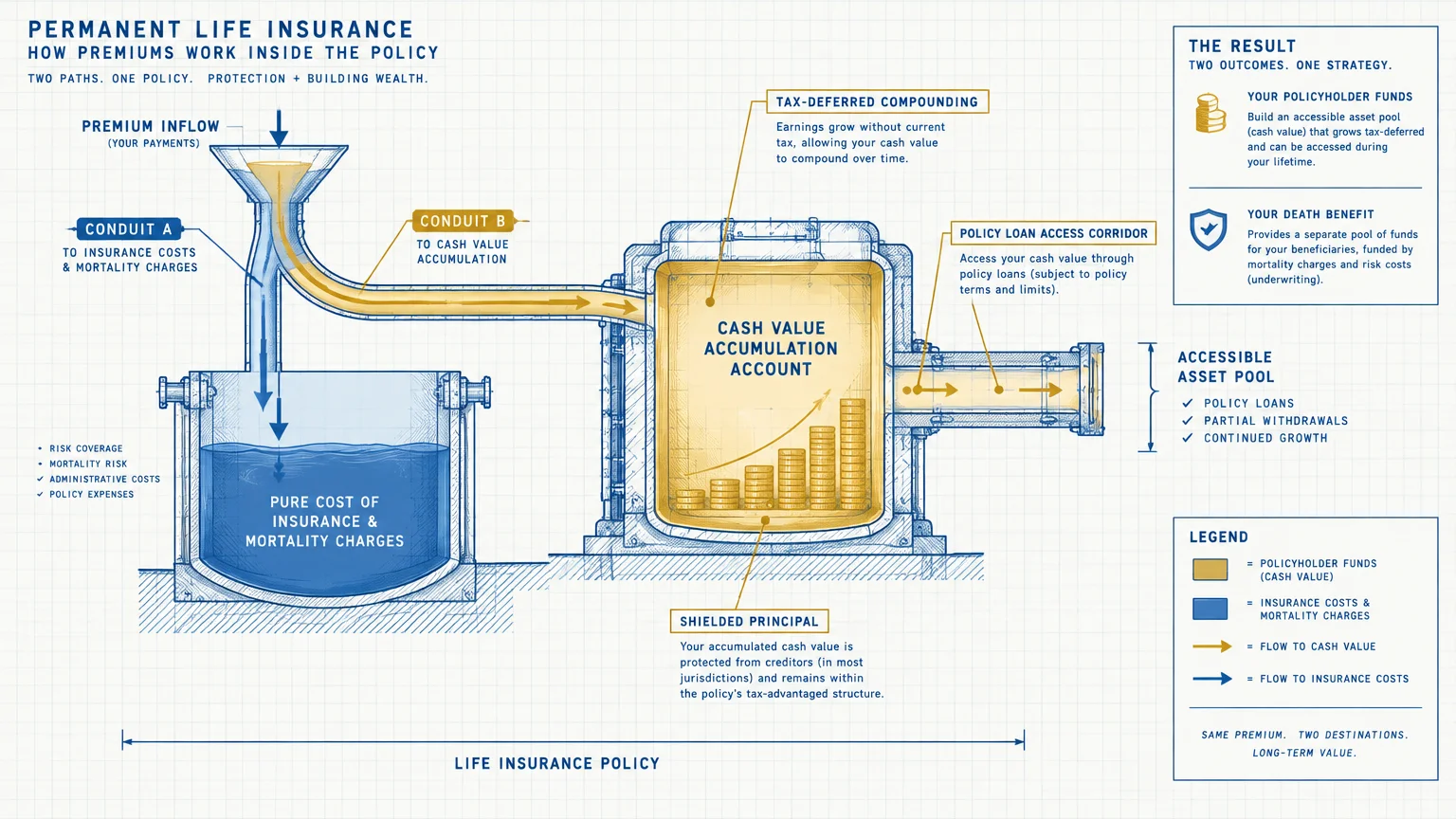
High-earning families routinely incorporate permanent cash-value life insurance contracts into their long-term asset structures. These include specially designed whole life, universal life, and private placement life insurance (PPLI) policies.
Cash value within these contracts accumulates on a tax-deferred basis, mirroring the internal compounding of retirement vehicles. Policy owners can borrow against this accumulated cash value via low-cost policy loans without triggering taxable income recognition.
“If you don’t find a way to make money while you sleep, you will work until you die.” — Warren Buffett, Chairman and CEO of Berkshire Hathaway
Upon the policyholder’s death, the contract distributes a tax-free death benefit to designated beneficiaries. This liquidity allows heirs to pay estate obligations and settle business transitions without executing forced sales of underlying family assets.
In many states, cash surrender values in life insurance enjoy statutory protections from commercial creditors and litigation. While policy fees require careful analysis, permanent life insurance serves as an effective estate planning tool when properly structured.
Comparing Wealth-Building Assets
Every asset class serves a distinct strategic purpose inside a balanced wealth-building framework. The following table illustrates how these ten holdings compare across return engines, liquidity profiles, and tax attributes.
| Asset Class | Primary Wealth Engine | Liquidity Profile | Key Tax Advantage |
|---|---|---|---|
| Public Equities | Long-term capital compounding | High (Daily market) | Preferential 0% to 20% long-term rates |
| Private Business Equity | Operating profit and valuation growth | Very Low | Pass-through write-offs, QSBS potential |
| Income Real Estate | Rental cash flow and amortization | Moderate to Low | Depreciation deductions, 1031 exchanges |
| Retirement / Roth Accounts | Market growth within tax shields | Low (Penalty before age 59½) | Tax-free withdrawals (Roth) or upfront deductions |
| Health Savings Accounts | Compounded market growth | High for medical | Triple tax advantage (deduction, growth, withdrawal) |
| Cash Equivalents | Capital preservation and liquidity | Immediate | State tax exemptions on Treasury paper |
| Private Equity / VC | Venture-stage business expansion | Illiquid (5–10 year lockup) | Carried interest capital gains rates |
| Intellectual Property | Scalable recurring royalties | Low to Moderate | Amortization of development expenses |
| Irrevocable Trusts | Generational wealth protection | Restricted by trust terms | Removes asset growth from federal gross estate |
| Cash Value Life Insurance | Stable yield and death liquidity | Moderate (Policy loans) | Tax-free policy loans and death benefits |
Avoiding Common Errors When Building Your Portfolio
Attempting to mimic high-net-worth investors without the proper foundation can derail your personal balance sheet. Avoiding these common mistakes will keep your wealth-building plan on track.
- Confusing Lifestyle Real Estate with Productive Assets: Purchasing an oversized primary residence increases your property taxes and maintenance costs without producing monthly cash flow. Focus on acquiring income-generating rental properties rather than overspending on personal living spaces.
- Chasing Illiquid Investments Prematurely: Locking savings into speculative startups or illiquid private funds before building emergency cash reserves causes unnecessary financial stress. Establish liquid emergency funds and maximize traditional tax shelters before exploring private market deals.
- Ignoring Annual Fee Drag and Expense Ratios: Paying excessive advisory commissions or high expense ratios severely erodes compounding returns over time. Prioritize low-cost index funds and transparent fee-only structures to keep capital working for you.
- Overlooking Tax-Bracket Transitions: Failing to plan for mandatory Roth transitions or capital gains thresholds can expose your earnings to unexpected tax liabilities. Review contribution caps and tax law adjustments each year to optimize your tax position.

When DIY Isn’t Enough
Self-directed index investing and automated savings apps work well for early-stage portfolio accumulation. However, specific financial milestones demand professional, specialized advice.
You should consider engaging a fee-only fiduciary advisor or estate planning attorney in the following situations:
- Navigating Concentrated Stock Positions or Company Exits: Selling a private enterprise or exercising substantial incentive stock options requires careful tax planning to prevent heavy bracket creep and Net Investment Income Taxes.
- Establishing Irrevocable Trust Structures: Creating multi-generational trusts and generational wealth transfers demands custom legal drafting to comply with evolving state and federal estate rules.
- Implementing Mega Backdoor Roth Strategies: Executing high-dollar after-tax 401(k) conversions requires strict plan compliance to avoid unintended taxable distribution penalties.
- Allocating Capital to Private Placements: Conducting due diligence on private equity offerings and debt syndications requires deep financial statement analysis and contract review.
You can locate vetted, fee-only fiduciary professionals through the Certified Financial Planner Board to ensure guidance aligns directly with your financial objectives.
Frequently Asked Questions
What is the single most important asset for building net worth from scratch?
Low-cost, broadly diversified public equities held inside tax-advantaged accounts are the most reliable asset for beginners. They provide historical compounding, minimal investment minimums, and instant diversification without requiring operational management.
Do I need to be an accredited investor to access alternative assets?
While direct private equity and venture capital funds require SEC accreditation, everyday investors can access similar alternative sectors. Publicly traded REITs, business development companies (BDCs), and royalty trusts offer comparable exposure directly through ordinary brokerage accounts.
Why do wealthy individuals prioritize capital gains over salary income?
Ordinary earned income faces federal income tax rates as high as 37%, plus payroll taxes. Long-term capital gains face preferential rates ranging from 0% to 20%, allowing investors to keep a larger share of their investment gains.
How much cash equivalent liquidity should an investor hold?
Most financial planners recommend keeping three to six months of living expenses in cash equivalents for emergency reserves. Wealthy investors frequently maintain six to twelve months of liquidity to comfortably absorb volatility and pursue sudden investment opportunities.
Taking Action on Your Wealth-Building Path
Building significant wealth does not require adopting all ten asset classes at once. Sustainable financial independence begins by mastering the assets currently within your reach.
Start by capturing your full employer retirement match and maximizing your annual IRA contributions. As your discretionary income expands, add income-producing real estate, taxable index portfolios, and strategic liquidity reserves to your foundation.
The information in this guide is meant for educational purposes. Your specific circumstances—including income, debt, tax situation, and goals—may require different approaches. When in doubt, consult a licensed professional.
Last updated: November 2026. Financial regulations and rates change frequently—verify current details with official sources.