Retirees received a 3.6% Social Security cost-of-living adjustment for 2027, adding $75 to the average monthly check. Yet overall consumer prices rose 3.7% over the 12 months ending September 2026, leaving your raise behind before January arrives.
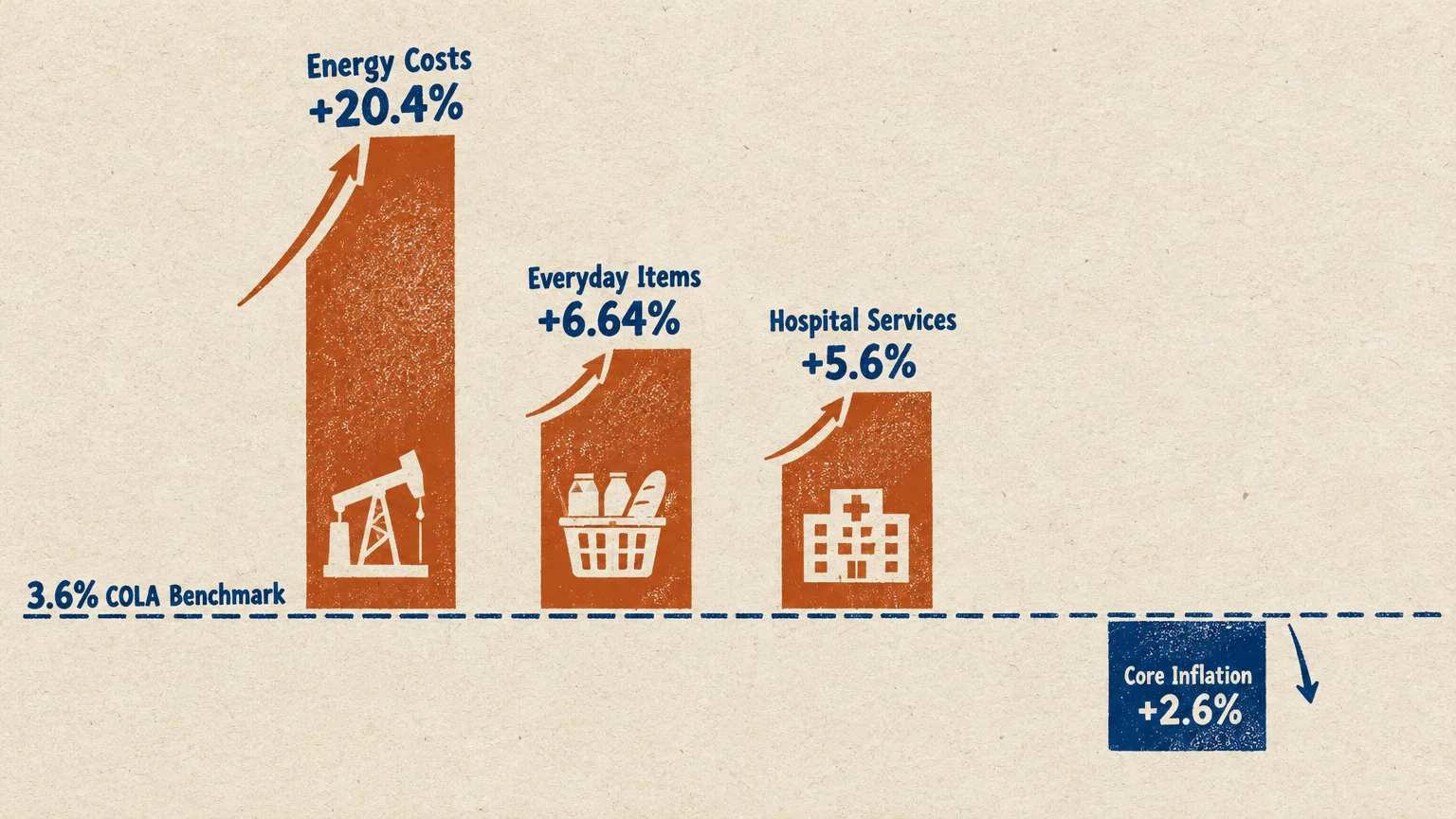
Headline averages also hide steep jumps on essentials you buy every week. Energy costs climbed 20.4%, hospital services rose 5.6%, and everyday items jumped 6.64% between December 2025 and October 2026.
Knowing where prices rose fastest helps you protect your Social Security purchasing power. Below is what the 2027 COLA really pays, what your expenses actually cost, and how to close the gap.
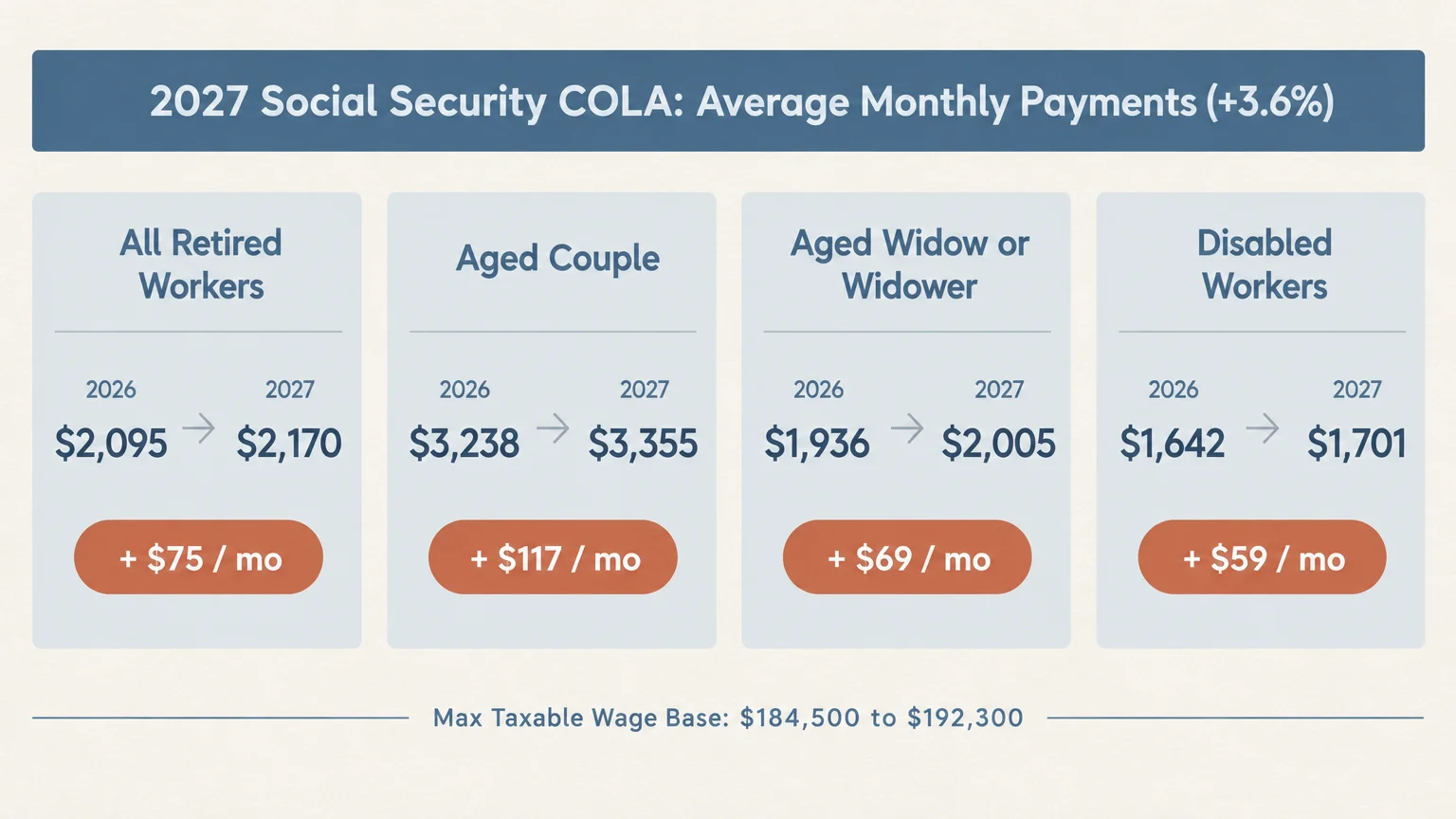
What the 3.6% 2027 COLA Actually Adds to Your Check
On October 14, 2026, the Social Security Administration (SSA) announced a 3.6% cost-of-living adjustment for 2027. That marks the largest annual increase in four years, up from 2.8% in 2026.
The 2027 COLA reaches roughly 76 million Americans across two federal programs. Nearly 72 million Social Security beneficiaries see higher payments in January 2027, while about 7.3 million Supplemental Security Income (SSI) recipients get their boost on December 31, 2026.
Your exact dollar increase depends on your current benefit amount and household category. According to SSA estimates, average monthly payments shift as follows:
- All retired workers: Average benefits increase by $75 per month, rising from $2,095 to $2,170.
- Aged couple (both receiving benefits): Combined monthly checks climb from $3,238 to $3,355, a $117 gain.
- Aged widow or widower living alone: Average monthly support grows from $1,936 to $2,005, adding $69 per month.
- All disabled workers: Monthly payments move up from $1,642 to $1,701, an extra $59 each month.
You can check your personalized benefit letter online in late November 2026 through your my Social Security Message Center if you chose paperless notices by November 18, 2026. Everyone else receives mailed paper notices in December 2026.
If you still work while collecting or delaying benefits, payroll taxes also shift in 2027. The SSA maximum earnings subject to Social Security tax rises from $184,500 in 2026 to $192,300 in 2027.
How Much Prices Rose on the Things You Actually Buy
Comparing your 3.6% cost of living increase against broad inflation numbers only tells part of the story. Data from the U.S. Bureau of Labor Statistics (BLS) released on October 14, 2026, shows all consumer items rose 3.7% over the 12 months ending September 2026.
That 3.7% figure already topped the 2.4% annual pace recorded in January 2026. Meanwhile, core inflation—which strips out food and energy—rose just 2.6% over the same period, masking the categories hitting retiree wallets hardest.
Monthly pressures continued right into autumn. On November 10, 2026, the BLS reported that the Consumer Price Index for All Urban Consumers (CPI-U) climbed another 0.4% in October after jumping 0.6% in September.
Note that the BLS could not publish 12-month percent changes for October 2026 for most categories because a federal lapse in appropriations prevented survey collection in October 2025. Even so, the American Institute for Economic Research (AIER) reported on November 12, 2026, that its Everyday Price Index—tracking 24 frequently bought items—sat 6.64% higher in October 2026 than in December 2025.
Seeing prices rising in 2026 side by side against your 2027 raise makes the squeeze unmistakable. The table below compares major household categories from the September 2026 12-month BLS release against the 3.6% COLA.
| Spending Category | 12-Month Price Change (Through Sept. 2026) | Difference vs. 3.6% COLA |
|---|---|---|
| Fuel oil | +74.2% | +70.6 percentage points faster |
| Gasoline | +34.2% | +30.6 percentage points faster |
| Airline fares | +22.4% | +18.8 percentage points faster |
| Energy overall | +20.4% | +16.8 percentage points faster |
| Tobacco and smoking products | +6.4% | +2.8 percentage points faster |
| Motor vehicle maintenance and repair | +5.8% | +2.2 percentage points faster |
| Hospital services | +5.6% | +2.0 percentage points faster |
| Piped natural gas | +5.0% | +1.4 percentage points faster |
| Electricity | +4.4% | +0.8 percentage points faster |
| Nonalcoholic beverages | +3.8% | +0.2 percentage points faster |
| Full-service restaurant meals | +3.8% | +0.2 percentage points faster |
| Fruits and vegetables | +3.7% | +0.1 percentage points faster |
| All items (CPI-U) | +3.7% | +0.1 percentage points faster |
| Housing and shelter overall | +3.2% | -0.4 percentage points slower |
| Groceries (food at home) overall | +1.8% | -1.8 percentage points slower |
| Used cars and trucks | -1.5% | -5.1 percentage points slower |
| Motor vehicle insurance | -5.0% | -8.6 percentage points slower |
Energy, Utilities, and Getting Around
Energy costs drove the sharpest divergence between official inflation averages and everyday household bills. Overall energy prices climbed 20.4% in the 12 months ending September 2026, then ticked up another 0.7% in October after surging 5.2% in September.
Fuel oil jumped 74.2% over the year, hitting seniors in older homes across colder states especially hard. Gasoline rose 34.2%, pushing national retail prices near $4.33 per gallon in mid-October according to AAA and media reports.
Home utility bills also outpaced your 3.6% raise. Piped natural gas climbed 5.0% and electricity rose 4.4%, raising baseline monthly heating and cooling expenses regardless of how little you drive.
Keeping an older vehicle on the road grew noticeably pricier too. Motor vehicle maintenance and repair surged 5.8%, while airline fares jumped 22.4% for retirees traveling to see family.
Motor vehicle insurance offered a brief bright spot with a 5.0% drop over the 12 months through September. However, BLS data shows auto insurance premiums began climbing again in October 2026.
Groceries, Dining Out, and Daily Staples
Grocery inflation cooled to 1.8% overall for the 12 months through September, aided by flat meat, poultry, fish, and egg prices (+0.3%) and a 0.7% dip in dairy. Yet October brought renewed pressure as grocery prices climbed 0.4% in a single month.
Even inside the 1.8% annual figure, staple items exceeded your COLA. Nonalcoholic beverages rose 3.8%, fruits and vegetables climbed 3.7%, and cereals and bakery products moved up 2.1%.
Restaurant meals stayed expensive if you dine out for convenience or social time. Food away from home rose 3.5% annually—led by a 3.8% rise at full-service restaurants and 3.2% at limited-service spots—before adding another 0.5% in October.
Housing and Hospital Care
Shelter costs rose 3.2% over the 12 months through September 2026 and accounted for over 30% of October’s 0.4% monthly CPI-U increase. Rent of primary residence rose 2.8%, while owners’ equivalent rent climbed 3.3%.
Healthcare prices split sharply depending on the type of care you needed. Medical care commodities fell 3.3% and physicians’ services rose a modest 2.1%, pulling overall medical care services to a 2.5% gain.
Hospital services told a very different story, jumping 5.6% over the 12-month period. A single inpatient stay or outpatient procedure can quickly erase months of extra Social Security income.
Why Social Security Purchasing Power Keeps Slipping Behind
When inflation for retirees feels worse than the annual COLA reflects, the calculation formula itself plays a major role. Federal law ties Social Security COLAs to the Consumer Price Index for Urban Wage Earners and Clerical Workers (CPI-W).
The CPI-W tracks spending patterns for roughly 30% of the U.S. population—specifically younger, working households—and excludes retirees altogether. Even within that index, CPI-W stood at 3.9% in September 2026, though the 3.6% COLA reflects the third-quarter average rather than September alone.
To measure senior spending more accurately, the BLS maintains an experimental research index for Americans age 62 and older called the R-CPI-E. That index weights medical care at roughly 12% of total household spending, compared with about 7% for the general urban population.
According to SSA actuaries, switching the COLA formula to the CPI-E would boost annual adjustments by about 0.15 percentage points per year on average. Over a 20-year retirement, those small annual shortfalls compound dramatically.
Social Security COLAs track what younger commuters buy during workdays, not what retirees pay for hospital bills, home heating, and daily essentials.
Research from The Senior Citizens League (TSCL) in its 2026 Loss of Buying Power study illustrates how wide that gap grows over a decade. Tracking 70 common goods and services used by older adults from 2016 to 2026, TSCL found prices for an affordably shopping retiree surged 43.55% compared with 37.60% for the CPI-W.
Because benefits lagged actual senior expenses, Social Security checks have lost 13.7% of their buying power since 2016. TSCL calculates it would take an immediate $295.85 monthly boost—roughly 15.7% to 15.8%, or $3,550 per year—to restore 2016 Social Security purchasing power for the average beneficiary.
That gap hits hard because so many households have little cushion. TSCL reports that 39% of seniors rely on Social Security for all of their income, and 89% of its 2026 survey respondents said 2026’s 2.8% COLA fell short of inflation.
Long-term program funding adds another layer of urgency to your planning. In its June 2026 report, the SSA warned that without congressional action, the Old-Age and Survivors Insurance (OASI) Trust Fund will deplete its reserves in the fourth quarter of 2032, leaving enough incoming revenue to pay 78% of scheduled benefits—a 22% cut—while the Medicare Part A trust fund is projected to run dry in 2033.
Medicare Deductions and Drug Costs That Shrink Your Raise
Before you plan how to spend an extra $75 a month, remember that Medicare Part B premiums usually come straight out of your Social Security payment. Your net deposit often grows far less than the headline 3.6% figure.
In 2026, the standard monthly Part B premium jumped $17.90—a 9.7% increase from $185 in 2025 to $202.90. That single deduction absorbed nearly a third of the average $57 COLA retirees received in 2026.
As of mid-November 2026, the Centers for Medicare and Medicaid Services (CMS) had not yet announced final 2027 Part B premiums and deductibles, which usually arrive late in the October 15 to December 7 Annual Enrollment Period. However, the 2026 Medicare Trustees Report projected the standard 2027 Part B premium will climb another $6.60 per month to $209.50.
Late in 2026, some beneficiaries also saw a temporary offset from Washington. In October 2026, the administration began issuing a one-time $90 rebate from the Medicare Improvement Fund to 20.8 million Original Medicare beneficiaries who live in the U.S. and do not receive Medicaid premium assistance.
That $90 payment does not recur in 2027 and excludes large groups of seniors. Roughly 36.1 million retirees enrolled in Medicare Advantage plans are ineligible for the rebate.
Prescription drug coverage under Part D also gets pricier in 2027, creating another drain on inflation retirees face:
- Higher out-of-pocket cap: The annual Part D spending limit rises by $300 in 2027, moving from $2,100 to $2,400.
- Steeper standard deductible: The standard Part D deductible is forecast to increase 14% for 2027, rising from $615 to $700.
- New GLP-1 coverage option: Through Medicare.gov, the Medicare GLP-1 Bridge program introduces a $50 monthly copayment in 2027 for qualifying Part D enrollees who lack existing coverage for GLP-1 medications.
Watch closely how you pay for prescriptions if you shop outside insurance. Using cash discount coupons through TrumpRx.gov instead of Part D coverage does not count as creditable coverage and does not apply toward your $700 deductible or $2,400 annual cap.
How Federal Taxes Interact With Your 2027 Cost of Living Increase
Higher nominal Social Security checks can quietly trigger higher income taxes. Despite widespread confusion around the Working Families Tax Cuts law, Congress did not eliminate federal income taxes on Social Security benefits.
Up to 85% of your Social Security benefits remain subject to federal income tax if your combined income crosses statutory thresholds. Because those income thresholds are not indexed for inflation, a 3.6% cost of living increase can expose a larger share of your benefits to tax.
Fortunately, new tax relief can help offset that pressure for older filers. For tax years 2025 through 2028, taxpayers age 65 and older qualify for an enhanced $6,000 senior deduction per eligible person on Schedule 1-A, according to the Internal Revenue Service (IRS).
Married couples filing jointly can claim $12,000 if both spouses are 65 or older. Best of all, you can take this $6,000 deduction whether you itemize deductions or claim the standard deduction.
Income limits still apply to the Schedule 1-A senior deduction. It begins phasing out at 6% per dollar once your modified adjusted gross income (MAGI) exceeds $75,000 for single filers or $150,000 for married joint filers, vanishing completely at $175,000 single or $250,000 joint.
Filing status matters here too. Taxpayers who use the married-filing-separately status cannot claim the enhanced $6,000 senior deduction at all.
Base standard deductions also rise for 2027 under IRS Revenue Procedure 2026-35, issued November 5, 2026. The 2027 base standard deduction climbs to $33,200 for married couples filing jointly (up $1,000 from 2026), $16,600 for single or married-filing-separately filers, and $24,925 for heads of household.
Existing additional standard deductions for taxpayers age 65 and older continue to stack on top of both the base standard deduction and the $6,000 senior deduction. For context, that additional senior standard deduction stood at $2,050 for a single filer age 65 or older in 2026.
If you are still working part-time or full-time in 2027, retirement accounts offer another way to shield income. Under IRS Notice 2026-66, the elective deferral limit for 401(k) and 457 plans rises from $24,500 in 2026 to $25,500 in 2027, helping you lower MAGI below deduction phase-out lines.

Practical Ways to Stretch Your 2027 Budget Against Rising Prices
You cannot change the CPI-W formula or stop utility rates from climbing. You can, however, reorganize your spending and tax elections so your 2027 COLA stretches further across the categories inflating fastest.
- Compare Part D plans before December 7: With the Part D deductible forecast to jump 14% to $700 and the cap rising to $2,400, run your exact medication list through the Medicare.gov plan finder. Check whether a different plan covers your prescriptions or lets you use the $50 Medicare GLP-1 Bridge copay instead of paying full cash prices.
- Cut peak energy and fuel exposure: Ask your electric or gas utility about budget billing or off-peak rate plans to smooth out 4.4% electricity and 5.0% natural gas increases. If your home relies on heating oil—up 74.2%—compare pre-buy locking contracts and check weatherization grants through USA.gov Benefits.
- Budget proactively for car upkeep: With repair costs up 5.8% and gasoline near $4.33 per gallon, combine errands into single trips and keep routine oil and tire maintenance on schedule. Catching wear early helps you avoid surprise $1,000 repair bills or financing a replacement vehicle.
- Shift grocery choices toward lower-inflation aisles: Lean into protein and dairy options that stayed near flat—dairy fell 0.7% and meat, poultry, fish, and eggs rose just 0.3%—while buying seasonal produce to counter 3.7% fruit and vegetable inflation. Trimming just two full-service restaurant meals a month (+3.8%) can also save more than your entire $75 COLA increase.
- Manage withdrawals around the $75,000 and $150,000 MAGI cliffs: Before taking extra distributions from traditional IRAs or 401(k)s, calculate how each dollar affects your Schedule 1-A phase-out and the taxation of up to 85% of your Social Security benefits. Drawing from Roth accounts or taxable cash reserves can keep your MAGI safely inside the sweet spot.
- Verify local and state senior relief programs: Property tax freezes, utility bill assistance, and Medicare Savings Programs can offset rising housing (+3.2%) and healthcare bills. You can also explore free budgeting worksheets from the Consumer Financial Protection Bureau (CFPB) to track monthly cash flow.
Pitfalls to Watch For
Even careful retirees can lose hundreds of dollars a year to fine-print traps around Medicare, taxes, and inflation planning. Watch out for these common mistakes as 2027 approaches:
- Replacing Part D coverage with cash coupons: Paying out of pocket through TrumpRx.gov discount coupons might look cheaper on a single refill, yet those purchases do not count toward your $700 deductible or $2,400 cap and do not qualify as creditable coverage. Dropping Part D without creditable coverage can trigger permanent late-enrollment penalties later.
- Counting on the $90 Part B rebate in your 2027 budget: That October 2026 payment was a one-time distribution for eligible Original Medicare enrollees. If you have Medicare Advantage or receive Medicaid premium help, you do not receive it, and no one should treat it as recurring income.
- Ignoring how COLAs trigger Social Security taxation: Assuming your 3.6% raise is tax-free can lead to an unexpected bill in April. Up to 85% of benefits remain taxable, so extra dividend income or IRA withdrawals can quickly push more of your COLA into taxable income.
- Filing Married Filing Separately at age 65 or older: Married couples who file separate returns automatically forfeit the enhanced $6,000 per-person senior deduction on Schedule 1-A. Always compare joint versus separate tax outcomes before finalizing your return.
- Treating Social Security as guaranteed at 100% forever: With the OASI Trust Fund projected to deplete reserves in Q4 2032, relying on benefits for every dollar of retirement income leaves no margin if Congress delays a fix and scheduled checks drop to 78%.
Getting Expert Help
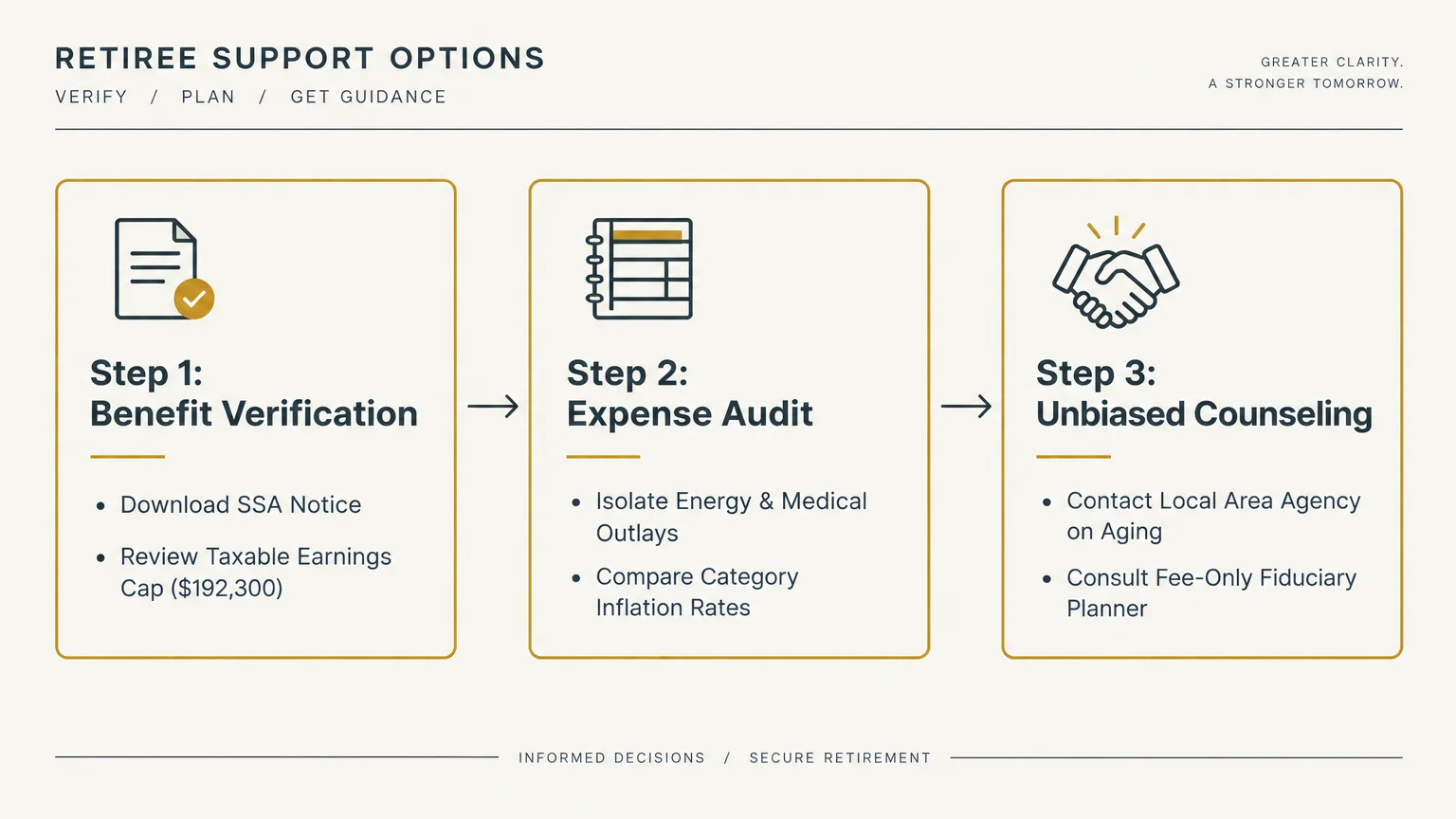
Most retirees can manage routine budgeting adjustments on their own. Still, several complex financial intersections in 2026 and 2027 justify sitting down with a credentialed professional—such as a fee-only Certified Financial Planner, a CPA, or a free State Health Insurance Assistance Program (SHIP) counselor.
- Navigating Medicare Part D and GLP-1 changes: If your medications push you near the $2,400 cap or you need the Medicare GLP-1 Bridge program, a SHIP counselor can compare plan formularies without sales commissions.
- Planning IRA withdrawals near MAGI phase-out thresholds: When your MAGI sits close to $75,000 single or $150,000 joint, a tax advisor can model Roth conversions or withdrawal timing to preserve your $6,000 or $12,000 Schedule 1-A deduction.
- Coordinating survivor or spousal Social Security strategies: Widows, widowers, and married couples choosing when to claim benefits often leave tens of thousands of dollars on the table without personalized break-even modeling.
- Stress-testing your portfolio ahead of 2032: If Social Security provides most of your income, a fee-only planner can build a realistic cash buffer and spending plan that protects your lifestyle even if benefit formulas or taxes change.
Frequently Asked Questions About the 2027 COLA and Inflation
When does the 3.6% 2027 COLA show up in Social Security payments?
Most Social Security beneficiaries see the 3.6% increase starting with their January 2027 payment, delivered on their normal Wednesday schedule or the third of the month. Roughly 7.3 million SSI recipients receive their increase slightly earlier on December 31, 2026.
Why didn’t my 2027 check rise by the full 3.6%?
Social Security applies the 3.6% COLA to your gross benefit before deductions, most commonly your monthly Medicare Part B premium. If the standard Part B premium rises from $202.90 in 2026 to the Trustees’ projected $209.50 in 2027—or higher—that extra deduction absorbs part of your net raise.
Federal tax withholding or higher income-related Medicare surcharges can also reduce your take-home deposit. Reviewing your December COLA notice shows the exact gross-to-net breakdown.
Are Social Security benefits tax-free for seniors in 2027?
No, Social Security benefits are not automatically tax-free in 2027, and up to 85% of your benefits can still be taxed depending on your total income. However, taxpayers age 65 and older can claim the $6,000 Schedule 1-A senior deduction ($12,000 for qualifying joint couples) through 2028, which reduces taxable income for many middle-income retirees.
How can I check my exact 2027 Social Security benefit amount?
Sign in to your my Social Security account on SSA.gov starting in late November 2026 if you opted into paperless notices by November 18, 2026. If you prefer paper mail, the SSA sends physical COLA letters throughout December 2026.
Your Next Step for 2027
Your 3.6% COLA provides welcome relief, yet energy bills, hospital costs, and everyday staples still demand a sharper spending plan. Confirm your exact Medicare Part B deduction once CMS releases final 2027 rates, review your Part D drug coverage before December 7, and map out your 2027 tax deductions early.
This is educational content based on general financial principles. Individual results vary based on your situation. Always verify current tax laws, investment rules, and benefit eligibility with official sources.
Last updated: November 2026. Financial regulations and rates change frequently—verify current details with official sources.