If you locked in a 2.75% adjustable-rate mortgage in early 2021, your five-year fixed period ends in 2026. Your monthly principal and interest payment could surge by $1,000 or more once market rates take over.
Across the country, roughly 148,000 adjustable-rate loans face a reset in 2026, with another 186,020 scheduled for 2027. With current 30-year fixed rates sitting above 7%, passive waiting can strain your cash flow fast.
Checking your loan caps, federal notice timeline, and refinance options today puts you back in control. Here is how the rate jump works and what steps you can take right now.
Why 2.75% Mortgages Are Resetting Right Now
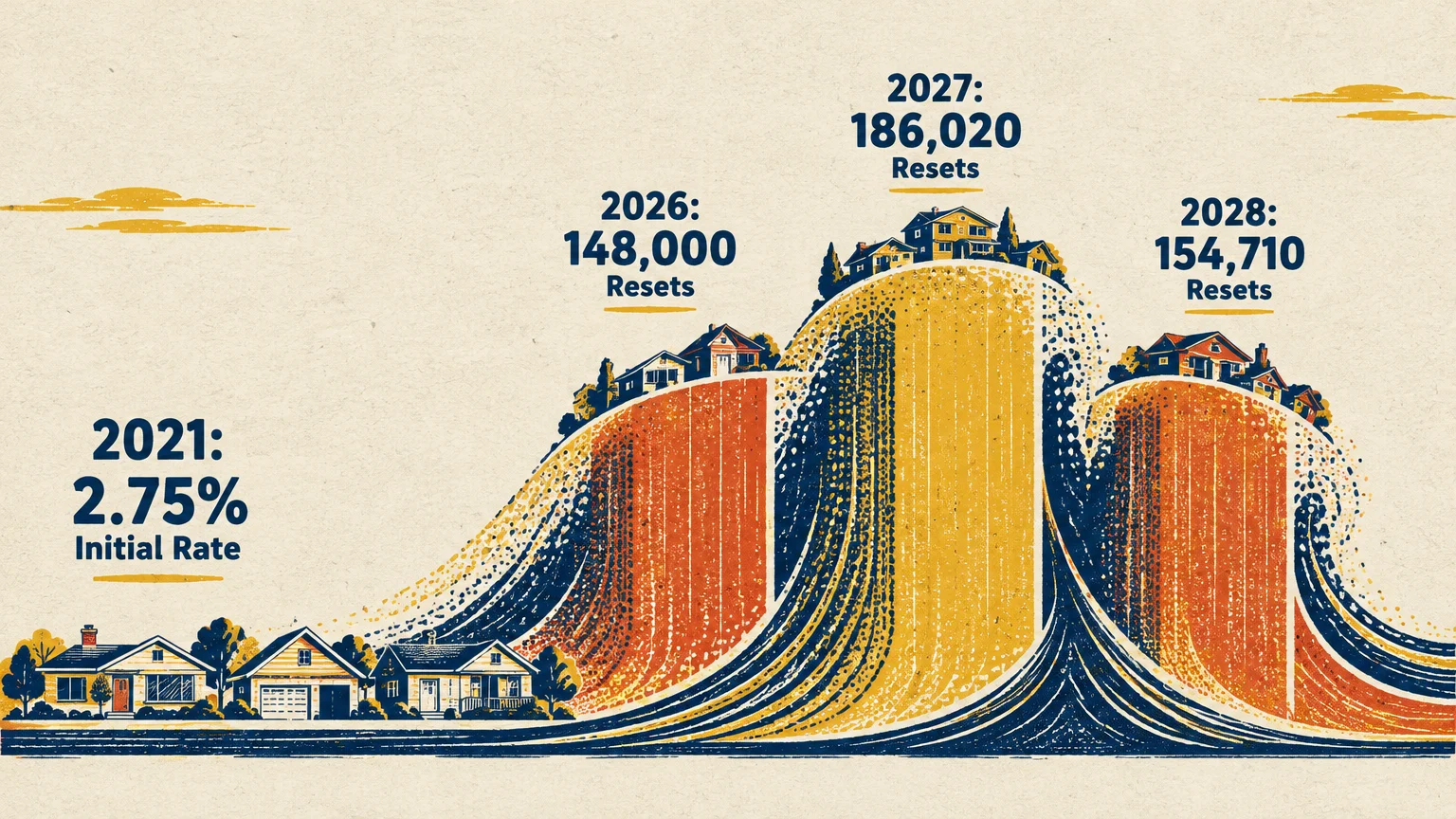
During the week ending January 7, 2021, Freddie Mac’s Primary Mortgage Market Survey recorded a 2.75% average initial rate on five-year hybrid ARMs alongside a record-low 2.65% on 30-year fixed mortgages. Later in November 2021, five-year ARM starter rates dipped as low as 2.53%.
Borrowers who chose those five-year hybrid loans enjoyed ultra-cheap payments for 60 months. Now the calendar has caught up, pushing early-2021 borrowers into their first adjustable-rate mortgage reset in 2026.
Data from Intercontinental Exchange and Optimal Blue (October 6, 2026) tracks 3.1 million active first-lien ARMs, representing 5.6% of all active U.S. mortgages and a five-and-a-half-year high. About one-third of those borrowers have already moved past their initial fixed period.
The coming wave will build before it peaks. Roughly 148,000 ARMs reset in 2026, climbing to 186,020 in 2027 and easing to 154,710 in 2028.
Most homeowners still sit on low fixed rates, as Cotality reported on November 11, 2026, that only 28% of existing U.S. mortgages carry rates above 5%. Serious delinquency on post-2010 ARMs also remains below 0.5%, showing borrowers have largely kept up so far.
Even with strong credit health, resetting into today’s rate environment delivers sticker shock. On November 12, 2026, Freddie Mac reported the average 30-year fixed rate at 7.11%, up from 6.24% a year earlier.
Bankrate placed the national average 5/1 ARM rate at 6.92% on November 17, 2026. The Mortgage Bankers Association weekly survey for November 11, 2026, recorded an average 7/6 SOFR ARM at 6.28% and 30-year fixed loans at 7.21%.
How an Adjustable-Rate Mortgage Reset Triggers a $1,000+ Payment Jump
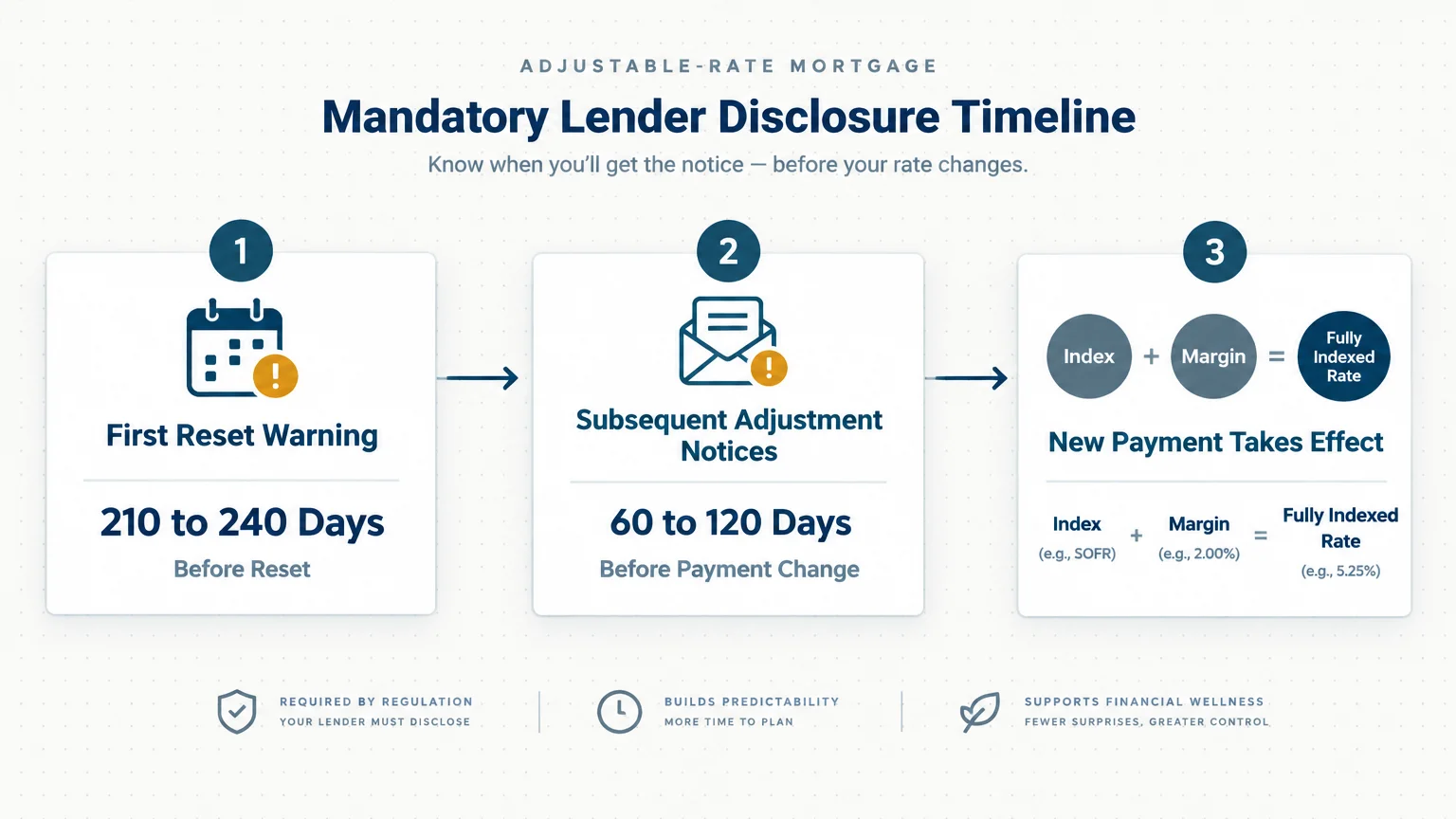
Your new rate after the introductory period is not guesswork. Lenders calculate every ARM rate increase using a simple formula spelled out in your promissory note: Index plus Margin equals your fully indexed rate.
The index tracks a benchmark market rate that moves with broader economic conditions. Conventional mortgages backed by Fannie Mae and Freddie Mac use the 30-Day Average Secured Overnight Financing Rate (SOFR), published by the New York Fed.
In early November 2026, daily SOFR averaged 3.94%, trading in a narrow range between 3.92% and 3.97%. Government-backed FHA and VA 5/1 ARMs typically track the 1-Year Constant Maturity Treasury (CMT), which reached 4.65% on November 13, 2026, up 26.36% year over year.
The margin is a fixed percentage your lender added when you closed the loan, and it never changes. Freddie Mac caps conventional SOFR ARM margins between 1.00% and 3.00%, with typical lender margins landing between 2.75% and 3.00%.
Historic Freddie Mac survey margins on 5/1 ARMs averaged 2.73% to 2.74% from 2020 through 2022. Combining a 3.94% SOFR index with a 2.75% to 3.00% margin produces a fully indexed rate of 6.69% to 6.94%.
Rate caps limit how fast your interest rate can climb toward that fully indexed figure at each step:
- Conventional 5/6 SOFR ARMs (2/1/5 caps): Your rate can rise no more than 2% at the first reset, 1% at each six-month adjustment after that, and 5% total above your starting rate.
- Conventional 7/6 and 10/6 SOFR ARMs (5/1/5 caps): Your rate can jump up to 5% on the very first adjustment, 1% every six months thereafter, and 5% lifetime above the initial rate.
- FHA and VA 5/1 ARMs (1/1/5 caps): Tied to the CMT index per Pennymac’s October 2026 guidelines, these loans adjust annually by at most 1% per year and 5% over the life of the loan.
To see how a mortgage payment increase crosses $1,000 a month, look at a $500,000 loan originated in early 2021 at 2.75%. Your initial principal and interest payment starts at $2,041 per month.
After 60 monthly payments, your remaining principal drops to roughly $442,480 with 25 years left on the schedule. When your 5/6 ARM hits its first 2% adjustment cap to 4.75%, your payment climbs to $2,523—an extra $482 each month.
Six months later, if market indexes hold steady, your rate climbs another 1% toward the 6.69% to 6.94% fully indexed zone. At 6.94%, your monthly payment reaches $3,110, adding $1,069 every month above your original 2021 payment.
Borrowers holding a 7/6 ARM with a 5% initial cap do not even get a phased ramp-up. Their loan can jump straight from 2.75% to the fully indexed rate on day one of the reset.
| Reset Stage ($500,000 Loan at 2.75% Start) | Interest Rate | Monthly Principal & Interest | Monthly Increase vs. 2.75% |
|---|---|---|---|
| Initial 5-Year Fixed Period (2021–2026) | 2.75% | $2,041 | $0 |
| First 5/6 ARM Reset (+2.00% Cap) | 4.75% | $2,523 | +$482 |
| Subsequent Reset (3.94% SOFR + 2.75% Margin) | 6.69% | $3,040 | +$999 |
| Subsequent Reset (3.94% SOFR + 3.00% Margin) | 6.94% | $3,110 | +$1,069 |
| Lifetime Rate Cap (+5.00% Above Start) | 7.75% | $3,342 | +$1,301 |
Smaller loan balances still feel substantial pressure. According to the Mortgage Bankers Association, the average new U.S. mortgage size reached $374,720 in September 2026, while Experian reported an average existing balance of $264,162 in June 2026.
A $374,720 loan from 2021 at 2.75% carries a $1,530 monthly payment initially. Reaching a 6.94% fully indexed rate pushes that payment to $2,331—an $801 monthly jump before factoring in rising property taxes or homeowners insurance.
For context, the Federal Housing Finance Agency reported an average monthly mortgage payment of $2,044 across all active U.S. loans in Q2 2026. State averages ranged from $1,189 in West Virginia to $2,996 in Washington, D.C.
Know Your ARM Reset Timeline and Legal Protections
Federal rules prevent your loan servicer from surprising you with a sudden bill hike. Under the Truth in Lending Act enforced by the Consumer Financial Protection Bureau (CFPB), servicers must send formal written notices well before your payment changes.
For your very first interest rate adjustment (12 CFR § 1026.20(d)), your servicer must mail an initial disclosure at least 210 days—and no more than 240 days—before the first adjusted payment comes due. That gives you roughly seven to eight months of runway to act.
Your initial ARM reset notice must arrive 210 to 240 days before the higher payment starts, and it must list estimated new payments, refinancing alternatives, modification options, and free housing counselor contacts.
Once your loan enters its adjustable phase, ongoing notices follow a shorter window under 12 CFR § 1026.20(c). Servicers must send your exact new rate and payment at least 60 days, and no more than 120 days, before each payment change.
Loans that adjust every 60 days or more frequently, along with certain pre-January 2015 mortgages, follow a 25-to-120-day notice window instead. Conventional SOFR loans also build in a 45-day lookback period, meaning your rate relies on the 30-Day Average SOFR published 45 days prior to adjustment.
If your 2021 loan originally referenced USD LIBOR, check your servicer correspondence carefully. USD LIBOR ceased publication after June 30, 2023, and Fannie Mae and Freddie Mac stopped purchasing LIBOR-indexed ARMs on January 1, 2021, and CMT-indexed ARMs on October 1, 2021.
Most legacy LIBOR loans automatically transitioned to a comparable SOFR-based replacement index under federal fallback rules. Confirming which benchmark currently governs your loan ensures your payment calculations match your servicer’s math.
Five Moves to Make Before Your ARM Rate Increases
Waiting until the first higher invoice lands limits your flexibility. Taking action during the 210-to-240-day notice window lets you compare every path on your own terms.
- Pull your original promissory note and closing disclosure. Locate your exact index, margin, initial cap, periodic cap, and lifetime cap so you can calculate your worst-case payment. Remember that Fannie Mae rules state an ARM rate can never adjust below its margin, even if benchmark rates plunge.
- Stress-test your monthly budget against the 2027 rate outlook. On October 28, 2026, the Federal Reserve voted 10–2 to hold its federal funds target range at 3.75% to 4.00%, with two members dissenting in favor of a quarter-point hike.
The effective federal funds rate stood at 3.88% on November 13, 2026, while the Fed’s September 2026 projections placed the median rate at 4.1% through 2027. Major forecasts compiled in November 2026 expect 30-year fixed rates to end 2027 between 6.4% (Goldman Sachs Research) and 7.5% (Fannie Mae ESR Group), averaging 7.0%.
In short, hoping for an immediate return to 3% or 4% mortgages is a risky financial plan. Build your household budget assuming mortgage rates hover near 6.4% to 7.1% over the next year.
- Compare refinancing into a fixed mortgage versus a fresh ARM. With refinance volume sitting 57% lower than a year earlier per the Mortgage Bankers Association, lenders are competing harder for qualified borrowers.
You can lock in payment certainty with a 30-year fixed loan around 7.11% or pay down principal faster with a 15-year fixed loan averaging 6.45%. Extending a $442,480 balance back out to 30 years at 7.11% lowers the payment to $2,976 compared to a 6.94% resetting ARM at $3,110.
Alternatively, resetting into a new 7/6 SOFR ARM at the November 2026 MBA average of 6.28% brings that same $442,480 balance down to $2,733 per month. Cotality’s November 2026 data shows ARMs now make up 20% of mortgage dollar volume, saving borrowers roughly $3,900 annually on a $500,000 loan compared to fixed options.
| Mortgage Option (Nov. 2026 Averages) | Average Rate | Monthly P&I ($442,480 Refinance, 30-Yr) | Best Fit for Resetting Homeowners |
|---|---|---|---|
| 30-Year Fixed (Freddie Mac PMMS) | 7.11% | $2,976 | Long-term stability if you plan to stay seven-plus years |
| 15-Year Fixed (Freddie Mac PMMS) | 6.45% | $3,841 (15-yr term) | High earners focused on rapid debt elimination |
| 7/6 SOFR ARM (MBA Survey) | 6.28% | $2,733 | Lower rate protection if you plan to sell or refinance by 2033 |
| 5/1 ARM (Bankrate Average) | 6.92% | $2,920 | Short-term bridge if you want five fixed years at a slight discount |
| 30-Year FHA (MBA Survey) | 6.98% | $2,938 (before MIP) | Borrowers with lower credit scores or smaller equity cushions |
- Shop multiple lenders before signing a refinance lock. Research from Bankrate’s Hidden Homeownership Tax report (November 5, 2026) revealed that 87% of borrowers in 2025 paid more than the lowest rate available by failing to shop competitively.
Request standardized Loan Estimates from at least three to five lenders—including your current servicer, a local credit union, and an online broker—within a single 14-day credit inquiry window. Comparing origination fees, discount points, and lender credits side by side often saves thousands upfront.
- Consider principal prepayments or a mortgage recast if refinancing fails to pencil out. If closing costs outweigh a tiny rate drop, throwing a lump sum toward principal before your reset shrinks the balance your new rate multiplies against.
Ask your servicer whether they offer a mortgage recast on your ARM, or verify how extra principal payments affect your next scheduled adjustment. Because ARMs re-amortize at each rate change, paying down principal naturally softens the recalculated monthly bill.

Tax Rules That Soften the Blow in 2026
Higher mortgage interest can reshape your annual tax return, though fewer homeowners benefit than you might expect. Under 2026 rules from the Internal Revenue Service (IRS), the basic standard deduction rises to $16,100 for single filers and $32,200 for married couples filing jointly.
Taxpayers age 65 and older receive an extra $2,050 deduction if single or $1,650 per spouse if filing jointly, alongside a temporary $6,000 bonus deduction for eligible older adults enacted in 2025. Your itemized deductions on Schedule A must clear those thresholds before mortgage interest produces any tax savings.
For borrowers who do itemize, the mortgage interest deduction remains capped on the first $750,000 of mortgage principal. Even with a $500,000 balance at 6.94%, paying roughly $30,000 in annual interest could push a married couple over the $32,200 standard deduction once state and local taxes join the tally.
One notable 2026 change helps homeowners who refinance with less than 20% home equity. Beginning with 2026 tax returns filed in 2027, private mortgage insurance (PMI) premiums are permanently tax-deductible again for qualifying itemizers under the One Big Beautiful Bill Act.
While a tax deduction never offsets a dollar-for-dollar mortgage payment increase, factoring realistic Schedule A savings into your net monthly housing cost prevents you from overstating the burden. Run both standard and itemized scenarios before deciding between paying down principal or keeping cash liquid.
Pitfalls to Watch For
Even financially savvy homeowners make costly errors when navigating an adjustable-rate mortgage reset. Watch out for these common traps as your adjustment date approaches:
- Waiting for the 60-day notice: By the time your exact dollar increase arrives two months out, underwriting a refinance can run past your first higher payment due date. Start comparing quotes as soon as your 210-to-240-day notice lands.
- Assuming your current lender offers the best deal: Loyalty rarely guarantees the lowest rate, as 87% of 2025 borrowers learned when skipping comparison shopping. Always pit your servicer’s retention offer against competing Loan Estimates.
- Ignoring your break-even timeline on closing costs: Refinancing costs thousands in title, appraisal, and lender fees. Divide total closing costs by your monthly savings to make sure you plan to keep the new loan past the break-even month.
- Forgetting escrow adjustments: Your lender’s reset notice calculates principal and interest only. Rising property tax assessments and homeowners insurance premiums can easily stack another $100 to $300 onto your total monthly draft.
- Overlooking conforming loan limits: For 2026, the Federal Housing Finance Agency set the baseline single-family conforming loan limit at $832,750, and $1,249,125 in designated high-cost areas. If your balance sits just above $832,750, paying down principal slightly before refinancing can help you avoid stricter jumbo underwriting.

Getting Expert Help
Running basic amortization numbers is easy, yet high-stakes housing choices often involve overlapping tax, credit, and cash-flow rules. Consider bringing in qualified, objective guidance in these specific situations:
- The projected payment strains your monthly essentials: Contact a housing counselor approved by the Department of Housing and Urban Development (HUD) at no cost. Counselors can review your budget and help you request a formal loan modification or forbearance plan before you miss a payment.
- You are debating liquidating investments to shrink your mortgage balance: Consult a fee-only Certified Financial Planner to compare guaranteed interest savings against capital gains taxes, retirement account penalties, and emergency fund liquidity.
- Your combined interest, PMI, and property taxes hover near the $32,200 joint standard deduction: Work with a CPA or enrolled agent to model your 2026 Schedule A tax savings accurately before locking a new loan structure.
- Your income changed since 2021 or you are self-employed: Speak with an independent mortgage broker who works with multiple wholesale lenders, especially if your loan approaches the $832,750 conforming threshold or requires bank-statement underwriting.
Frequently Asked Questions
How much can my 2.75% ARM go up at the first reset?
Your first jump depends entirely on your loan’s initial rate cap. Most conventional 5/6 SOFR ARMs cap the first increase at 2%, moving a 2.75% loan to 4.75%, while FHA and VA 5/1 ARMs cap the initial move at 1%.
Conventional 7/6 and 10/6 ARMs carry a 5% initial cap, meaning your rate can jump directly to the full index-plus-margin rate in a single adjustment. Check your promissory note so you know which cap applies to your mortgage.
Should I refinance my resetting ARM into a 7.11% fixed mortgage or another ARM?
If you plan to stay in your home for seven to ten years or longer and prioritize predictable monthly expenses, locking a fixed rate around 7.11% eliminates future adjustment risk. You also retain the option to refinance again if rates eventually decline.
If you expect to move or pay off the home within five to seven years, a fresh 7/6 SOFR ARM near 6.28% delivers immediate monthly relief. Run the break-even math on closing costs for both options before choosing.
When will my lender tell me my new ARM payment?
Federal Regulation Z requires your servicer to mail an initial adjustment estimate between 210 and 240 days before your first higher payment is due. That early letter outlines your projected rate and lists alternatives to help you prepare.
Your servicer must then send the exact final rate and dollar amount 60 to 120 days prior to the payment change. Ongoing resets after the first adjustment also follow that 60-to-120-day disclosure schedule.
Can I deduct the extra mortgage interest on my 2026 taxes?
You can only claim a tax benefit if you itemize deductions on Schedule A and your total deductions beat the 2026 standard deduction of $16,100 (single) or $32,200 (married filing jointly). Interest is deductible only on the first $750,000 of mortgage debt.
Starting with 2026 tax returns, qualifying itemizers can also deduct PMI premiums again. Ask a tax professional how much of your higher payment actually translates into tax relief.
Start by downloading your current mortgage statement, reviewing your reset caps, and collecting three competing refinance quotes before your 210-day clock runs down. Taking proactive steps this month gives you space to adjust your budget or lock a better loan structure without panic.
This is educational content based on general financial principles. Individual results vary based on your situation. Always verify current tax laws, investment rules, and benefit eligibility with official sources.
Last updated: November 2026. Financial regulations and rates change frequently—verify current details with official sources.