On November 12, 2026, the IRS announced higher 401(k) limits for 2027, raising the standard employee deferral cap to $25,500. That $1,000 boost gives you extra tax-advantaged room starting January 1, 2027.
Older savers gain even more flexibility through higher catch-up allowances, including an enhanced $11,750 tier for workers ages 60 through 63. Meanwhile, mandatory Roth catch-up rules and the new federal Saver’s Match reshape how different earners plan ahead.
Knowing your exact 2027 numbers now lets you adjust your payroll elections before your first January paycheck hits.
2027 401(k) Contribution Limits at a Glance
The Internal Revenue Service published the official 401(k) limits 2027 figures in News Release IR-2026-136 and Notice 2026-66. Every inflation adjustment takes effect on January 1, 2027, for the 2027 tax year.
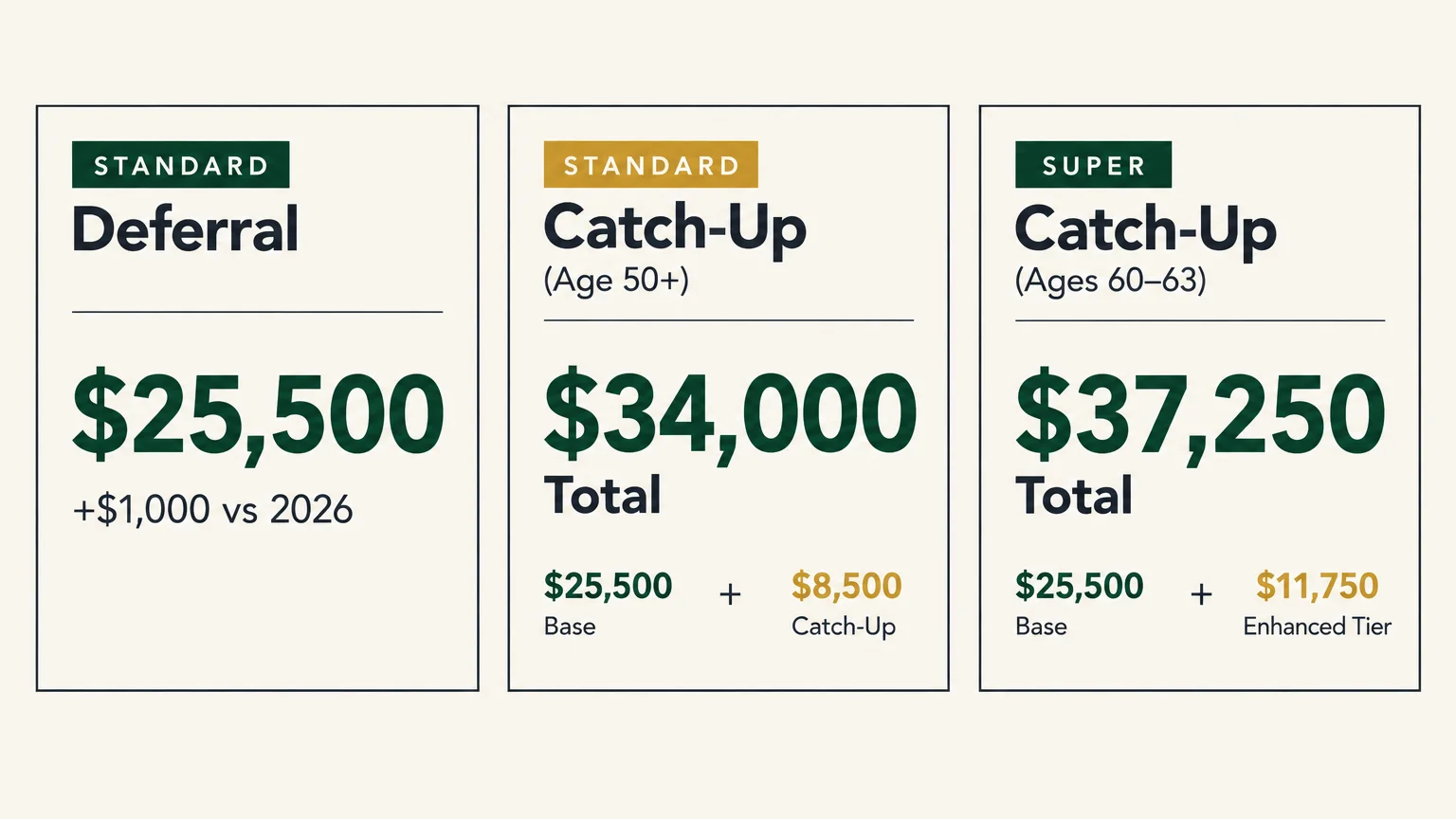
Your base elective deferral limit rises by $1,000—an increase of roughly 4.1% over 2026. This $25,500 cap covers traditional pre-tax contributions, designated Roth 401(k) deferrals, or a combination of both.
The same $25,500 employee cap applies across 403(b) plans, most governmental 457(b) plans, and the federal Thrift Savings Plan (TSP). You can review plan rules and annual notices directly on the IRS official website.
| Contribution Category | 2026 Limit | 2027 Limit | 2027 Change |
|---|---|---|---|
| Standard Employee Elective Deferral | $24,500 | $25,500 | +$1,000 |
| Standard Catch-Up (Age 50+) | $8,000 | $8,500 | +$500 |
| Total Employee Deferral (Age 50+) | $32,500 | $34,000 | +$1,500 |
| Enhanced Catch-Up (Ages 60–63) | $11,250 | $11,750 | +$500 |
| Total Employee Deferral (Ages 60–63) | $35,750 | $37,250 | +$1,500 |
| Combined Employee + Employer Cap (Section 415(c)) | $72,000 | $75,000 | +$3,000 |
| Starter 401(k) / Deferral-Only 403(b) | $6,000 | $6,500 | +$500 |
| Annual Plan Compensation Limit (Section 401(a)(17)) | $360,000 | $375,000 | +$15,000 |
Remember that 2026 limits remain active through December 31, 2026. If you want to finish maxing out your $24,500 limit for 2026, your final paycheck of the year is your deadline.
Keep the shared-limit rule in mind if you hold two jobs with 401(k) or 403(b) plans. The $25,500 ceiling applies to you as an individual taxpayer across all workplace plans combined, not per employer.
Catch-Up Contributions in 2027: Standard vs. Ages 60–63 Super Tier
Catch-up contributions 2027 rules offer two distinct tiers depending on the age you reach during the calendar year. You do not need to wait until your birthday arrives to begin contributing extra funds.
If you turn 50 or older at any point in 2027, you qualify for the standard $8,500 catch-up allowance. Combined with the $25,500 base deferral, your maximum employee contribution reaches $34,000 for the year.
Under SECURE 2.0, workers who attain age 60, 61, 62, or 63 in 2027 qualify for a much larger super catch-up limit. That special tier increases to $11,750 in 2027, up from $11,250 in 2026.
Adding that $11,750 allowance to your $25,500 base cap brings your total employee deferral potential to $37,250. That equals $1,500 more than eligible savers in that age bracket could defer in 2026.
- Ages 49 and under: Contribute up to $25,500 in employee deferrals.
- Ages 50 through 59: Contribute up to $34,000 ($25,500 base plus $8,500 standard catch-up).
- Ages 60 through 63: Contribute up to $37,250 ($25,500 base plus $11,750 enhanced catch-up, if your plan allows it).
- Ages 64 and older: Return to the standard $8,500 catch-up tier, for a $34,000 employee deferral cap.
Verify two crucial details with your benefits department before counting on the $11,750 tier. First, employers are permitted—not required—to offer the enhanced catch-up option for workers ages 60 through 63.
Second, watch the age-64 cliff if you turn 64 during 2027. Eligibility depends strictly on the age you turn by December 31, 2027, so turning 64 automatically drops your catch-up limit back to $8,500.
Always confirm with your plan administrator whether your workplace 401(k) supports the optional $11,750 catch-up tier for ages 60 through 63 before adjusting your payroll percentages.
Mandatory Roth Catch-Up Rules for High Earners Take Full Effect
Age is no longer the only factor shaping your catch-up strategy. Under SECURE 2.0 (IRC Section 414(v)(7)(A)) and IRS Notice 2026-66, high earners face a mandatory after-tax rule on catch-up dollars.
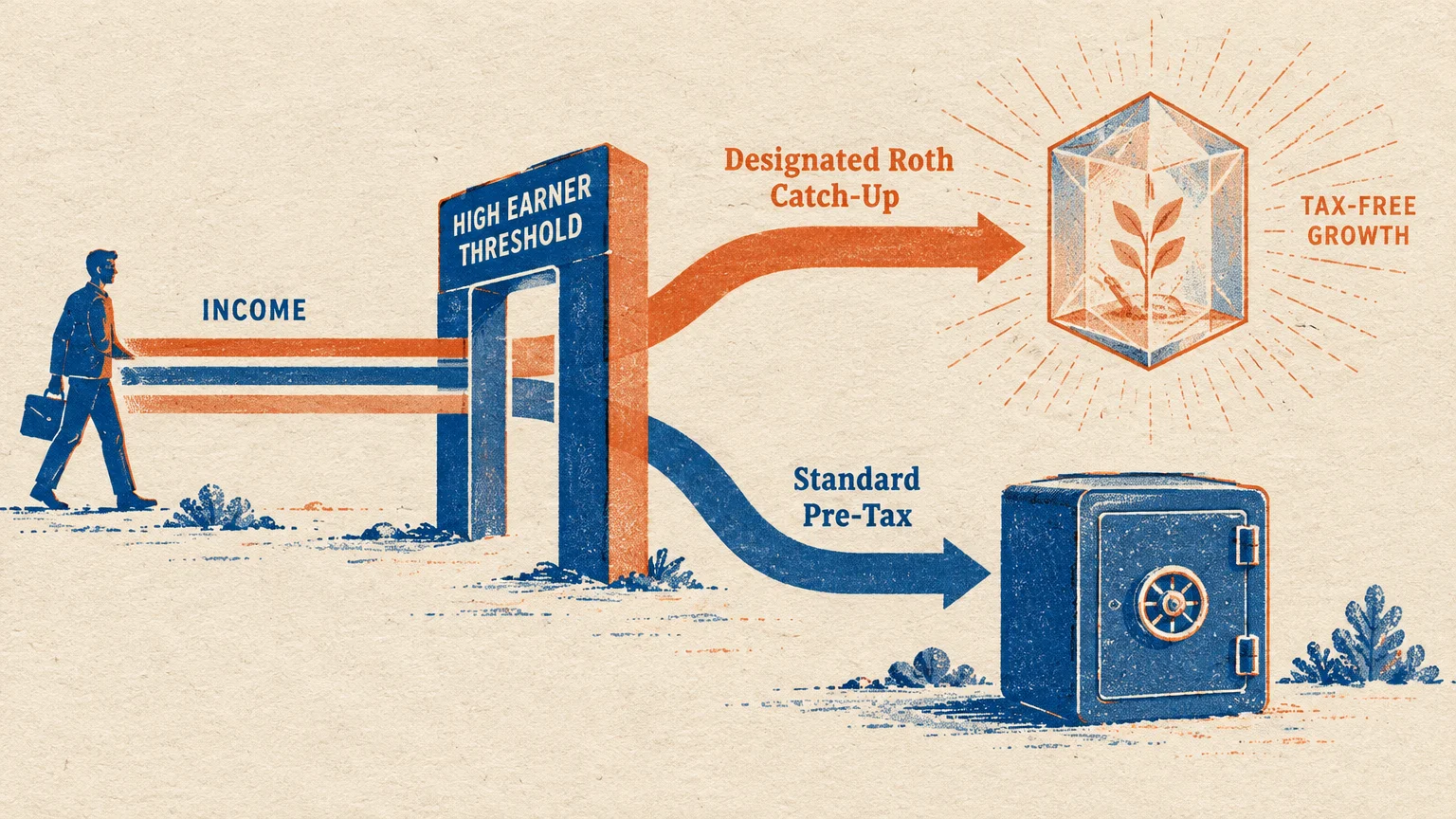
If your prior-year (2026) FICA wages from your plan-sponsoring employer exceeded $155,000, every catch-up dollar you contribute in 2027 must go into a Roth account. That threshold climbed from the $150,000 wage trigger based on 2025 pay.
While the statutory rule began taking effect in 2026, final IRS regulations published on September 16, 2025, formally govern compliance starting in 2027. Employers and payroll providers now enforce strict automated tracking around this $155,000 line.
Notice what this rule does—and does not—affect. You can still make all $25,500 of your regular base deferrals as pre-tax contributions if you choose.
Only the catch-up portion above $25,500—either $8,500 or $11,750—must be treated as after-tax Roth dollars. Those Roth catch-ups will not lower your 2027 taxable income, though qualified withdrawals in retirement come out tax-free.
This rule creates a serious trap if your employer’s plan lacks a Roth feature. When a 401(k), 403(b), or governmental 457(b) plan does not offer Roth contributions, employees above $155,000 cannot make any catch-up contributions at all.
Pay close attention to how the $155,000 test works so you do not miscalculate your eligibility:
- FICA wages only: The test looks at Social Security wages reported in Box 3 of your 2026 W-2, not your household adjusted gross income or investment earnings.
- Employer-specific look-back: Only 2026 FICA wages paid by the specific employer sponsoring your current 2027 plan count toward the $155,000 trigger.
- Job switchers: If you start with a brand-new employer in 2027 and earned zero 2026 FICA wages from that company, you can still make pre-tax catch-ups there in 2027.
If your 2026 wages hovered near $155,000, review your final 2026 paystub and upcoming W-2 carefully. Knowing your exact Box 3 figure prevents surprises when payroll rejects pre-tax catch-up elections.
Total Employer + Employee Limits and Executive Compensation Caps
Your $25,500 employee limit represents only one slice of the total retirement savings limits available inside a workplace plan. IRS Section 415(c) sets a much broader combined ceiling for total annual additions.
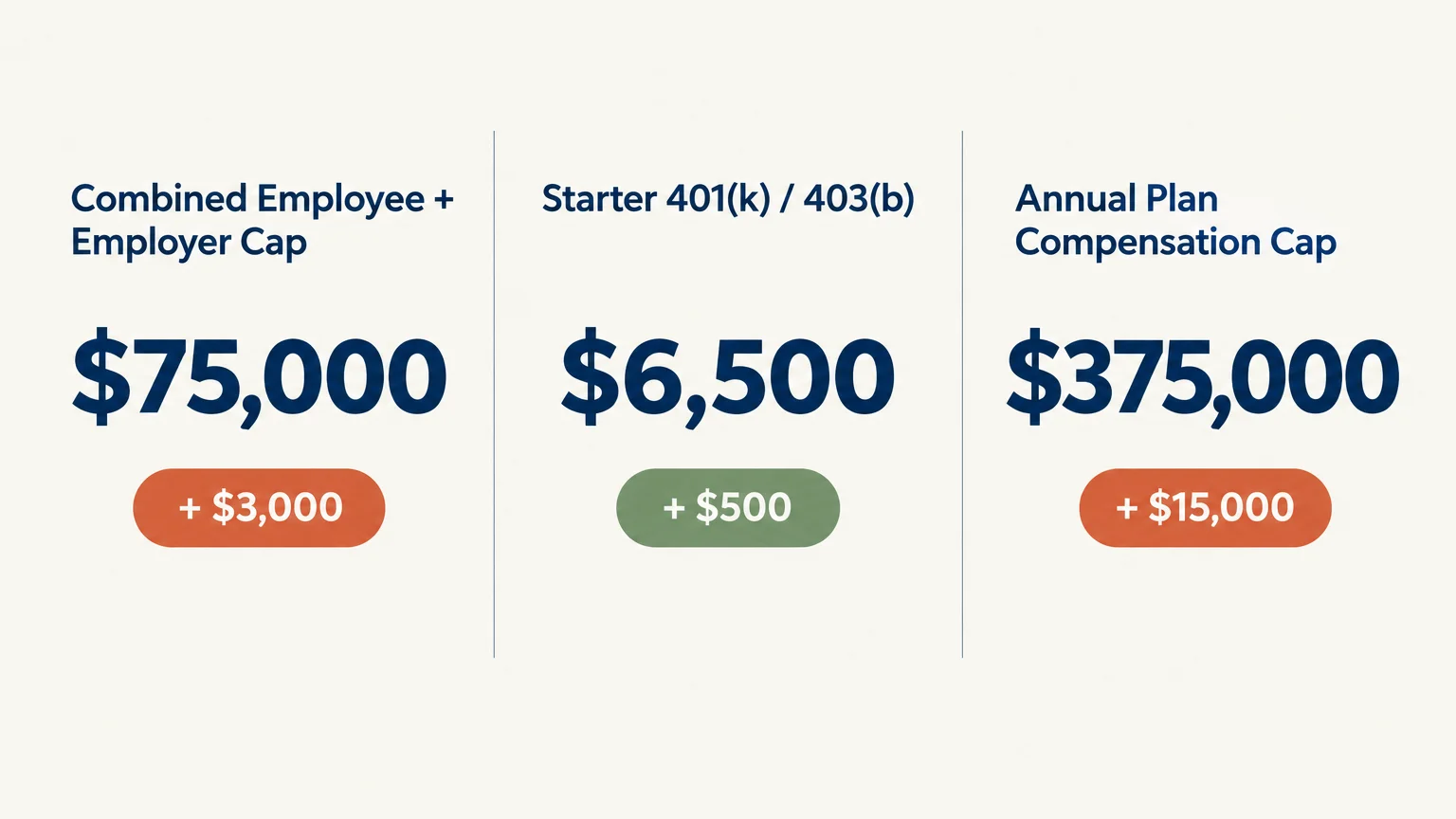
In 2027, the combined employee plus employer contribution limit increases to $75,000, up $3,000 from $72,000 in 2026. Total annual additions still cannot exceed 100% of your eligible compensation.
Age-based catch-up contributions sit completely outside that $75,000 ceiling. That means a worker age 50 to 59 could shelter up to $83,500 in total 2027 plan contributions ($75,000 plus $8,500).
A worker ages 60 through 63 in a qualifying plan could reach $86,750 combined ($75,000 plus $11,750). Those figures include your deferrals, employer matches, profit-sharing contributions, and any voluntary non-Roth after-tax contributions.
After subtracting your $25,500 base employee deferral from the $75,000 cap, $49,500 of room remains for employer contributions and after-tax additions. Savers whose plans permit after-tax contributions and in-plan Roth conversions often use this extra space for mega backdoor Roth strategies.
Notice 2026-66 also updates several key compensation and nondiscrimination thresholds that affect higher earners and business owners:
- Annual Plan Compensation Limit (Section 401(a)(17)): Increases to $375,000 in 2027, up from $360,000. Employer matches and profit-sharing formulas can only apply to your first $375,000 of pay.
- Highly Compensated Employee (HCE) Threshold: Increases to $170,000 in 2027, up from $160,000. Plans that fail annual nondiscrimination testing may cap or refund deferrals for HCEs.
- Key Employee Officer Threshold: Increases to $245,000 in 2027, up from $235,000, for top-heavy plan testing.
- Defined Benefit Plan Limit (Section 415(b)): Increases to $300,000 in annual benefits, up from $290,000 in 2026.
- Starter 401(k) / Deferral-Only 403(b) Limit: Increases to $6,500 in 2027 (up from $6,000), plus a $1,100 catch-up for workers age 50 and older.
If your employer designates you as an HCE because your prior-year pay topped the threshold, ask HR whether your plan uses a safe harbor match. Safe harbor plans bypass nondiscrimination testing so your 401(k) deferrals never get refunded unexpectedly.
How Other 2027 Retirement and Tax-Advantaged Limits Compare
Workplace plans do not adjust in isolation, and checking all IRS 2027 limits helps you coordinate every tax-advantaged account you own. Interestingly, not every retirement account rose alongside the 401(k) contribution limit 2027 update.
Under IRS Notice 2026-66, Traditional and Roth IRA limits stay flat for 2027 at $7,500 combined across all your IRAs. The IRA catch-up contribution for savers age 50 and older also remains unchanged at $1,100, keeping the total IRA cap at $8,600.
IRA limits remained flat because the IRS calculates IRA and 401(k) adjustments using different inflation benchmarks and rounding increments of $500. Even though IRA dollar limits stayed level, income phase-out ranges climbed significantly for 2027.
| Account / Rule | 2027 Single / Head of Household MAGI Phase-Out | 2027 Married Filing Jointly MAGI Phase-Out |
|---|---|---|
| Roth IRA Contributions | $158,000 – $173,000 | $250,000 – $260,000 |
| Traditional IRA Deduction (Covered by Workplace Plan) | $83,000 – $93,000 (Single) | $133,000 – $153,000 |
| Traditional IRA Deduction (Spouse Covered, You Are Not) | Not applicable | $250,000 – $260,000 |
| Federal Saver’s Match (50% Match Phases Out) | $20,500 – $35,500 (Single) / $30,750 – $53,250 (HOH) | $41,000 – $71,000 |
Married couples filing separately still face a $0 to $10,000 phase-out range for both Roth contributions and Traditional IRA deductions. Higher Roth MAGI thresholds mean more households can contribute directly without needing a backdoor Roth conversion.
Small-business and self-employed retirement accounts saw healthy increases in Notice 2026-66 as well. Standard SIMPLE IRA and SIMPLE 401(k) deferral limits rise to $17,500 in 2027, up from $17,000 in 2026.
Certain eligible small employers, such as those with 25 or fewer employees, can offer an elevated SIMPLE deferral limit of $19,100, up from $18,100. Catch-up caps for SIMPLE plans remain $4,000 (standard age 50+), $3,850 (plans using the higher base limit), and $5,250 (ages 60–63).
For freelancers and business owners using SEP IRAs, the maximum employer contribution rises to the lesser of 25% of compensation or $75,000, matching the Section 415(c) jump from $72,000. You can compare workplace and individual account mechanics using educational guides on Investor.gov.
Healthcare tax shelters increased too under IRS Rev. Proc. 2026-24 and Rev. Proc. 2026-35. Health Savings Account (HSA) limits rise to $4,500 for self-only coverage (up from $4,400) and $9,000 for family coverage (up from $8,750), plus an unchanged $1,000 catch-up at age 55 and older.
Medical Flexible Spending Account (FSA) limits increase to $3,500 in 2027, up from $3,400, while the maximum unused carryover rises from $680 to $700. Pairing an HSA with your 401(k) gives you triple tax advantages for future medical expenses.
New for 2027: How the Federal Saver’s Match Replaces the Saver’s Credit
Low- and moderate-income earners see one of the biggest structural changes in years starting in 2027. Under IRS Notice 2026-48 and Notice 2026-66 Footnote 2, the federal Saver’s Match officially replaces the nonrefundable Saver’s Credit for retirement contributions.
Previously, the Saver’s Credit only lowered your tax bill—meaning filers with zero federal tax liability often received no benefit. Beginning with tax year 2027, the federal government sends real matching dollars straight into your eligible 401(k) or IRA.
The program matches up to 50% of your first $2,000 in eligible annual retirement contributions, worth up to $1,000 per person per year. Married couples filing jointly where both spouses contribute can potentially claim up to $2,000 total in matching deposits.
Check your projected 2027 Modified Adjusted Gross Income (MAGI) against the exact phase-out brackets:
- Single filers: Receive the full 50% match below $20,500 MAGI, phasing out completely at $35,500.
- Head of Household filers: Receive the full 50% match below $30,750 MAGI, phasing out completely at $53,250.
- Married Filing Jointly: Receive the full 50% match below $41,000 MAGI, phasing out completely at $71,000.
You will claim the Saver’s Match on your 2027 federal tax return filed in early 2028. Once processed, the Treasury deposits the match directly into an eligible retirement plan or IRA that agrees to accept federal matching funds.
Two practical notes deserve attention before you file. First, ask your IRA custodian or 401(k) administrator in 2027 whether their account accepts Saver’s Match deposits, because participation by plan custodians is voluntary.
Second, the older Saver’s Credit does not disappear entirely—it remains active solely for ABLE account contributions for eligible individuals with disabilities. Those ABLE credit income ceilings sit at $83,000 (joint), $62,250 (head of household), and $41,500 (single) for 2027.

How to Update Your Payroll Contributions for 2027
Knowing the new numbers does not boost your nest egg until you update your payroll elections. Most employer portals let you set either a flat dollar amount per paycheck or a percentage of gross pay.
Follow these steps to dial in your exact 2027 schedule without over-contributing or missing employer matching dollars:
- Count your 2027 pay periods: Check whether you receive 26 biweekly paychecks, 24 semi-monthly paychecks, or 12 monthly paychecks in 2027.
- Calculate your target per-paycheck deferral: Divide $25,500 by your pay period count—roughly $981 per biweekly check, $1,062.50 per semi-monthly check, or $2,125 per month.
- Add your age-based catch-up amount: To hit $34,000 at age 50+, aim for about $1,308 biweekly or $1,417 semi-monthly; to hit $37,250 at ages 60–63, aim for about $1,433 biweekly or $1,552 semi-monthly.
- Check your employer’s match rules: Ask HR whether your company offers a year-end true-up if you max out early, or requires steady contributions across every paycheck to capture the full match.
- Verify Roth vs. pre-tax routing: If your 2026 FICA wages exceeded $155,000, confirm how your payroll system splits your $25,500 base deferrals from your mandatory Roth catch-up dollars.
- Finish 2026 deadlines first: Make any last 2026 401(k) adjustments before December 31, 2026, and remember you still have until April 15, 2027, to make 2026 IRA contributions.
If maxing out $25,500 feels out of reach right now, focus on capturing 100% of your employer’s matching contribution first. Then schedule an automatic 1% escalation every year so your savings rate climbs smoothly as your pay grows.
For broader guidance on balancing workplace retirement savings with emergency funds and high-interest debt, explore the free planning resources at the Consumer Financial Protection Bureau.
Common Mistakes to Avoid
Even experienced savers lose tax advantages or employer matches when new IRS thresholds roll out. Watch out for these frequent errors as 2027 begins:
- Exceeding $25,500 across two employers: Payroll systems at a new job cannot see what you already contributed at a former job earlier in 2027. Track your year-to-date deferrals manually so you do not trigger excess deferral penalties.
- Maxing out early without a true-up match: If your employer matches per paycheck without a year-end true-up, hitting $25,500 in September means forfeiting matching money for October through December.
- Assuming your 401(k) offers the $11,750 super catch-up: Some employers never updated plan documents for the optional ages 60–63 tier. Verify plan eligibility before projecting $37,250 in deferrals.
- Ignoring the $155,000 FICA catch-up rule: High earners whose plans lack a Roth option could find their catch-up contributions blocked entirely until their employer adds a Roth feature.
- Confusing 401(k) and IRA contribution deadlines: 2027 401(k) deferrals must occur through payroll by December 31, 2027, whereas 2027 IRA contributions remain open until Tax Day in April 2028.
You can also check general investor education materials on workplace retirement accounts through FINRA or verify Social Security wage-base history through the Social Security Administration.

Professional vs. Self-Guided
Many workers can manage their 2027 401(k) updates alone in ten minutes, while complex tax profiles benefit from professional guidance. Match your situation to the scenarios below:
- Single W-2 job with straightforward goals (Self-Guided): If you earn a steady salary under $155,000 and simply want to capture your employer match or hit $25,500 evenly across 26 paychecks, adjusting your payroll portal yourself works cleanly.
- Near the $155,000 Roth catch-up or $170,000 HCE line (Consider Professional): When bonuses, overtime, or RSUs push your FICA wages near $155,000 or $170,000, a CPA can help model pre-tax vs. Roth tax brackets and plan around potential HCE refunds.
- Targeting the $75,000 total cap via mega backdoor Roth (Professional): Coordinating base deferrals, employer matches, non-Roth after-tax contributions, and in-plan Roth conversions across multiple plans requires precise Section 415(c) tracking.
- Balancing side-business income or Saver’s Match MAGI limits (Professional): If you combine a W-2 401(k) with a SEP IRA, or want to lower MAGI via pre-tax 401(k) deferrals to unlock the Saver’s Match or direct Roth IRA eligibility, a CFP or CPA can optimize every dollar.
Frequently Asked Questions About 2027 401(k) Limits
What is the maximum 401(k) contribution limit for 2027?
For 2027, the standard employee deferral limit is $25,500. Workers age 50 and older can contribute up to $34,000 with the $8,500 catch-up, while eligible workers ages 60 through 63 can reach $37,250.
Including employer matches and profit-sharing, total combined contributions under Section 415(c) can reach $75,000—or $83,500 at age 50+ and $86,750 at ages 60 through 63.
Who qualifies for the $11,750 super catch-up contribution in 2027?
You qualify if you turn age 60, 61, 62, or 63 at any point during calendar year 2027 and your employer’s plan adopts this SECURE 2.0 feature. Once you turn 64, your catch-up limit returns to the standard $8,500.
Do employer matching contributions count toward the $25,500 limit?
No, employer matches and profit-sharing contributions do not count against your $25,500 personal deferral cap. Instead, your deferrals plus all employer contributions share the broader $75,000 Section 415(c) annual limit.
What happens if I earned over $155,000 in 2026 and want to make catch-up contributions in 2027?
If your 2026 FICA wages from your current plan-sponsoring employer topped $155,000, your 2027 catch-up contributions must go into a Roth 401(k) account. You can still contribute your base $25,500 pre-tax, but if your plan offers no Roth option, you cannot make catch-up contributions at all.
Your Next Steps for 2027
Log into your employer’s retirement portal this week to review your current deferral percentage, verify whether your plan offers a Roth option and the ages 60–63 catch-up tier, and confirm your 2026 FICA wage total. Setting your updated contribution election before January ensures every 2027 paycheck works toward your retirement goals automatically.
This article provides general financial education and information only. Everyone’s financial situation is unique—what works for others may not work for you. For personalized advice, consider consulting a qualified financial professional such as a CFP or CPA.
Last updated: November 2026. Financial regulations and rates change frequently—verify current details with official sources.