Collecting both a pension and full Social Security used to be out of reach for millions of public servants. Federal law changed dramatically in 2025, wiping out two major benefit cuts for teachers, firefighters, and police officers.
Yet many retirees still see smaller combined checks than they expect. Private pension offsets, dual-entitlement limits, early claiming rules, and federal taxes still trim your monthly retirement income.
Understanding which rules disappeared and which ones remain helps you protect every dollar you earned.
At a Glance: Why Your Pension Might Still Affect Your Social Security
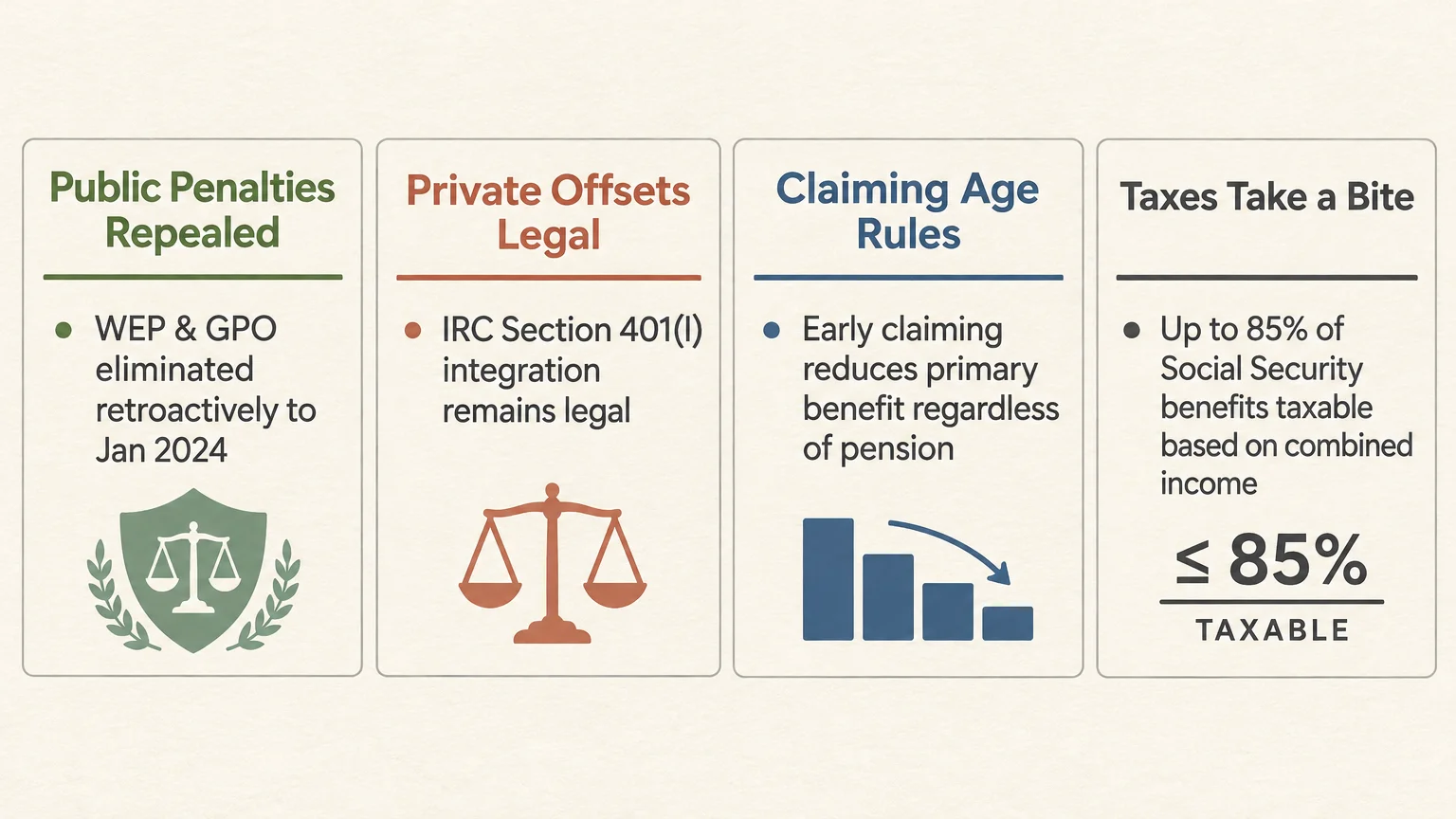
Major legislation reshaped public retirement rules, but several traps still reduce combined payouts in 2026. Keep these four realities in mind as you plan your retirement income:
- Public pension penalties are gone: The Social Security Fairness Act repealed the Windfall Elimination Provision (WEP) and Government Pension Offset (GPO) retroactively to January 2024.
- Private pension offsets remain legal: Under Internal Revenue Code section 401(l), private employers can still reduce your company pension payout based on your Social Security benefit.
- Claiming rules still cut checks: Working before Full Retirement Age, claiming early, or triggering dual-entitlement rules reduces your monthly Social Security check regardless of your pension.
- Taxes take a bite: Pension checks push up your IRS combined income, potentially making up to 85% of your Social Security benefits taxable.
The Social Security Fairness Act: What Changed for Public Employees
For decades, retirees who worked in government jobs outside the Social Security system faced steep benefit reductions. On January 5, 2025, Congress enacted the Social Security Fairness Act, repealing both WEP and GPO.
The bill passed with broad bipartisan support—327 to 75 in the House in November 2024 and 76 to 20 in the Senate in December 2024. Those votes ended benefit offsets that had been part of federal law since 1983.
The repeal applies retroactively to benefits payable for January 2024 and later, per the Social Security Administration (SSA). Any benefit months before January 2024 remained subject to the old reductions.
SSA identified over 2.8 million current beneficiaries—and over 3.2 million broader affected records—whose monthly checks had been cut or eliminated. Automatic monthly adjustments began on February 25, 2025, with most recipients seeing larger deposits by April 2025.
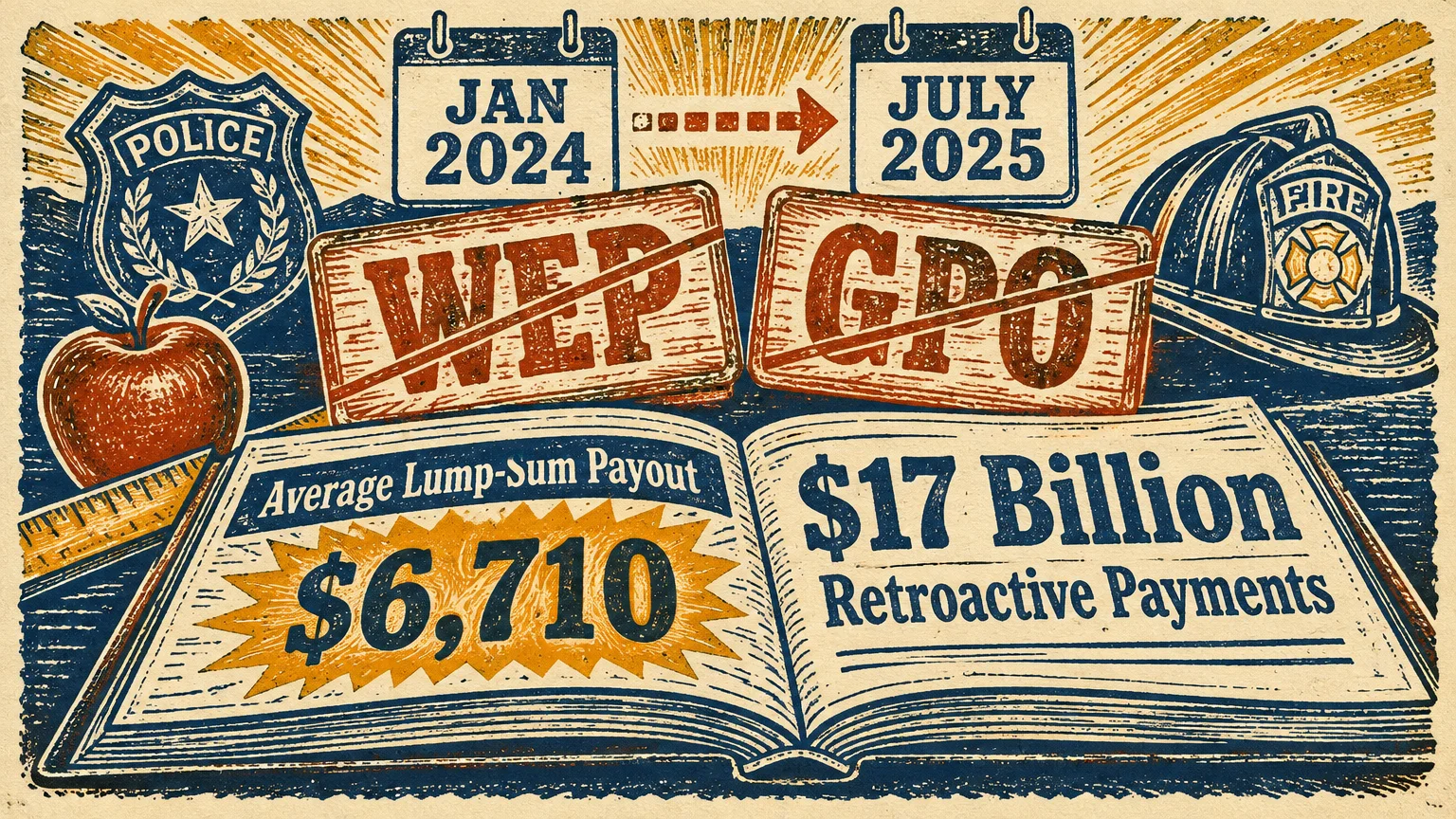
By July 7, 2025, SSA finished sending more than 3.1 million retroactive payments totaling $17 billion, five months ahead of schedule. Early 2025 lump-sum payouts averaged $6,710 per eligible retiree.
While the repeal restored billions to public workers, it also accelerated financial strain on the system. The Congressional Budget Office (CBO) estimated that repealing WEP and GPO increases Social Security outlays by $196 billion over 10 years through 2034.
In 2026 projections, CBO estimates the Old-Age and Survivors Insurance trust fund will reach insolvency by mid-2032—six months earlier than previously projected. Without congressional action, that shortfall would trigger automatic benefit cuts of 26% to 28%, or 23% in 2033 if trust funds are combined.
Repealing WEP and GPO restored full earned benefits to millions of public workers, yet it did not eliminate every rule that reduces combined retirement income.
What WEP and GPO Used to Cut—and Why Knowing Still Matters
Even though WEP and GPO are repealed, understanding how they worked helps you check whether you missed back pay or still need to file a claim. According to SSA, roughly 72% of state and local public employees already paid Social Security taxes and never faced these cuts.
The remaining 28%—roughly 6.5 million to 6.6 million workers—held non-covered government positions without Social Security withholding. That group included many public school teachers, police officers, firefighters, and pre-1984 federal workers under the Civil Service Retirement System (CSRS).
By contrast, federal employees hired after 1983 under the Federal Employees Retirement System (FERS) pay the standard 6.2% Social Security payroll tax. Retirees with certain foreign pensions also faced WEP reductions under the old rules.
How the Old WEP Formula Worked
Social Security calculates your Primary Insurance Amount using a progressive formula that replaces 90% of your first tier of average indexed monthly earnings. It then replaces 32% of the second tier and 15% of earnings above that.
Under WEP, workers with a non-covered pension and 20 or fewer years of substantial covered earnings—$31,275 in 2024—saw that 90% factor drop as low as 40%. The reduction phased out completely once a worker reached 30 years of substantial covered work.
The maximum monthly WEP penalty climbed to $558 in 2023 and $587 in 2024, capped at half the non-covered pension. If you started a second career in the private sector after teaching or policing, WEP likely shrank your earned check.
How the Old GPO Formula Worked
Enacted in 1977 and set to a two-thirds cut in 1983, GPO targeted spousal and survivor benefits rather than your own work record. It reduced any Social Security spousal or widow benefit by two-thirds of your non-covered government pension.
SSA data from 2022 showed GPO affected 734,601 people—roughly 12.6% of all 5.84 million spousal and survivor beneficiaries. The National Education Association reported that over 70% of affected retirees lost their entire spousal or survivor check.
Why Non-Filers Must Still Act
If you never applied for Social Security because GPO or WEP would have wiped out your check, SSA cannot adjust your account automatically. You must submit a new application to claim your restored benefits.
Here is the catch: retroactive pay on new applications is generally limited to up to six months before your filing month. Waiting to apply costs you permanent monthly checks you cannot recover back to January 2024.
Why Private Retirees Still Lose Out: Pension Integration Rules
Public employees are no longer penalized on their Social Security checks, yet millions of private-sector workers face the reverse problem. Federal law still allows private companies to reduce your employer pension payout because you qualify for Social Security.
This practice is called Social Security integration, and it remains completely legal under Internal Revenue Code section 401(l) and related Treasury regulations. Enacted under the Tax Reform Act of 1986, these rules let defined-benefit plans coordinate payouts with federal benefits.
In an integrated offset plan, your employer promises a pension formula—then subtracts a portion of your projected Social Security benefit from your company check. Under IRC section 401(l) and AARP guidance, that offset can reduce your accrued pension by up to 50%.
Notice which check shrinks under private integration rules. Social Security still pays your full earned benefit, while your private pension administrator trims the monthly check coming from the company plan.
Many workers never spot this reduction until they request a formal pension estimate near retirement. Your HR summary plan description spells out whether your pension uses an offset formula or an excess formula.
If you have a private defined-benefit pension, take these steps before choosing your retirement date:
- Request your plan document: Ask your benefits administrator for the full summary plan description and look for terms like Social Security offset or integration.
- Check the offset calculation date: Verify whether the plan uses your actual Social Security earnings history or an estimated wage projection, which can overstate your cut.
- Compare lump-sum vs. annuity options: Confirm how the offset affects a monthly pension annuity compared with rolling a lump sum into an IRA.
Other Rules That Trim Your Combined Checks in 2026
Even without WEP, GPO, or private pension integration, standard Social Security rules still stop many retirees from collecting every theoretical dollar. Three core rules govern how much lands in your bank account each month.
Social Security’s Dual-Entitlement Rule
Repealing GPO did not change dual-entitlement rules for workers who paid Social Security taxes throughout their careers. If you earned your own retirement benefit and also qualify for a spousal benefit, you cannot stack both checks in full.
SSA pays your own earned retirement benefit first, then reduces any spousal or survivor benefit dollar-for-dollar by that amount. You effectively receive whichever single amount is higher—not both checks added together.
For example, suppose your own earned benefit is $1,600 per month and your spousal benefit would be $1,800. SSA pays your $1,600 plus a $200 spousal top-up, totaling $1,800 rather than $3,400.
The Retirement Earnings Test
Many retirees start collecting a pension in their late 50s or early 60s, claim Social Security early, and pick up part-time work. If you claim Social Security before Full Retirement Age and keep earning wages, SSA temporarily withholds part of your benefit.
In 2026, SSA withholds $1 in benefits for every $2 you earn above $24,480 per year, or $2,040 per month. That limit rises to $25,560 per year, or $2,130 per month, in 2027.
A higher threshold applies during the calendar year you reach Full Retirement Age. In 2026, SSA withholds $1 for every $3 earned above $65,160 per year ($5,430 per month), rising to $67,920 ($5,660 per month) in 2027.
Note that pension payouts, IRA withdrawals, and investment dividends do not count toward the earnings limit—only active wages or net self-employment income count. Once you reach Full Retirement Age, the earnings test disappears completely.
Early Claiming Reductions vs. Delayed Credits
Your claiming age permanently shapes how your Social Security check compares to your pension. For anyone born in 1960 or later, Full Retirement Age is 67; for those born in 1959, it is 66 and 10 months.
Claiming as early as age 62 permanently locks in a reduced monthly check. Waiting past Full Retirement Age earns delayed retirement credits of 8% per year up to age 70.
In 2026, the maximum possible monthly Social Security benefit illustrates how steep that gap is: $2,969 at age 62, $4,152 at Full Retirement Age, and $5,181 at age 70. Meanwhile, the average retired-worker benefit stands at $2,092.17 per month as of November 2026.
Retirees receive a 2.8% cost-of-living adjustment (COLA) in 2026, followed by a 3.6% COLA taking effect in January 2027 for nearly 72 million beneficiaries. That 2027 increase projects to lift the average retired-worker check to roughly $2,170 per month.
Unlike Social Security, many private pensions offer no COLA at all, losing purchasing power every year inflation persists. Using your pension to cover expenses in your early 60s lets your Social Security benefit keep growing, earning 8% annually after Full Retirement Age until age 70.
Public vs. Private Pension Rules: A Side-by-Side Comparison
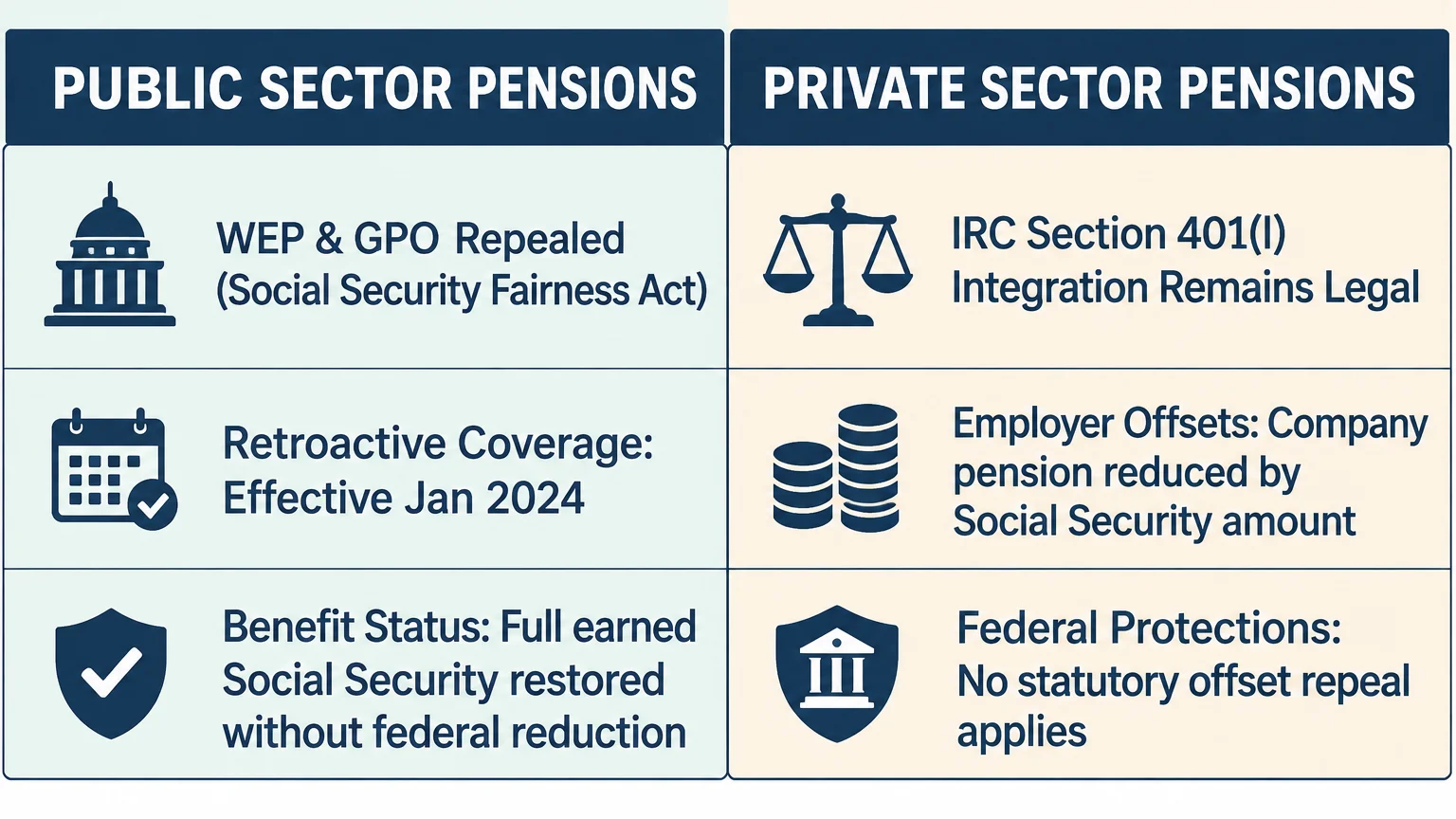
Because public and private pensions interact with Social Security in opposite ways, comparing your exact situation prevents costly surprises. The table below outlines how different pension types affect your combined retirement income in 2026.
| Retiree Category | Which Check Gets Reduced? | Maximum Reduction Rule | 2026 Status |
|---|---|---|---|
| Non-covered public employee (pre-2025 rules) | Social Security retirement, spousal, or survivor check | Up to $587/month WEP cut (2024); 66.7% GPO spousal cut | Repealed retroactively to Jan. 2024 |
| Non-covered public employee (today) | Neither check reduced by WEP or GPO | Full earned Social Security plus full government pension | Active; non-filers must apply |
| Private pension with offset integration | Employer pension check | Up to 50% of accrued pension before offset (IRC 401(l)) | Still legal and active |
| Covered worker claiming spousal benefit | Social Security spousal or survivor add-on | Dollar-for-dollar offset by your own earned benefit | Still active |
| Pensioner working before Full Retirement Age | Social Security check (temporarily withheld) | $1 per $2 above $24,480 in 2026 ($25,560 in 2027) | Still active |
How Taxes Shrink Both Checks—and New 2026 Relief
Even when neither your pension nor your Social Security faces an offset, federal taxes can quietly claw back a sizable share of both checks. Your pension income counts directly toward the formula the Internal Revenue Service (IRS) uses to tax Social Security.
IRS rules base Social Security taxation on your combined income—your adjusted gross income, plus nontaxable interest, plus half of your annual Social Security benefits. Those base thresholds have never been indexed for inflation.
For single filers, up to 50% of Social Security benefits become taxable when combined income lands between $25,000 and $34,000, and up to 85% above $34,000. For married couples filing jointly, the 50% tier runs from $32,000 to $44,000, jumping to 85% above $44,000.
Because a modest $30,000 or $40,000 pension pushes most households straight past $44,000 in combined income, pensioned retirees routinely hit the 85% taxable tier. However, recent federal tax legislation softens that blow through 2028.
The New $6,000 Senior Tax Deduction (2025–2028)
The 2025 tax law—the One Big Beautiful Bill Act—did not eliminate federal taxes on Social Security benefits outright. Instead, per IRS guidance updated in September 2026, it created an enhanced deduction of $6,000 per person age 65 or older for tax years 2025 through 2028.
Married couples filing jointly where both spouses are 65 or older can claim $12,000 in extra deductions on top of their regular standard deduction. A White House Council of Economic Advisers analysis cited by Fidelity estimates that only about 12% of seniors still owe federal tax on benefits after applying this relief.
Higher-income pensioners still face a phaseout, though. The deduction shrinks by 6% of your modified adjusted gross income above $75,000 for single filers or $150,000 for joint filers, disappearing completely at $175,000 single or $250,000 joint.
Retroactive Lump Sums and State Taxes
If you received a retroactive Social Security Fairness Act payout during 2025, that lump sum appeared on your 2025 Form SSA-1099 issued in January 2026. Receiving back pay for 2024 alongside regular 2025 checks can temporarily spike your income into a higher tax bracket or Medicare surcharge tier.
Fortunately, state taxes are far lighter than federal rules. Only eight to nine states still tax Social Security benefits in 2026, with states like West Virginia reaching a 100% state exemption in 2026.
You can verify how your state treats both public pensions and Social Security through USA.gov Benefits or your state department of revenue before finalizing your withholding.

Avoiding Common Errors When Coordinating a Pension and Social Security
Rules surrounding pensions and Social Security have shifted rapidly, making outdated assumptions expensive. Watch out for these frequent mistakes as you map out your retirement cash flow.
- Assuming SSA will find you automatically: If you never applied for spousal or retirement benefits because old WEP or GPO rules zeroed them out, SSA will not send a check until you file—and new claims generally cap retroactivity at six months.
- Forgetting the 40-credit work requirement: Even without WEP, you still need 40 Social Security work credits to collect your own retirement benefit. In 2026, earning one credit requires $1,890 in covered wages, and covered workers pay 6.2% payroll tax on earnings up to $184,500 ($192,300 in 2027).
- Confusing pension income with earned wages: Pension distributions do not trigger the Retirement Earnings Test, so you do not have to delay Social Security purely because your pension exceeds $24,480.
- Overlooking Medicare Part B surcharges: Large pension withdrawals combined with a retroactive Social Security payout can trigger higher Medicare premiums two years later, so review Medicare.gov income brackets before taking extra distributions.
- Ignoring private offset math: Counting both an unreduced private pension estimate and a full Social Security statement can leave you short if your employer’s plan integrates Social Security under IRC section 401(l).
Taking time to verify your exact Social Security statement alongside your pension benefit letter protects your monthly budget from nasty surprises. Checking both documents side by side takes less than an hour and gives you reliable numbers for your household spending plan.
When DIY Isn’t Enough
Basic benefit calculators handle simple careers well, yet combining pensions and Social Security often creates edge cases where a qualified professional pays for themselves. Consider hiring a fee-only planner from the Certified Financial Planner Board or a CPA in these four scenarios:
- You received a large retroactive lump sum: An accountant can run a lump-sum election calculation on your 2025 tax return to see whether attributing prior-year Social Security back pay to 2024 lowers your tax bill.
- Your private pension includes an offset formula: A financial planner can audit your employer’s offset calculation and compare taking the reduced monthly annuity against rolling over a lump sum.
- You and your spouse have mixed covered and non-covered careers: Coordinating dual-entitlement limits, survivor protections, and 8% delayed retirement credits requires modeling multiple claiming ages across both lifetimes.
- Your combined pension and withdrawals approach phaseout limits: Careful tax planning between ages 65 and 70 can keep your modified adjusted gross income below the $75,000 single or $150,000 joint thresholds for the $6,000 senior deduction.
Frequently Asked Questions
Can I collect a full government pension and full Social Security in 2026?
Yes, if you earned enough work credits under Social Security, you can collect both in full. The Social Security Fairness Act repealed WEP and GPO retroactively to January 2024, ending federal penalties on non-covered public pensions.
Did the repeal of WEP and GPO eliminate private pension offsets?
No, the repeal only ended reductions to Social Security benefits for government and foreign pensions. Private employers can still reduce your company pension check under Internal Revenue Code section 401(l) Social Security integration rules.
Do I still have to pay taxes on Social Security if I have a pension?
Possibly, because your pension counts toward IRS combined income thresholds starting at $25,000 for single filers and $32,000 for joint filers. However, the $6,000 per-person senior deduction for 2025 through 2028 eliminates federal benefit taxes for most middle-income retirees.
What if I never applied for spousal benefits because of the old GPO rule?
You must submit an application to SSA immediately because non-filers do not receive automatic adjustments. Retroactive payments for newly filed claims are generally capped at six months before the month you apply.
Your Next Steps for a Stronger Retirement Plan
Start by logging into your online Social Security account to confirm your earnings record and verify whether any non-covered pension adjustments still appear. Next, ask your public or private pension administrator for a current benefit estimate showing whether any offset applies to your monthly check.
Reviewing both income streams alongside current 2026 tax thresholds puts you back in control of your retirement paycheck. This article provides general financial education and information only. Everyone’s financial situation is unique—what works for others may not work for you. For personalized advice, consider consulting a qualified financial professional such as a CFP or CPA.
Last updated: November 2026. Financial regulations and rates change frequently—verify current details with official sources.