Your 2027 Social Security notice is arriving online in late November 2026, delivering a 3.6% cost-of-living adjustment. Knowing which lines on that one-page letter control your real deposit lets you set your 2027 budget in just two minutes.
Your gross raise tells only part of the story because the standard Medicare Part B deduction and potential income-related surcharges shrink what hits your bank account. Federal tax withholding and work limits can change your take-home pay even further.
Checking your personalized numbers inside your online account today helps you confirm exact payment dates and adjust withholding early. You can catch billing surprises well before your January deposit arrives.
The 2-Minute Checklist for Your 2027 COLA Notice
On October 14, 2026, the Social Security Administration (SSA) announced a 3.6% cost-of-living adjustment for 2027. This marks the largest increase since 2023 and steps up from the 2.8% adjustment applied in 2026.
The SSA calculates this increase from third-quarter inflation data using the Consumer Price Index for Urban Wage Earners and Clerical Workers. Between the third quarter of 2025 and the third quarter of 2026, that index rose from 317.265 to 328.746.
Roughly 76 million Americans will see this 2027 Social Security increase on their statements. That group includes nearly 72 million Social Security beneficiaries and about 7.3 million Supplemental Security Income (SSI) recipients, with some individuals receiving both.
When you open your 2027 COLA notice, the SSA presents everything on a simplified, one-page plain-language letter. You do not need to decode pages of legal jargon to find your actual cash flow.
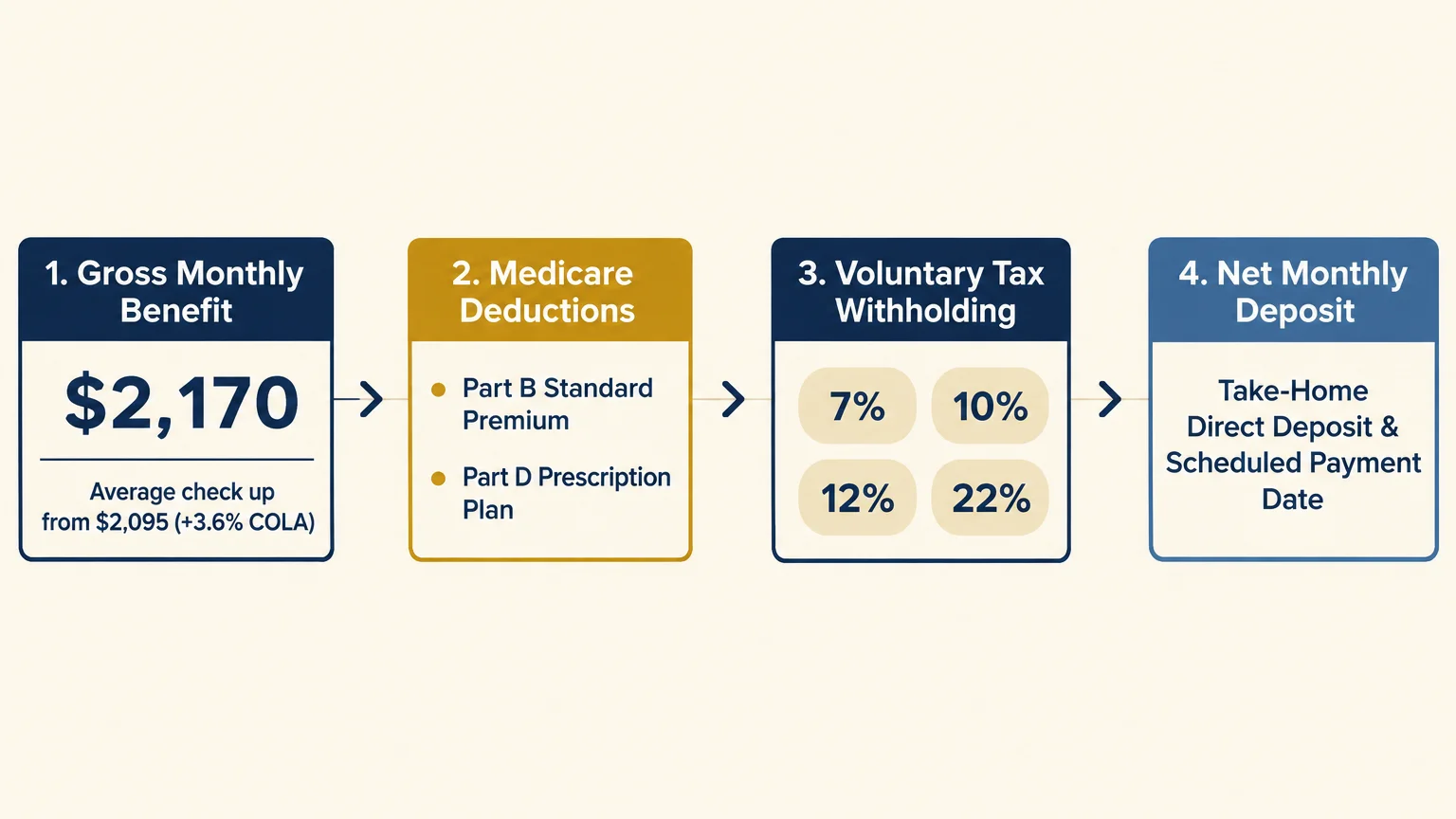
Focus on these four numbers first to assess your 2027 budget in under two minutes:
- Your new gross monthly benefit: This figure reflects your 2026 base benefit multiplied by the 3.6% raise before any premiums or taxes come out.
- Your Medicare deductions: Look directly below your gross amount for your 2027 Medicare Part B deduction, plus any Part D prescription plan premiums or income-related surcharges.
- Your voluntary tax withholding: Confirm whether you elected to have federal income taxes withheld at 7%, 10%, 12%, or 22% before your payment leaves the Treasury.
- Your net deposit and payment date: This bottom-line amount is what actually lands in your bank account, alongside the exact calendar date your higher deposit begins.
According to the SSA 2027 COLA Fact Sheet, the average monthly retirement check rises by about $75 per month before deductions. That moves the average individual payment from $2,095 to $2,170 per month, or roughly $900 extra per year.
Married couples receiving retirement benefits see an average monthly boost of $117, lifting combined checks from $3,238 to $3,355 according to Kiplinger, citing SSA data. Meanwhile, the maximum retirement benefit for workers claiming at full retirement age climbs to $4,188 per month in 2027, up from $4,152 in 2026.
Disability and SSI recipients also receive the full 3.6% boost across their 2027 payments. Average Social Security Disability Insurance (SSDI) checks rise by about $59 per month, moving from $1,642 to $1,701—or from $2,970 to $3,077 for disabled workers with a spouse and children.
For SSI recipients, maximum federal monthly payments rise to $1,029 for an eligible individual and $1,544 for an eligible couple. An eligible essential person sees a maximum federal payment of $516 per month in 2027.