What the Medicare Part B Deduction Takes From Your Raise
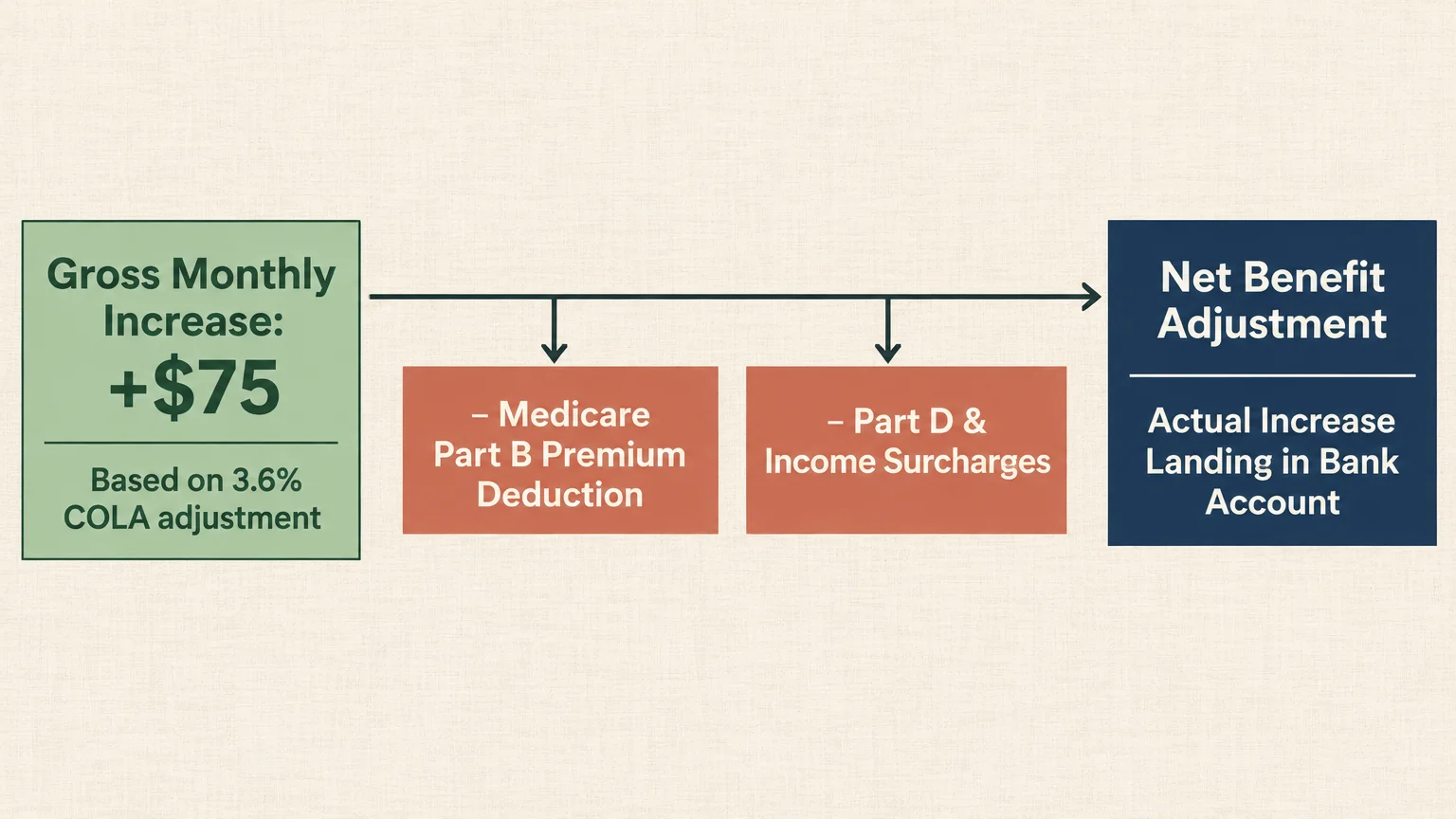
For most retirees, Medicare premiums are deducted automatically from Social Security checks before the money ever reaches a bank account. That means a jump in Medicare costs directly offsets part of your 2027 Social Security increase.
On November 17, 2026, the Centers for Medicare & Medicaid Services (CMS) announced that the standard Part B monthly premium rises to $209.40 in 2027. That is a $6.50 monthly increase—about 3.2%, or roughly $78 per year—over the $202.90 standard premium in 2026.
Apply that math to the average $75 gross monthly retirement raise, and you keep roughly $68.50 extra per month before any tax withholding. While the 2027 Part B increase stays modest compared to the 3.6% COLA, higher out-of-pocket medical costs can still pinch tight budgets.
CMS also raised the annual Medicare Part B deductible to $292 for 2027, up $9 from $283 in 2026. Review your outpatient healthcare budget on Medicare.gov so that higher deductible does not catch you off guard in January.
Beneficiaries with smaller Social Security checks sometimes worry that a Medicare premium hike could reduce their net deposit. Federal law protects eligible enrollees through a safeguard known as the hold-harmless provision under 42 U.S.C. § 1395r(f).
This rule prevents a Part B premium increase from dropping your net Social Security check below the previous month’s amount. Because the 2027 average $75 raise easily exceeds the $6.50 standard Part B hike, very few people will need hold-harmless protection this year.
Still, it helps to know the strict eligibility rules for hold-harmless protection in case your gross raise is unusually small:
- You must receive Social Security benefits for both November and December of the prior year.
- Your Part B premiums must be deducted directly from your Social Security payments in both December and January.
- You cannot be newly enrolling in Part B for the first time in January.
- You cannot be subject to higher Income-Related Monthly Adjustment Amount (IRMAA) surcharges.
Hospital coverage under Medicare Part A also carries updated cost-sharing figures for 2027, according to CMS. About 99% of beneficiaries continue paying a $0 monthly Part A premium based on their work history.
Enrollees with 30 to 39 quarters of Medicare-covered work pay a reduced Part A buy-in premium of $328 per month in 2027, up from $311 in 2026. If you are admitted to the hospital, the Part A inpatient deductible increases by $40 to $1,776 per benefit period.
Extended hospital stays carry daily coinsurance of $444 for days 61 through 90 and $888 per day for lifetime reserve days. Skilled nursing facility stays cost $222 per day for days 21 through 100 in 2027.
2027 IRMAA Surcharges and How to Appeal With Form SSA-44
Roughly 9% of Medicare Part B enrollees pay more than the $209.40 standard premium due to higher prior-year income. If your 2027 COLA notice shows a steep Medicare Part B deduction, check whether an IRMAA surcharge was added to your account.
CMS calculates 2027 IRMAA brackets using your 2025 Modified Adjusted Gross Income (MAGI) reported to the IRS. Crossing a bracket threshold by even one dollar pushes both your Part B premium and any Part D prescription surcharge higher.
Use this table of CMS figures released on November 17, 2026, to verify your per-person 2027 Medicare monthly charges:
| 2025 MAGI (Single Filer) | 2025 MAGI (Joint Filer) | 2027 Monthly Part B Total | 2027 Monthly Part D Surcharge |
|---|---|---|---|
| $112,000 or less | $224,000 or less | $209.40 | $0.00 |
| $112,001 to $141,000 | $224,001 to $282,000 | $293.10 | $15.40 |
| $141,001 to $177,000 | $282,001 to $354,000 | $418.80 | $39.70 |
| $177,001 to $212,000 | $354,001 to $424,000 | $544.40 | $64.00 |
| $212,001 to $499,999 | $424,001 to $749,999 | $670.00 | $88.30 |
| $500,000 or more | $750,000 or more | $711.80 | $96.40 |
Notice that the Part D surcharge is billed in addition to your regular Part D drug plan premium. Married couples filing jointly who both enroll in Medicare pay these surcharges individually, doubling the household impact.
Your 2025 tax return might reflect peak working wages, a business sale, or a spouse’s income that no longer exists in 2027. If your income fell because of a qualifying life-changing event—such as retiring, reducing work hours, or losing a spouse—you can request a lower tier.
Download and submit Form SSA-44 to the SSA along with proof of the event and an estimate of your lower current income. Filing this appeal promptly prevents you from overpaying hundreds of dollars each month throughout 2027.
Exact 2027 Payment Dates: When Your Higher Check Arrives
Even though the 3.6% increase applies to January 2027 benefits, calendar holidays shift the deposit date for millions of people. Checking your payment date inside your 2027 COLA notice helps you align automatic bill payments and avoid overdrafts.
Most Social Security retirement and disability deposits follow a Wednesday schedule tied to the beneficiary’s birth date. SSI recipients and long-term beneficiaries follow separate rules at the turn of the year.
| Beneficiary Group | First 2027 COLA Payment Date | Reason for Schedule |
|---|---|---|
| SSI recipients | Thursday, December 31, 2026 | Moved up because January 1 is a federal holiday |
| Social Security normally paid on the 3rd | Thursday, December 31, 2026 | Moved up because January 3, 2027 falls on a Sunday |
| Birth dates on the 1st–10th | Wednesday, January 13, 2027 | Second Wednesday of January |
| Birth dates on the 11th–20th | Wednesday, January 20, 2027 | Third Wednesday of January |
| Birth dates on the 21st–31st | Wednesday, January 27, 2027 | Fourth Wednesday of January |
That December 31 early group includes pre-May 1997 filers, dual Social Security and SSI recipients, state-paid Medicare enrollees, and beneficiaries living abroad. If you receive spousal or survivor benefits, your payment arrives based on the primary worker’s birth date rather than your own.
Treat a December 31 deposit carefully when setting your holiday spending limits. That payment covers your January 2027 living expenses, meaning your next regular check will not arrive until February.