Waking up to find your Social Security payment paused can instantly derail your monthly budget. Millions of retirees and disability recipients depend on direct deposits arriving like clockwork on their scheduled Wednesday distribution dates.
A benefit interruption rarely happens without warning, yet the official trigger often catches recipients completely off guard. Understanding why the Social Security Administration freezes funds gives you the power to resolve issues quickly.
Simple administrative oversights, income shifts, and overlooked asset rules can halt your regular monthly checks. Here is what causes an SSA payment halt and how you can restore your funds.
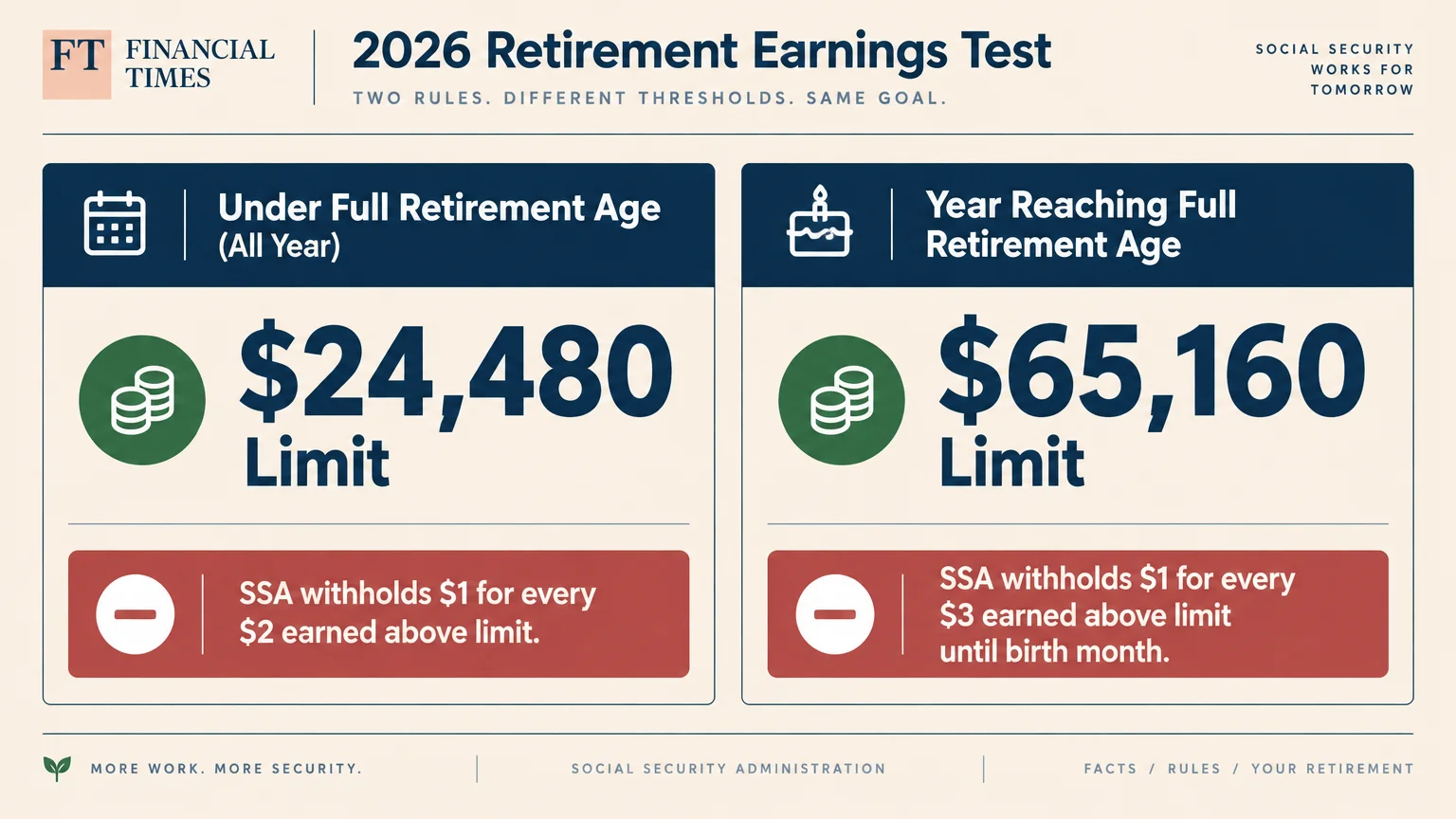
The Retirement Earnings Test: Earning Too Much Before Full Retirement Age
Many Americans choose to claim retirement benefits early while continuing to work part-time or full-time. If you claim before your full retirement age, strict annual earnings caps apply to your wages.
In 2026, recipients who remain under full retirement age all year can earn up to $24,480 before penalties apply. Once you earn above that threshold, the agency withholds $1 in benefits for every $2 earned over the limit.
For the year you reach full retirement age, the earnings threshold rises significantly to $65,160 in 2026. In that milestone year, the agency withholds $1 for every $3 earned above the limit until your birth month.
Most workers assume the government trims a small fraction from each check to collect excess earnings. Instead, the Social Security Administration (SSA) holds back entire monthly checks until the full deduction is satisfied.
If your projected earnings exceed the threshold by several thousand dollars, the agency may cancel multiple consecutive deposits. These withheld benefits are not permanently lost, but the immediate cash freeze can shock your finances.
Once you reach full retirement age, the earnings cap disappears entirely. The government then recalculates your monthly benefit upward to credit you for the checks withheld during your earlier working years.
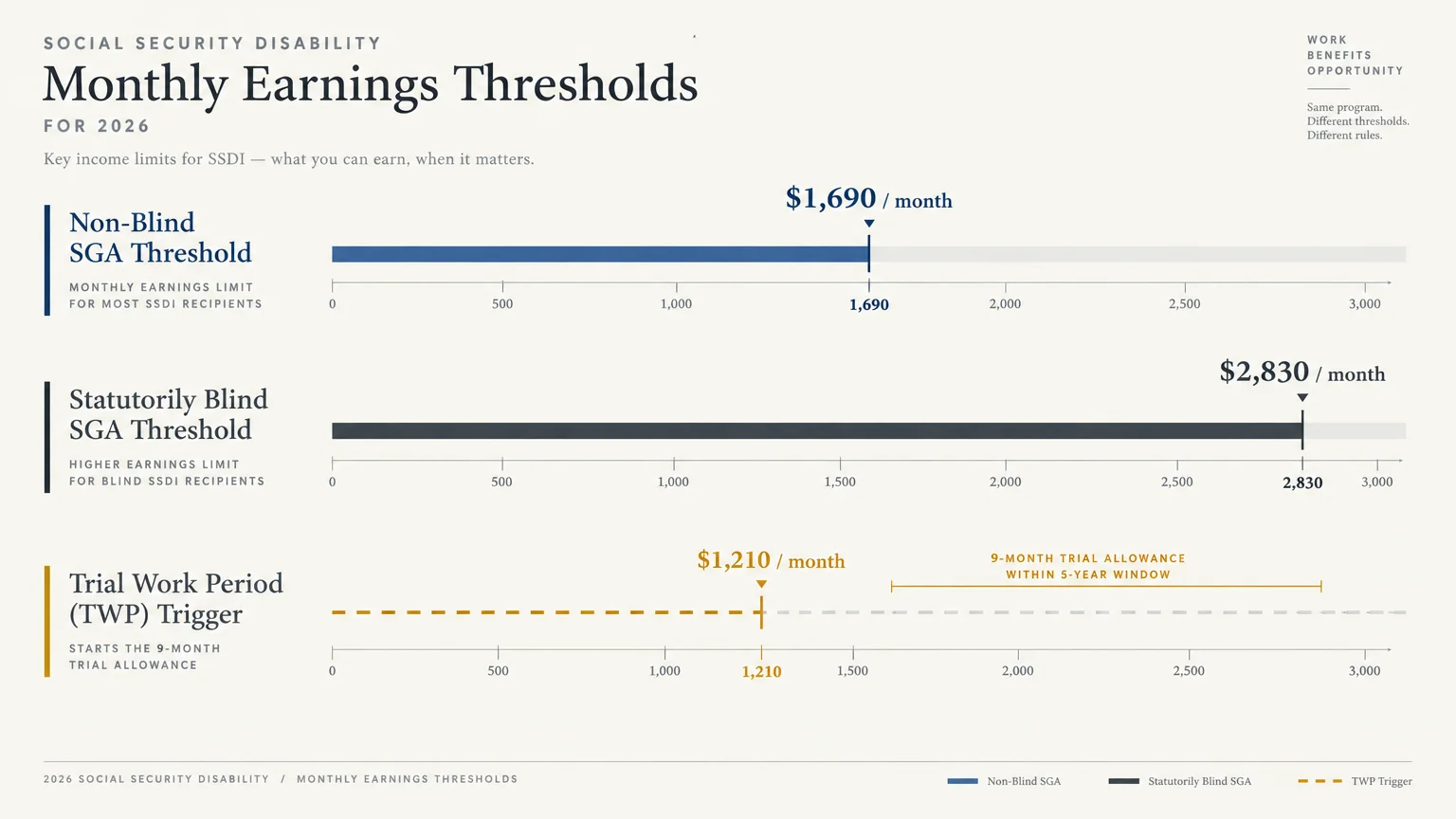
Social Security Disability: Exceeding Substantial Gainful Activity
Social Security Disability Insurance provides crucial financial support for individuals unable to engage in substantial work. Returning to work while receiving these benefits can quickly trigger a social security suspension.
The agency uses a monthly earnings benchmark known as Substantial Gainful Activity to measure work capacity. In 2026, earning more than $1,690 per month as a non-blind individual qualifies as substantial activity.
For statutorily blind recipients, the 2026 monthly Substantial Gainful Activity threshold is set higher at $2,830. Surpassing these specific dollar amounts signals to the government that your disabling condition may no longer prevent work.
The rules provide flexibility through the Trial Work Period, allowing you to test your ability to work. In 2026, any calendar month where you earn over $1,210 counts toward your nine-month trial allowance.
Once you exhaust those nine trial months within a rolling five-year window, your safety net narrows. Earning above the gainful activity limit during the subsequent 36 months causes an immediate benefit suspension.
Failing to report your gross earnings promptly each month almost always leads to retroactive suspensions. The agency will demand repayment for every month you worked above the permitted threshold.
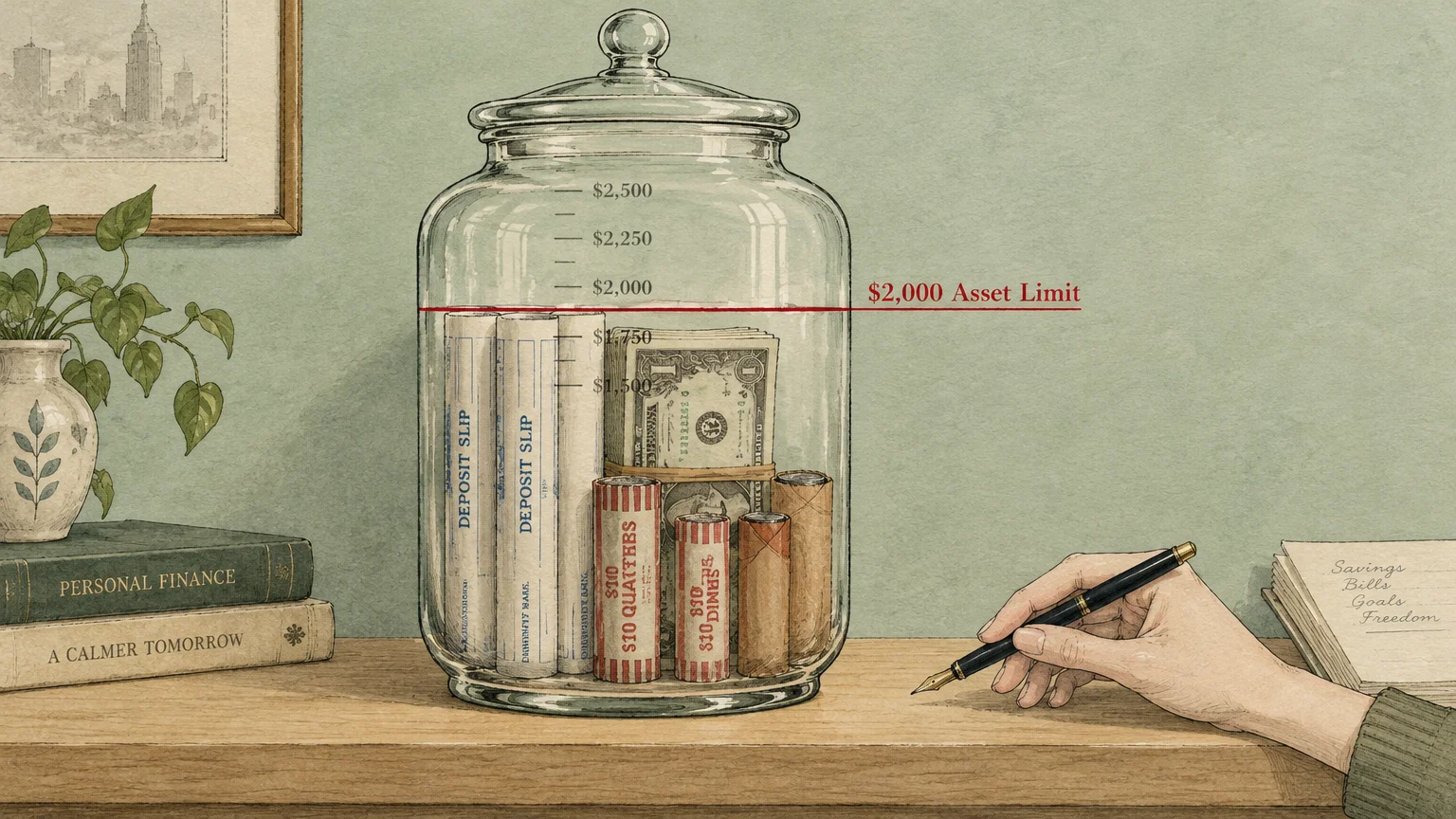
Supplemental Security Income Asset Creep: The $2,000 Threshold
Supplemental Security Income is a strictly needs-based program designed for low-income seniors and disabled individuals. Unlike traditional retirement benefits, this program enforces rigid asset caps that have remained unchanged since 1989.
An individual beneficiary cannot possess more than $2,000 in countable financial resources on the first day of any month. For a married couple receiving benefits, the strict combined resource limit is $3,000.
Countable assets include checking accounts, savings balances, cash on hand, secondary vehicles, and certain investments. Even a temporary cash gift deposited into your bank account can trigger an unexpected SSA payment halt.
In 2026, the maximum federal monthly benefit stands at $994 for individuals and $1,491 for couples. Accumulating a few dollars over the asset ceiling eliminates your entire monthly deposit until balances drop.
Recent policy changes offer modest relief for family support. The agency no longer counts informal food assistance from relatives as unearned income, though non-cash shelter assistance still impacts eligibility.
Carefully monitor your bank accounts toward the end of every calendar month. Spending excess funds on exempt necessities like home repairs or medical supplies preserves your ongoing monthly eligibility.

Agency Clawbacks: Handling Sudden Overpayment Withholding
The government frequently makes mathematical errors, issuing higher benefits than individuals actually qualify to receive. When the agency discovers its mistake, it initiates aggressive clawback procedures to recover the taxpayer funds.
In April 2025, the agency established a standard default withholding rate of 50% for Title II overpayments. This clawback rule applies directly to regular retirement, survivors, and disability insurance checks.
Before this policy update, the agency attempted to collect 100% of monthly payments to recover overpaid sums. Supplemental Security Income clawbacks remain legally capped at a lower 10% maximum monthly reduction.
Beneficiaries receive a written notice detailing the calculated debt and the scheduled reduction date. You have exactly 30 days from the notice date to submit an official appeal or request a waiver.
Filing your paperwork within that 30-day window stops collection efforts while agency representatives review your case. If you miss that critical deadline, your upcoming monthly deposit will automatically drop by half.
“You must be proactive with your financial life, especially when dealing with fixed income and government programs.” — Suze Orman, Personal Finance Author
You can request an administrative waiver if the overpayment occurred through no fault of your own. Demonstrating that repaying the debt prevents you from meeting basic living expenses can erase the balance.
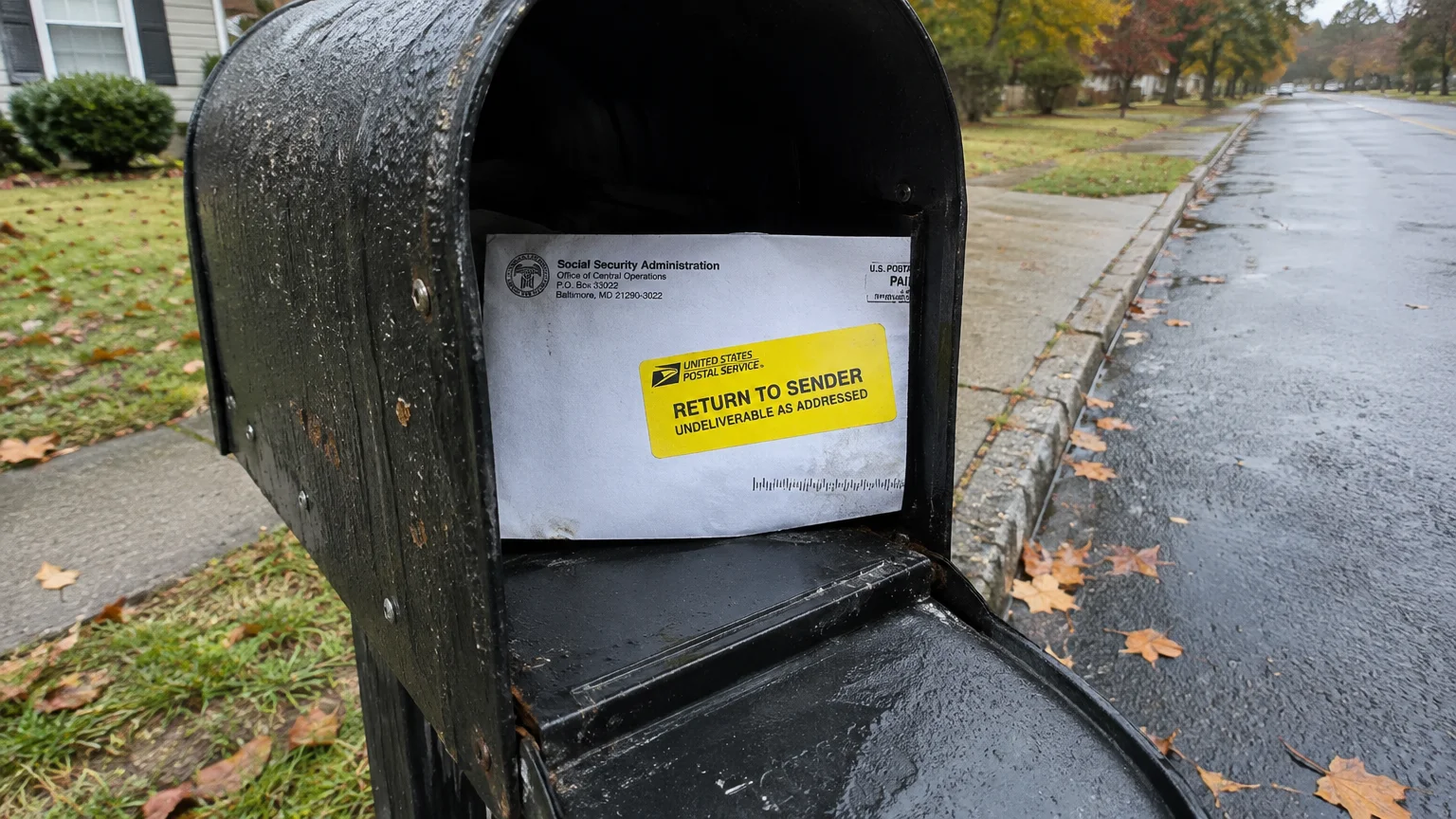
Administrative Traps: Undeliverable Mail and Closed Bank Accounts
Not every payment freeze stems from complex financial calculations or earnings limits. Simple clerical errors and missed postal communications routinely cause why social security stopped for unsuspecting recipients.
Federal regulations mandate electronic distributions through direct bank deposits or prepaid Direct Express debit cards. If you close your checking account without updating your payment profile, the bank rejects the transfer.
When a bank returns a monthly distribution, the agency places an automatic freeze on future disbursements. Your funds remain trapped in federal accounts until you provide verified routing details.
Physical postal mail presents another common administrative trap. If the postal service returns agency mail as undeliverable, the government flags your profile with a “whereabouts unknown” status.
This automated security status instantly suspends monthly payments to prevent identity theft and fraud. You must contact your local field office with proof of residency to lift the administrative hold.
Always notify the agency immediately whenever you change physical addresses or switch financial institutions. Updating your digital profile online prevents preventable disruptions to your vital income stream.

Extended Travel and Living Abroad: The Rules Expats Miss
Retiring overseas or taking extended vacations is a popular dream, but foreign travel introduces strict distribution rules. The specific program funding your monthly checks dictates where and how long you can travel.
For Supplemental Security Income recipients, leaving the 50 states or Washington, D.C., carries swift penalties. Traveling outside the country for 30 consecutive days or a full calendar month terminates your eligibility.
U.S. territories like Puerto Rico and Guam count as outside the country under strict program definitions. Once suspended, your deposits will not restart until you return to the mainland for 30 consecutive days.
United States citizens receiving traditional retirement benefits can live abroad in most sovereign nations indefinitely. However, federal sanctions block payment transfers to Treasury-restricted countries like Cuba and North Korea.
Additional restrictions apply to nations like Belarus, Kazakhstan, and Uzbekistan due to local banking barriers. Beneficiaries residing in those countries must attend personal consular interviews to receive accumulated benefits.
Expatriates must also complete annual proof-of-life paperwork using Form SSA-7162. Failing to mail back this vital questionnaire results in an immediate suspension of your overseas deposits.
Non-citizens face tighter restrictions when living outside American borders for extended periods. In most cases, benefits stop after six consecutive calendar months outside the United States unless specific treaty exceptions apply.
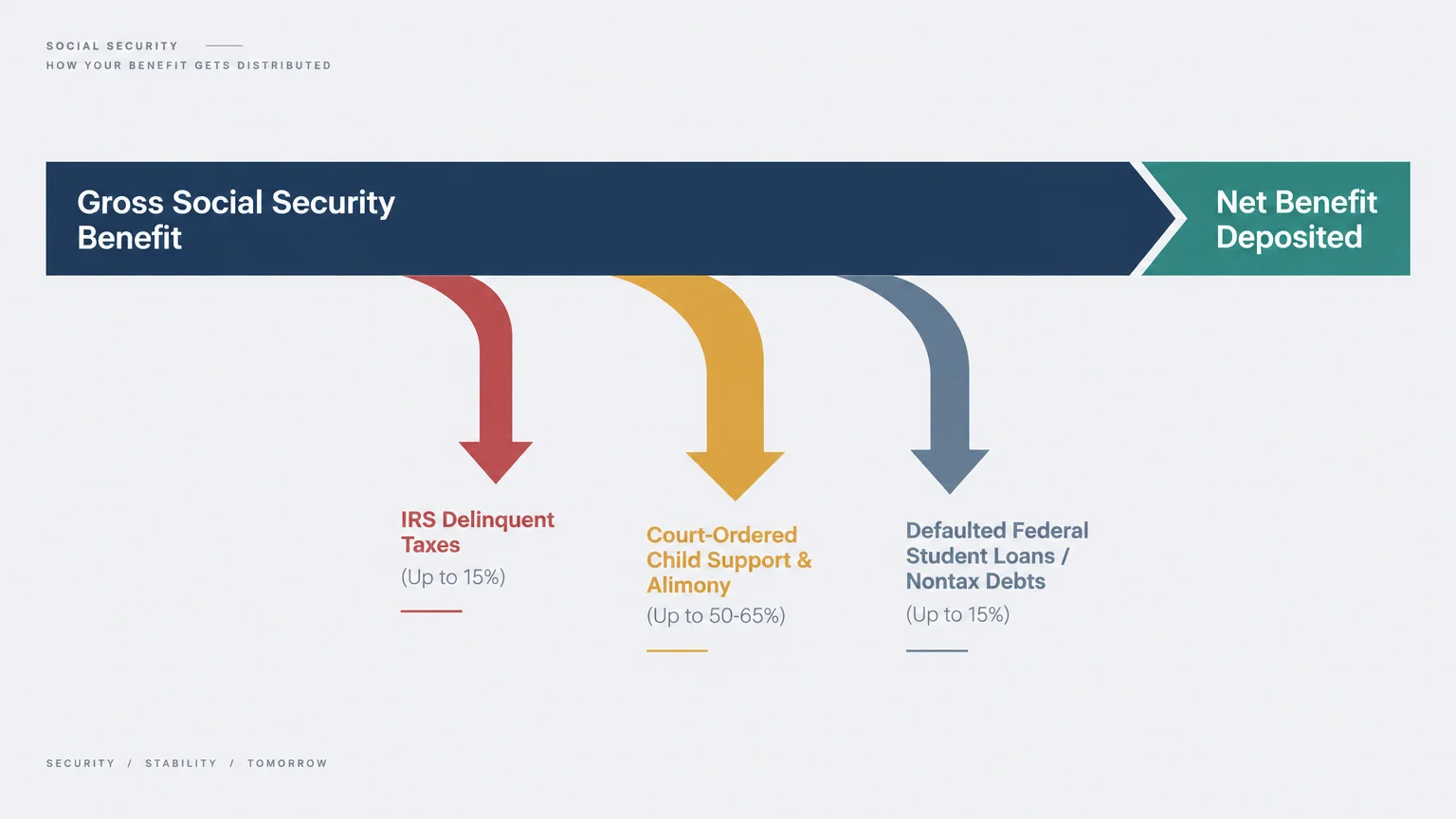
Involuntary Garnishments: Taxes, Alimony, and Federal Debts
Many people believe federal benefits remain completely shielded from collection agencies and external debts. While standard private creditors cannot touch your checks, government bodies possess broad legal authority to intercept deposits.
The Internal Revenue Service (IRS) can attach your retirement or disability income to recover delinquent taxes. Under the Federal Payment Levy Program, the tax agency automatically garnishes up to 15% of your monthly benefit.
Court-ordered child support and alimony obligations present another significant threat to your monthly deposits. State enforcement agencies can legally garnish between 50% and 65% of your checks to satisfy domestic support orders.
Federal student loan defaults represent an evolving legal area for retirees and disabled borrowers. Through the Treasury Offset Program, the Department of Education can garnish up to 15% of monthly benefits.
Federal law protects the initial $750 of monthly retirement benefits from student loan collections. Furthermore, the Department of Education paused involuntary offsets in mid-2025 and extended protections into 2026, though administrative risks remain.
Supplemental Security Income benefits enjoy total immunity from tax levies, child support orders, and federal debt offsets. Consult the Consumer Financial Protection Bureau (CFPB) to understand statutory garnishment limitations on private debts.

Incarceration and Legal Sanctions
Entering the criminal justice system leads to an immediate and mandatory halt of federal disbursements. The law strictly prohibits distributing public retirement or disability funds to individuals confined in correctional institutions.
For traditional retirement and disability insurance, payments stop if you are convicted and confined for over 30 continuous days. The freeze takes effect on the 31st day of institutional confinement.
Supplemental Security Income payments suspend when a recipient spends a full calendar month in jail or prison. Your benefits do not accrue while incarcerated; the money for those months is permanently lost.
Family members receiving auxiliary checks based on your earnings record generally continue receiving their distributions during your incarceration. However, individuals receiving benefits on their own work records forfeit their payments completely.
Restoring your distributions after release requires deliberate action and official documentation. You must bring formal prison release paperwork directly to an agency office to re-establish your active status.
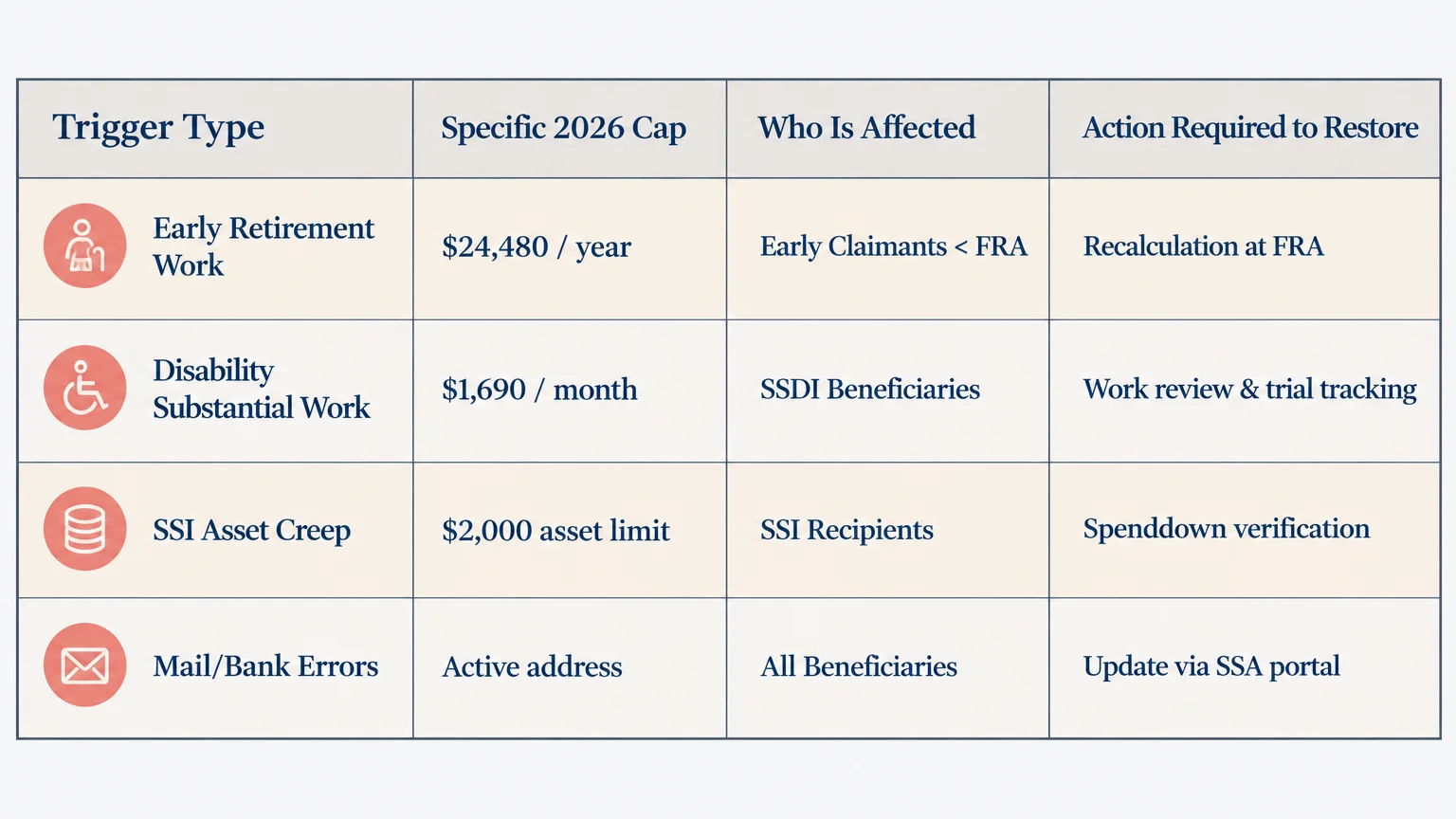
Comparison of Common Triggers for a Benefit Interruption
The table below summarizes the most common events that halt monthly checks, showing the affected program and restoration requirements.
| Trigger Event | Affected Program | Statutory Limit or Threshold | Resolution Method |
|---|---|---|---|
| Retirement Earnings Test | Retirement (Under FRA) | $24,480 annual earnings in 2026 | Deduction cleared; benefit recalculation at FRA |
| Substantial Gainful Activity | Disability (SSDI) | $1,690 monthly earnings ($2,830 if blind) | Provide income proof; request expedited reinstatement |
| Excess Resource Count | Needs-Based (SSI) | $2,000 individual / $3,000 couple assets | Spend down excess funds on exempt necessities |
| Agency Overpayment Debt | Retirement, SSDI, SSI | 50% withholding (Title II) / 10% (SSI) | File appeal or waiver within 30 days |
| Returned Postal Mail | All Programs | Single undeliverable correspondence piece | Verify current address at local field office |
| Foreign Proof-of-Life | Retirement / Expats | Unreturned Form SSA-7162 | Submit completed questionnaire to embassy or agency |

What Can Go Wrong: Avoiding Preventable Benefit Freezes
Navigating federal programs requires vigilance to prevent administrative errors from cutting off your cash flow. Simple oversights often create months of administrative delays before deposits resume.
- Ignoring written agency notices: Discarding official mail guarantees you miss vital 30-day appeal windows for overpayments and earnings recalculations.
- Closing old bank accounts prematurely: Switching financial institutions before your new direct deposit details process causes banks to reject funds.
- Failing to track gross wages: Calculating earnings caps using take-home net pay instead of pre-tax gross income triggers unexpected earnings penalties.
- Missing foreign verification deadlines: Expatriates frequently overlook Form SSA-7162 mailings, prompting automatic suspensions after scheduled filing deadlines pass.
- Accumulating modest savings on SSI: Holding slightly over $2,000 across checking accounts on the first of the month halts needs-based payments.
Protect yourself by checking your online agency dashboard at least once every quarter. Addressing small discrepancies early keeps your monthly checks arriving on schedule without unpleasant surprises.
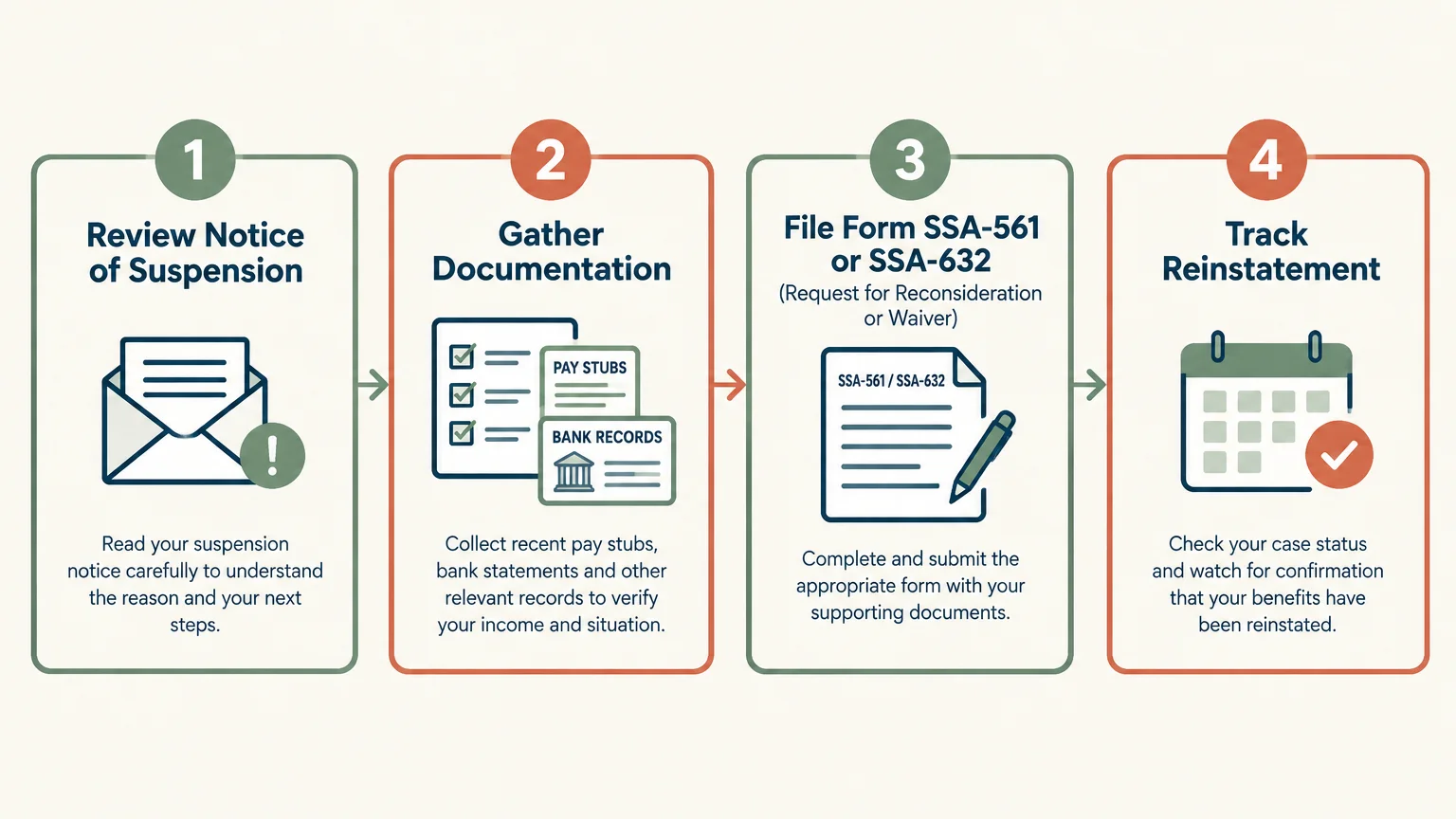
How to Reinstate Your Paused Payment
Discovering an unexpected payment halt requires fast, methodical action to restore your cash flow. Do not wait for the government to reach out; initiate contact the moment a scheduled deposit fails to appear.
Start by logging into your personal online account to review recent notifications and active status codes. The portal displays digital copies of recent agency correspondence that explain why the freeze occurred.
If the pause stems from banking details or undeliverable mail, you can often correct the records online immediately. Updating your mailing address or routing numbers clears simple administrative holds quickly.
For earnings adjustments or overpayments, contact your local field office by telephone or schedule an in-person appointment. Locating staff through USA.gov Benefits helps you bypass overwhelmed national call centers.
If the agency withheld funds unfairly, file Form SSA-561 to request a formal administrative reconsideration. If you cannot afford overpayment deductions, submit Form SSA-632 to seek a financial hardship waiver.
Gather supporting documentation before speaking with representatives, including recent pay stubs, bank statements, and medical records. Well-organized evidence dramatically accelerates processing times and expedites back-payment distributions.

When to Consult a Professional
While many administrative issues resolve through basic communication, certain scenarios require professional expertise. Navigating dense federal regulations without skilled advice can lead to severe financial losses.
Consult an experienced public benefits attorney if the agency issues an overpayment claim exceeding $10,000. Legal counsel can challenge improper agency accounting methods and negotiate sustainable repayment compromises.
Self-employed retirees earning substantial income should consult a certified public accountant before claiming benefits early. Tax professionals help structure business withdrawals to prevent triggering catastrophic earnings test withholding.
Families supporting disabled individuals should consult a special needs estate planner before transferring financial assets. Establishing a properly structured special needs trust preserves critical needs-based eligibility while providing financial security.
Seek guidance from a disability attorney if the government attempts to terminate your disability status for gainful activity. Skilled representatives protect your rights during medical reviews and expedited reinstatement filings.
Frequently Asked Questions About Paused Benefits
Can Social Security freeze my payments without sending prior notice?
The agency must send written notices before altering or suspending your monthly benefit payments. However, if mail is returned as undeliverable, an immediate “whereabouts unknown” hold takes effect without prior warning.
How long does it take for the agency to restart suspended benefits?
Resolving simple bank routing errors or address verifications usually restores payments within one to two payment cycles. Complex appeals involving disability earnings or overpayment waivers often take three to six months to settle.
Do I lose the benefits withheld under the Retirement Earnings Test forever?
No, the agency does not keep benefits withheld due to pre-full retirement age employment earnings. When you reach your full retirement age, the agency recalculates your monthly check upward to repay those withheld sums.
Can private debt collectors garnish my monthly Social Security check?
Federal law explicitly shields your benefits from standard consumer creditors, including credit card issuers and medical bill collectors. Only government entities enforcing tax debts, child support, or federal loans can legally garnish benefits.
Protecting Your Financial Safety Net
Maintaining an active, uninterrupted flow of federal benefits requires ongoing attention to administrative rules and reporting deadlines. Treat your benefit management as an essential component of your monthly personal finance routine.
Report address changes, marital transitions, and earned income shifts immediately to prevent costly agency recalculations. Keeping your personal records aligned with agency guidelines ensures your hard-earned benefits arrive reliably every single month.
This is educational content based on general financial principles. Individual results vary based on your situation. Always verify current tax laws, investment rules, and benefit eligibility with official sources.
Last updated: October 2026. Financial regulations and rates change frequently—verify current details with official sources.