Claiming every legal tax break keeps more money in your pocket, yet certain deductions and credits consistently draw extra scrutiny from federal tax computers. Knowing which claims trigger automated reviews helps you protect your refund before you file.
Recent tax law overhauls have created brand-new deductions for 2025 and 2026 while permanently shutting the door on others. Understanding these updated rules lets you claim what you legitimately earn without stumbling into costly tax filing mistakes.
Below are four high-risk areas where IRS scrutiny peaks—and the exact records you need to back up your return.
How the IRS Flags Returns in 2026
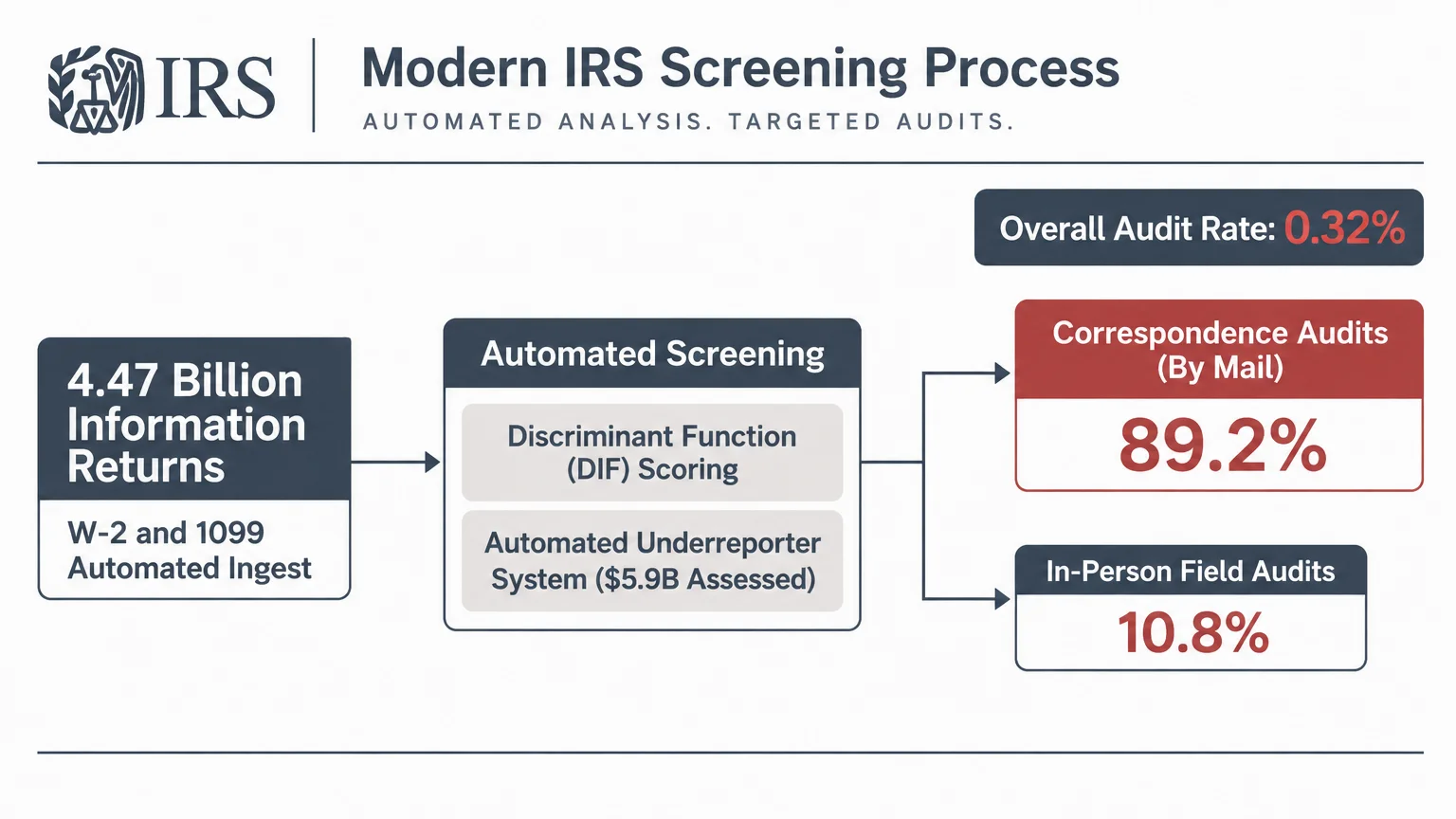
Most taxpayers never face a traditional in-person audit. According to the FY 2025 IRS Data Book published in June 2026, the agency examined just 0.32% of individual returns for Tax Year 2021, or roughly 1 in 316 filings.
That figure marks a steep drop from 1 in 99 returns for Tax Year 2010. Across Tax Years 2015 through 2023, cumulative individual audit coverage stood at 0.36% as of the end of FY 2025.
Staffing reductions have also slowed traditional examinations. Between FY 2024 and FY 2025, the IRS lost roughly 27% of its Examination and Collection staff and launched 30% fewer audits, according to the Treasury Inspector General for Tax Administration (TIGTA).
Do not mistake lower headcount for weak enforcement, however. The IRS still closed 497,621 audits in FY 2025 and recommended $26.8 billion in additional tax.
Nearly all individual exams happen through the mail rather than at a field office. Of the 441,578 individual audits closed in FY 2025, 89.2% were correspondence audits, while in-person field audits have fallen 48% since FY 2020.
Automation handles the heaviest screening long before a human agent reviews a file. In FY 2025, the IRS processed roughly 4.47 billion information returns—including W-2s and 1099s—and closed 987,460 Automated Underreporter mismatch cases assessing $5.9 billion.
Alongside document matching, the agency uses a confidential Discriminant Function (DIF) scoring system. This software flags returns whose deductions deviate sharply from statistical norms for your income bracket and occupation.
Automated matching and statistical scoring run on every return you file; claiming an outsized write-off without matching documentation is the fastest way to receive an IRS notice by mail.
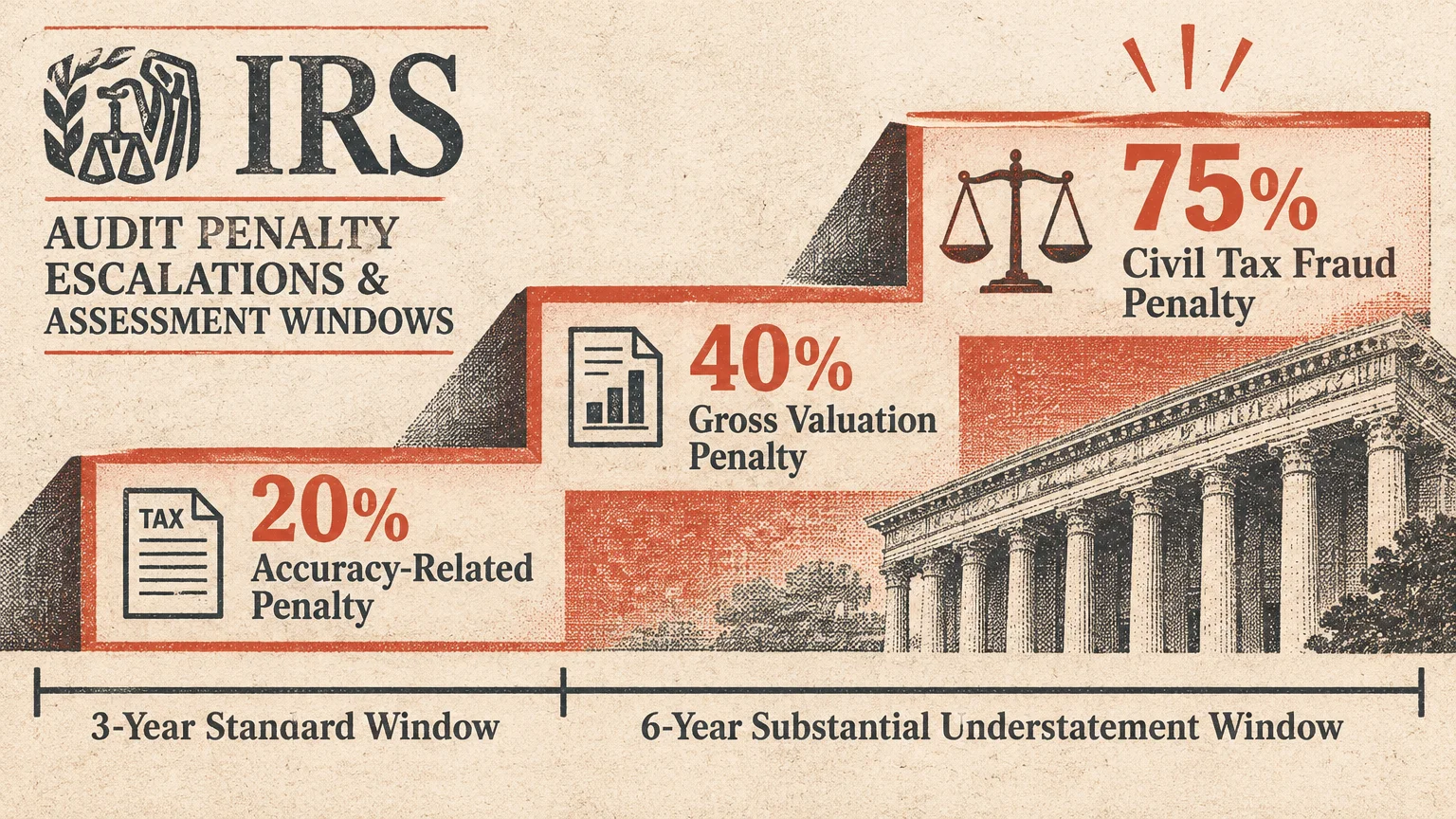
Once a return draws IRS scrutiny, the timeline for potential assessments can stretch for years. Under federal law, the agency generally has three years from your filing or due date to assess extra tax.
That window doubles to six years if you understate your gross income by 25% or more. In cases of tax fraud, the IRS faces no time limit at all.
Mistakes on risky tax deductions also carry steep financial consequences beyond unpaid tax and accruing interest. Under Internal Revenue Code (IRC) Sections 6662 and 6663, penalties escalate quickly based on severity:
- Accuracy-related penalty (20%): Applies to underpayments caused by negligence, rule disregard, or a substantial understatement exceeding the greater of 10% of your required tax or $5,000.
- Gross valuation or foreign asset penalty (40%): Triggers when you severely inflate property values or fail to disclose qualifying foreign financial accounts.
- Civil tax fraud penalty (75%): Applies when the government establishes intentional evasion on any portion of an underpayment.
Knowing how these triggers work puts you in control. Next, examine the four specific tax breaks most likely to generate letters and audit notices.
1. The Home Office Deduction
Remote work became permanent for millions of professionals, yet the federal tax code treats employees and business owners very differently. One of the most common tax breaks audit risk triggers happens when salaried workers attempt to write off a spare bedroom.
If you receive a W-2, you cannot claim a federal home office deduction on your personal return. Congress originally suspended miscellaneous itemized deductions for 2018 through 2025, and the One, Big, Beautiful Bill Act (OBBBA, Public Law 119-21) enacted July 4, 2025, made that ban permanent.
Even if your employer mandates remote work and refuses to reimburse your internet or desk costs, the deduction remains off-limits. Claiming unreimbursed employee expenses on your federal return is a guaranteed compliance error.
Self-employed individuals who file Schedule C can still claim the deduction, provided they satisfy strict rules outlined in IRS Publication 587 guidelines. Passing the test requires clearing two separate hurdles.
First, your workspace must pass the exclusive and regular use test. A kitchen table where your family eats dinner or a guest room with a fold-out sofa disqualifies the entire space from deduction.
Narrow exceptions exist only for licensed daycare providers and qualifying inventory storage. For everyone else, personal overlap in the room violates the exclusive use requirement.
Second, the home office must serve as your principal place of business or a regular spot for meeting clients or patients in person. Running occasional administrative tasks from home while keeping an outside office rarely qualifies.
You can calculate the write-off using actual expenses or the IRS simplified method. Under the simplified option, you deduct $5 per square foot of qualifying space up to 300 square feet, capping the deduction at $1,500 annually.
Both methods share one hard ceiling that catches many new freelancers off guard. Your home office deduction cannot exceed your gross business income minus your other business expenses.
To keep this write-off safe from IRS scrutiny, measure your dedicated workspace accurately and sketch a quick floor plan for your records. Saving dated photos of your office setup also provides fast proof during a mail audit.

2. Charitable Contributions and Noncash Donations
Generosity lowers your tax bill, yet inflated or poorly documented gifts rank among the oldest IRS audit red flags. Noncash donations like used clothing, furniture, vehicles, and appreciated property draw especially close review.
Federal rules escalate your paperwork requirements as your donation value climbs. Under IRS Form 8283 and Publication 526, missing a single signature or appraisal deadline can wipe out the entire write-off.
Here are the mandatory documentation thresholds you must satisfy before claiming charitable gifts:
- Gifts of $250 or more: You need a contemporaneous written acknowledgment from the charity stating whether you received any goods or services in exchange.
- Noncash gifts totaling over $500: You must attach Form 8283 (Section A), and donated clothing or household items generally must be in good used condition or better.
- Single items or similar item groups over $5,000: Aside from publicly traded securities, you must complete Form 8283 (Section B), obtain a qualified appraisal signed within 60 days prior to the gift, and get the charity’s signature in Part V.
If a charity sells or disposes of appraised property worth over $5,000 within three years, it must file Form 8282 within 125 days and send you a copy. When the charity’s sale price comes in far below your appraised value, expect questions from the IRS.
Aggressive valuation schemes remain a major enforcement priority. Noncash charitable contribution shelters involving inflated appraisals—such as syndicated conservation easements or questionable art deals—appeared directly on the IRS 2026 Dirty Dozen list.
Under IRC Section 170(h)(7), partnership or S-corporation conservation contributions exceeding 2.5 times the members’ relevant basis are generally disallowed. Steer clear of promoters promising a tax write-off worth multiples of your cash outlay.
Beyond documentation traps, major rule changes under OBBBA took effect on January 1, 2026, reshaping how both itemizers and non-itemizers deduct charity. Failing to apply these new limits creates easy automated mismatches.
First, itemizers now face a new 0.5% Adjusted Gross Income (AGI) floor starting in Tax Year 2026. You can only deduct charitable gifts that exceed 0.5% of your AGI.
Second, top earners face a haircut on itemized write-offs. Beginning in Tax Year 2026, taxpayers in the 37% marginal bracket have the tax benefit of all itemized deductions—including charitable gifts—capped at 35 cents per dollar.
Third, non-itemizers gained a brand-new above-the-line deduction starting in Tax Year 2026. Filers taking the standard deduction ($16,100 single, $32,200 joint, or $24,150 head of household in 2026) can deduct up to $1,000, or $2,000 for joint filers.
That non-itemizer break comes with strict guardrails under IRC Section 170(p). Only cash gifts to qualifying 501(c)(3) public charities count; contributions to donor-advised funds, private non-operating foundations, and noncash goods are excluded.
Do not round up goodwill bag estimates or claim noncash items under the new $1,000/$2,000 cash rule. Overstatements under this provision explicitly trigger the 20% accuracy-related penalty under IRC Section 6662(b)(9).
3. Business Vehicle Deductions and Side-Hustle Losses
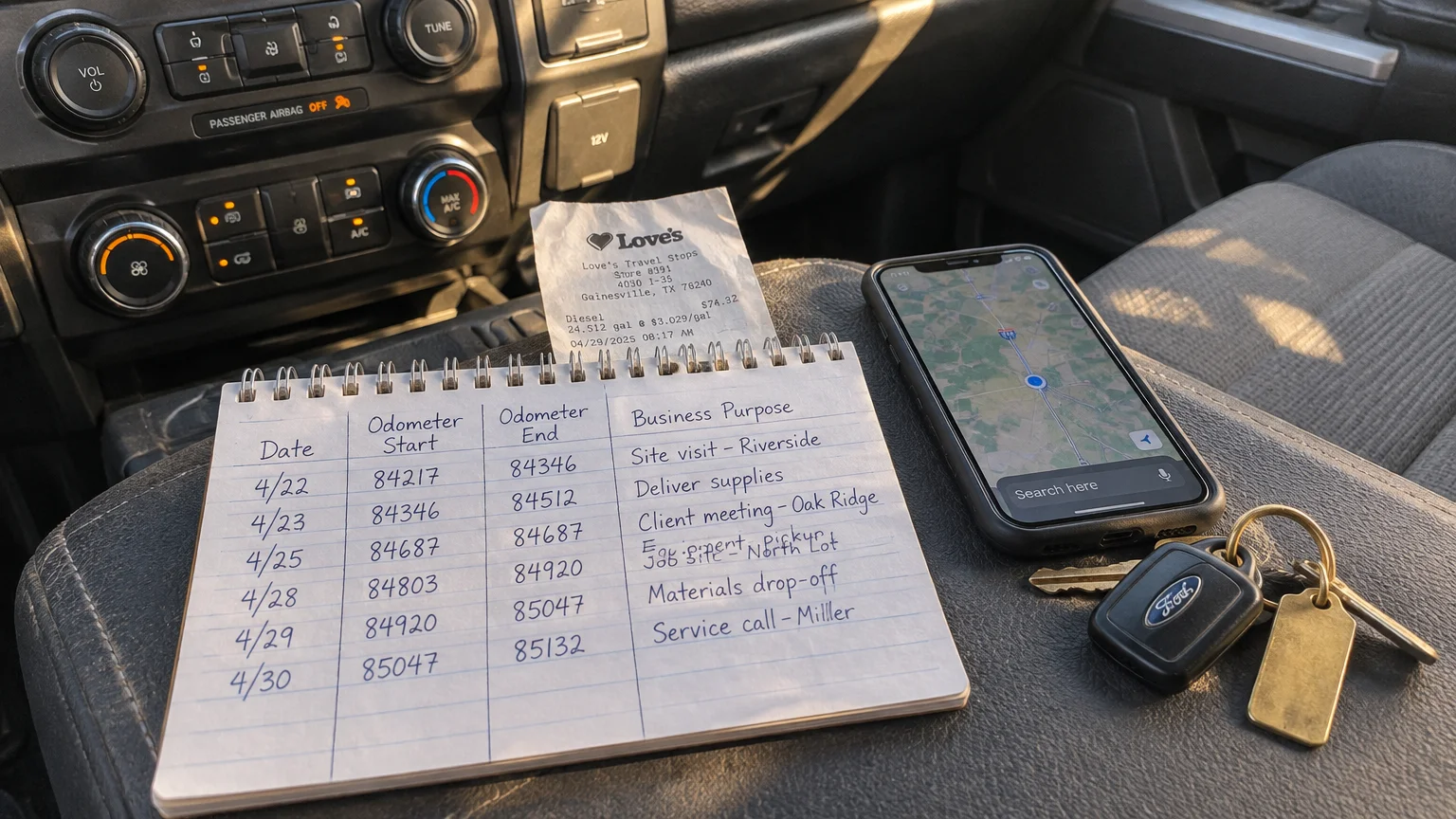
Self-employed workers and gig drivers rely heavily on vehicle write-offs, yet claiming 100% business use on your sole family car practically invites an examination. The IRS knows personal errands happen, and strict substantiation laws require proof for every business mile.
Under IRC Section 274(d) and Revenue Procedure 2019-46, reconstructed estimates created at tax time do not hold up in an audit. You need a contemporaneous written or app-based log recording the date, destination, business purpose, and miles driven for each trip.
Never include regular commuting between your home and a primary outside workplace as business mileage. Commuting miles are strictly personal unless you qualify for a principal-place-of-business home office or travel to temporary work sites.
Tax Year 2026 also introduced an unusual mid-year rate change that can trip up filers using tax software or spreadsheets. According to IRS announcements IR-2026-29, IR-2025-128, and IR-2024-312, standard mileage rates shifted on July 1, 2026:
- Business driving: 70 cents per mile in 2025; 72.5 cents per mile from January 1 through June 30, 2026; and 76 cents per mile from July 1 through December 31, 2026.
- Medical and qualifying active-duty military or intelligence moves: 21 cents per mile in 2025; 20.5 cents per mile from January 1 through June 30, 2026; and 23.5 cents per mile from July 1 through December 31, 2026.
- Charitable driving: Fixed by statute under IRC Section 170(i) at 14 cents per mile across both years.
Splitting your 2026 mileage log into first-half and second-half totals ensures you capture the extra 3.5 cents per mile after June 30 without misstating your return. Applying the 76-cent rate to January through June miles creates an avoidable error.
Vehicle write-offs often collide with an even bigger trap on Schedule C: recurring side-hustle losses. When a small business posts losses year after year to offset W-2 wages, the IRS may classify the venture as a hobby under IRC Section 183.
The tax code generally presumes a profit motive if your activity turns a net profit in at least three of five consecutive tax years. For horse breeding, training, showing, or racing, the benchmark is two of seven years.
Even before reaching five years, auditors look at whether you keep separate business bank accounts, adjust losing strategies, and depend on the income. Operating a passion project with endless deductions and tiny revenue looks like personal consumption.
Reclassification as a hobby carries a devastating penalty following recent tax legislation. Because OBBBA permanently eliminated miscellaneous itemized deductions under IRC Section 67(h), 100% of hobby expenses are now disallowed while 100% of gross hobby revenue remains taxable.
Keep in mind that Schedule C income already attracts intense oversight. IRS tax gap research estimates a 55% net misreporting rate for income with little or no third-party reporting, such as sole proprietor cash receipts.
Digital platform reporting rules also deserve careful attention if you sell goods or trade cryptocurrency on the side. While OBBBA restored the federal Form 1099-K threshold to $20,000 and 200 transactions, all taxable gig and resale profits remain reportable without a form.
Similarly, cryptocurrency exchanges began issuing Form 1099-DA for 2025 transactions, with mandatory cost-basis tracking starting for 2026 acquisitions. You can verify current digital asset and small business reporting obligations on the official IRS website before filing.
4. Refundable Credits and the New Schedule 1-A Tax Breaks
Many people assume IRS audits target only millionaires, yet data proves otherwise. Refundable credits and new middle-class deductions carry some of the highest examination rates in the entire tax system.
According to the FY 2025 IRS Data Book, Tax Year 2021 returns claiming the Earned Income Tax Credit (EITC) were audited at 0.70%, or 1 in 144. That rate topped the 0.60% audit rate for filers earning $500,000 to $1,000,000.
It also ran more than triple the 0.2% audit rate for filers earning $50,000 to $200,000. Overall, EITC filings made up 20.0% of Tax Year 2021 individual returns yet accounted for 43.9% of all individual exams and 21% of individual audits closed in FY 2025.
High error rates drive this aggressive verification. The IRS estimated that 27.3% of EITC payments—totaling $15.9 billion—were improper in FY 2024.
Across four major refundable credit programs—the EITC, Additional Child Tax Credit, American Opportunity Tax Credit, and Net Premium Tax Credit—the agency estimated a 26.5% improper payment rate totaling $28.1 billion in FY 2025. Worse yet, 96% of EITC audit adjustment dollars on paid-preparer returns came from non-credentialed preparers.
Alongside refundable credits, filers now face strict verification traps on brand-new deductions introduced for 2025 through 2028. Roughly 45% of individual returns filed during the 2026 season claimed one or more OBBBA breaks on new IRS Schedule 1-A, per IRS IR-2026-74.
Schedule 1-A is available to both itemizers and standard-deduction filers, making it wildly popular and heavily screened. Three headline deductions on this form carry tight eligibility rules that catch careless claimants:
- Car loan interest deduction: Allows up to $10,000 per year in interest on loans for new, personal-use vehicles under 14,000 pounds with final assembly in the United States, purchased after December 31, 2024. Leases and used cars do not qualify, you must report the Vehicle Identification Number (VIN) on your return, lenders report $600 or more of interest on new Form 1098-VLI, and the break phases out above $100,000 MAGI ($200,000 joint).
- Overtime pay deduction: Allows up to $12,500 per year ($25,000 joint), phasing out above $150,000 MAGI ($300,000 joint). It applies solely to the Fair Labor Standards Act (FLSA) Section 7 overtime premium portion—meaning only the extra half in time-and-a-half pay, never base wages or voluntary bonuses—and remains subject to Social Security and Medicare taxes.
- Tip income deduction: Allows up to $25,000 per return, phasing out by $100 for each $1,000 of MAGI above $150,000 ($300,000 joint). Only voluntary cash or charged tips in IRS-listed occupations qualify; mandatory service charges and owners or workers in specified service trades or businesses (SSTBs) under IRC Section 199A are excluded.
Because lenders and employers report VINs, interest totals, and wage breakdowns directly to the government, automated mismatch software catches Schedule 1-A errors fast. Double-check your Form W-2 boxes and Form 1098-VLI statements before entering any figures.
While reviewing 2026 thresholds, watch two additional rules for errors. For Tax Year 2026, the state and local tax (SALT) deduction cap sits at $40,400 ($20,200 married filing separately), phasing down above $505,000 MAGI to a $10,000 floor, while seniors age 65 and older can claim an enhanced $6,000 deduction subject to income phaseouts.
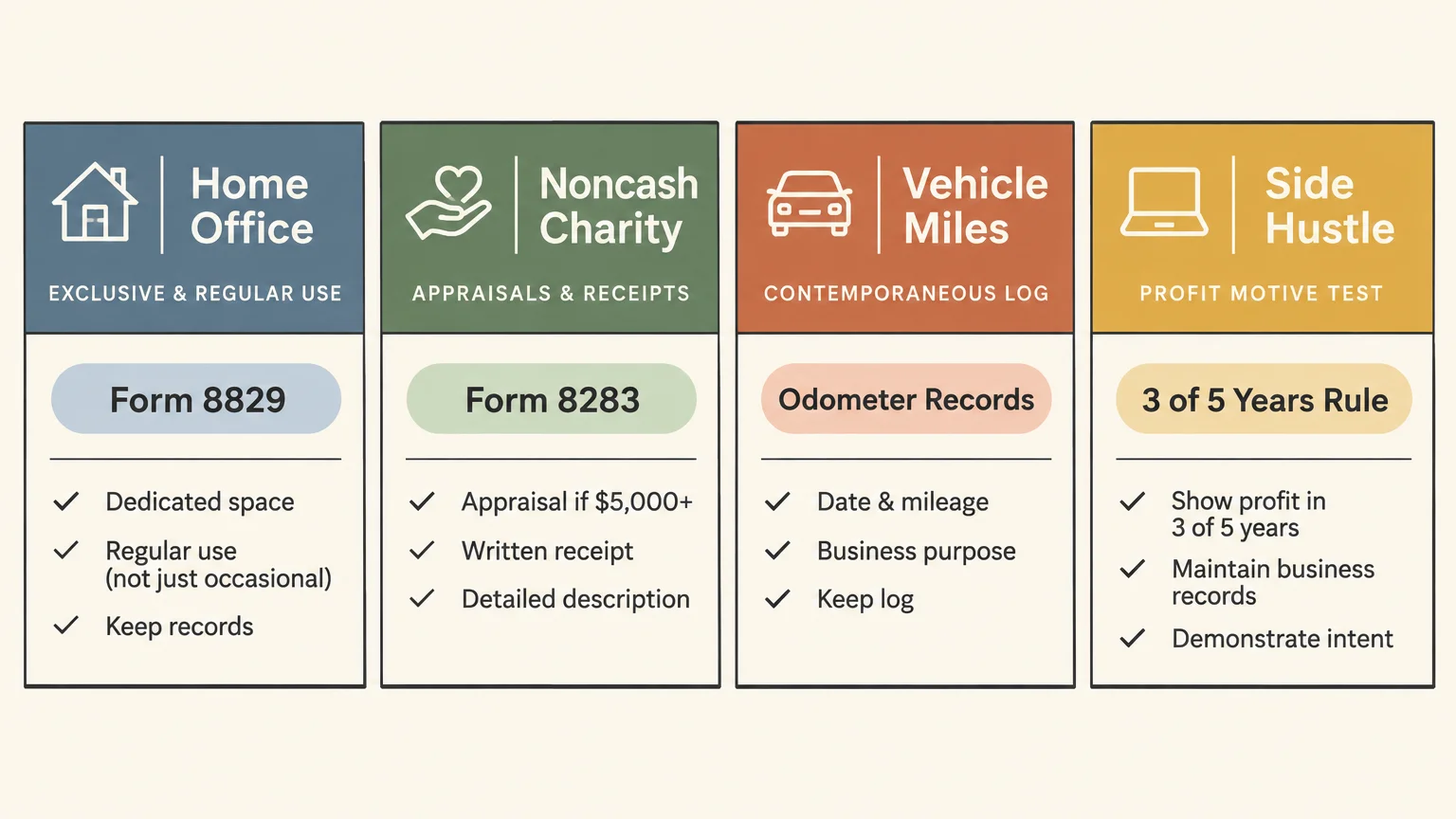
Quick Comparison: 4 High-Scrutiny Tax Breaks at a Glance
Reviewing how each claim gets flagged helps you spot weak spots in your paperwork before submitting your return. The table below outlines the primary triggers, proof requirements, and financial exposure for all four areas.
| Tax Break | Primary Audit Trigger | Key Documentation Required | Biggest Financial Risk |
|---|---|---|---|
| Home Office Deduction | W-2 remote workers claiming space, or shared family rooms | Floor plan, exclusive-use proof, Schedule C profit calculation | Full disallowance plus 20% accuracy-related penalty |
| Charitable Contributions | Inflated noncash estimates, missing appraisals, or 2026 cash-only violations | $250 letters, Form 8283 (Sections A/B), 60-day qualified appraisal | Disallowed write-off plus 20% or 40% valuation penalty |
| Business Vehicles & Schedule C Losses | Claiming 100% business driving or multi-year side-hustle losses | Contemporaneous mileage log split mid-2026, separate bank records | Hobby reclassification: 0% expenses allowed, 100% revenue taxed |
| EITC & Schedule 1-A Breaks | Wrong child residency, non-U.S. vehicles, or base overtime pay | Residency proof, VIN & Form 1098-VLI, FLSA premium breakdown | Delayed refund, 20% accuracy penalty, and credit repayment |
Keeping clean records ahead of tax season eliminates almost every risk listed above. For practical checklists on organizing receipts year-round, explore consumer tax guidance from Kiplinger’s tax planning resources or NerdWallet’s tax filing guides.
Pitfalls to Watch For
Even well-meaning taxpayers fall into preventable traps when rushing to meet the April filing deadline. Avoiding these specific tax filing mistakes dramatically reduces your odds of receiving an automated IRS notice:
- Hiring unvetted seasonal preparers: With 96% of paid-preparer EITC audit adjustment dollars tied to non-credentialed preparers, using someone who promises an unusually huge refund without checking your records puts your finances at risk. Always verify preparer credentials and never sign a blank return.
- Applying the wrong 2026 mileage rate: Lumping all 2026 business driving under the July-through-December 76-cent rate overstates your first-half deduction. Track January-to-June miles at 72.5 cents separately from July-to-December miles at 76 cents.
- Treating base overtime or mandatory service fees as tax-free: Only the extra half-time FLSA premium qualifies for the Schedule 1-A overtime break, and mandatory restaurant gratuity charges do not count as voluntary tips. Claiming the entire paycheck amount creates an instant W-2 mismatch.
- Ignoring unreported side income below Form 1099-K limits: Selling items for a profit or earning freelance cash remains taxable even if you fall under the $20,000 and 200-transaction Form 1099-K threshold. Report every dollar of net profit and keep cost-basis receipts for digital assets reported on Form 1099-DA.
Taking fifteen minutes to review your return against these four pitfalls before clicking submit protects your refund from months of correspondence delays.
Getting Expert Help
Basic W-2 returns with standard deductions rarely require paid assistance, yet complex claims demand a credentialed eye. Consider consulting a Certified Public Accountant (CPA), Enrolled Agent (EA), or qualified tax attorney in these specific situations:
- Your Schedule C business has posted net losses for two or more years: A credentialed advisor can help you document profit intent, structure business records properly, and avoid catastrophic hobby reclassification under IRC Section 183.
- You plan to donate property worth more than $5,000: Navigating Form 8283 Section B, qualified appraisal timing, and the 2026 0.5% AGI floor requires technical accuracy to avoid 20% or 40% penalties.
- You receive a correspondence audit or Automated Underreporter notice: Responding hastily to an IRS letter can waive appeal rights or invite broader review; an EA or CPA knows exactly which documents satisfy examiners.
- You earn tips or car loan interest near phaseout limits or inside an SSTB: An expert can verify whether your occupation qualifies for Schedule 1-A deductions and calculate exact MAGI phaseouts.
If you prefer hands-on guidance before choosing a professional, review general consumer protections around tax preparation fees on the Consumer Financial Protection Bureau website or browse educational breakdowns at Investopedia’s tax center.
Frequently Asked Questions
What happens if the IRS flags one of my deductions?
In nearly 9 out of 10 individual cases, the IRS sends a correspondence audit letter by mail requesting specific receipts, logs, or written acknowledgments. Providing clear documentation that matches your return usually resolves the review without penalties or an in-person meeting.
Can remote W-2 employees deduct home internet or office furniture in 2026?
No, federal law permanently bars W-2 employees from claiming miscellaneous itemized deductions for unreimbursed work expenses. Your best option is asking your employer about setting up a tax-free accountable expense reimbursement plan.
Do I need receipts to claim the new $1,000 charitable deduction for non-itemizers?
Yes, you still must keep bank records, canceled checks, or charity receipts showing the date, amount, and qualifying 501(c)(3) recipient, plus a written acknowledgment for any single gift of $250 or more. Noncash donations and donor-advised fund gifts do not qualify for this break.
How far back can the IRS audit my tax return?
Generally, the agency has three years from your return’s due date or filing date to review and assess additional tax. That limit expands to six years if you omit 25% or more of your gross income, and no time limit exists for fraud.

Your Next Smart Tax Move
Never skip a legitimate deduction simply out of fear of an audit. When your claims follow current 2025 and 2026 statutes—and your folders hold mileage logs, appraisals, VINs, and written charity letters—you can file with genuine confidence.
Start a dedicated digital folder today for next year’s receipts, split your 2026 mileage records by June 30, and double-check every Form 1098-VLI or W-2 figure before filing. The information in this guide is meant for educational purposes. Your specific circumstances—including income, debt, tax situation, and goals—may require different approaches. When in doubt, consult a licensed professional.
Last updated: November 2026. Financial regulations and rates change frequently—verify current details with official sources.