Sweeping 2026 tax law changes have rewritten the rules for charitable giving, retirement catch-ups, and standard deductions. Waiting until spring means missing several December 31 cutoffs that cannot be undone.
In its November 2026 readiness notice, the IRS urged taxpayers to complete year-end transactions early and prepare for the phase-out of paper refund checks. Taking action now helps you lock in new tax breaks and avoid steep penalties.
Whether you file with the standard deduction or itemize, these practical year-end moves put more money back in your pocket.
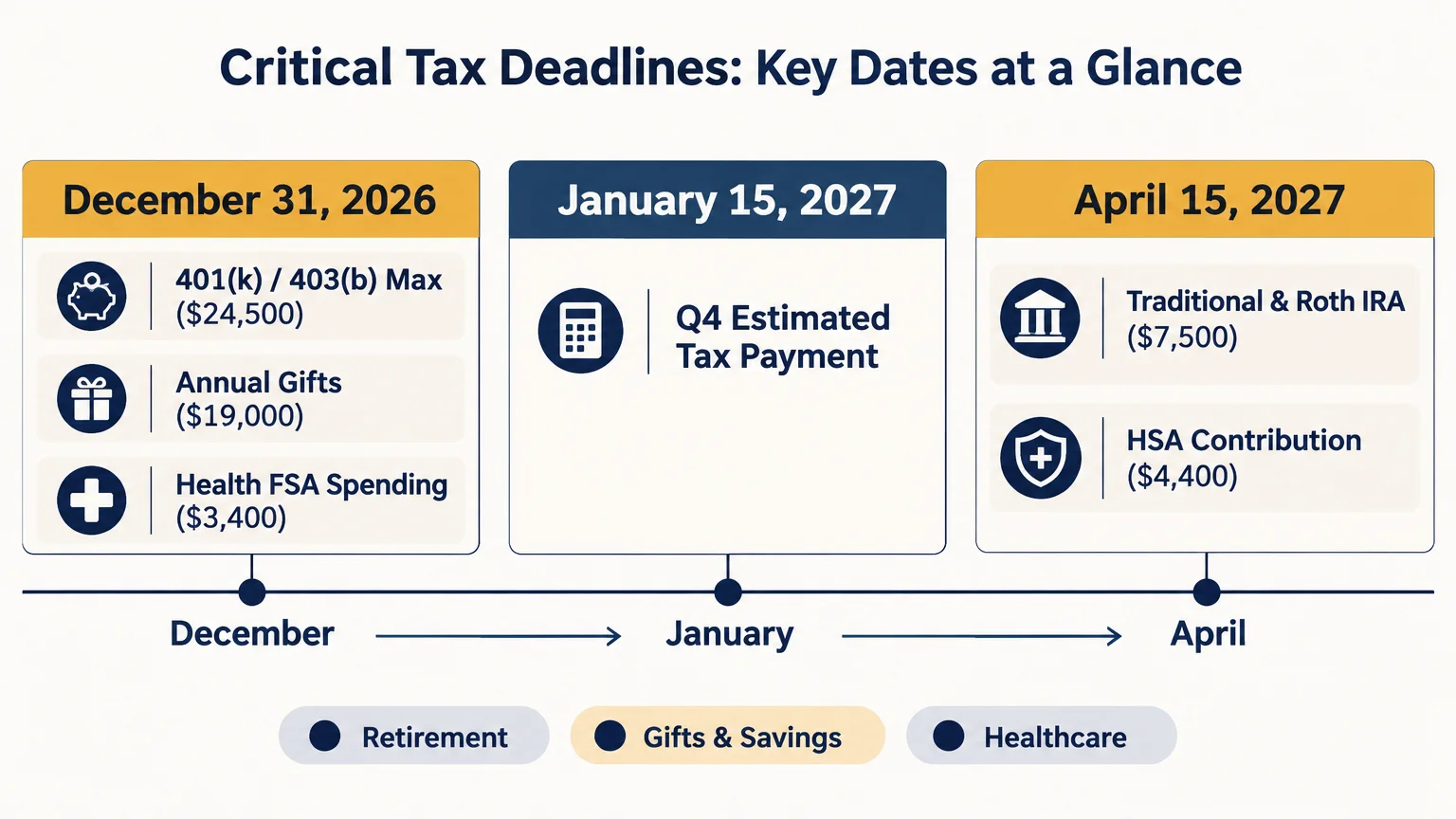
At a Glance: Key 2026 Year-End Deadlines
Not every 2026 tax move shares the same cutoff date. Knowing which transactions require action by December 31—and which give you extra breathing room into 2027—helps you prioritize your cash and paperwork.
Use this deadline table to map out your remaining 2026 calendar before payroll and brokerage processing times slow down in late December.
| Tax Move | 2026 Limit or Key Rule | Hard Deadline |
|---|---|---|
| Workplace 401(k), 403(b), 457(b), and TSP contributions | $24,500 standard; $8,000 catch-up (50–59, 64+) or $11,250 (60–63) | December 31, 2026 |
| Required minimum distributions (age 74+) | Full 2026 RMD required to avoid a 25% excise penalty | December 31, 2026 |
| Charitable gifts and QCDs | $1,000/$2,000 non-itemizer cash cap; $111,000 QCD limit (70½+) | December 31, 2026 |
| Health FSA spending | $3,400 limit; max $680 carryover or 2½-month grace period if offered | December 31, 2026 |
| Tax-loss harvesting | Offset gains plus up to $3,000 ($1,500 MFS) of ordinary income | December 31, 2026 |
| Annual tax-free family gifts | $19,000 per recipient ($38,000 for married couples) | December 31, 2026 |
| Q4 2026 estimated tax payment | Waived if you file and pay your full 2026 balance by February 1, 2027 | January 15, 2027 |
| First-ever RMD (turning 73 in 2026) | Delaying creates two taxable RMDs in the 2027 tax year | April 1, 2027 |
| Traditional/Roth IRA and HSA contributions | IRA: $7,500 ($8,600 if 50+); HSA: $4,400 self-only or $8,750 family | April 15, 2027 |
Lock In Your 2026 Workplace Retirement and Benefit Contributions
Your paycheck is one of the strongest tools you have for tax planning before December 31. Unlike IRAs, workplace retirement deferrals and most flexible spending choices must run through payroll before the calendar flips.
Check your most recent pay stub to see how much room you have left under the 2026 IRS caps. Payroll departments often need one to two weeks to process changes, so submit updates well ahead of your final 2026 paycheck.
Max Out Workplace Retirement Plans
Under IRS Notice 2025-67, employees with a 401(k), 403(b), governmental 457(b), or federal Thrift Savings Plan can defer up to $24,500 in 2026. Including employer matches and profit-sharing, the total combined limit reaches $72,000.
If you are age 50 to 59—or 64 and older—you can add an $8,000 catch-up contribution, bringing your employee total to $32,500. Workers aged 60 through 63 qualify for an enhanced $11,250 catch-up, pushing their total to $35,750.
Small-business workers in a SIMPLE IRA or SIMPLE 401(k) face a $17,000 deferral cap in 2026. Those age 50 and older can contribute an extra $4,000 standard catch-up.
Keep one major rule change in mind if you are a higher earner. Beginning January 1, 2026, anyone age 50 or older whose 2025 FICA wages with their sponsoring employer exceeded $150,000 must make all age-based catch-up contributions on a Roth after-tax basis.
If your employer plan does not offer a Roth option, you cannot make catch-up contributions to that plan at all. Verify your 2025 W-2 wages and your payroll elections now so excess pretax deferrals do not create headaches in January.
Spend Down Health and Dependent Care FSAs
Health Flexible Spending Accounts allow up to $3,400 in pretax contributions for 2026 under IRS Revenue Procedure 2025-32. Because these accounts follow use-it-or-lose-it rules, unspent money generally vanishes after December 31, 2026.
Check your employer’s summary plan description to see which safety net applies to you. Plans may offer either a carryover of up to $680 into 2027 or a grace period of up to 2½ months—never both.
Watch out for a subtle trap if you plan to switch to a Health Savings Account (HSA) in 2027. Carrying over general-purpose health FSA dollars into 2027 can block your eligibility to contribute to an HSA for the new year.
Parents and caregivers also have a bigger 2026 benefit window under Public Law 119-21. The Dependent Care FSA limit is $7,500 per household—or $3,750 if married filing separately—so submit qualifying daycare or eldercare receipts before plan cutoffs.
Save IRAs and HSAs for After Payroll Closes
You do not need to rush cash into an IRA or HSA before December 31 if your budget is tight during the holidays. Both accounts accept 2026 contributions right up until April 15, 2027.
For 2026, traditional and Roth IRA limits sit at $7,500, plus a $1,100 catch-up for savers age 50 and older. HSA limits are $4,400 for self-only coverage and $8,750 for family coverage, with an extra $1,000 catch-up if you are 55 or older.
Meet Your Required Minimum Distribution Deadline Without Overpaying
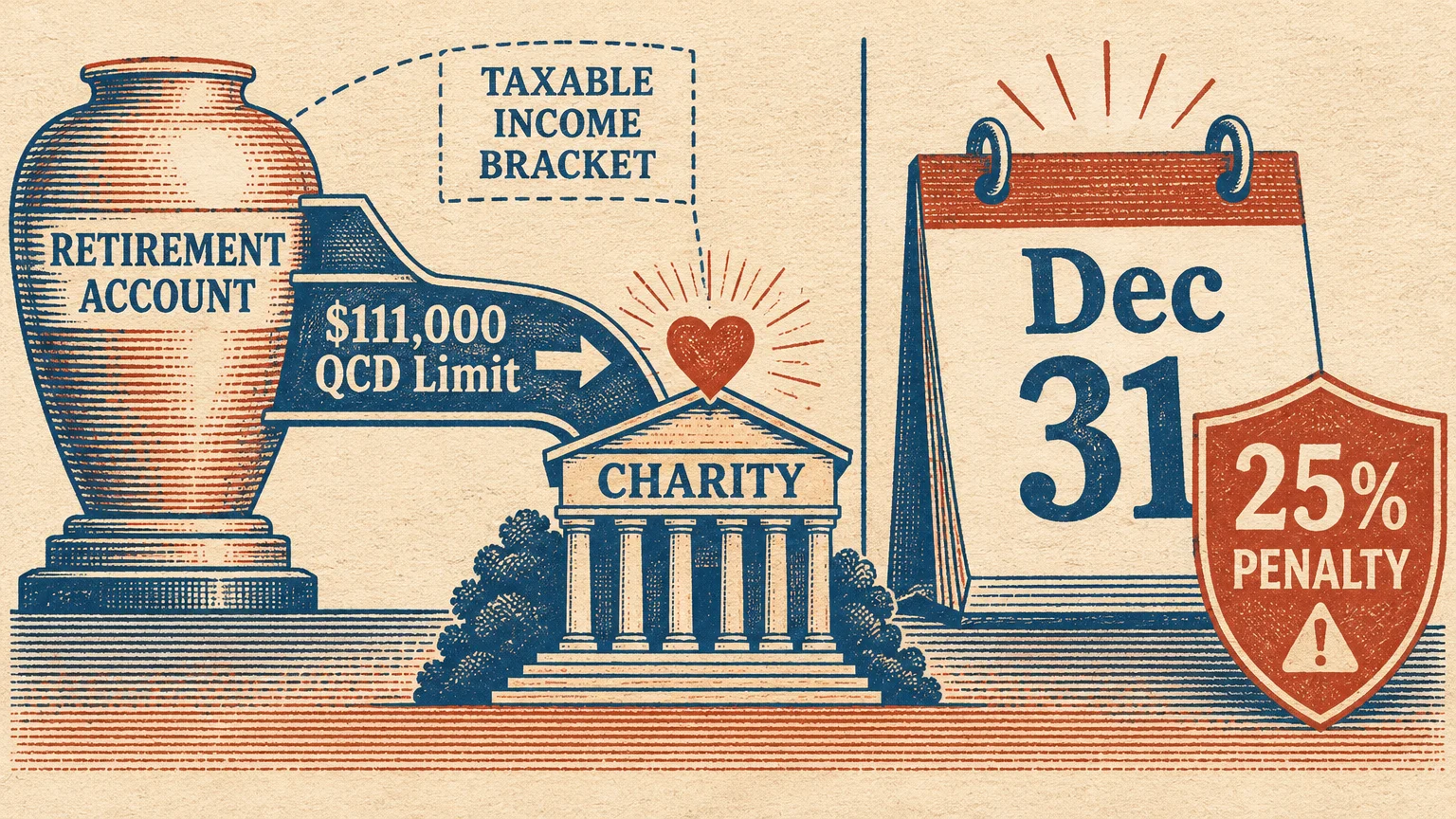
Missing your required minimum distribution deadline triggers one of the steepest penalties in the tax code. The IRS levies a 25% excise tax on any RMD amount you fail to withdraw on time.
If you are age 74 or older in 2026, you must complete your annual withdrawal by December 31, 2026. This rule covers traditional IRAs, SEP IRAs, SIMPLE IRAs, 401(k)s, 403(b)s, and 457(b) plans.
Roth IRAs and designated Roth workplace accounts—such as Roth 401(k) and Roth 403(b) balances—do not require distributions while the original owner is alive. You can leave those funds growing tax-free without worrying about a December withdrawal.
Avoid the First-Year RMD Stacking Trap
If you turn 73 in 2026, the IRS gives you a one-time extension until April 1, 2027 to take your very first RMD. That breathing room sounds helpful, yet delaying often backfires on your tax bill.
Pushing your 2026 distribution into early 2027 forces you to take two taxable RMDs in a single calendar year. You will have to withdraw the delayed 2026 amount by April 1 and your regular 2027 distribution by December 31.
Stacking two payouts in 2027 can push you into a higher marginal tax bracket or raise Medicare premium surcharges. Compare your 2026 and projected 2027 income before choosing to wait.
Exceptions and Fixing a Missed Payout
Still working past age 73 can spare you from taking a payout from your current employer’s retirement plan. As long as your plan allows it and you own less than 5% of the business, you can delay RMDs from that active workplace account until you retire.
Note that this working exception never applies to traditional, SEP, or SIMPLE IRAs, or to old 401(k)s left with former employers. You must still withdraw RMDs from those outside accounts by December 31.
If you discover a missed RMD from an earlier year, act quickly to shrink the damage. Taking the shortfall within two years and filing IRS Form 5329 cuts the 25% excise tax down to 10%, and the IRS may waive it entirely for reasonable error with a written explanation.
Claim the New 2026 Charitable Donations Tax Deduction Rules
Generosity looks very different on 2026 tax returns thanks to Public Law 119-21, also known as the One Big Beautiful Bill Act. Whether you itemize or take the standard deduction, verify how the new rules treat your charitable donations tax deduction before December 31.
Because each giving path follows different IRS thresholds, picking the right method can increase the tax value of your year-end donations. Review the three main options below before writing checks or transferring shares.
- Permanent deduction for non-itemizers: Under IRS announcement IR-2026-135, standard-deduction filers can deduct up to $1,000 ($2,000 for married couples filing jointly) for 2026 cash gifts to eligible public charities.
- New floor and cap for itemizers: Itemizers can only deduct charitable gifts that exceed 0.5% of their adjusted gross income (AGI), and taxpayers in the top 37% bracket have their itemized deduction tax savings capped at 35%.
- Qualified Charitable Distributions (QCDs): IRA owners age 70½ or older can transfer up to $111,000 directly from an IRA to a qualified 501(c)(3) charity—or $222,000 for a married couple with separate IRAs—completely tax-free.
Non-itemizers must follow strict boundaries to claim the new $1,000 or $2,000 write-off. Noncash donations such as clothing or stock, gifts to donor-advised funds (DAFs), and gifts to private non-operating foundations do not qualify.
Keep receipts, canceled checks, or bank statements for every dollar you plan to claim, since the cap is not indexed for inflation and requires proof if audited. You can confirm a charity’s tax-exempt status using the search tools on IRS.gov.
If you itemize, the new 0.5% AGI floor means small, scattered donations may yield zero tax benefit. For example, a household with $120,000 in AGI cannot deduct the first $600 of charitable giving, and disallowed amounts below that floor generally cannot carry forward.
Consider “bunching” two years of gifts—either directly or into a donor-advised fund—into 2026 to clear the 0.5% floor once instead of losing part of the deduction two years in a row. Remember that cash gifts to public charities cap at 60% of AGI, while appreciated assets held over a year cap at 30% of AGI.
Retirees age 70½ and older often get the biggest win from QCDs. Because a direct IRA-to-charity transfer never enters your AGI, it bypasses the 0.5% floor and satisfies your RMD at the same time—plus you can use a one-time $55,000 transfer toward a qualifying split-interest vehicle.

Review New 2026 Deductions, SALT Caps, and Family Gifting
Several temporary and expanded breaks take effect for 2026 under IRS Tax Tip 2026-12 and Public Law 119-21. Checking where you stand before year-end ensures you capture every eligible deduction and finish annual family gifts on time.
Even if you normally take the standard deduction, the 2026 rules let you stack several brand-new write-offs right on top of it.
Compare Standard Deductions and the Higher SALT Cap
For 2026, IRS Revenue Procedure 2025-32 sets the base standard deduction at $16,100 for single and married-filing-separately taxpayers, $24,150 for heads of household, and $32,200 for married couples filing jointly. Many households who took the standard deduction in prior years should run the math again for 2026.
That is because the state and local tax (SALT) deduction cap jumped to $40,400 in 2026 ($20,200 if married filing separately). The cap begins phasing down once modified adjusted gross income (MAGI) exceeds $505,000, though it will not drop below $10,000.
If you live in a high-property-tax or high-income-tax state, paying your next property tax installment or estimated state income tax before December 31 could push your itemized deductions past the standard deduction. Check your local tax billing portal to see whether prepayments are permitted.
Check New Breaks for Seniors, Workers, and Car Buyers
Both itemizers and non-itemizers can claim several temporary 2026 deductions if they meet income and documentation requirements. Seniors age 65 and older receive an extra $6,000 deduction per eligible spouse—or $12,000 on a joint return when both are 65 or older.
This senior bonus phases out above $75,000 MAGI for single filers ($150,000 joint) and stacks on top of the regular age-65 standard deduction add-on of $2,050 (single) or $1,650 per spouse (joint). Checking your year-end capital gains or Roth conversions could keep your MAGI safely below that phaseout cliff.
Three worker and borrower deductions also debut for 2026 returns:
- Qualified tips: Eligible service workers can deduct up to $25,000 in qualified tip income, subject to income phaseouts.
- Qualified overtime: Workers earning overtime pay can deduct up to $12,500 ($25,000 on a joint return) for qualified overtime compensation.
- U.S.-assembled car loan interest: Borrowers who financed a qualifying new U.S.-assembled passenger vehicle can deduct up to $10,000 in loan interest, reported on Form 1098-VLI when interest totals $600 or more.
Use Your 2026 Annual Gift Tax Exclusion
In 2026, you can give up to $19,000 per recipient—or $38,000 per recipient for married couples splitting gifts—without filing a gift tax return or reducing your $15,000,000 lifetime federal estate and gift tax exemption. You can gift cash, stocks, or 529 plan contributions to as many individuals as you wish.
Unused annual exclusions do not carry over into 2027, when the limit rises to $20,000 per recipient. Make sure checks clear or brokerage transfers settle by December 31, 2026 so the gift counts toward this year’s allowance.
Harvest Investment Losses and Fix Your Tax Withholding
Your brokerage account and your paycheck stubs deserve one last check before New Year’s Eve. Selling underwater investments and tweaking final tax payments can trim your April bill and prevent underpayment penalties.
Review realized capital gains from earlier in the year alongside any side-gig or freelance income you earned without withholding.
Offset Gains With Tax-Loss Harvesting
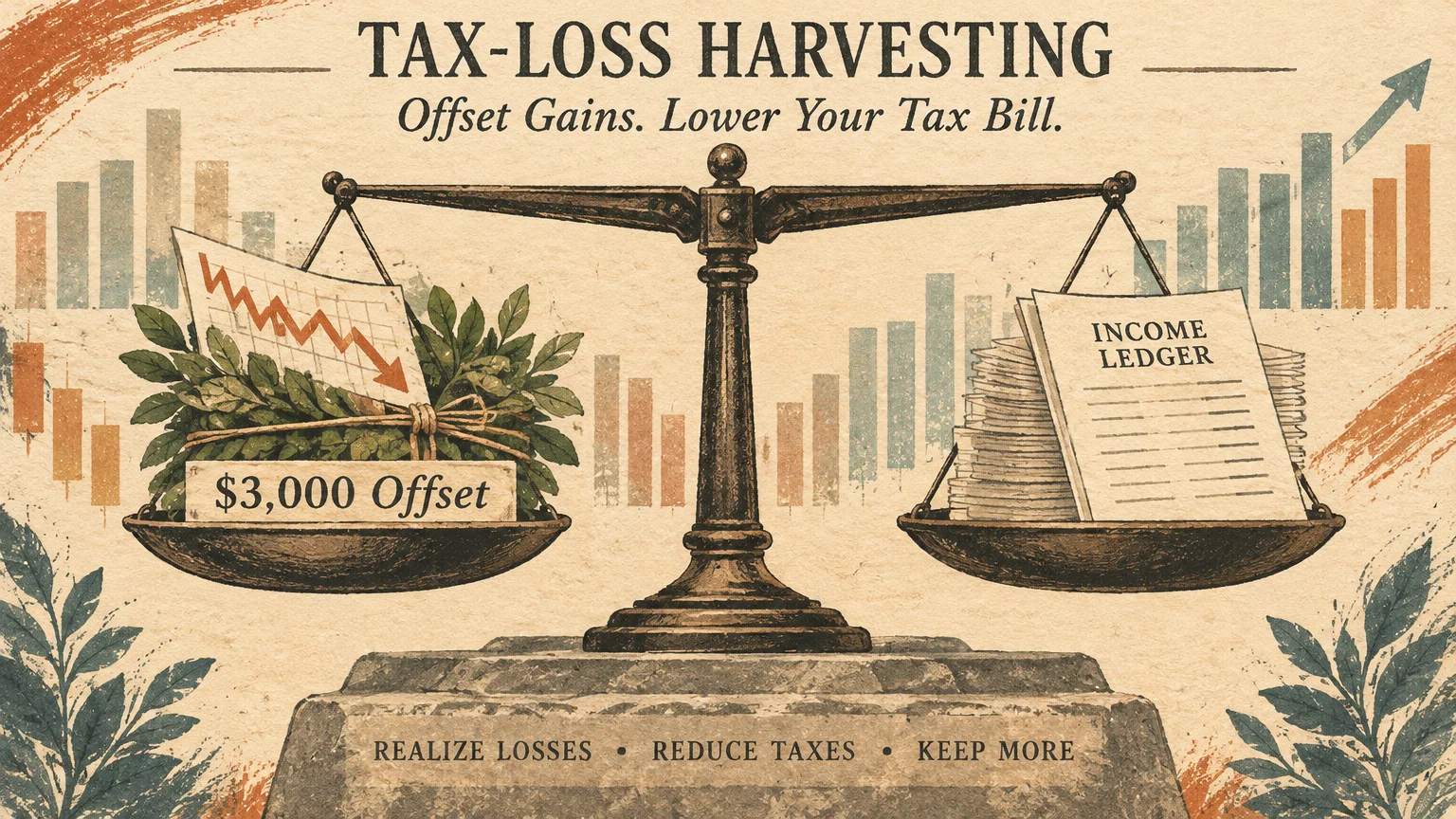
If you sold winning stocks, mutual funds, or digital assets in a taxable brokerage account during 2026, you can sell losing positions by December 31, 2026 to cancel out those taxable gains. If your realized losses exceed your gains, you can deduct up to $3,000 ($1,500 if married filing separately) against ordinary income and carry leftover losses into future years.
Watch out for the IRS wash-sale rule before clicking sell. Buying the same or a substantially identical security within 30 days before or after the sale disallows the tax loss—even if the replacement purchase happens inside an IRA or a spouse’s account.
To stay invested without breaking the rule, swap into a broad index fund or a different company in the same sector until the 30-day window passes. You can brush up on investment account rules and investor protections at Investor.gov or check market mechanics with FINRA.
Adjust Withholding and Plan Q4 Estimated Payments
Did a bonus, second job, marriage, or side hustle throw off your taxes this year? Under IRS publication 5349-A and announcement IR-2026-128, you can run your numbers through the IRS Tax Withholding Estimator and submit an updated Form W-4 to your employer.
Here is why a late-year W-4 adjustment is so effective: the IRS treats payroll tax withholding as if it were paid evenly throughout the entire year. Boosting withholding on your remaining December paychecks can erase underpayment penalties that built up earlier in 2026.
Self-employed workers, freelancers, and investors without enough withholding have a slightly later deadline. Your fourth-quarter 2026 estimated tax payment on Form 1040-ES is due January 15, 2027, though the IRS waives that payment if you file your full 2026 return and pay the entire balance by February 1, 2027.
Also keep track of payment apps and online marketplaces. Under Public Law 119-21, platforms must issue Form 1099-K for 2026 when gross payments exceed $20,000 and 200 transactions—yet all taxable business income remains reportable even if you stay below that threshold.
Prepare Your IRS Account, Bank Details, and Records Now
Good tax planning before December 31 goes beyond deductions and investments. In November 2026, the IRS specifically urged taxpayers to modernize how they receive refunds, lock down their accounts against identity theft, and organize paperwork before filing season opens.
Spending 20 minutes on digital housekeeping today saves hours of frustration in February or March.
Get Ready for the Paper Refund Check Phase-Out
Under Executive Order 14247, the IRS is phasing out paper tax refund checks in favor of electronic direct deposit. Taxpayers who still rely on mailed Treasury checks should open a checking or savings account now and keep their routing and account numbers handy.
If you need help comparing low-fee or no-fee checking accounts, review consumer protections and account-opening checklists from the Consumer Financial Protection Bureau. Direct deposit delivers refunds faster and eliminates the risk of lost or stolen mail.
Set Up Your IRS Online Account and IP PIN
Log into or create an IRS Individual Online Account to view past transcripts, verify estimated payments you made during 2026, and manage payment schedules. For mobile access, download the new IRS mobile app—launched September 25, 2026 to replace IRS2Go.
While logged in, request an Identity Protection PIN (IP PIN) under IRS guidance IR-2026-127. This six-digit number stops scammers from filing a fraudulent tax return using your Social Security number.
Stay alert for phishing texts, emails, and phone calls claiming to come from the IRS as filing season approaches. The agency does not initiate contact by social media or text message to demand immediate payment or ask for your banking details.
Finally, designate one digital or physical folder for incoming tax forms. You will need Forms W-2, Forms 1099 from banks, brokerages, payment apps, and marketplaces, Form 1098-VLI for eligible auto loans, digital asset transaction logs, and receipts for every charitable gift.

Avoiding Common Errors
Even organized taxpayers stumble on fine-print rules during the December rush. Double-check your year-end moves against these common mistakes before submitting final transactions:
- Triggering an accidental wash sale: Selling a stock at a loss on December 20 while automatic dividend reinvestment buys shares of the same fund on December 28 will disallow part of your loss. Turn off automatic dividend reinvestment a month before harvesting losses.
- Losing 2027 HSA eligibility to an FSA carryover: Rolling even $100 of unused general-purpose health FSA money into 2027 can block you from making HSA contributions next year. Spend down your FSA completely or verify whether your employer offers a limited-purpose option.
- Assuming all donations qualify for the new $1,000/$2,000 deduction: Dropping off furniture at a thrift shop or funding a donor-advised fund will not qualify for the non-itemizer write-off. Only documented cash gifts to eligible public charities count.
- Overlooking the mandatory Roth catch-up rule: High earners over age 50 whose 2025 FICA wages exceeded $150,000 cannot make pretax catch-up contributions in 2026. Confirm your payroll system routed your extra deferrals into a Roth bucket.
- Counting on the April 1 RMD grace period without running the math: Delaying your first RMD at age 73 forces two taxable distributions into 2027, which can spike both your income tax rate and Medicare costs.
When DIY Isn’t Enough
Online calculators and tax software handle straightforward returns well, yet 2026 introduces overlapping thresholds that reward tailored planning. Consider hiring a Certified Public Accountant (CPA), Enrolled Agent (EA), or fee-only Certified Financial Planner before December 31 in these four situations:
Your MAGI sits near key 2026 phaseout cliffs: Earning near $75,000 ($150,000 joint) for the senior deduction or above $505,000 for the SALT cap requires careful timing of bonuses, Roth conversions, and capital gains.
You turn 73 in 2026 with multiple retirement accounts: Deciding whether to take your first RMD in December or stack two payouts in 2027—or pair a QCD with your RMD—benefits from multi-year tax projections.
You run a side business or have heavy digital asset activity: Reconciling Form 1099-K marketplace totals, crypto cost basis, quarterly estimated payments, and self-employed retirement plans before year-end prevents messy audit notices later.
You plan major charitable bunching or family wealth transfers: Coordinating appreciated stock gifts over the 0.5% AGI floor alongside $19,000 annual gifts and trust strategies calls for coordinated tax and legal guidance. You can also compare year-end tax planning guides from Kiplinger before meeting with a pro.
Frequently Asked Questions
What is the required minimum distribution deadline for 2026?
If you are age 74 or older in 2026, you must withdraw your full RMD by December 31, 2026 to avoid a 25% excise tax penalty. Those turning 73 in 2026 may delay their very first RMD until April 1, 2027, though doing so requires taking two taxable RMDs in 2027.
Can I claim the $1,000 charitable deduction if I take the standard deduction in 2026?
Yes. Beginning with the 2026 tax year, standard-deduction filers can deduct up to $1,000 ($2,000 for married couples filing jointly) for qualifying cash donations to eligible public charities, provided you keep receipts or bank records. Noncash goods, donor-advised funds, and private non-operating foundations do not qualify.
Do I have until April 15, 2027 to max out my 401(k) for 2026?
No. Employee contributions to a 401(k), 403(b), governmental 457(b), or TSP must come through payroll and generally must be completed by December 31, 2026. Only IRAs and HSAs let you make 2026 contributions up to April 15, 2027.
What happens if I do not have a bank account for my 2026 tax refund?
Under Executive Order 14247, the IRS is phasing out paper tax refund checks and urges taxpayers without a bank account to open one before filing season. Having an active checking or savings account ready lets you receive your refund safely by direct deposit without delays.
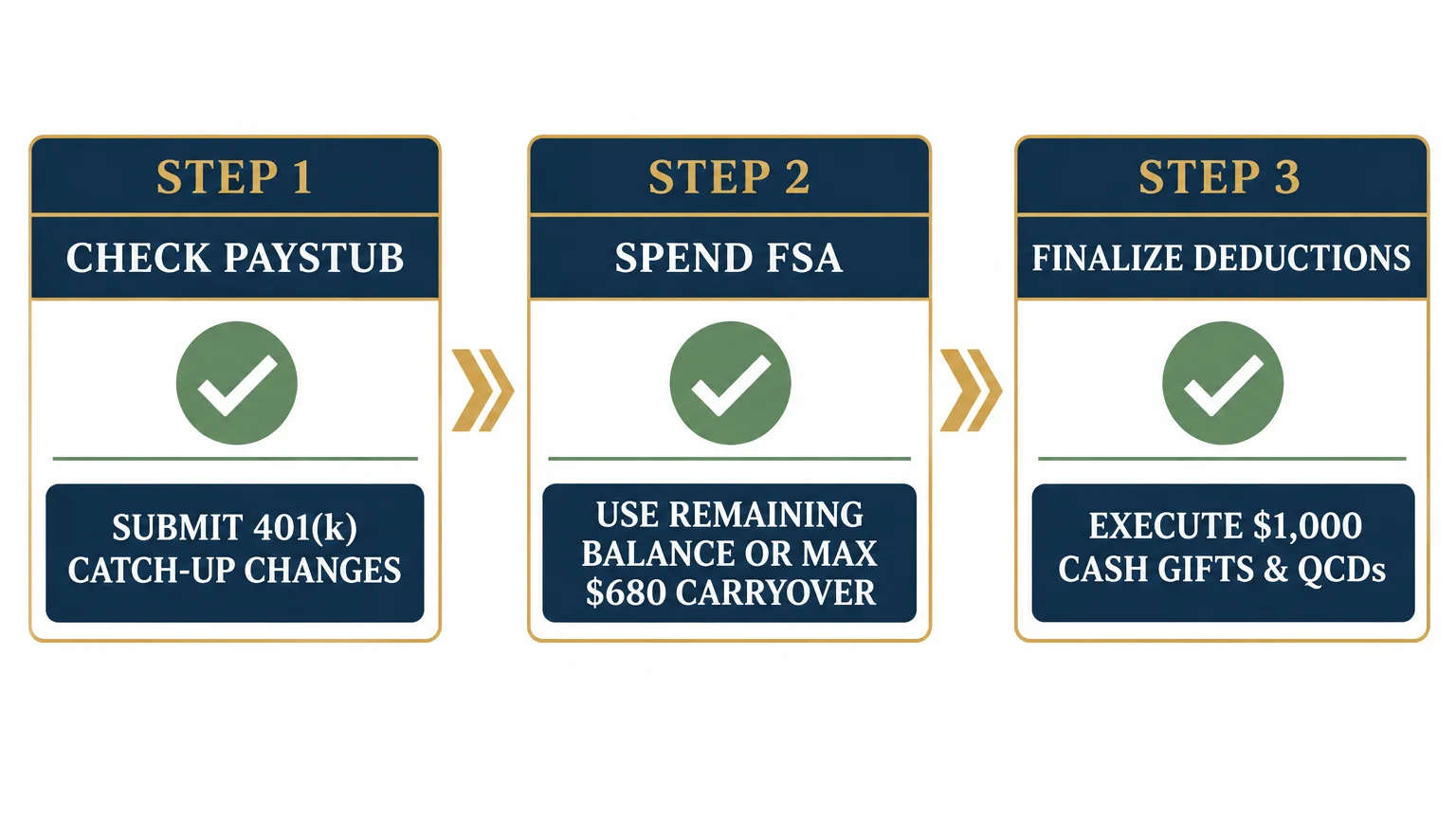
Your Next Moves Before December 31
Pick two or three high-impact moves today—such as adjusting your final 401(k) payroll deferral, completing your RMD, or verifying your bank details for direct deposit—and put them on your calendar this week. Small steps before December 31 save far more than scrambling in April.
The information in this guide is meant for educational purposes. Your specific circumstances—including income, debt, tax situation, and goals—may require different approaches. When in doubt, consult a licensed professional.
Last updated: November 2026. Financial regulations and rates change frequently—verify current details with official sources.