If you recently received a predetermination letter from the Social Security Administration, your upcoming Medicare premiums may spike dramatically. This notice warns that your income from two years ago triggers an Income-Related Monthly Adjustment Amount, or IRMAA surcharge.
You have a narrow 10-day window to respond before the agency formalizes higher monthly deductions. Taking fast action prevents unwarranted surcharges on your Medicare Part B and Part D coverage before payroll withholding begins.
Whether you retired recently or the tax data reflects outdated records, submitting updated proof now keeps unnecessary costs off your monthly benefits.
What Is an IRMAA Predetermination Notice?
A predetermination notice alerts you that the Social Security Administration found higher earnings on your past tax return. It informs you of a planned Medicare Part B and Part D surcharge before billing begins.
The Social Security Administration sends these advance letters to new Medicare attainers or during IRS verification matches. It is not a final bill.
Because it is an advance warning, this notice does not include formal administrative appeal rights. Instead, it invites you to resolve discrepancies directly with your local field office.
Why the 10-Day Window Matters
Social Security gives you 10 days from receipt to present updated financial evidence. The agency tracks this with a 20-day diary that accounts for mailing time each way.
If you do not respond within this window, the agency issues an Initial Determination Notice. Surcharges then lock into monthly benefit deductions automatically.
Acting inside 10 days prevents unneeded deductions before withholding starts. It spares you from waiting months for refunds on money you never owed.
Missing this initial window does not eliminate your rights forever. You still receive 60 days to appeal the subsequent initial determination, and qualifying life changes allow relief all year.

Four Common Errors You Can Fix in 10 Days
You can stop a planned surcharge immediately if the agency relied on erroneous or outdated tax records. Address these common situations before deductions begin:
- Outdated Tax Years: Social Security used tax data from three years prior because your two-year prior return was still processing. Providing a copy of your filed return resolves this discrepancy.
- Separated Spouses: You filed as Married Filing Separately but lived apart from your spouse for the entire year, qualifying you for single-filer thresholds.
- Amended Tax Filings: The Internal Revenue Service has not yet finalized your Form 1040-X amended return showing lower earnings.
- Life-Changing Events: You experienced a major life transition, such as retirement or a work reduction, that drastically lowered your income.
If any of these scenarios match your household, contact Social Security right away. Providing clear documentation stops the surcharge process in its tracks.
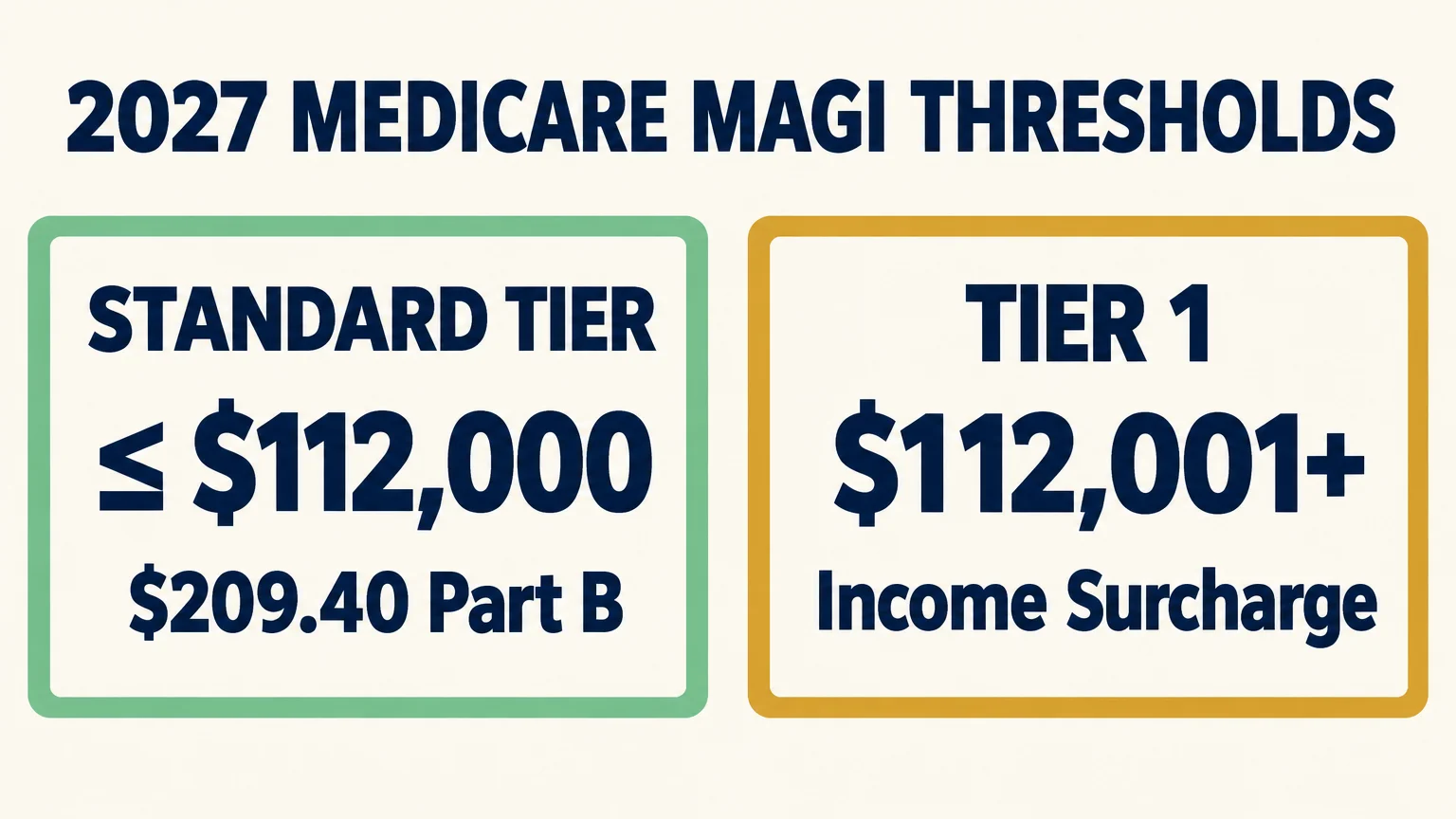
Understanding 2027 Medicare Surcharges
Medicare calculates your 2027 premiums using Modified Adjusted Gross Income from your 2025 tax return. MAGI combines your adjusted gross income with any tax-exempt interest.
Each tier operates as a strict financial cliff. Earning just one dollar over a threshold triggers the full monthly surcharge for that entire bracket.
| Income Bracket | 2025 MAGI (Single) | 2025 MAGI (Joint) | 2027 Part B Premium | 2027 Part D Surcharge |
|---|---|---|---|---|
| Standard Tier | $112,000 or less | $224,000 or less | $209.40 / month | $0.00 / month |
| Tier 1 | $112,001 – $141,000 | $224,001 – $282,000 | $293.10 / month | +$15.40 / month |
| Tier 2 | $141,001 – $177,000 | $282,001 – $354,000 | $418.80 / month | +$39.70 / month |
| Tier 3 | $177,001 – $212,000 | $354,001 – $424,000 | $544.40 / month | +$64.00 / month |
| Tier 4 | $212,001 – $499,999 | $424,001 – $749,999 | $670.00 / month | +$88.30 / month |
| Tier 5 | $500,000 or more | $750,000 or more | $711.80 / month | +$96.40 / month |
The standard Part B premium for 2027 is $209.40 per month. Surcharges apply on top of that base rate for higher earners.
Beneficiaries who pay an IRMAA surcharge lose protection under the Social Security hold harmless rule. As a result, higher Medicare premiums can consume your annual cost-of-living adjustment.

How to File a Life-Changing Event
If your income dropped due to retirement or work reduction, you qualify for an immediate adjustment. Social Security recognizes eight official life-changing events.
You can submit Form SSA-44 alongside signed copies of your recent tax return and termination letters. While Form SSA-44 simplifies this filing, verbal or written requests are also legally acceptable.
Submit your documentation through your online account, by certified mail, or by visiting a local field office. You can also call Social Security directly at 1-800-772-1213.
“A budget is telling your money where to go instead of wondering where it went.” — Dave Ramsey, Author and Personal Finance Expert
Proactively managing administrative deadlines ensures your hard-earned retirement dollars stay under your control rather than tied up in agency delays.
Common Mistakes to Avoid
Navigating government notices can feel overwhelming, but avoiding simple missteps preserves your budget. Watch out for these three pitfalls:
Calling Medicare instead of Social Security. Medicare delivers health benefits, but Social Security manages eligibility, income calculations, and premium withholding. Direct all correspondence to Social Security.
Assuming you lost your chance after 10 days. Missing the advance window triggers automatic withholding, but you still have 60 days to file a formal appeal once the determination arrives.
Failing to provide supporting evidence. Simply claiming your income dropped will not stop the adjustment. You must include verifiable proof, such as an employer statement or filed tax transcript.
Frequently Asked Questions
What happens if I miss the 10-day predetermination window?
Social Security issues a formal Initial Determination Notice and begins withholding the surcharge from your benefit check. You then have 60 days to appeal or request a redetermination.
Who bills me if I do not collect Social Security yet?
If you do not receive monthly Social Security benefits, the Centers for Medicare & Medicaid Services bills you directly via Form CMS-500.
Can I request an IRMAA reduction at any point in the year?
Yes, you can report a qualifying life-changing event at any time during the calendar year under federal regulations. SSA will recalculate premiums and refund any overpayments.
Next Steps for Your Medicare Coverage
Review your predetermination letter immediately and check your 2025 tax documents against the official IRMAA tiers. Contact Social Security right away to submit your documents and protect your cash flow.
The information in this guide is meant for educational purposes. Your specific circumstances—including income, debt, tax situation, and goals—may require different approaches. When in doubt, consult a licensed professional.
Last updated: November 2026. Financial regulations and rates change frequently—verify current details with official sources.