Your monthly Social Security check anchors your retirement plan; even small missteps can permanently shrink your payments. Overlooking key program rules can cost you hundreds of dollars every month.
Timing mistakes, hidden tax thresholds, and unexpected Medicare deductions frequently blindside unsuspecting retirees. Fortunately, understanding administrative rules allows you to sidestep these costly financial traps.
Learning how benefit calculations work puts you in complete control of your hard-earned benefits. Here are eight critical Social Security check mistakes you should avoid to safeguard your retirement income.
1. Claiming Benefits at Age 62 Without Factoring the Permanent Cut
Filing for Social Security as soon as you turn 62 is tempting. However, claiming early locks in a permanent reduction in your monthly benefit check.
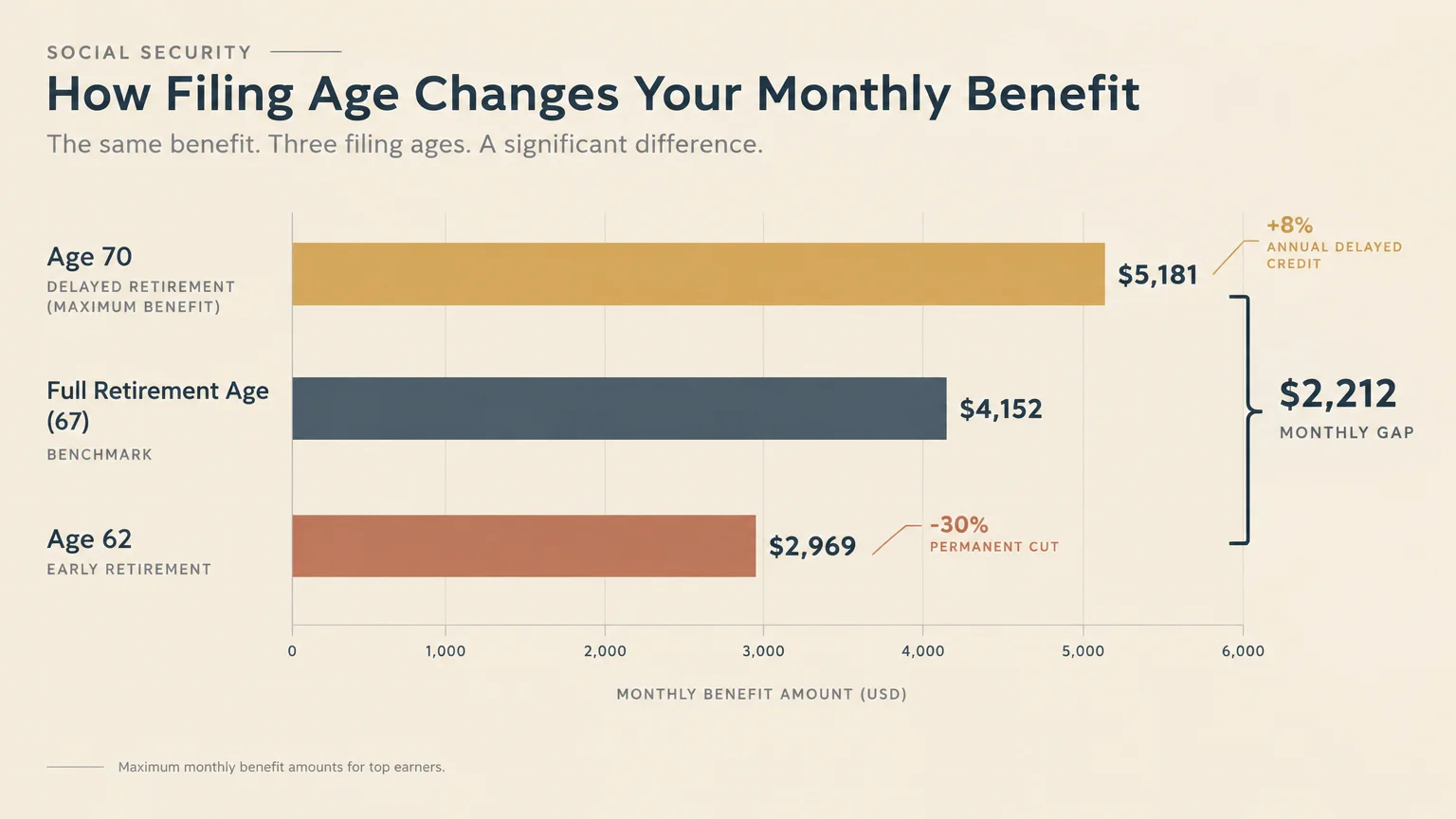
For anyone born in 1960 or later, your Full Retirement Age (FRA) is 67. Claiming at age 62 slashes your monthly benefit by up to 30% for the rest of your life.
In contrast, waiting beyond your Full Retirement Age earns you delayed retirement credits. Your monthly payment increases by 8% each year you delay until age 70.
Consider the maximum benefit amounts available in 2026 to see this gap clearly. A top earner claiming at age 62 receives a maximum check of $2,969 per month.
That same earner receives $4,152 per month at Full Retirement Age. If they delay claiming until age 70, their monthly check climbs to $5,181.
That amounts to a monthly difference of $2,212 between claiming at 62 and waiting until 70. Over a twenty-year retirement, that gap represents hundreds of thousands of dollars.
Many retirees claim early out of fear that the program will run out of funds. Making filing decisions based on fear often results in permanent, self-inflicted income losses.
You should calculate your break-even age before submitting your application. Most retirees break even on delayed benefits between ages 78 and 82.
If you enjoy good health and family longevity, delaying your claim provides exceptional longevity insurance. It also maximizes the future survivor benefit for your surviving spouse.
“If you can wait until age 70 to collect Social Security, that is the best financial move you can make for your retirement security.” — Suze Orman, Personal Finance Author and Host

2. Triggering the Retirement Earnings Penalty While Working
Collecting benefits early while continuing to work often creates an unwelcome surprise. The Social Security Administration enforces a strict earnings test if you claim before Full Retirement Age.
In 2026, the annual earnings limit for workers under Full Retirement Age all year is $24,480. That breaks down to an earnings threshold of $2,040 per month.
If your gross wages exceed that threshold, the agency withholds $1 in benefits for every $2 you earn above the limit. The earnings ceiling will rise to $25,560 in 2027.
A different threshold applies during the calendar year you reach your Full Retirement Age. In 2026, you can earn up to $65,160 before your birth month without penalty.
Above that $65,160 cap, the government withholds $1 for every $3 earned. That limit rises to $67,920 in 2027.
The earnings test disappears entirely once you reach your Full Retirement Age birthday month. From that point forward, you can earn unlimited income without losing a dime of your benefit check.
Fortunately, the money withheld under the earnings test is not lost forever. When you reach Full Retirement Age, the agency recalculates your check to credit those withheld months.
Even so, withholding disrupts your cash flow when you need income most. Working full-time while claiming at 62 often reduces your monthly checks to zero temporarily.
Review your expected earned wages before starting benefits. You can review administrative guidelines directly on the official Social Security Administration website before applying.

3. Falling Into the Federal Social Security “Tax Torpedo”
Many retirees assume their Social Security checks arrive completely tax-free. In reality, up to 85% of your benefits may face federal income taxation.
The federal government determines taxability using a metric called provisional income. You calculate provisional income by adding your Adjusted Gross Income, nontaxable interest, and 50% of your Social Security benefits.
Congress established the taxation thresholds in 1983 and has never adjusted them for inflation. Because of this legislative freeze, routine cost-of-living adjustments push more retirees into taxable territory each year.
The 2026 Cost-of-Living Adjustment (COLA) raised monthly checks by 2.8%, averaging roughly $56 more per month. Beneficiaries will also see a 3.6% COLA in 2027, adding approximately $75 per month.
These annual increases offer welcome relief against inflation, but they also trigger higher tax bills. The tax rules divide beneficiaries into two simple income tiers:
- Single Filers: Provisional income between $25,000 and $34,000 exposes up to 50% of benefits to tax; income above $34,000 taxes up to 85%.
- Married Filing Jointly: Provisional income between $32,000 and $44,000 exposes up to 50% of benefits to tax; income above $44,000 taxes up to 85%.
Viral online rumors recently claimed that federal legislation eliminated all taxes on retirement benefits. In truth, the July 2025 One Big Beautiful Bill Act (OBBBA) did not eliminate federal taxes on Social Security benefits.
The law established a temporary senior deduction, but it left the statutory provisional income tiers completely unchanged. Believing these online myths can lead to severe tax penalties when you file your returns.
You can manage this tax torpedo by orchestrating strategic distributions from your retirement accounts. Drawing funds from Roth IRAs keeps your provisional income low because Roth withdrawals are nontaxable.
You can check updated filing worksheets on the official Internal Revenue Service portal. Planning your withdrawals ahead of time protects your check from surprise federal tax liabilities.
4. Overlooking Medicare Part B Premiums and IRMAA Surcharges
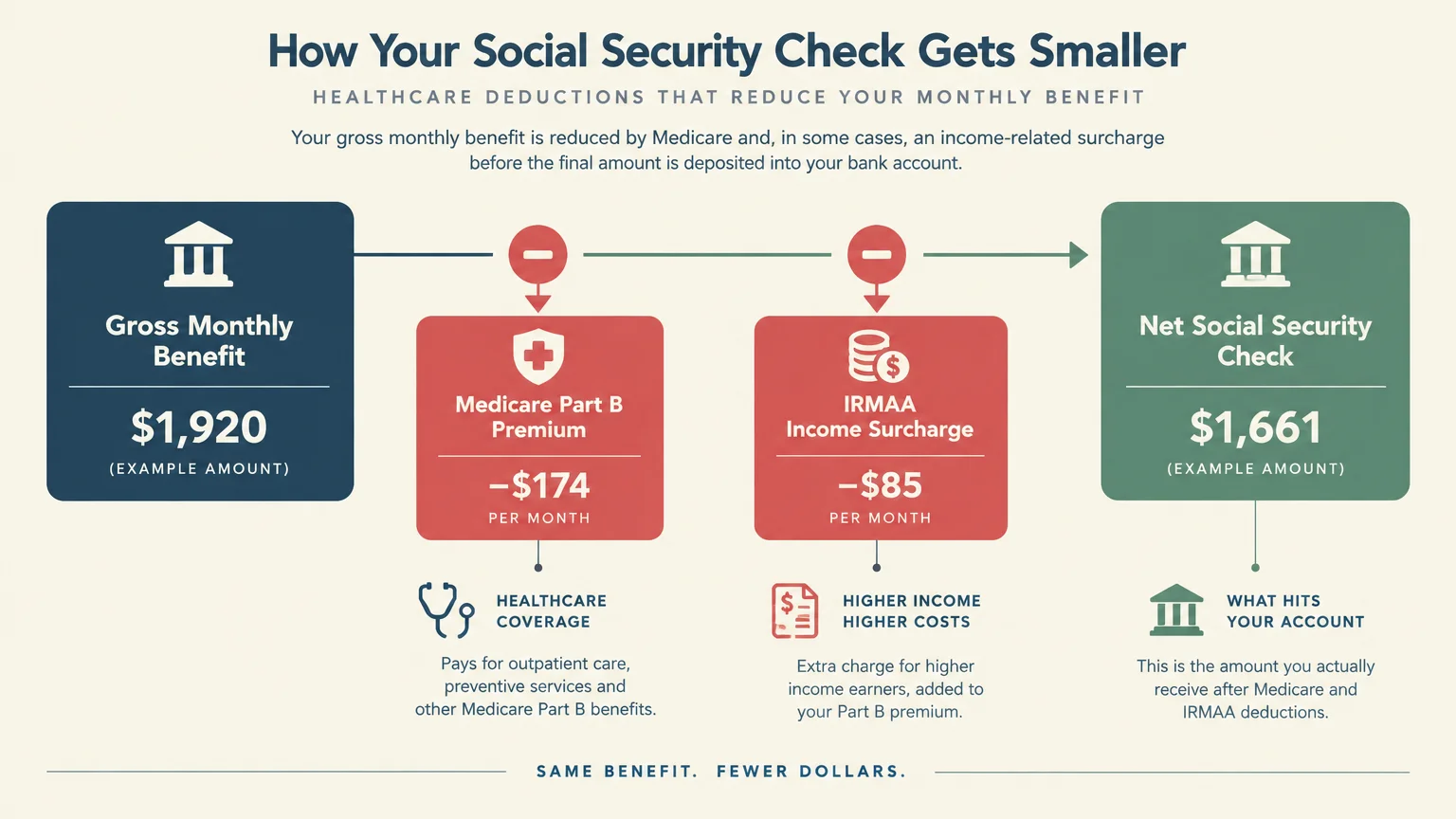
Your gross Social Security award rarely matches the net deposit that lands in your bank account. The federal government automatically deducts Medicare Part B premiums before depositing your monthly check.
In 2026, the standard Medicare Part B monthly premium is $202.90, up from $185.00 in 2025. This automatic deduction reduces your take-home benefit by more than $2,434 per year.
High-income retirees face an even steeper reduction known as the Income-Related Monthly Adjustment Amount (IRMAA). IRMAA adds a tiered surcharge to your Part B and Part D premiums.
The government bases your 2026 IRMAA surcharge on your modified adjusted gross income from two years prior. Your 2024 tax return dictates your premium costs throughout 2026.
In 2026, IRMAA surcharges trigger when single filers report income exceeding $109,000. For married couples filing jointly, the surcharge kicks in above $218,000.
Reaching these thresholds can increase your monthly Medicare premium from $202.90 to more than $500 per person. That steep deduction can consume a massive portion of your Social Security payment.
One-time events often trigger IRMAA unexpectedly. Selling a family home, executing a large Roth conversion, or taking a big capital gain can easily push you over the threshold.
If your income dropped recently due to retirement or widowhood, you do not have to accept the surcharge. You can file Form SSA-44 with documentation to appeal the decision based on a life-changing event.
You can explore premium brackets and health insurance requirements on Medicare.gov. Monitoring these thresholds prevents surprise deductions from shrinking your monthly checks.

5. Ignoring SSA Overpayment Notices and Default Clawbacks
Receiving an overpayment notice from the Social Security Administration causes immediate stress. Ignoring the letter, however, will quickly lead to severe financial disruption.
The agency frequently sends overpayment letters after discovering unreported wages or administrative calculation errors. When the agency overpays a beneficiary, it demands full repayment of those excess funds.
Under updated regulations taking effect for notices flagged on or after April 25, 2025, the default withholding rate is severe. The government can automatically withhold up to 50% of your monthly Title II retirement check.
Losing half of your monthly check overnight can devastate your household budget. Fortunately, you have specific legal rights and procedural remedies to challenge or reduce this collection effort.
Do not wait for the automatic withholding to begin. Take action immediately using one of three official administrative paths:
- File Form SSA-561 (Request for Reconsideration): Use this form if you believe the government calculated the overpayment incorrectly or that you owe nothing.
- File Form SSA-632 (Request for Waiver of Overpayment Recovery): Submit this form if the error was not your fault and repaying the money would cause severe financial hardship.
- File Form SSA-634 (Request for Change in Overpayment Recovery Rate): Use this document to propose an affordable repayment plan, such as $10 or $50 per month, instead of losing 50% of your check.
Filing your paperwork within 30 days of the notice date pauses clawback withholding while your case is reviewed. Acting quickly preserves your full monthly payment while you resolve the dispute.
The Consumer Financial Protection Bureau encourages consumers to keep meticulous records of all administrative correspondence. Store copies of your letters, submission receipts, and tracking numbers in a secure folder.
6. Forgetting State Income Taxes in the Remaining Eight States
Retirees often focus exclusively on federal taxes while ignoring state-level tax obligations. Depending on where you maintain legal residency, your state government might tax your monthly benefit check.
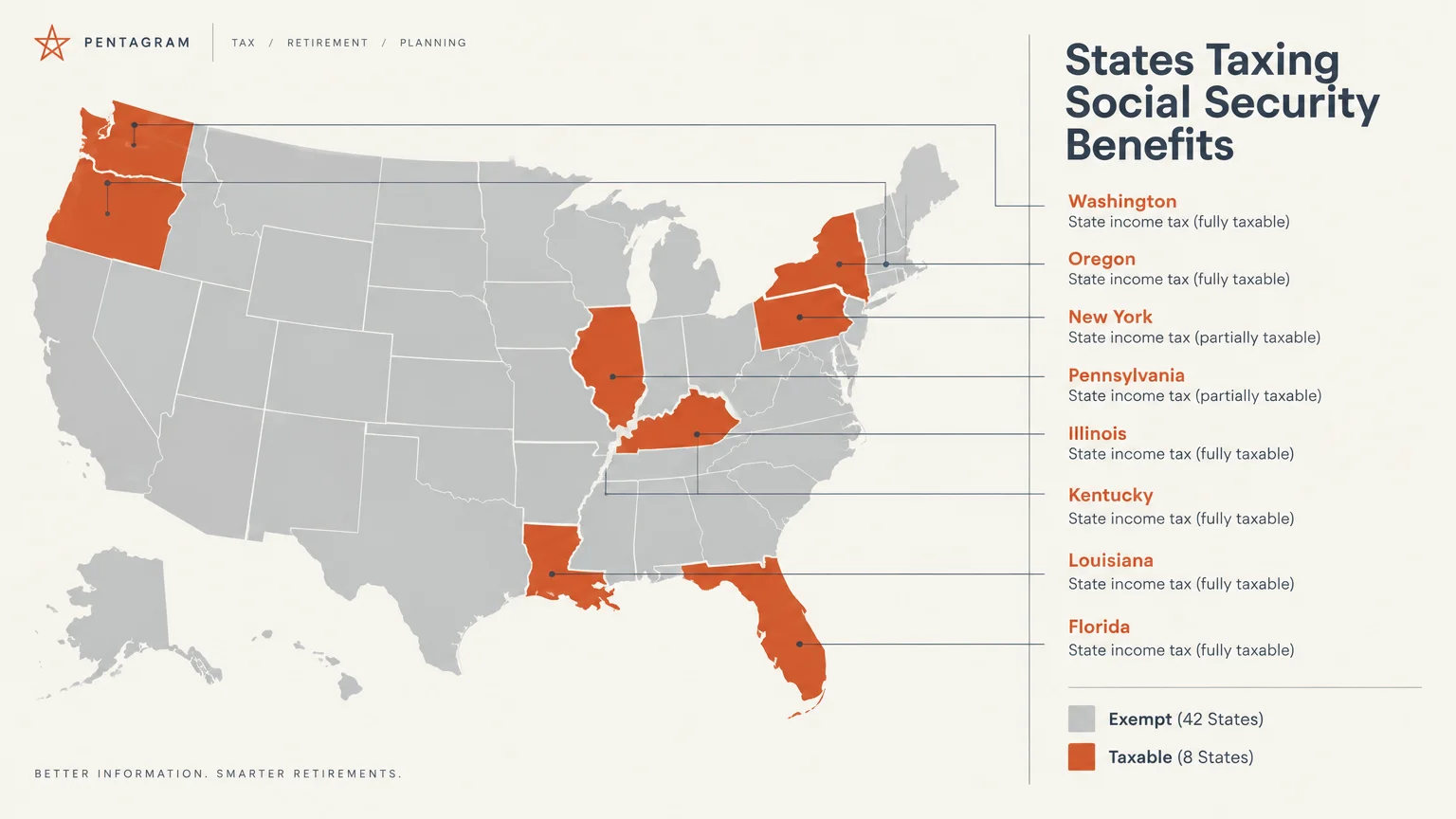
Fortunately, the vast majority of states exempt Social Security benefits entirely from state income taxation. As of 2026, only eight states continue to tax benefit checks under specific circumstances.
The eight states that retain the power to tax benefits are Colorado, Connecticut, Minnesota, Montana, New Mexico, Rhode Island, Utah, and Vermont. West Virginia completed its multi-year phase-out and fully exempts benefits starting in 2026.
Even among the eight states that tax benefits, most offer generous exemptions based on age or income. Many middle-income retirees in these states end up paying zero state tax on their benefits.
In Minnesota and Rhode Island, for example, state deductions shelter low- and moderate-income beneficiaries from state liability. However, higher earners often forfeit these exemptions and pay standard state tax rates.
Failing to account for state taxation leads to unpleasant surprises during tax season. You may find yourself owing hundreds of dollars in unpaid state income taxes.
If you live in one of these eight states, evaluate how your state calculates taxable income. You can adjust your state quarterly estimated tax payments to prevent underpayment penalties.
Relocating across state lines during retirement also carries significant tax consequences. Verify your target state’s retirement tax policies before establishing legal residency.

7. Failing to Optimize Spousal and Survivor Benefit Timing
Social Security planning is rarely an individual endeavor for married couples. Failing to coordinate filing strategies between spouses can cost your household tens of thousands of dollars.
A spousal benefit allows you to receive up to 50% of your spouse’s Full Retirement Age benefit amount. However, claiming your own benefit early permanently reduces any spousal boost you receive later.
To qualify for spousal benefits, the primary worker must file for their own retirement benefits first. Coordinating when each spouse files ensures you extract the maximum total income from the program.
Survivor benefits require even more careful coordination than regular spousal benefits. When one spouse passes away, the surviving spouse inherits the higher of the two monthly benefit amounts.
The smaller benefit check disappears completely upon the first spouse’s death. If the higher-earning spouse claimed benefits at 62, they permanently reduce the survivor income available to their partner.
High-earning spouses can protect their partners by delaying their claims until age 70. This delay guarantees the surviving spouse the highest possible inflation-protected monthly check for life.
Divorced individuals often leave substantial benefits on the table as well. If your marriage lasted at least ten years, you may qualify for benefits on your ex-spouse’s earnings record.
Claiming divorced spousal benefits does not impact your former spouse’s benefit amount or their current partner’s check. You do not even need your ex-spouse’s permission or cooperation to apply.
Explore your household filing options thoroughly before submitting your application. A coordinated strategy provides robust financial defense for whichever spouse lives longer.

8. Neglecting to Audit Your Official Social Security Earnings Record
The Social Security Administration does not guess your monthly benefit amount. The agency calculates your payment based on your highest 35 years of inflation-adjusted earnings.
If an employer reported your wages incorrectly decades ago, your monthly check will be permanently smaller. Millions of workers possess errors on their official earnings records without realizing it.
Clerical mistakes occur more often than most workers think. An inverted digit in your Social Security number or an employer reporting error can leave entire working years showing zero income.
Having a zero factored into your top 35 earning years drags down your average monthly earnings. That administrative error translates directly into smaller retirement checks every single month.
You can easily check your work record by creating an account on the agency’s web portal. Download your Social Security Statement annually and inspect each year of reported income carefully.
Compare your recorded earnings against your past tax returns and W-2 statements. If you discover a discrepancy, submit Form SSA-7008 along with proof of your actual wages.
Correcting an earnings mistake becomes much harder as decades pass. Employers go out of business, payroll firms purge old records, and finding old tax forms gets difficult.
Auditing your statement takes only fifteen minutes of your time once a year. That brief review ensures the government pays you every penny you earned over your career.
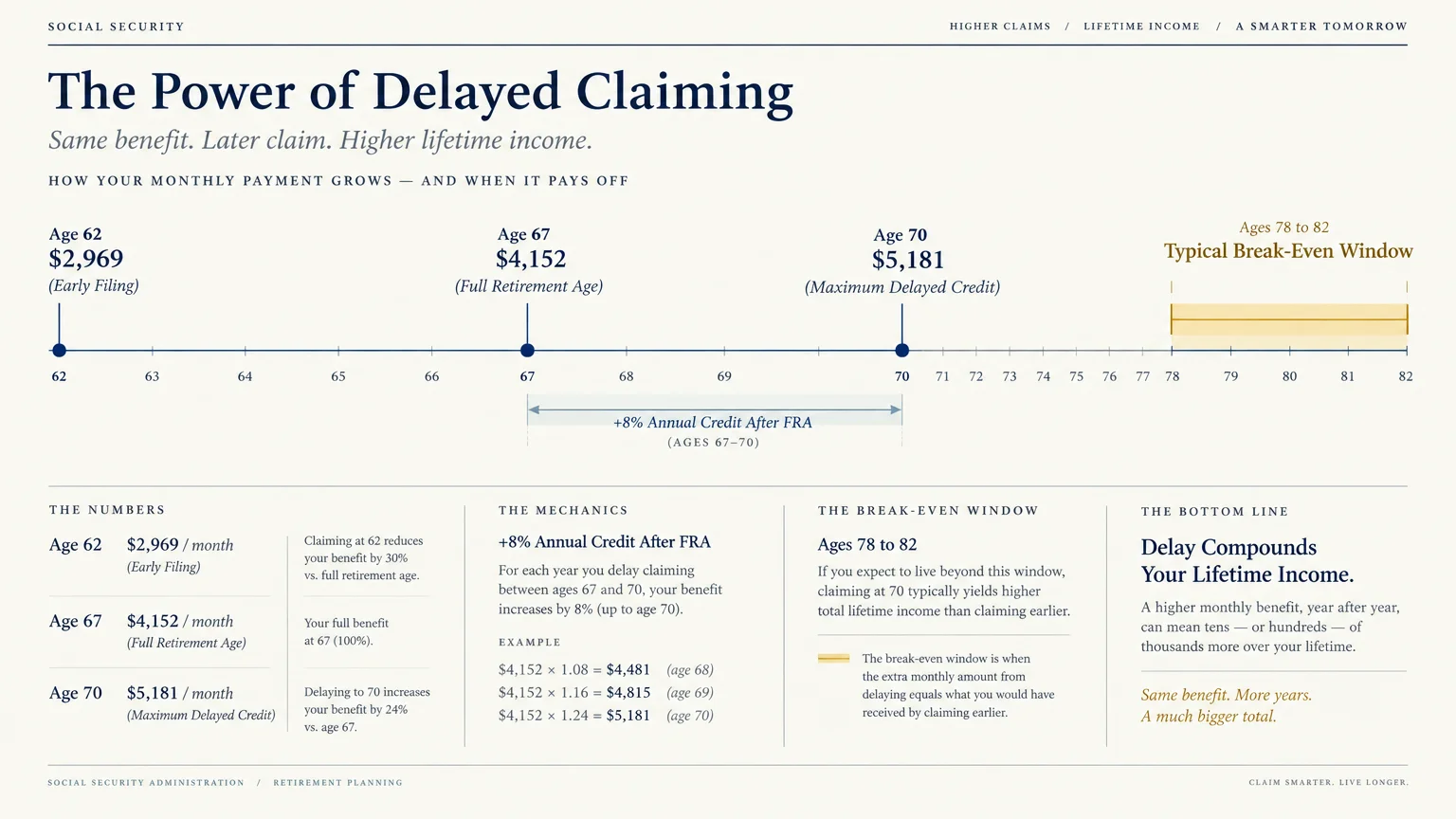
Comparing Claiming Ages: How Timing Transforms Your Monthly Check
Choosing an age to start Social Security benefits represents one of the most critical financial choices of your retirement. The age you select permanently dictates your baseline income, your survivor protections, and your freedom to work.
The table below summarizes the key trade-offs between filing at age 62, waiting for Full Retirement Age, or delaying until age 70. Review these figures to see how timing alters your monthly checks.
| Filing Age | Monthly Benefit (% of FRA) | 2026 Maximum Monthly Check | Annual Earnings Penalty Applies? | Delayed Credits Earned |
|---|---|---|---|---|
| Age 62 (Early Claim) | 70% of FRA Amount | $2,969 | Yes ($24,480 cap in 2026) | None (Permanent reduction) |
| Age 67 (Full Retirement Age) | 100% of FRA Amount | $4,152 | No (Unlimited earnings allowed) | Standard Baseline |
| Age 70 (Delayed Claim) | 124% of FRA Amount | $5,181 | No (Unlimited earnings allowed) | +24% total delayed boost (+8%/year) |
The numbers illustrate why postponing your claim yields such powerful returns. Delaying from age 62 to age 70 increases your baseline monthly check by approximately 77%.
Furthermore, each future cost-of-living adjustment compounds on that higher baseline number. Over a long retirement, this compounding creates a massive gap in cumulative lifetime income.

Professional vs. Self-Guided Social Security Planning
Navigating the rules of the Social Security system requires careful attention to detail. Some retirees can handle their claiming decisions independently, while others benefit immensely from professional advice.
Evaluating your household complexity helps you determine whether to hire an expert. Consider these common scenarios to decide which path fits your situation:
- Single Beneficiary with a Straightforward Career: If you are unmarried with no dependents and have a steady work history, self-guided planning works well. Review your official statement, calculate your break-even age, and choose a filing date aligned with your health.
- Couples with Significant Age or Earnings Gaps: When one spouse earned substantially more or is much older, hire a fee-only financial planner. An advisor can model joint life expectancies to maximize spousal and survivor lifetime payouts.
- Retirees Transitioning with Large Taxable Assets: If you hold large traditional 401(k) balances or face substantial deferred compensation, seek professional tax guidance. A Certified Financial Planner (CFP) can design a withdrawal schedule that prevents IRMAA surcharges and minimizes the federal tax torpedo.
- Individuals Facing Complex SSA Overpayment Disputes: If the government claims you owe thousands in overpayments, work with an administrative advocate or legal aid professional. They can guide you through appeals forms to protect your check from immediate clawbacks.
Deciding between DIY planning and professional support comes down to your personal balance sheet. Spending a few hundred dollars on an objective claiming analysis can prevent thousands of dollars in permanent mistakes.
Frequently Asked Questions About Social Security Checks
Can the government really take half of my Social Security check for an overpayment?
Yes. Under administrative policy for overpayments flagged on or after April 25, 2025, the default withholding rate for Title II benefits is up to 50%. You can prevent this deduction by filing an appeal or requesting a hardship waiver within thirty days.
Do I have to pay federal income tax on my Social Security benefits?
You must pay federal taxes if your provisional income exceeds statutory thresholds. If provisional income tops $34,000 for single filers or $44,000 for couples, up to 85% of benefits face federal tax. Recent legislation did not repeal these rules.
What happens to my withheld benefits if I exceed the earnings limit?
The money withheld under the earnings test is not lost permanently. When you reach Full Retirement Age, the agency recalculates your check upward to credit the months benefits were withheld. Your monthly check increases to compensate you over time.
Why was my monthly check smaller than the award letter promised?
Your check is likely smaller due to automatic deductions for Medicare Part B premiums, which cost $202.90 per month in 2026. Higher earners also face IRMAA surcharges, and state taxes may apply depending on where you reside.
Next Steps to Protect Your Monthly Social Security Check
Maximizing your Social Security check requires proactive planning rather than passive acceptance. Log in to your personal online account today to verify that your historical earnings records match your tax files.
Before selecting a start date, calculate how your choice impacts your spouse and your future tax bracket. Strategic patience often pays the highest dividends when managing your government benefits.
This is educational content based on general financial principles. Individual results vary based on your situation. Always verify current tax laws, investment rules, and benefit eligibility with official sources.
Last updated: October 2026. Financial regulations and rates change frequently—verify current details with official sources.