Divorcing later in life often alters your retirement expectations, but your previous marriage could provide a valuable income stream. You may qualify to claim divorced social security benefits based on your former spouse’s earnings history.
Many retirees overlook this opportunity because they assume their divorce decree severed all federal ties. In reality, claiming ex’s benefits does not reduce your former partner’s payout or notify them in any way.
Whether your ex-spouse continues to work or has already retired, strict federal guidelines dictate what you can receive. Learning these divorced spouse rules will help you protect your retirement cash flow and claim what is legally yours.
Rule 1: The 10-Year Marriage Requirement Holds Strict Boundaries
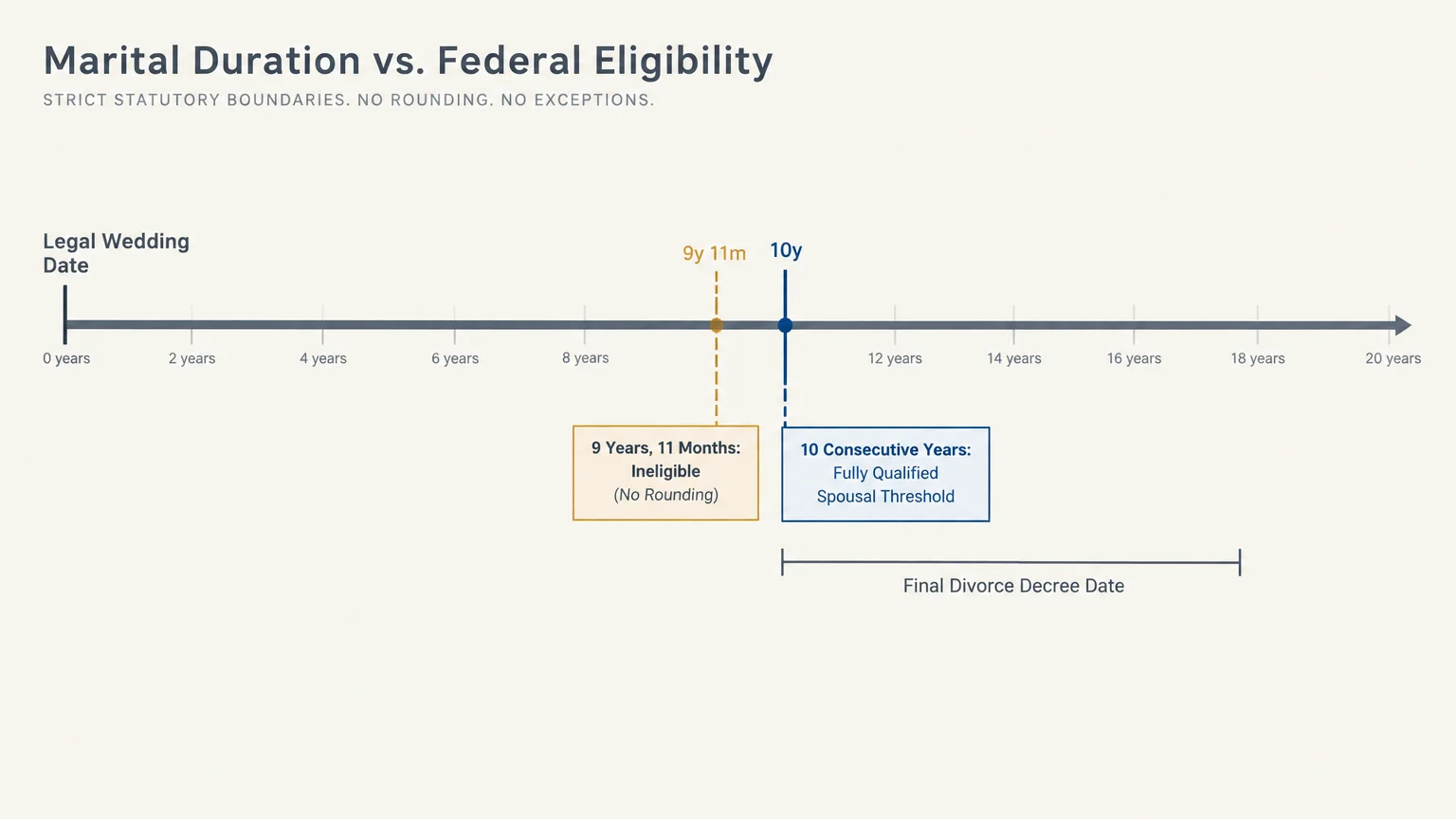
To collect benefits on your former spouse’s earnings record, your marriage must have lasted for at least 10 consecutive years. The Social Security Administration measures this timeline strictly from the legal wedding date to the final divorce decree date.
If your marriage ended at nine years and eleven months, you cannot qualify for spousal benefits. The agency does not round up partial years or make exceptions for informal separations.
A specific regulatory exception exists if you divorced and later remarried the exact same partner. You can combine both marriage durations to reach the 10-year threshold if you remarried no later than the calendar year after your divorce finalized.
You must present official government documents to establish this timeline when filing your claim. You will need your official marriage certificate, final divorce judgment, and both legal names.
Rule 2: You Can Claim Independently After Two Years Apart
Under standard spousal benefit guidelines, a married individual cannot collect spousal benefits until their partner officially files for retirement. Divorced retirees, however, operate under the independently entitled ex-spouse rule.
You can collect payments on your former spouse’s work record even if they have not yet applied for their own benefits. This rule protects you from an ex-spouse delaying their filing out of spite or personal preference.
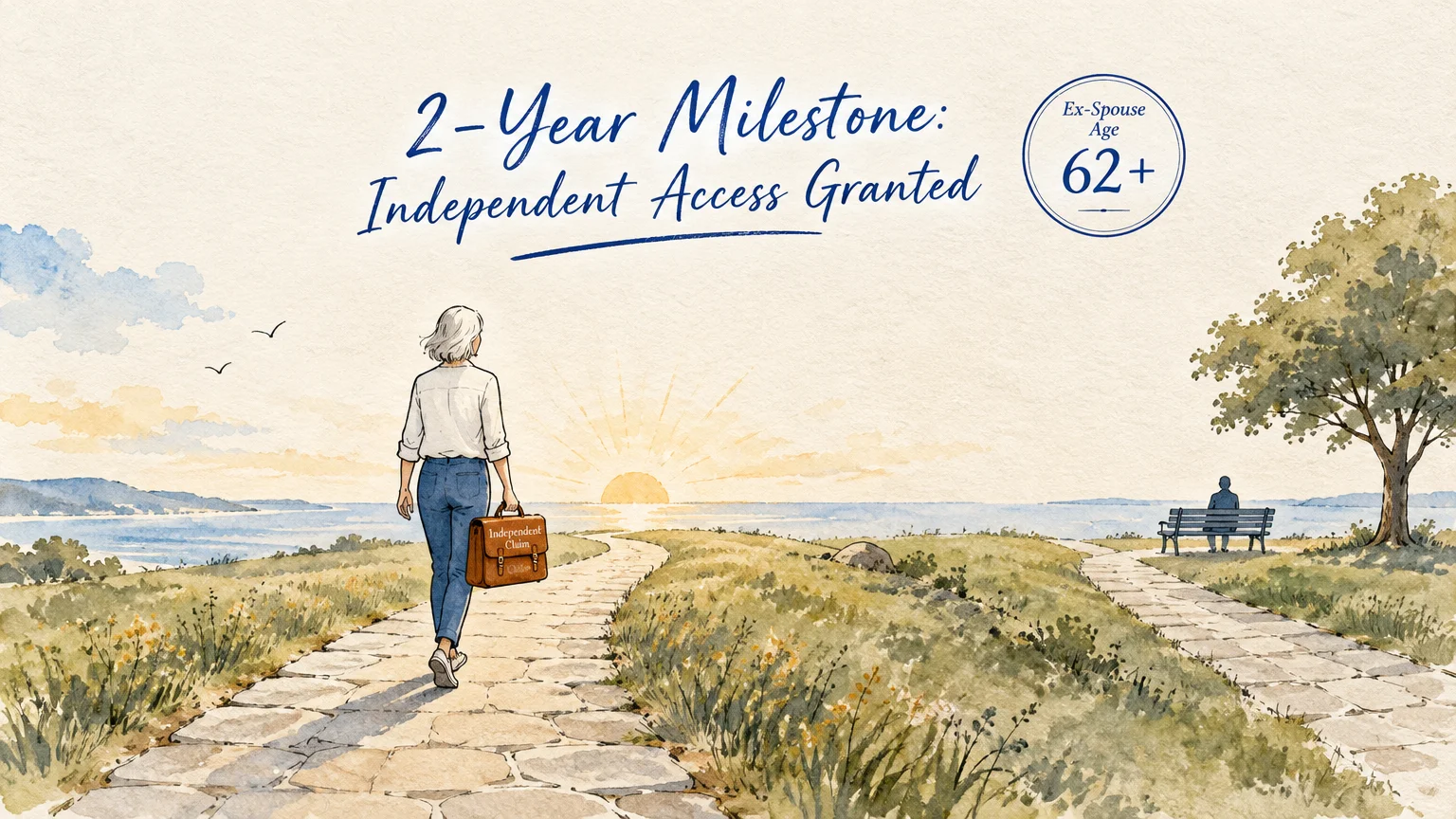
To take advantage of this provision, your divorce must have been finalized for at least two continuous years. Your former spouse must also meet the age requirement for retirement benefits by being at least 62 years old.
If you have been divorced for less than two continuous years, your ex-spouse must actively file for benefits before you can submit a claim. Once you pass that two-year milestone, their personal filing decisions no longer control your access.
Rule 3: Spousal Benefits Cap at 50 Percent of Baseline Earnings
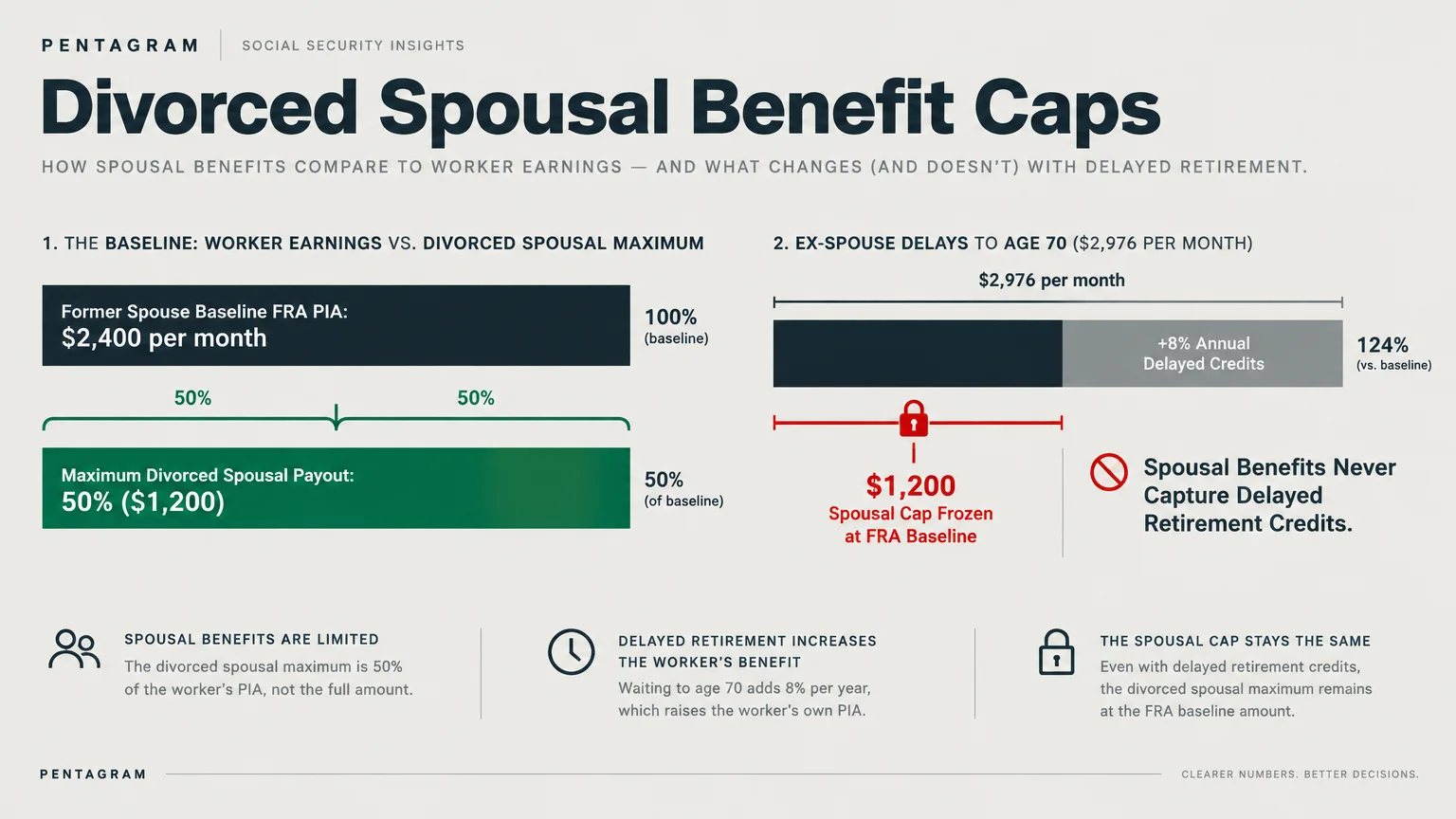
The maximum monthly benefit you can receive on a living ex-spouse’s earnings record is 50 percent of their Primary Insurance Amount. The Primary Insurance Amount represents the monthly check your ex-spouse qualifies for at their Full Retirement Age.
Spousal payouts do not include any delayed retirement credits your former spouse might accumulate by working until age 70. Their personal monthly check may increase by 8 percent per year after Full Retirement Age, but your spousal ceiling stays frozen.
Consider an example where your former spouse’s Full Retirement Age benefit is $2,400 per month. If you file at your own Full Retirement Age, your maximum monthly spousal payment reaches exactly $1,200.
If your ex-spouse waits until age 70 to boost their personal payout to $2,976 per month, your spousal benefit remains calculated from the baseline $2,400. Spousal entitlements never capture delayed retirement credits on a living worker’s record.
“A divorce does not erase the years you spent building a household together. Social Security recognizes that contribution, giving you independent rights to the benefits you earned as a team.” — Suze Orman, Personal Finance Author
Rule 4: Filing Early Triggers a Permanent Benefit Reduction
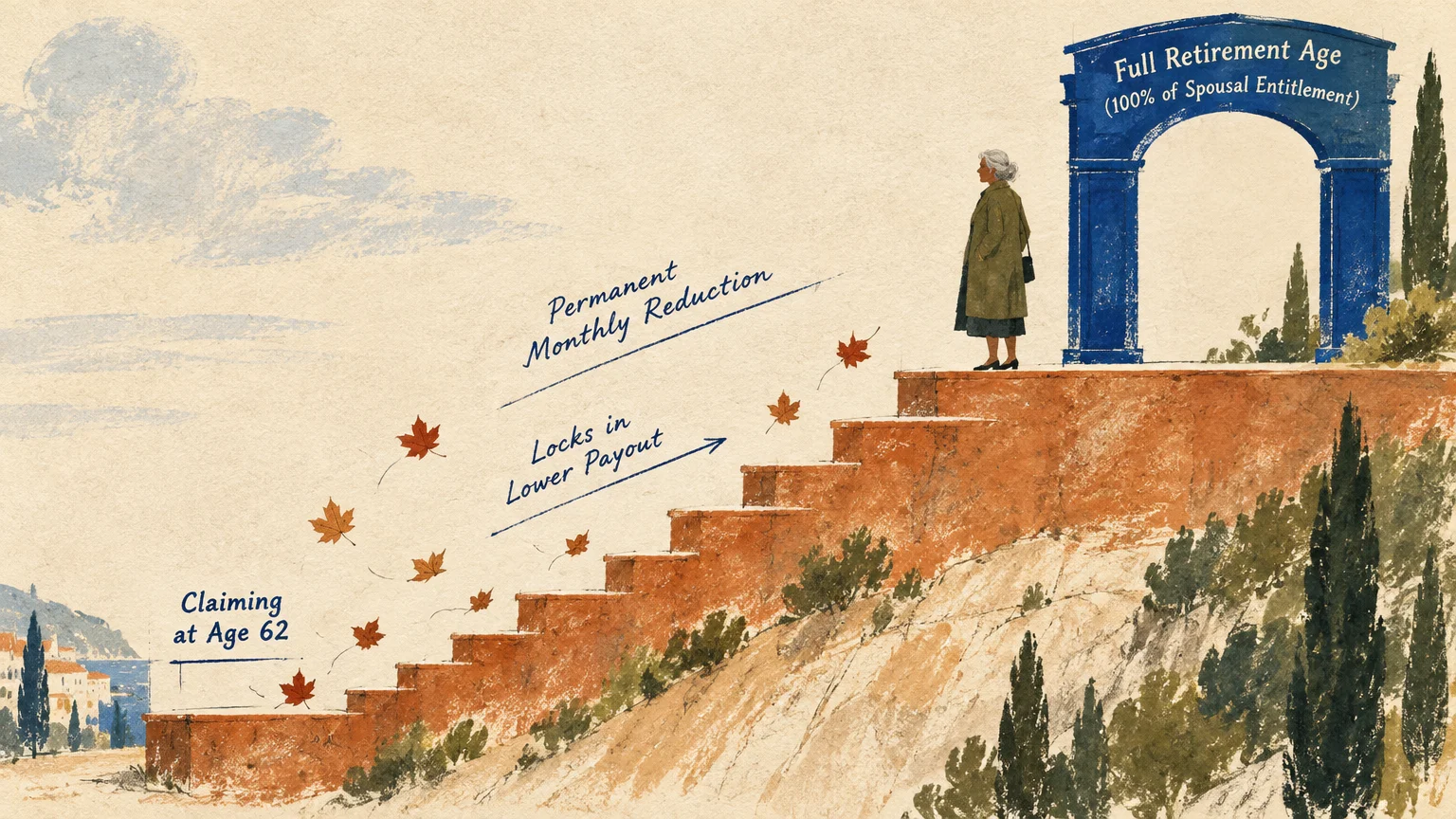
You become eligible to claim spousal benefits once you reach age 62, but filing early permanently cuts your monthly payment. To collect the maximum 50 percent spousal rate, you must wait until your own Full Retirement Age.
For everyone born in 1960 or later, Full Retirement Age is 67. Claiming spousal benefits at age 62 slashes your payment down to roughly 32.5 percent of your ex-spouse’s baseline amount.
This early claiming reduction remains locked in for the rest of your life; your benefit will not automatically rise once you reach age 67. Deciding to file early means accepting a reduced baseline payment indefinitely.
Before submitting early paperwork to the Social Security Administration, review your long-term income needs. A permanent 35 percent reduction to your spousal benefit can significantly weaken your financial stability in later retirement years.
Rule 5: Deemed Filing Prevents Double-Dipping on Living Benefits
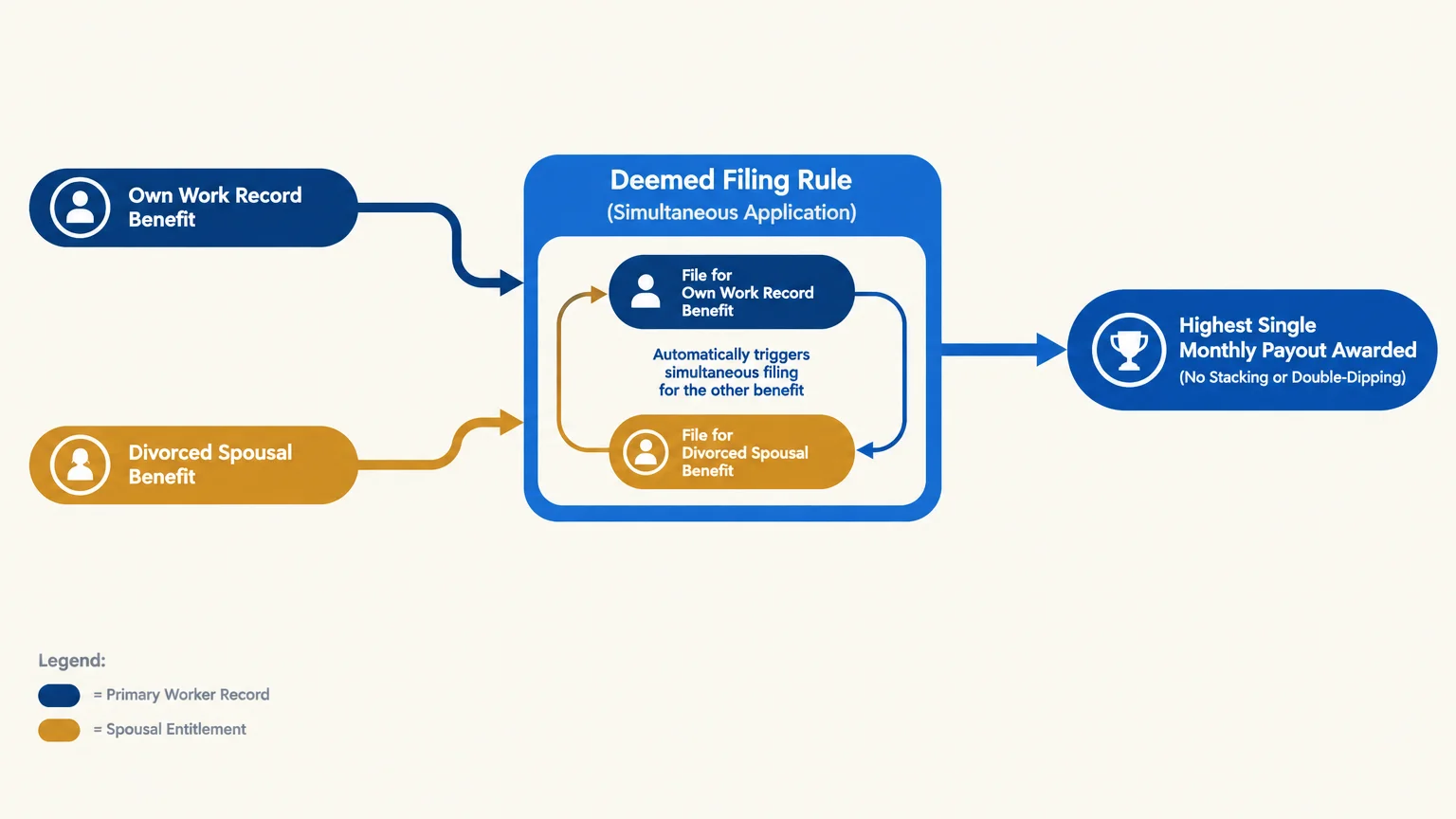
Federal law prevents retirees from collecting both their own retirement check and a full spousal benefit at the same time. The Bipartisan Budget Act established universal deemed filing rules that apply whenever you apply for retirement funds.
When you file for benefits, the government treats your application as a claim for both your personal retirement and your spousal entitlement. You cannot restrict your application to collect only spousal funds while allowing your personal record to earn delayed credits.
The agency calculates your personal retirement entitlement first and pays that baseline balance. If your divorced spousal benefit is larger than your personal benefit, they add a supplemental top-up to bridge the difference.
Suppose your personal retirement benefit at Full Retirement Age is $800, while your divorced spousal entitlement is $1,100. You receive your $800 earned benefit plus a $300 spousal supplement, delivering the $1,100 total.

Rule 6: Survivor Rules Unlock 100 Percent Payouts and Switching Tactics
If your former partner passes away, your spousal benefit converts into a surviving divorced spouse benefit. This transition fundamentally changes both the payout calculations and the filing restrictions on your account.
As a surviving divorced spouse, you can claim up to 100 percent of your deceased ex-spouse’s monthly benefit. This payment includes any delayed retirement credits your former spouse earned by waiting until age 70 before claiming.
You can claim survivor benefits starting at age 60, or at age 50 if you have a qualified disability. Claiming before your own Full Retirement Age reduces the survivor payment percentage, but the earnings baseline remains significantly higher.
Most importantly, deemed filing does not apply to survivor benefits. You can collect a surviving ex-spouse benefit first, allow your personal retirement credit to compound until age 70, and then switch to your higher personal payout.
Rule 7: Remarriage Resets Your Eligibility Status
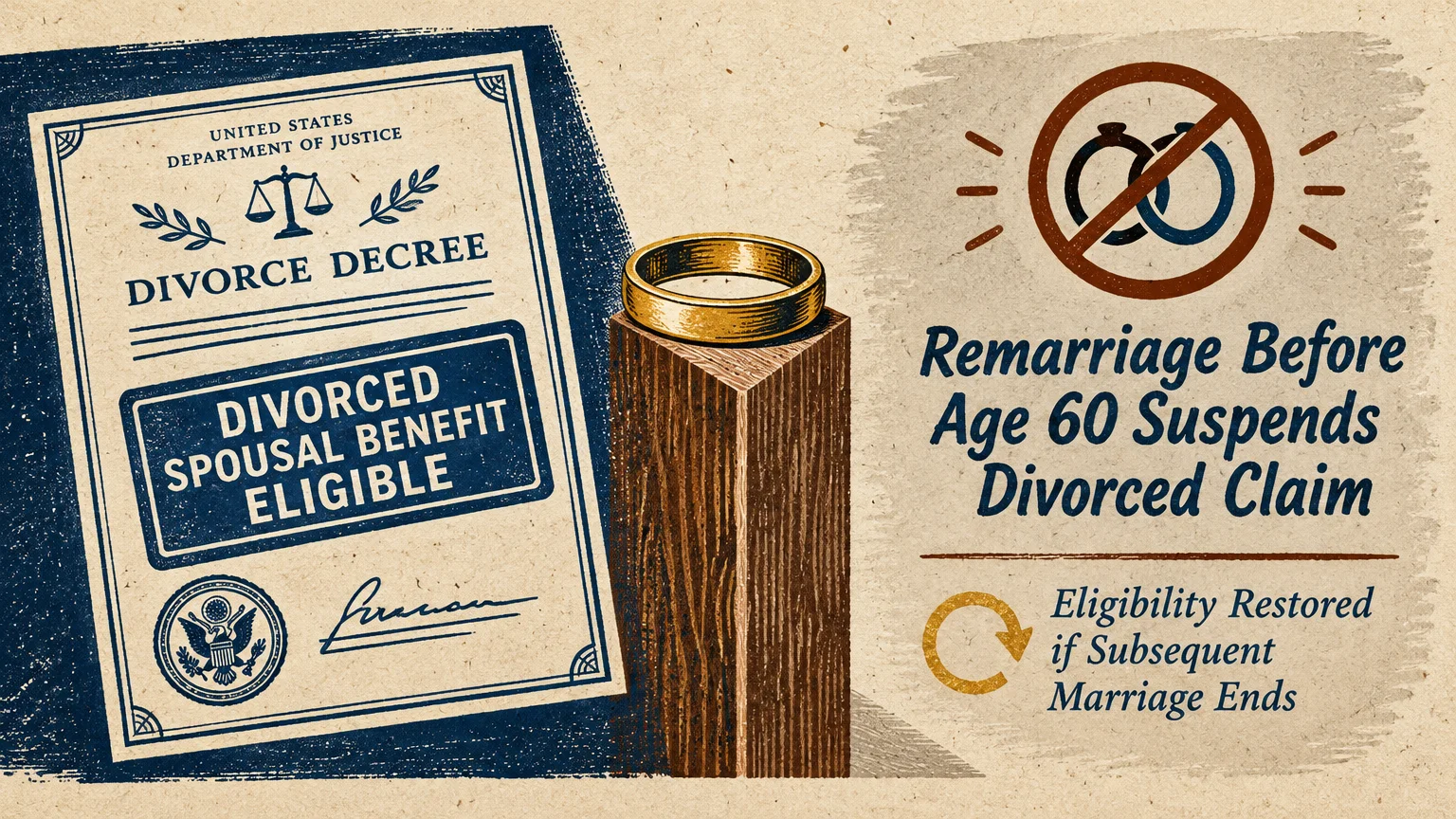
Your current marital status directly controls your ability to collect divorced social security benefits. If your ex-spouse is still living, getting remarried completely revokes your eligibility to collect on their earnings record.
You cannot receive spousal benefits based on an ex-spouse’s earnings while you are legally married to someone else. However, if your subsequent marriage ends through death, divorce, or annulment, your eligibility on your previous spouse’s record immediately returns.
The rules change favorably if your former spouse is deceased. You can remarry at age 60 or older—or age 50 if disabled—without losing your surviving divorced spouse benefits.
Remarrying before reaching age 60 forfeits survivor benefits on a deceased ex-partner’s work record. If you remarry at age 61, you retain full rights to collect survivor checks based on your former marriage.

Rule 8: Your Claim Remains Harmless and Invisible to Your Ex
Many divorced retirees hesitate to apply because they fear conflict or retaliation from their former spouse. Federal privacy laws ensure that your application and payments remain completely confidential.
The government will never notify your ex-spouse that you have claimed benefits based on their employment record. Your former spouse will not receive letters, emails, or account notices regarding your filing status.
Furthermore, your divorced benefit claim creates zero financial impact on your former partner. Your monthly check does not reduce their current benefit or limit their future retirement payments in any way.
Your payments also have zero effect on what your former partner’s current spouse or dependent children receive. Spousal and survivor claims filed by ex-spouses do not count toward the maximum family benefit limit applied to their household.

Historic Shift: The Social Security Fairness Act Repeals GPO and WEP
For decades, public sector workers faced severe federal pension offsets that wiped out their spousal benefits. Former teachers, police officers, and municipal employees who earned non-covered pensions regularly saw their spousal checks eliminated entirely.
The legislative landscape shifted permanently when the Social Security Fairness Act was signed into law on January 5, 2025. This historic statute permanently repealed both the Government Pension Offset and the Windfall Elimination Provision, retroactive to January 2024.
Under previous law, the Government Pension Offset reduced spousal and survivor benefits by two-thirds of the worker’s government pension amount. This penalty routinely erased thousands of dollars in legitimate spousal entitlements for public servants.
Because of this legislative repeal, public retirees with non-covered pensions can now collect full divorced spousal and survivor benefits. You no longer forfeit your spousal Social Security entitlement simply because you dedicated your career to public service.
The Retirement Earnings Test: Working While Collecting Before Full Retirement Age
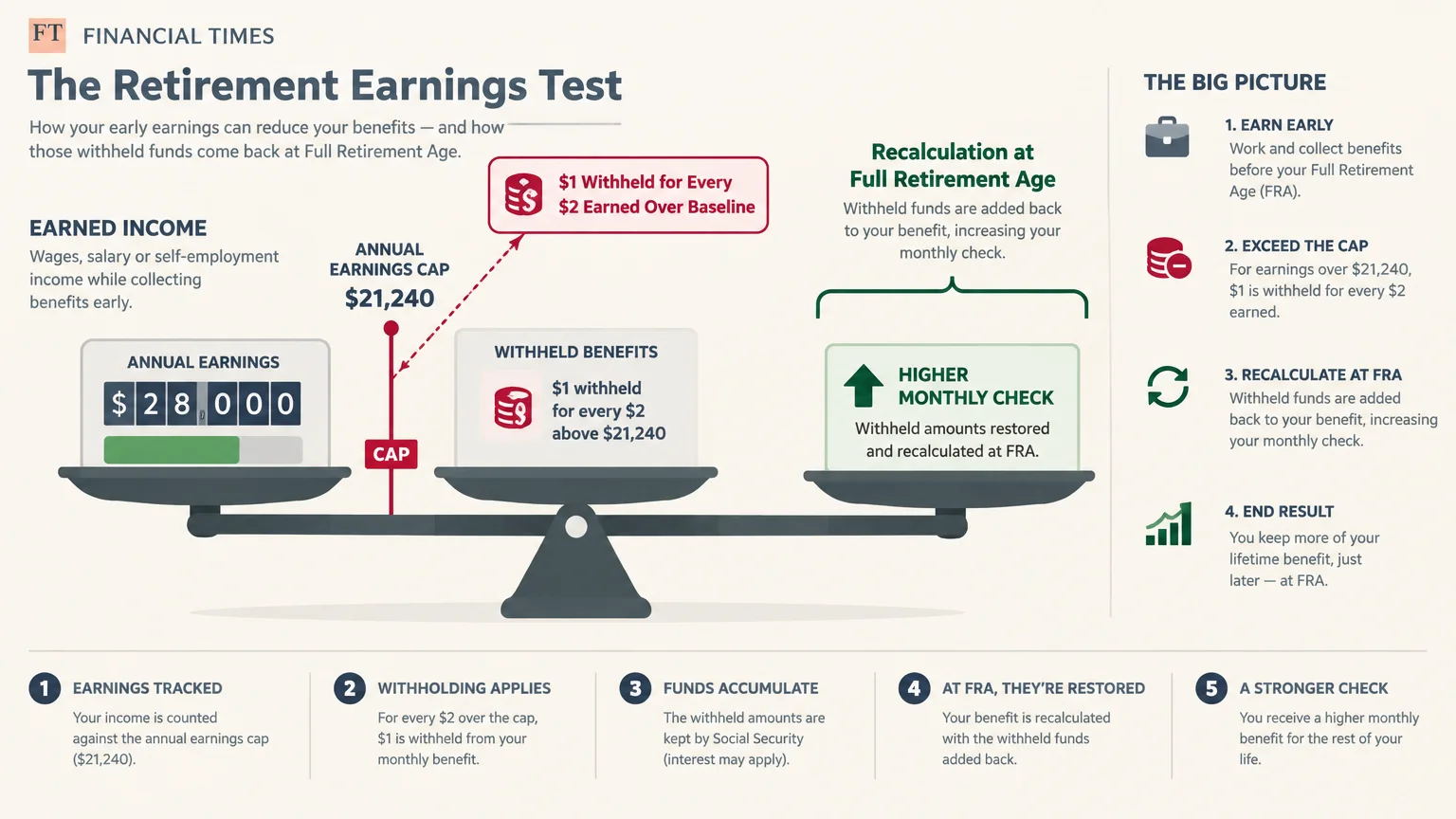
Continuing to work while receiving divorced benefits before reaching Full Retirement Age triggers federal earnings restrictions. Earning too much wage income will cause the government to temporarily withhold a portion of your monthly checks.
In 2026, the annual earnings limit for retirees who remain under Full Retirement Age for the entire year is $24,480. The government withholds $1 of benefits for every $2 you earn above that threshold.
In 2027, that annual earnings baseline increases to $25,560. If you reach Full Retirement Age during 2026, a higher limit of $65,160 applies, with $1 withheld for every $3 earned above the cap.
In 2027, the cap for workers reaching Full Retirement Age rises to $67,920. Once you reach your exact Full Retirement Age, the earnings test disappears entirely, and the agency recalculates your benefit to return withheld amounts over time.

Comparing Living Ex-Spouse Benefits vs. Surviving Ex-Spouse Benefits
The rules governing Social Security after divorce differ depending on whether your former partner is living or deceased. Understanding these structural differences helps you time your application strategically.
| Benefit Provision | Living Ex-Spouse Benefit | Surviving Divorced Spouse Benefit |
|---|---|---|
| Earliest Claiming Age | Age 62 (permanent reduction) | Age 60 (age 50 if disabled) |
| Maximum Benefit Amount | 50% of ex-spouse’s baseline PIA | Up to 100% of deceased ex’s total check |
| Delayed Credit Value | Excluded; caps strictly at Full Retirement Age PIA | Included; captures credits earned up to age 70 |
| Remarriage Rules | Must remain unmarried to collect | Permitted if remarriage occurs at age 60 or older |
| Deemed Filing Rules | Applies; forced to file for own benefit simultaneously | Does not apply; can claim survivor check and delay own |
The distinction between these two categories offers substantial tactical flexibility for surviving divorcees. Review detailed regulatory guidelines on Investopedia to see how delayed filing models improve cash flow.
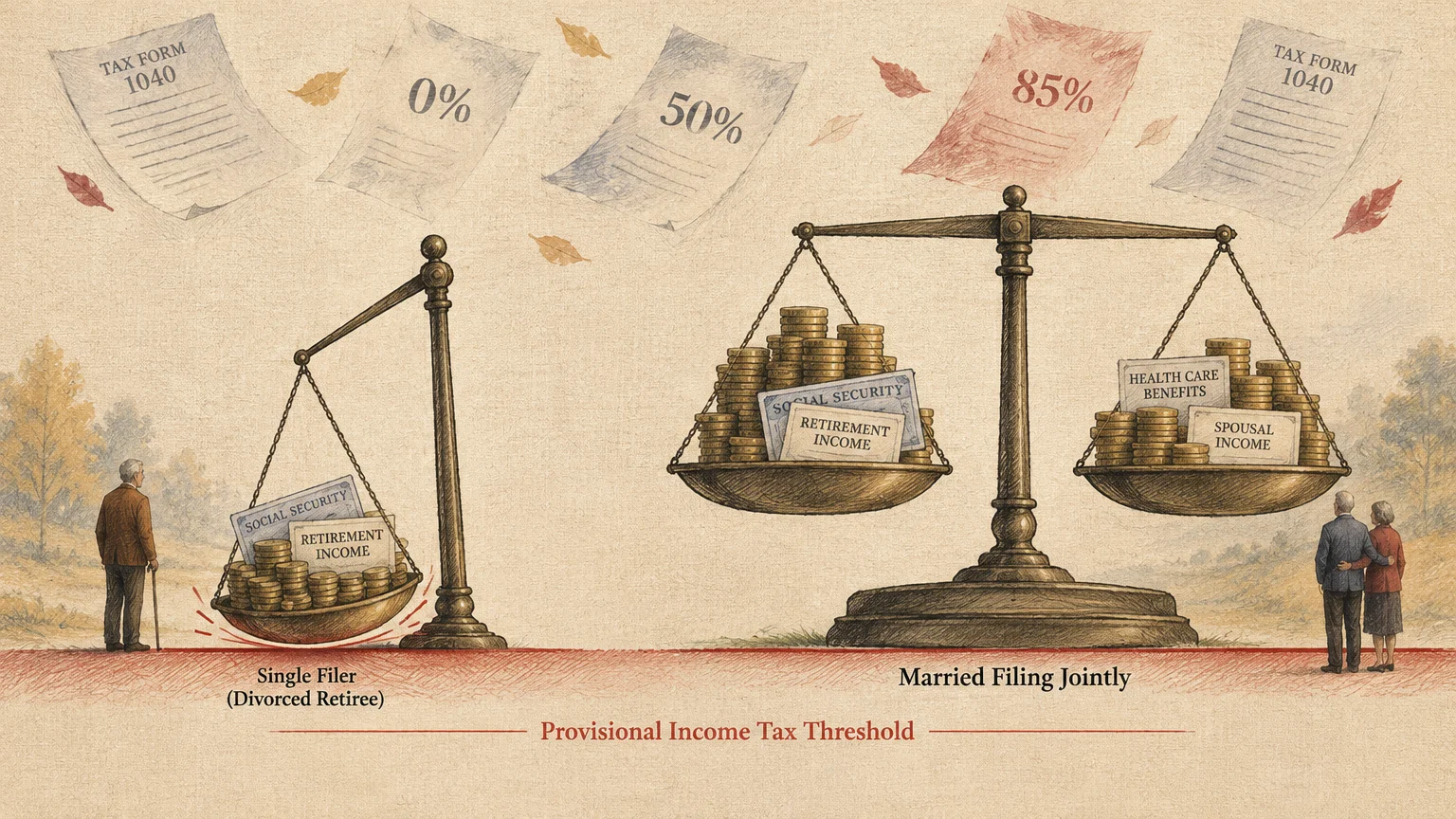
The Single Tax Trap: How Benefit Taxation Hits Divorced Retirees
Collecting benefits on your ex’s record can push your total income into taxable territory. The federal government uses your combined income to determine whether your monthly checks face income taxes.
Your combined income equals your adjusted gross income, plus any tax-exempt municipal interest, plus half of your total annual Social Security payment. The Internal Revenue Service applies fixed thresholds that have never been adjusted for inflation.
Because divorced retirees file federal taxes as Single or Head of Household, they encounter lower taxation trigger points than married couples. If your combined income falls between $25,000 and $34,000, up to 50 percent of your benefits become taxable.
If your combined income exceeds $34,000 as an individual filer, up to 85 percent of your benefits face federal income tax. Managing mandatory retirement distributions alongside your benefits helps prevent unexpected tax bills.

What Can Go Wrong: Costly Filing Pitfalls to Avoid
Filing errors can permanently depress your monthly income or cause you to forfeit thousands of dollars in retroactive payments. Being aware of frequent filing mistakes protects your lifetime financial security.
- Filing immediately at age 62: Claiming spousal benefits at the earliest date slashes your monthly payout to 32.5 percent of your ex’s baseline rate.
- Missing survivor switching opportunities: Failing to let your own retirement benefit compound to age 70 while collecting survivor benefits costs you guaranteed annual growth.
- Failing to locate legal records early: Not having certified marriage and divorce certificates delays the processing of your application for months.
- Assuming remarriage permanently bars claims: Forgetting that your eligibility revives if your subsequent marriage ends leaves money unclaimed.
- Ignoring GPO repeal updates: Public sector retirees who were previously denied benefits under the Government Pension Offset must contact the agency to claim payments.
Taking time to gather documents and review claiming timelines ensures you do not surrender valuable benefits. Thorough preparation prevents administrative stalls when dealing with regional field offices.

When to Consult a Professional
While standard divorced spousal filings remain straightforward, complex personal scenarios demand professional financial guidance. Consulting a credentialed retirement planner or tax specialist helps optimize your overall plan.
You should seek specialized professional advice in several key situations:
- Navigating serial marriages: If you were married multiple times for at least 10 years each, an advisor can determine which ex-spouse record yields the highest lifetime payout.
- Managing post-divorce tax brackets: A Certified Public Accountant can structure your individual retirement account withdrawals to keep combined income below the $25,000 or $34,000 tax thresholds.
- Reviewing public pension benefits: A specialist can help retired public employees retroactively correct past benefit denials caused by the repealed Government Pension Offset rules.
- Coordinating retirement cash flow: An advisor evaluates your complete asset base alongside federal consumer resources from the Consumer Financial Protection Bureau to establish sustainable withdrawal rates.
Professional input ensures you integrate your monthly benefits cleanly into your broader investment, tax, and estate planning strategies.
Frequently Asked Questions About Divorced Social Security Benefits
Do I need my ex-spouse’s permission or Social Security number to file?
You do not need your former spouse’s permission or consent to submit an application. While having their Social Security number speeds up processing, the agency can locate their work record using their full legal name, date of birth, and parents’ names.
What happens if my ex-spouse remarries multiple times?
Your ex-spouse’s subsequent marriages have zero impact on your legal entitlement to benefits. Even if your former partner remarries multiple times, every qualified former spouse who met the 10-year rule can collect independent spousal benefits simultaneously.
Can I collect benefits on my ex-spouse’s record if my own retirement benefit is higher?
No, you cannot collect divorced spousal benefits if your own earned retirement benefit exceeds 50 percent of your ex-spouse’s baseline amount. The government will simply pay you your own higher earned retirement benefit.
Will collecting on an ex-spouse affect my Medicare coverage?
Claiming divorced spousal benefits does not negatively impact your eligibility for Medicare Part A or Part B. You remain eligible for premium-free Part A at age 65 based on your ex-spouse’s record if you lack sufficient personal work credits.
Understanding your rights under federal retirement guidelines allows you to make informed decisions that enhance your financial freedom. Review your earnings records, compile your legal documentation, and evaluate your timing carefully before initiating your claim.
This article provides general financial education and information only. Everyone’s financial situation is unique—what works for others may not work for you. For personalized advice, consider consulting a qualified financial professional such as a CFP or CPA.
Last updated: October 2026. Financial regulations and rates change frequently—verify current details with official sources.