Planning a memorial service often forces grieving families to make urgent financial choices under intense emotional pressure. Knowing how to spot hidden funeral costs before signing a contract can save you thousands of dollars while honoring your loved one with dignity.
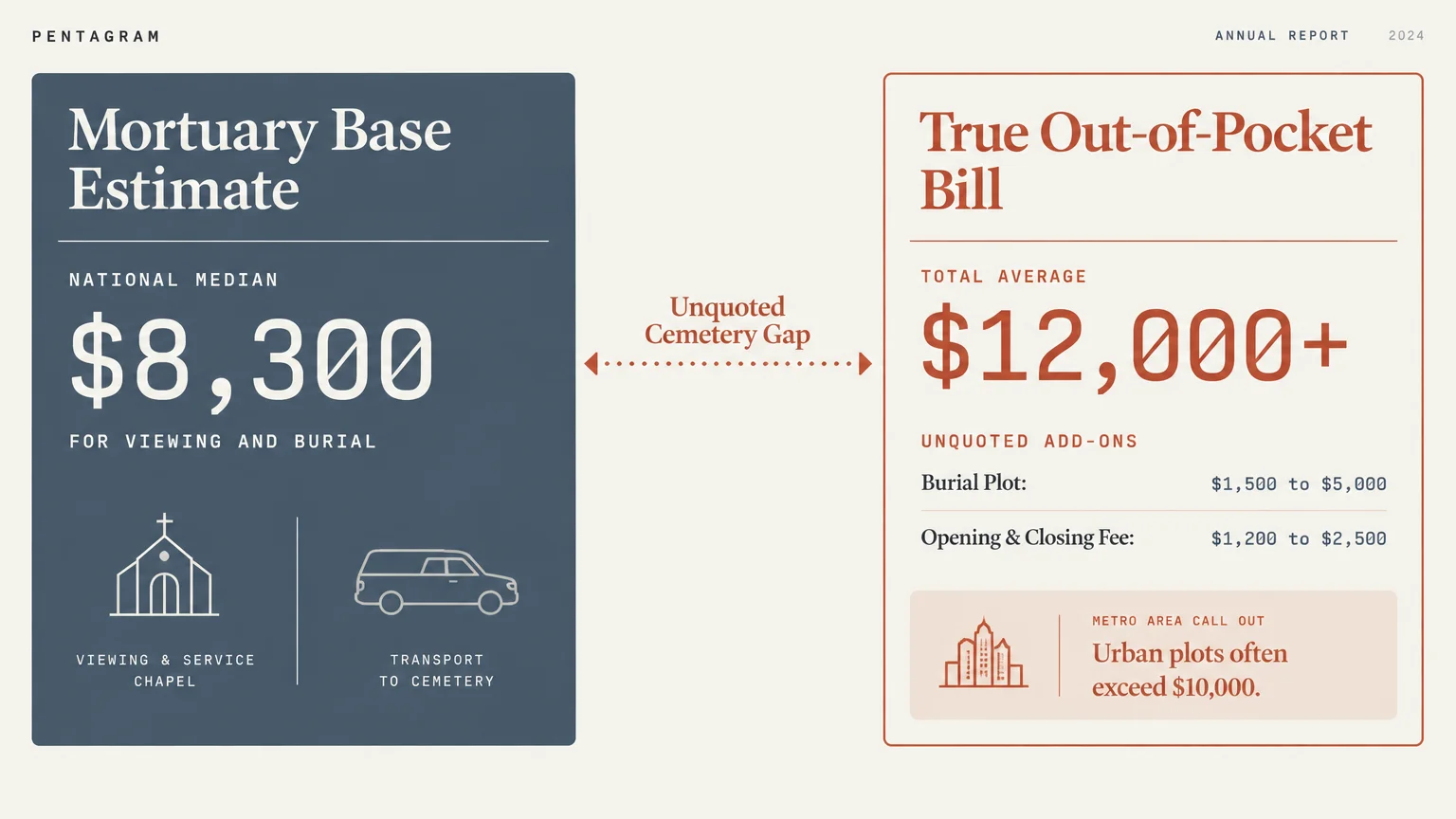
The national median cost of a funeral with viewing and burial stands at $8,300, according to the National Funeral Directors Association. However, that figure leaves out essential cemetery plots, grave vaults, and third-party fees that routinely push final bills past $12,000.
This guide reveals the itemized fees funeral directors rarely highlight upfront and explains your legal rights under federal consumer protection laws.
The General Price List and Mandatory Professional Fees
When you start funeral planning, federal law protects your pocketbook. The Federal Trade Commission enforces the Funeral Rule, which has safeguarded consumers since April 30, 1984.
Under this regulation (16 CFR Part 453), providers must give you an itemized General Price List to keep immediately upon discussing services in person. They must also quote prices over the phone whenever you call and ask.
Despite these federal protections, funeral providers face no mandate to publish their price lists on their websites. The FTC initiated formal rulemaking in late 2022 to require online pricing, but the proposed change has not taken effect.
As a result, most families must request prices manually while navigating intense bereavement. This lack of transparency makes comparing local mortuaries unnecessarily challenging.
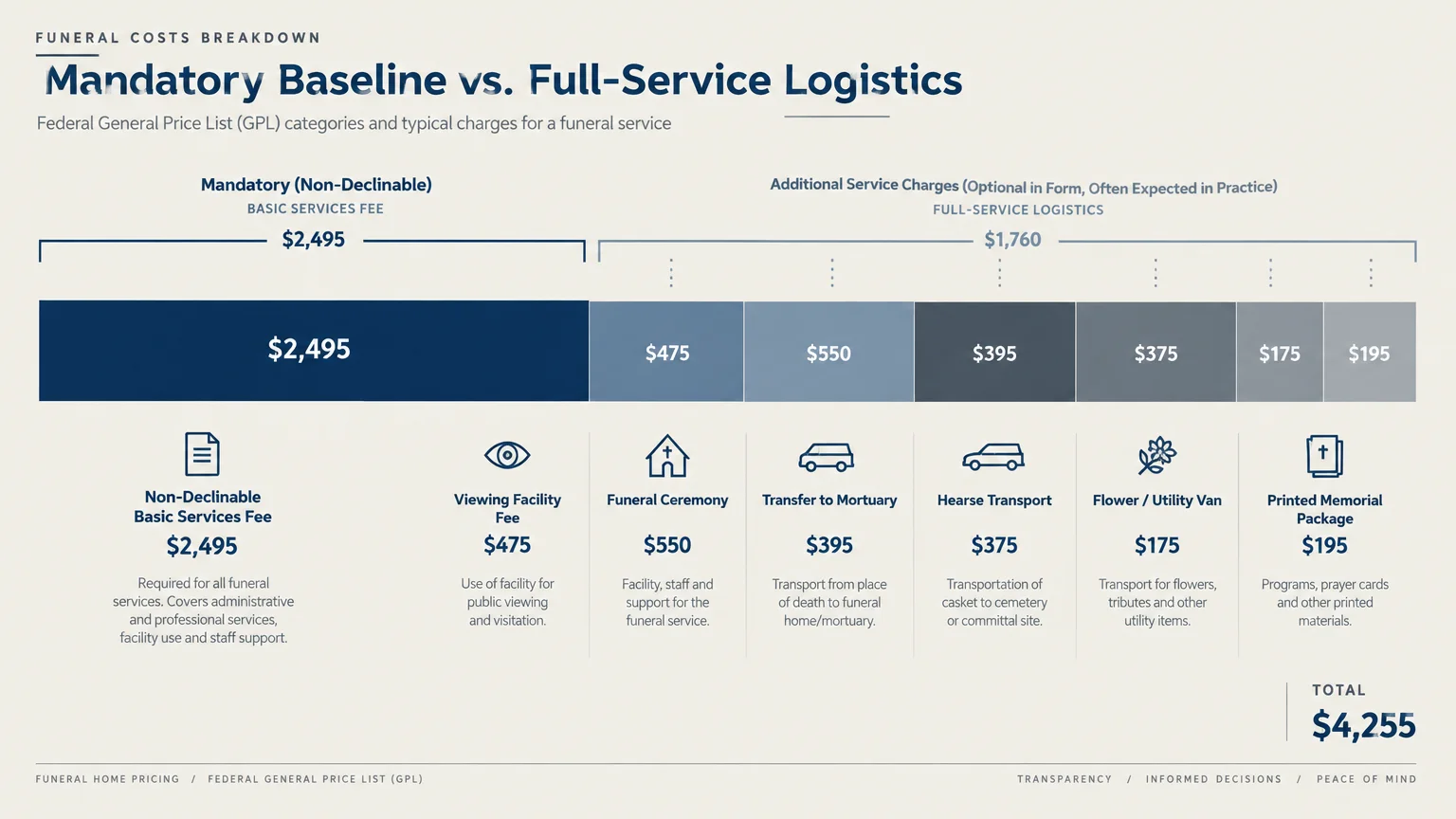
The largest foundational charge on every funeral bill is the basic services fee. The National Funeral Directors Association reports a national median cost of $2,495 for this single line item.
Federal law designates this basic services fee as non-declinable. It covers the funeral home’s general overhead, regulatory licensing, administrative coordination, and shelter of the deceased.
Because you cannot decline this charge, it forms the non-negotiable floor of your bill whenever you hire a full-service provider. Standard staffing and logistical charges quickly stack on top of that professional fee.
Facility fees for hosting a viewing average $475, while conducting a formal funeral ceremony adds another $550. Transportation costs introduce further mandatory itemizations.
Transferring your loved one from the place of death to the mortuary carries a median fee of $395. Securing a funeral hearse costs an additional $375 on average.
Hiring a separate service utility car or flower van adds approximately $175. Even basic paper goods carry separate line charges.
A standard printed memorial package, containing basic register books and service folders, carries a median cost of $195. Understanding these itemized fees prevents surprises when you review your first written estimate.

Cemetery Expenses: The Massive Gap in Funeral Quotes
The single biggest financial shock for grieving families is learning that funeral home quotes almost never include cemetery costs. Funeral homes and cemeteries operate as completely separate businesses with distinct fee structures.
When you add cemetery requirements, the total cost of a funeral escalates rapidly. Securing a ground burial plot typically costs between $1,500 and $5,000, depending on the geographic region and whether the cemetery is public or private.
Urban memorial parks charge significantly more for limited ground space. In major metropolitan areas, cemetery plots frequently exceed $10,000.
Once you own the plot, the cemetery charges an interment fee known as “opening and closing” the grave. This fee pays the cemetery crew to dig the grave, place support equipment, lower the casket, refill the soil, and sod the surface.
Opening and closing fees typically add $1,200 to $2,500 to your final bill. Cemeteries routinely add weekend or afternoon surcharges ranging from $400 to $1,000 if interment occurs on a Saturday or Sunday.
Next comes the outer burial container, commonly called a grave vault or grave liner. The National Funeral Directors Association reports the median cost of an outer burial container is $1,500.
Adding this vault brings the median burial baseline to roughly $9,995 before counting cemetery plot or grave digging fees. No state law requires an outer burial container.
However, nearly all private and municipal cemeteries require vaults in their bylaws to prevent the ground from sinking under maintenance equipment. You must purchase this heavy concrete or steel box, but you can buy it from outside vendors.
Monuments and headstones represent another substantial expense outside the mortuary invoice. A simple bronze or granite ground marker runs $1,000 to $2,000, while upright monuments routinely cost $3,500 to $7,000.
Cemeteries also levy monument setting fees to pour concrete foundations and inspect grave markers. These installation charges frequently add $300 to $800 to your cemetery bill.
Finally, expect an endowment care or perpetual maintenance assessment. State statutes often permit cemeteries to append a mandatory 10% to 15% surcharge to ground sales for lawn maintenance.
Comparing Base Estimates to True Out-of-Pocket Expenses
Funeral providers quote median prices based only on their immediate facility and logistical charges. The table below illustrates the financial difference between standard base estimates and actual out-of-pocket expenses.
| Arrangement Type | Base Funeral Quote (NFDA Median) | Overlooked Cemetery & Vault Fees | Third-Party & Cash Advances | Realistic Total Cash Outlay |
|---|---|---|---|---|
| Burial with Viewing & Ceremony | $8,300 ($9,140 inflation-adjusted) | $3,500 – $7,500 (plot, open/close, vault) | $1,500 – $3,000 (obituary, flowers, certificates) | $13,300 – $19,640 |
| Cremation with Viewing & Ceremony | $6,280 | $1,000 – $3,500 (columbarium niche, urn vault) | $1,200 – $2,500 (urn, service, certificates) | $8,480 – $12,280 |
| Direct Cremation (No Ceremony) | $2,645 – $2,750 | $0 (if kept at home or scattered) | $300 – $800 (permits, death certificates) | $2,945 – $3,550 |
This table demonstrates why families who budget solely for advertised funeral prices find themselves facing unmanageable debt. Cemetery interments and supplemental cash advances nearly double base costs.
Shifting cultural preferences reflect these rising expenses. The cremation rate in the United States has reached 63.4%, compared to a 31.6% burial rate.
Projections from industry analysts indicate the cremation rate will climb to 82.3% by 2045. Many consumers embrace cremation specifically to bypass burdensome cemetery plot and grave vault markups.
Merchandise Markups: Caskets and Alternative Containers
Merchandise markups represent one of the most profitable areas for funeral homes. The median retail cost for a standard 20-gauge metal casket purchased through a funeral home is $2,500.
Showroom markup models often inflate casket prices 300% to 500% over wholesale manufacturing costs. Elaborate wood, bronze, or copper caskets frequently retail for $5,000 to $12,000.
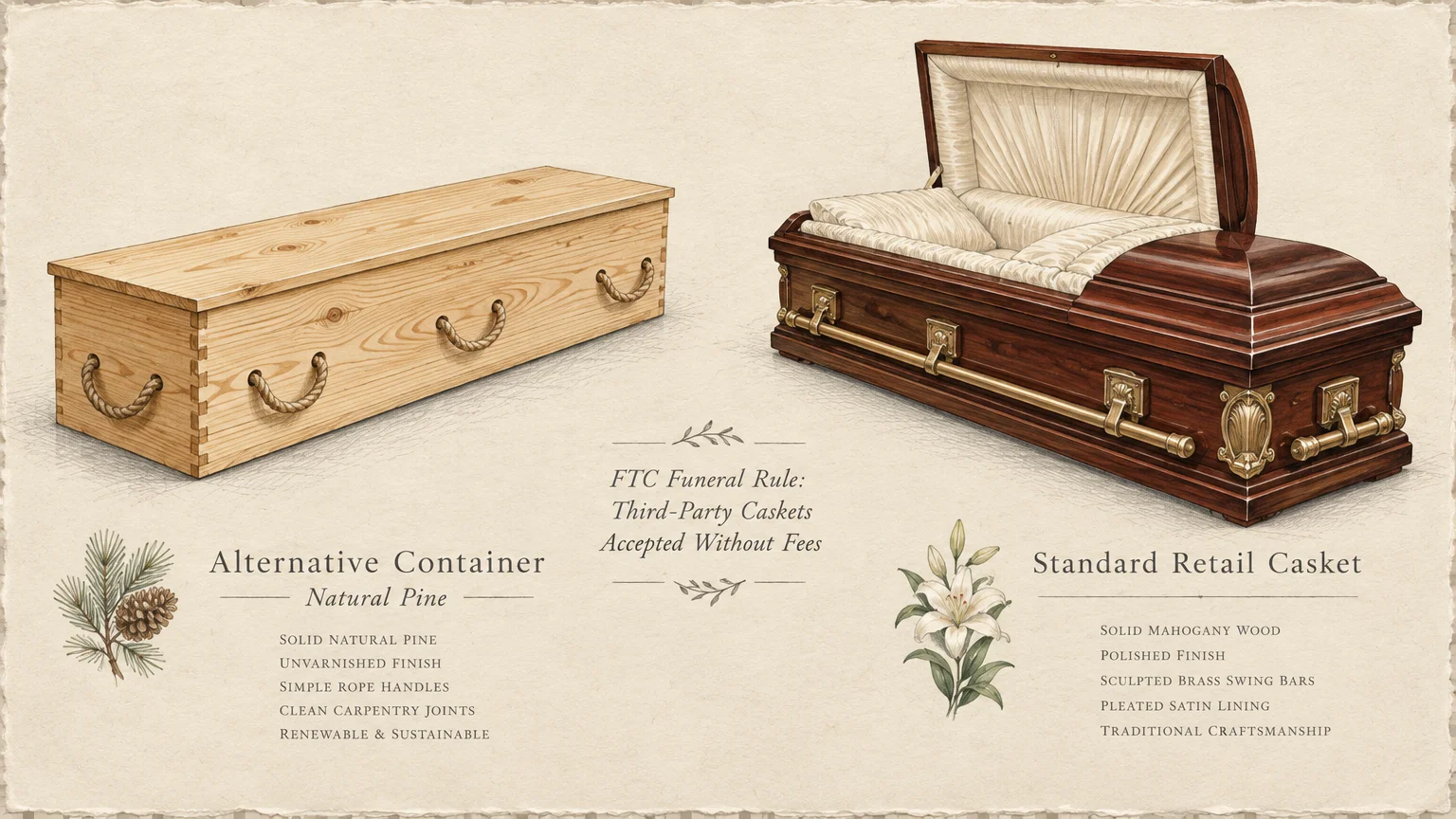
Federal regulations specifically grant you the legal right to purchase caskets, urns, and memorial goods from third-party retailers. Independent online merchants and warehouse clubs sell comparable metal caskets for $1,000 to $1,500.
The FTC Funeral Rule explicitly prohibits funeral directors from refusing delivery of a third-party casket. Mortuaries cannot charge handling fees or surcharges to accept delivery.
Federal regulators fine funeral homes over $53,000 per violation for charging unauthorized casket handling fees or refusing outside merchandise. The civil penalty was adjusted to $53,088 in 2025.
Before you enter a showroom, the funeral director must present a written Casket Price List. Review this list carefully before inspecting physical floor models.
Showrooms frequently position high-margin models under flattering spotlighting while placing budget options in obscured corners. Knowing this sales tactic helps you maintain your predetermined spending budget.
Be cautious regarding “protective” or “sealer” caskets equipped with rubber gaskets. Funeral directors sometimes imply these mechanisms preserve human remains indefinitely.
Federal law prohibits sellers from claiming that a gasketed casket will keep out air, water, or bacteria permanently. Rubber seals simply prevent outside fluids from entering during transport and ground settling.
If you choose direct cremation, you never need a metal or finished wood casket. Funeral homes must offer an alternative container made of unfinished wood, fiberboard, or heavy corrugated cardboard.
The NFDA reports the median direct cremation cost is $2,645 when you supply your own container. The median cost rises slightly to $2,750 when the funeral home provides their standard corrugated container.
Purchasing independent containers protects your savings while remaining respectful to the deceased. You can review independent comparison tools through Consumer Reports to evaluate casket alternatives without sales pressure.
Body Preparation and Embalming Misconceptions
Embalming represents another recurring expense that catches grieving relatives off guard. The national median cost for professional embalming is $845.
Funeral homes typically add $295 for other body preparation, which includes hairdressing, cosmetic application, and dressing the deceased. Many consumers incorrectly believe that state laws mandate embalming across the board.
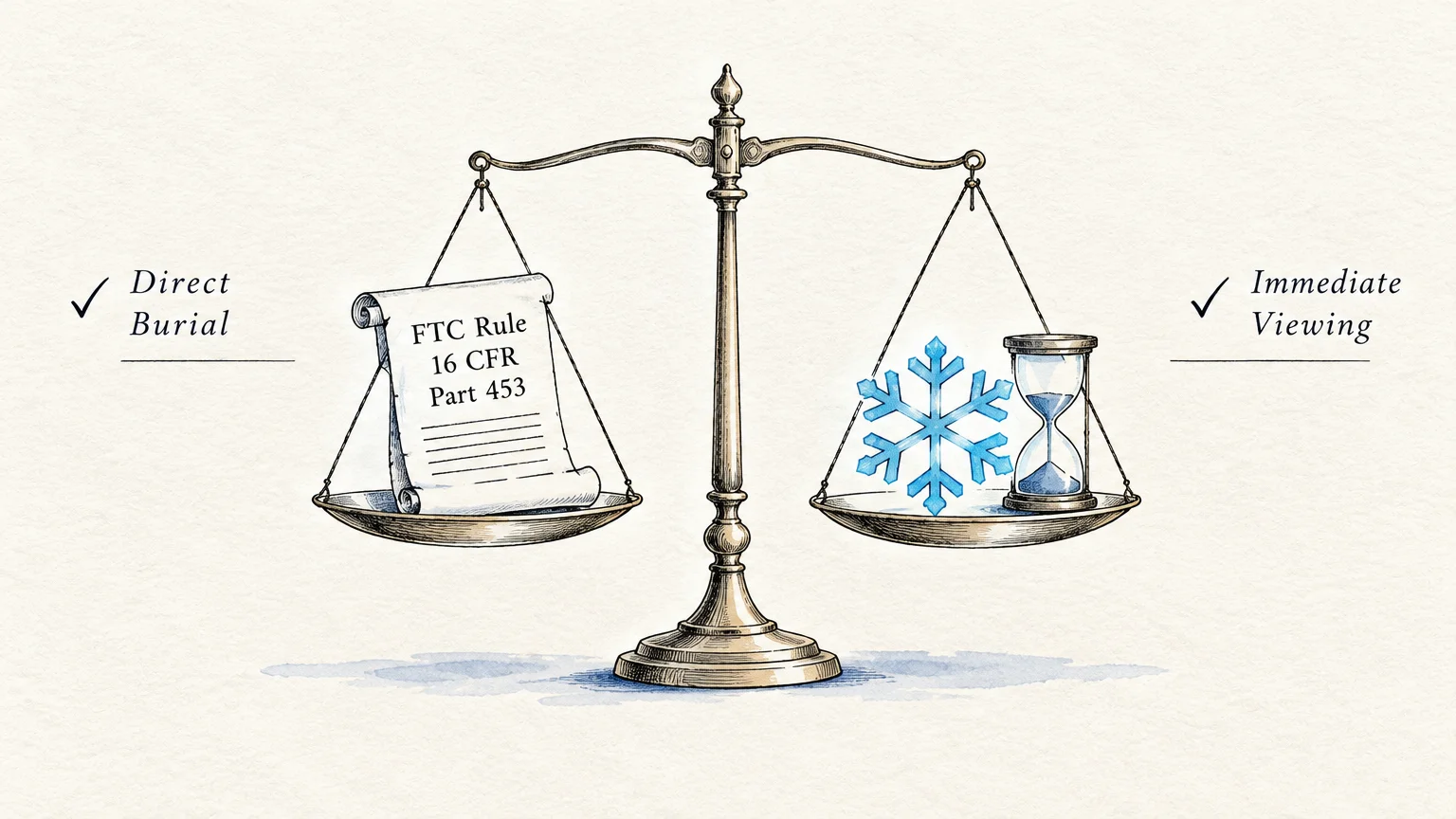
No state law universally requires routine embalming for every deceased person. Embalming is primarily an aesthetic procedure designed to temporarily preserve a body for open-casket public viewings.
State public health statutes only mandate embalming under specific, uncommon conditions. These exceptions generally involve long-distance interstate transport, delayed burial beyond statutory windows, or highly communicable diseases.
If you prefer a closed-casket service or immediate burial, you can decline embalming entirely. Funeral homes must obtain express permission before performing and billing for this procedure.
If a mortuary lacks refrigeration facilities, they may require embalming for extended visitations. Standard refrigeration fees range from $50 to $150 per day.
Refrigeration remains substantially less expensive than full embalming and cosmetic restoration when services occur within a few days of death. Always ask for daily refrigeration pricing before agreeing to invasive preservation techniques.
“Do not equate how much you spend on a funeral with how much you loved the deceased. Spending money you do not have creates financial tragedy out of emotional grief.” — Suze Orman, Personal Finance Author
Evaluating preservation options objectively shields you from emotional spending. Honest funeral providers will clarify legal requirements without pressuring you into unnecessary restoration procedures.

Cash-Advance Items: Third-Party Fees on Your Final Invoice
Funeral invoices contain a distinct category known as cash-advance items. These are third-party fees the funeral director pays on your behalf and adds to your final bill.
Because these charges come from external entities, funeral homes rarely detail them during initial consultations. Certified death certificates are among the most underestimated cash-advance expenses.
Municipal vital statistics offices charge $15 to $35 for each certified copy of a death certificate. Financial institutions, life insurance carriers, title companies, and probate courts require original certified documents.
Settling a standard estate typically demands 10 to 15 certified copies. That administrative requirement easily adds $200 to $450 to your upfront out-of-pocket costs.
Publishing an obituary in a local newspaper represents another significant expense. Major regional newspapers charge $400 to over $1,200 for a detailed obituary with a color portrait.
Digital memorial websites offer free or low-cost alternatives for sharing service details and remembrances. You can publish a short death notice in print and host full biographies online.
Honorariums for clergy members, officiants, and church musicians constitute common cash advances. Families typically provide $200 to $400 for the officiant and $150 to $250 for musicians.
Catering fees and floral arrangements add further expense if arranged directly through the mortuary invoice. Casket floral sprays routinely cost $250 to $600 from affiliated florists.
Local police departments often charge fees for funeral procession escorts. Municipalities frequently charge $100 to $300 per officer or patrol vehicle to direct traffic.
Reviewing these line items ahead of time keeps discretionary cash advances within reasonable limits. You can manage debt risk by consulting the Consumer Financial Protection Bureau for consumer credit safeguards.
Government Support and Estate Tax Realities
Many consumers assume government benefits or income tax write-offs will offset substantial funeral expenses. In reality, statutory death benefits offer minimal relief.
The Social Security Administration pays a one-time lump-sum death benefit of only $255. Congress established this $255 statutory limit in 1954, and the payment has never increased.
Furthermore, this benefit is strictly limited to an eligible surviving spouse or dependent minor child. If a single individual dies without dependent children, no one can collect the $255.
Surviving spouses must apply for this payment within two years of the date of death. Funeral homes sometimes offer to file this paperwork, but the funds go directly to the spouse.
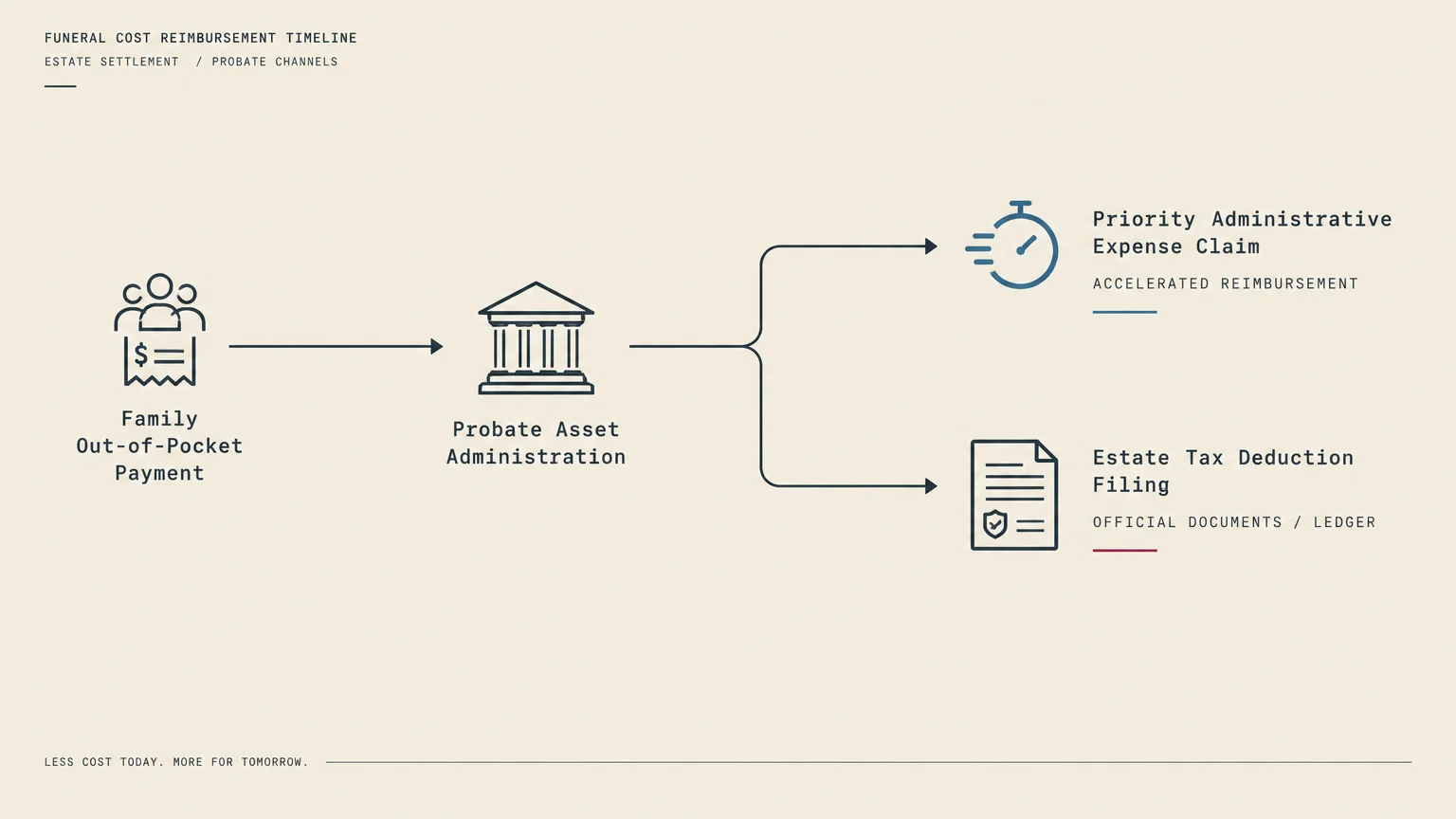
Families also face stringent restrictions on tax deductions. The Internal Revenue Service strictly prohibits individual taxpayers from deducting funeral or burial costs on personal Form 1040 returns.
Funeral costs do not qualify as deductible medical expenses under federal tax rules. Funeral expenses are only tax-deductible when paid by a taxable estate on federal Form 706 (26 CFR § 20.2053-2).
However, the Working Families Tax Cuts Bill (Public Law 119-21) established a federal estate tax exemption of $15 million per individual ($30 million for married couples). Because of this elevated threshold, fewer than 0.1% of estates owe federal estate taxes.
Consequently, the estate tax deduction provides zero practical tax relief to working families. If your loved one served in the military, explore federal veteran allowances through USA.gov Benefits.
The Department of Veterans Affairs provides free burial plots and headstones in national cemeteries for qualifying service members. Utilizing veteran benefits can eliminate thousands of dollars in cemetery and monument expenses.

Pitfalls to Watch For
Navigating funeral planning requires vigilance against predatory sales tactics and contractual oversights. Knowing what to watch for preserves your family’s budget.
- Emotional spending traps: Sales representatives may subtly suggest that buying cheaper caskets or declining services shows a lack of love. Set a firm budget before entering the facility.
- Inflexible pre-need contracts: Many prepaid funeral plans lack transferability if you move to another state. Ensure pre-need contracts use state-regulated trusts or guaranteed-price life insurance policies.
- Bundled package markups: Packaged services often bundle items you do not need, such as limousine rentals or limousine escorts. The Funeral Rule guarantees your right to purchase goods and services item by item.
- After-hours and holiday surcharges: Holding services on weekends or evenings triggers staff overtime fees and elevated cemetery digging costs. Scheduling weekday morning services saves hundreds of dollars.
- Overpaying for cemetery merchandise: Purchasing grave vaults and markers directly from the cemetery often carries substantial markups. Independent monument builders frequently sell equivalent markers for 30% to 50% less.
Maintaining awareness of these common pitfalls keeps you in complete control of your family’s financial commitments.

Getting Expert Help
Navigating funeral logistics during bereavement is deeply demanding. Seeking specialized third-party assistance helps protect your rights and budget in specific circumstances.
If you face sudden funeral arrangements with limited financial resources, contact a local chapter of the Funeral Consumers Alliance. This non-profit consumer group surveys regional mortuary prices and helps families identify economical providers.
If you are pre-planning your estate, consult a Certified Financial Planner or an elder law attorney. These professionals can establish payable-on-death (POD) bank accounts or irrevocable funeral trusts to shield funds from probate without forfeiting Medicaid eligibility.
If you suspect a funeral provider violated the FTC Funeral Rule by refusing an outside casket or denying an itemized price list, file formal complaints. Contact both your state funeral licensing board and the Federal Trade Commission to initiate regulatory investigations.
Frequently Asked Questions
Can a funeral home refuse to accept a casket I purchased online?
No. Under the federal Funeral Rule, funeral providers must accept any casket purchased from an outside retailer without charging handling fees, delivery fees, or storage surcharges.
Is embalming required by law?
No state law mandates universal embalming. Embalming is generally only required in rare cases involving long delays, public viewings, or transport across state lines where refrigeration is unavailable.
Why do cemeteries charge so much to open and close a grave?
Opening and closing fees cover specialized excavation equipment, professional labor, safety shoring, lowering devices, soil replacement, and site reseeding. Cemeteries also use these fees to offset general operating expenses.
Are funeral and burial expenses tax-deductible on personal tax returns?
No. The IRS does not allow individuals to deduct funeral, cremation, or burial expenses on Form 1040. They only qualify as deductions on formal estate tax returns for estates exceeding the federal exemption threshold.
Actionable Steps for Fair Funeral Planning
Managing funeral costs starts with knowing your federal consumer rights. Always ask for an itemized General Price List before discussing specific memorial arrangements.
Decide whether a traditional burial, viewing with cremation, or direct cremation aligns best with your loved one’s values and your family budget. Shop independently for caskets, urns, and cemetery monuments rather than accepting initial showroom quotes.
Separate cemetery requirements from funeral home offerings to calculate true out-of-pocket costs before signing agreements. Taking these methodical steps honors your loved one while preserving your family’s financial stability.
This is educational content based on general financial principles. Individual results vary based on your situation. Always verify current tax laws, investment rules, and benefit eligibility with official sources.
Last updated: October 2026. Financial regulations and rates change frequently—verify current details with official sources.