Making a career change after 50 does not mean starting at the bottom. You can move into a second career that pays above the national median wage of $50,980.
Older workers stay in steady demand. In October 2026, 38.3 million workers ages 55 and older held jobs, with a 2.8% unemployment rate compared to 4.1% overall.
You can use your past work skills to enter fields with strong openings and clear pay. Below are nine practical paths, plus key tax and benefit rules.

Why a Second Career After 50 Makes Financial Sense
Many older adults keep working to grow savings and stay active. About 37.2% of Americans age 55 and older were in the labor force in October 2026.
Among people age 65 and older, 19.1% worked or sought jobs in 2025. That share rose from 12.9% in 2000 as more adults chose longer careers.
Federal law also protects your right to compete fairly. The Age Discrimination in Employment Act bars age bias against workers 40 and older at firms with 20 or more staff.
Companies with 20 or more workers must also offer employees age 65 and older the same health plan given to younger staff.
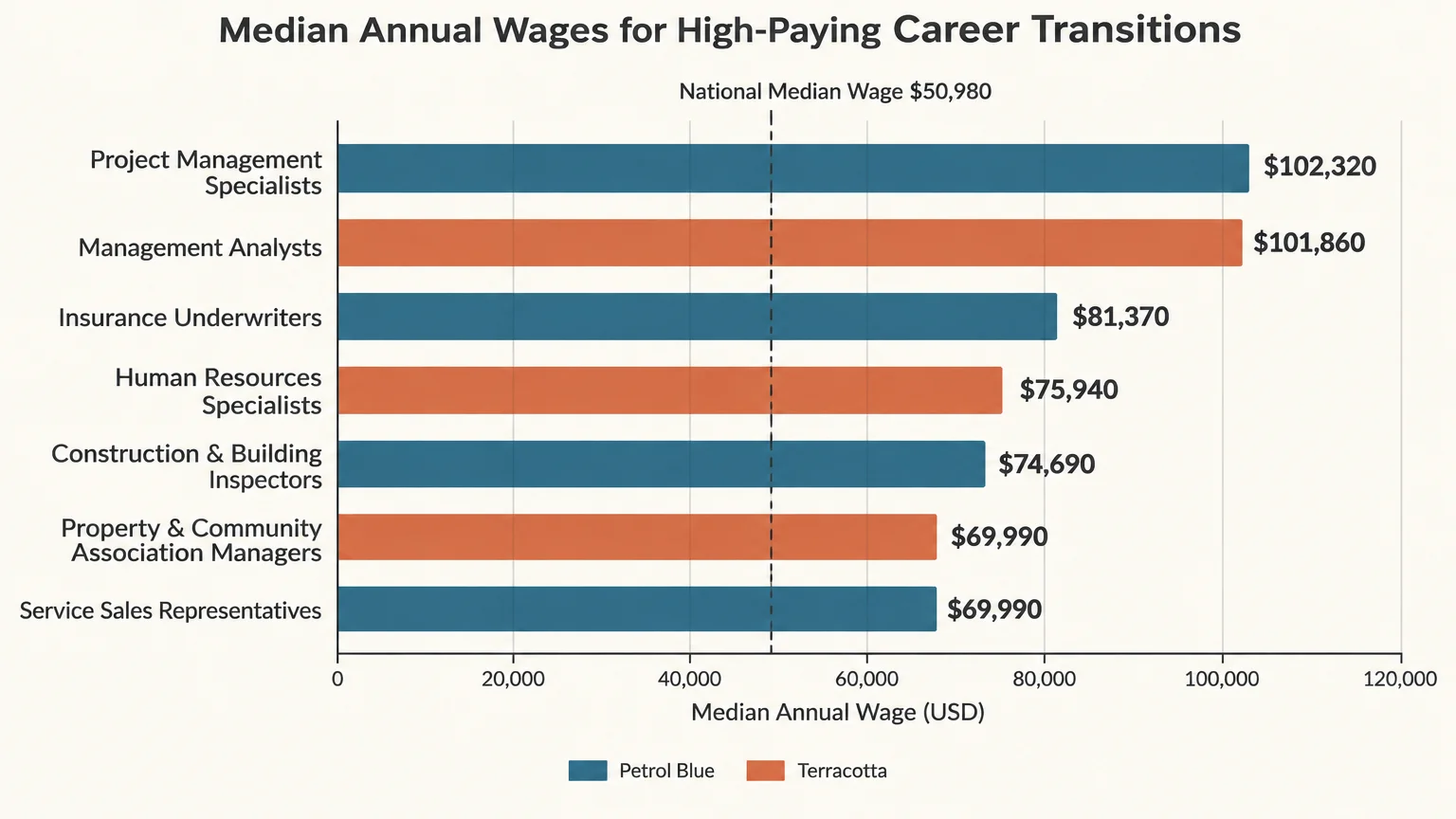
9 High-Paying Jobs for Older Adults
These nine roles use Bureau of Labor Statistics May 2025 wage data and 2025–2035 projections. Most value steady judgment and people skills over heavy labor.
1. Project Management Specialists
Project managers keep budgets, teams, and deadlines on track. They earn a median annual wage of $102,320, making this one of the top high paying jobs older workers can target.
Jobs should grow 7% from 2025 to 2035, adding 73,200 roles. Entry usually needs a bachelor’s degree, and past office experience helps you qualify.
2. Management Analysts
Management analysts help companies cut waste and improve daily work. Median pay is $101,860 per year, or $48.97 per hour, with top earners making $171,640.
Employment should rise 10% through 2035, adding 109,200 jobs. You typically need a bachelor’s degree, and years of solving business problems give you an edge.
3. Insurance Underwriters
Insurance underwriters review applications to decide if a company should insure a person or property. The median pay is $81,370 per year, and entry usually requires a bachelor’s degree.
Careful reading, basic math, and sound judgment matter most in this desk role.
4. Human Resources Specialists
Human resources specialists hire workers, explain benefits, and guide company rules. They earn a median wage of $75,940 per year and typically need a bachelor’s degree.
The field should grow 6.4% through 2035, with 73,700 openings each year. Life experience helps when interviewing applicants and handling sensitive staff talks.
5. Construction and Building Inspectors
Inspectors check buildings to confirm work meets safety codes. Employed inspectors earn a median wage of $74,690 per year, or $35.91 per hour.
Retirements create about 14,800 openings each year through 2035. State licensing rules vary, such as Florida requiring 120 hours of approved courses and an exam.
6. Property and Community Association Managers
Property managers oversee apartments, condos, and offices for owners. They earn a median wage of $69,990 per year, and 31.3% were self-employed in 2025.
Entry usually needs a high school diploma, under five years of related work, and short training. About 36,900 openings appear yearly, with 3.7% growth through 2035.
7. Service Sales Representatives
Service sales reps sell business services like payroll or security plans. Median pay is $69,990 per year, with 115,700 yearly openings projected through 2035.
You typically need a high school diploma, no past experience, and moderate training at work. Clear listening often beats hard selling.
8. Insurance Sales Agents
Insurance agents help people buy auto, home, health, or life policies. They earn a median wage of $62,280 per year, with 43,100 openings each year.
A high school diploma, state license, and on-the-job training are the main entry steps. Building client trust makes this a strong fit for older adults.
9. Bookkeeping, Accounting, and Auditing Clerks
Bookkeepers track daily bills, payroll, and business records. They earn a median pay of $50,670 per year, or $24.36 per hour, with some college and no degree.
Turnover opens 144,100 jobs each year through 2035 despite software automation. Census data also counted 254,312 solo bookkeeping firms in 2023.
Compare Pay and Entry Paths Side by Side
Compare median pay, schooling needs, and yearly openings before picking your next move.
| Role | Median Annual Wage | Typical Entry Education | 2025–2035 Outlook |
|---|---|---|---|
| Project Management Specialists | $102,320 | Bachelor’s degree | +7% growth (+73,200 jobs) |
| Management Analysts | $101,860 | Bachelor’s degree | +10% growth (+109,200 jobs) |
| Insurance Underwriters | $81,370 | Bachelor’s degree | Steady desk role |
| Human Resources Specialists | $75,940 | Bachelor’s degree | +6.4% growth (73,700 openings/yr) |
| Construction and Building Inspectors | $74,690 | State license or training | 14,800 openings/yr |
| Property Managers | $69,990 | High school diploma | +3.7% growth (36,900 openings/yr) |
| Service Sales Representatives | $69,990 | High school diploma | +2.7% growth (115,700 openings/yr) |
| Insurance Sales Agents | $62,280 | High school diploma | +3.3% growth (43,100 openings/yr) |
| Bookkeeping Clerks | $50,670 | Some college, no degree | 144,100 openings/yr |

How a Mid Life Career Switch Affects Taxes and Benefits
A new paycheck affects both your retirement savings limits and Social Security checks. Review current rules before your first day.
Retirement Catch-Up Limits
The 401(k), 403(b), and governmental 457(b) employee limit is $24,500 in 2026 and $25,500 in 2027. Workers age 50 and older can add an $8,000 catch-up in 2026, or $8,500 in 2027.
People ages 60 to 63 can use an optional super catch-up up to $11,250 in 2026 and $11,750 in 2027. Rules from the Internal Revenue Service require Roth catch-ups in 2026 if your 2025 wages with that employer topped $150,000.
You can also put $7,500 into a Traditional or Roth IRA in 2026 and 2027. Adults age 50 and older get a $1,100 catch-up, or $8,600 total.
Social Security Earnings Limits
Full retirement age is 67 for anyone born in 1960 or later. Working before that age while claiming benefits can trigger temporary withholding.
If you are under full retirement age all year, the Social Security Administration caps earnings at $24,480 in 2026 and $25,560 in 2027. Above that limit, $1 is withheld for every $2 earned.
In the year you reach full retirement age, the limit rises to $65,160 in 2026 and $67,920 in 2027. Above that cap, $1 is withheld for every $3 earned.
Once you reach full retirement age, there is no earnings limit at all. You keep your full monthly check no matter how much you earn.
Tax Breaks for New Training
The Lifetime Learning Credit cuts taxes by 20% on up to $10,000 in eligible tuition, up to $2,000 per return. It covers job-skill classes with no degree needed, though a valid Social Security number is needed starting in 2026.
This credit phases out between $80,000 and $90,000 in modified adjusted gross income for single filers, or $160,000 to $180,000 for joint filers. You can also use 529 plans tax-free for approved credential programs.

Common Mistakes to Avoid
Watch out for these four common traps when planning your switch.
- Underestimating job search time: While older workers have low unemployment, 32% of job seekers age 55 and older face long-term joblessness versus 28.1% of younger seekers. Save enough cash for several months of bills.
- Claiming Social Security too soon: Filing early while working full time often triggers benefit withholding. Compare your expected pay to annual limits before applying.
- Skipping health plan checks: Dropping coverage without checking rules can bring lifelong penalties. Compare new job plans with Medicare options before leaving a job or turning 65.
- Ignoring age bias: Survey data shared in June 2026 by AARP and SHRM showed 64% of workers 50 and older saw or faced age bias. Focus your resume on recent wins and current tools.
Frequently Asked Questions
What are the easiest high-paying second careers without a college degree?
Property management ($69,990 median) and service sales ($69,990 median) typically need only a high school diploma. Insurance sales ($62,280 median) and bookkeeping ($50,670 median) also pay well with short training.
Can you collect Social Security and still work full time?
Yes, you can work while collecting benefits at any age. Once you reach full retirement age, there is no earnings limit, though earlier claims face temporary withholding above yearly caps.
Where can older workers find free career and benefit help?
You can explore federal job training, health, and retirement tools at USA.gov Benefits. Local workforce centers also offer free resume reviews and license guidance.

Your Next Steps
Pick two roles above that match skills you already use every day. Check local license rules, review your tax and Social Security numbers, and build a cash buffer before applying.
The information in this guide is meant for educational purposes. Your specific circumstances—including income, debt, tax situation, and goals—may require different approaches. When in doubt, consult a licensed professional.
Last updated: November 2026. Financial regulations and rates change frequently—verify current details with official sources.