Planning your retirement paycheck means looking beyond a single government check. Most older adults combine multiple monthly payments for retirees—from federal benefits and workplace pensions to personal savings withdrawals.
Knowing every program you qualify for helps you avoid leaving guaranteed cash on the table. This guide walks through every major monthly income source, current 2026 and 2027 payment limits, and the deductions that affect your take-home pay.
Whether you are approaching age 62 or already managing retirement accounts, you can build a steadier cash-flow plan. Let us break down how each paycheck works and what changes arrive in 2027.
Social Security, SSDI, and SSI Monthly Checks
For most households, Social Security retirement benefits form the backbone of monthly income. After a 2.8% increase in 2026, the Social Security Administration (SSA) announced a 3.6% cost-of-living adjustment (COLA) starting in January 2027.
According to SSA estimates, the average retired worker check rises from $2,095 to $2,170 per month in January 2027. An aged couple both receiving benefits sees an average jump from $3,238 to $3,355, while an aged widow or widower rises from $1,936 to $2,005.
Your claiming age heavily changes what you collect each month. Full Retirement Age (FRA) is 67 for anyone born in 1960 or later, and claiming at 62 permanently cuts your monthly payout by up to 30%.
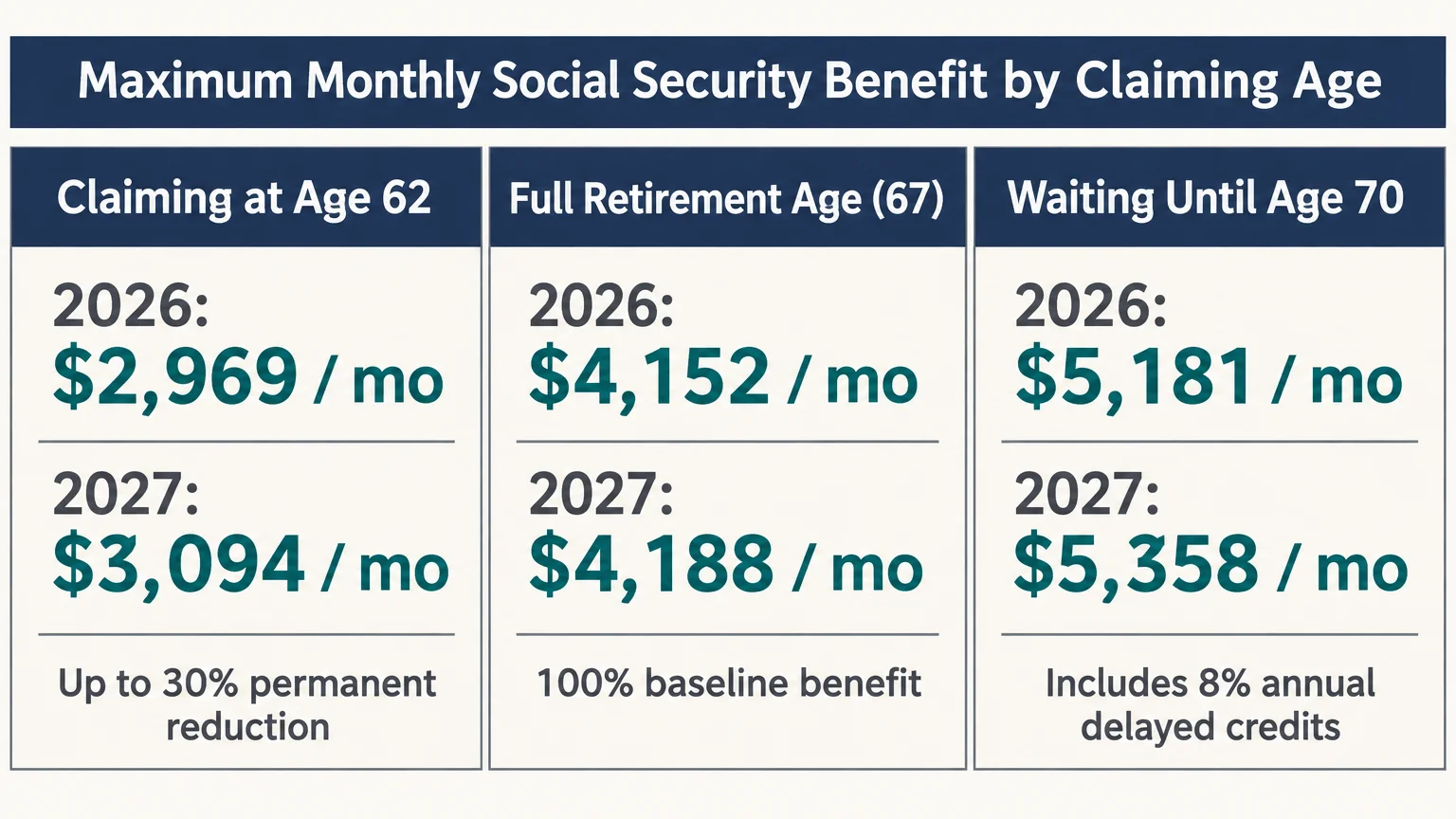
For top earners with 35 years at the taxable wage maximum ($184,500 in 2026; $192,300 in 2027), maximum monthly checks reach these levels:
- Claiming at age 62: $2,969 per month in 2026, rising to $3,094 in 2027.
- Claiming at Full Retirement Age: $4,152 per month in 2026, rising to $4,188 in 2027.
- Waiting until age 70: $5,181 per month in 2026, rising to $5,358 in 2027 through 8% annual delayed credits.
If you work while collecting early benefits, watch the earnings test. Under FRA all year, SSA withholds $1 for every $2 earned above $24,480 in 2026 ($25,560 in 2027); in your FRA year, the threshold is $65,160 in 2026 ($67,920 in 2027).
Public employees also received major relief under the Social Security Fairness Act, signed in January 2025. It permanently repealed the Windfall Elimination Provision and Government Pension Offset, restoring full Social Security and survivor checks for millions of teachers, firefighters, and civil servants.
Retirees with disabilities or limited resources may qualify for two additional SSA programs. Social Security Disability Insurance (SSDI) averages $1,642 per month in 2026 and $1,701 in 2027, automatically converting to retirement benefits at FRA.
Meanwhile, Supplemental Security Income (SSI) provides needs-based monthly cash up to $994 for an individual ($1,491 for a couple) in 2026, rising to $1,029 ($1,544 for a couple) in 2027. Countable asset limits remain $2,000 for individuals and $3,000 for couples.

Employer, Federal, and Military Pensions
Traditional defined-benefit pensions still deliver steady checks for millions of retirees. If a private-sector single-employer plan terminates in 2027, the Pension Benefit Guaranty Corporation (PBGC) guarantees up to $8,113.64 per month at age 65 for a straight-life annuity, up from $7,789.77 in 2026.
Federal civilian retirees receive adjustments set by the Office of Personnel Management (OPM). Effective December 1, 2026, Civil Service Retirement System (CSRS) pensions rise 3.6%, while eligible Federal Employees Retirement System (FERS) retirees receive a 2.6% COLA because FERS caps inflation adjustments.
Most regular FERS retirees do not receive COLAs until age 62. Those who retire earlier under unreduced rules may receive the FERS Special Retirement Supplement, which faces the same $25,560 earnings limit in 2027 as early Social Security.
Military retirees and veterans can layer multiple monthly retiree benefits together. Military retired pay and Survivor Benefit Plan checks increase by 3.6% effective December 1, 2026, with the first adjusted payment arriving December 31, 2026.
Tax-free VA disability compensation pays $3,938.58 per month in 2026 for a 100%-rated veteran with no dependents, projected to reach $4,080.37 in 2027. Low-income wartime veterans may also qualify for the needs-based VA Veterans Pension, covering the gap up to $17,441 annually ($18,069 estimated for 2027) or $29,093 ($30,141 estimated) with Aid and Attendance.

Retirement Account Withdrawals and Lifetime Annuities
Personal savings inside 401(k)s, IRAs, and Thrift Savings Plans let you build your own monthly paycheck. Morningstar’s 2026 research estimates a 3.9% starting withdrawal rate for inflation-adjusted spending over 30 years, or up to 5.7% using flexible guardrails.
Financial planner William Bengen’s updated historical research puts a worst-case safe starting rate slightly higher at 4.7%. Whatever rate you pick, remember that Required Minimum Distributions (RMDs) eventually force withdrawals starting at age 73 (born 1951–1958) or age 75 (born 1960 or later).
Missing an RMD triggers a 25% excise tax, though correcting the mistake promptly cuts that penalty to 10%. Dividing your annual RMD by 12 and setting up automated monthly transfers keeps your cash flow predictable.
Treat guaranteed checks like Social Security and pensions as the floor for your essential bills, and use flexible portfolio withdrawals for discretionary spending.
If you want more guaranteed income, Single Premium Immediate Annuities (SPIAs) convert a lump sum into lifetime monthly checks within a year. In late 2026, $100,000 buys roughly $693 to $701 per month for a 65-year-old man, $658 to $672 for a woman, or $617 to $622 for a couple.
You can also buy a Qualified Longevity Annuity Contract (QLAC) inside a traditional IRA or 401(k). QLACs let you defer up to $210,000 in 2026 ($220,000 in 2027) from RMD calculations until payouts begin, no later than age 85.
Home Equity and Needs-Based Monthly Support
Your home equity and federal nutrition programs can also generate monthly income for seniors on tight budgets. Through a Home Equity Conversion Mortgage (HECM) backed by the U.S. Department of Housing and Urban Development, homeowners age 62 and older can receive monthly tenure or term payouts.
These reverse mortgages require HUD-approved counseling and carry a nationwide claim limit of $1,249,125 in 2026, projected to rise to $1,283,100 in 2027. You make no monthly mortgage payments as long as you live in the home and pay property taxes, insurance, and upkeep.
For grocery relief, check your eligibility for SNAP through USA.gov Benefits. For fiscal year 2027 (October 2026 through September 2027), maximum monthly SNAP allotments reach $306 for one person and $562 for two people in most states.
Households with someone age 60 or older get friendlier SNAP rules. You are exempt from the federal gross income test, can deduct out-of-pocket medical expenses above $35 per month, and qualify under a higher $4,750 federal asset limit (waived in most states).

Comparing Monthly Retirement Income Sources
Seeing how different retirement income sources behave helps you balance inflation protection, longevity risk, and taxes. Use this comparison to map out which checks cover fixed bills versus flexible goals.
| Income Source | Inflation Adjustment | Tax Treatment | Key Eligibility Rule |
|---|---|---|---|
| Social Security | Annual COLA (3.6% for 2027) | Up to 85% taxable above thresholds | Age 62+ with 40 work credits |
| SSI | Annual COLA (3.6% for 2027) | Tax-free | Age 65+ or disabled; strict asset limit |
| Private / Federal Pensions | Varies (3.6% CSRS; 2.6% FERS) | Usually taxable as ordinary income | Vested service with employer |
| VA Disability Pay | Annual COLA (3.6% for 2027) | 100% federal tax-free | Service-connected disability rating |
| 401(k) / IRA Withdrawals | Self-managed | Ordinary income (tax-free if Roth) | RMDs start at age 73 or 75 |
| Immediate Annuity (SPIA) | Fixed unless rider purchased | Interest portion taxed; principal excluded | Lump-sum purchase from insurer |
| Reverse Mortgage (HECM) | Fixed or credit-line growth | Loan proceeds are non-taxable | Age 62+ homeowner with equity |

Taxes and Medicare Deductions That Shrink Your Check
Gross monthly payouts rarely match what lands in your checking account. Most retirees see standard Part B premiums deducted directly from Social Security through Medicare.gov, rising from $202.90 per month in 2026 to $209.40 in 2027.
Higher earners pay extra Income-Related Monthly Adjustment Amount (IRMAA) surcharges. If your 2025 modified adjusted gross income exceeded $112,000 single ($224,000 joint), 2027 Part B surcharges add $83.70 to $502.40 per month.
Federal income taxes can also nibble at your checks. Up to 50% of Social Security becomes taxable once provisional income tops $25,000 single ($32,000 joint), and up to 85% becomes taxable above $34,000 single ($44,000 joint).
You can avoid surprise April tax bills by filing IRS Form W-4V with the Internal Revenue Service to withhold 7%, 10%, 12%, or 22% from Social Security. Thankfully, new tax rules give seniors extra breathing room between 2025 and 2028.
Under the One Big Beautiful Bill Act, taxpayers age 65 and older receive an extra $6,000 deduction per person ($12,000 joint), phasing out above $75,000 single ($150,000 joint) income. That stacks atop the 2027 standard deduction ($16,600 single; $33,200 joint) and existing age-65 bonus ($2,100 single; $1,700 per spouse).
Frequently Asked Questions
What is the fastest way to increase a Social Security monthly check?
Delaying your claim past age 62 boosts your permanent monthly payout by roughly 5% to 8% per year until age 70. Replacing low-earning years in your top-35 work history with higher current wages can also raise your calculation.
Can I collect VA disability compensation and Social Security at the same time?
Yes, VA disability compensation does not reduce Social Security retirement or SSDI payments. However, VA disability payments do count as income when determining eligibility for needs-based SSI or VA Veterans Pension benefits.
Do reverse mortgage monthly payments affect Social Security or Medicare?
No, reverse mortgage payouts are loan advances rather than taxable income, so they never reduce Social Security or trigger Medicare IRMAA surcharges. However, unspent reverse mortgage cash sitting in a bank account can affect needs-based SSI or Medicaid eligibility.

Next Steps for Your Retirement Paycheck
Start by logging into your online Social Security, pension, and brokerage portals to list every expected 2027 payment side by side. Subtract your estimated Medicare premiums and tax withholding so you budget using real net cash flow.
If your guaranteed checks fall short of essential bills, compare SNAP eligibility, delay Social Security if possible, or price a small immediate annuity. This article provides general financial education and information only.
Everyone’s financial situation is unique—what works for others may not work for you. For personalized advice, consider consulting a qualified financial professional such as a CFP or CPA.
Last updated: November 2026. Financial regulations and rates change frequently—verify current details with official sources.