Your January 2027 bank deposit may look bigger on paper, yet your budget could feel tighter by March. Rising healthcare deductions, stubborn winter prices, and frozen tax thresholds quietly absorb much of a headline raise before spring arrives.
Whether you collect Social Security or earn a paycheck, seeing where every dollar goes helps you protect your buying power. Breaking down the exact math behind 2027 COLA inflation and payroll shifts lets you adjust your cash flow early.
The Gap Between Your 2027 Raise and Real-World Inflation
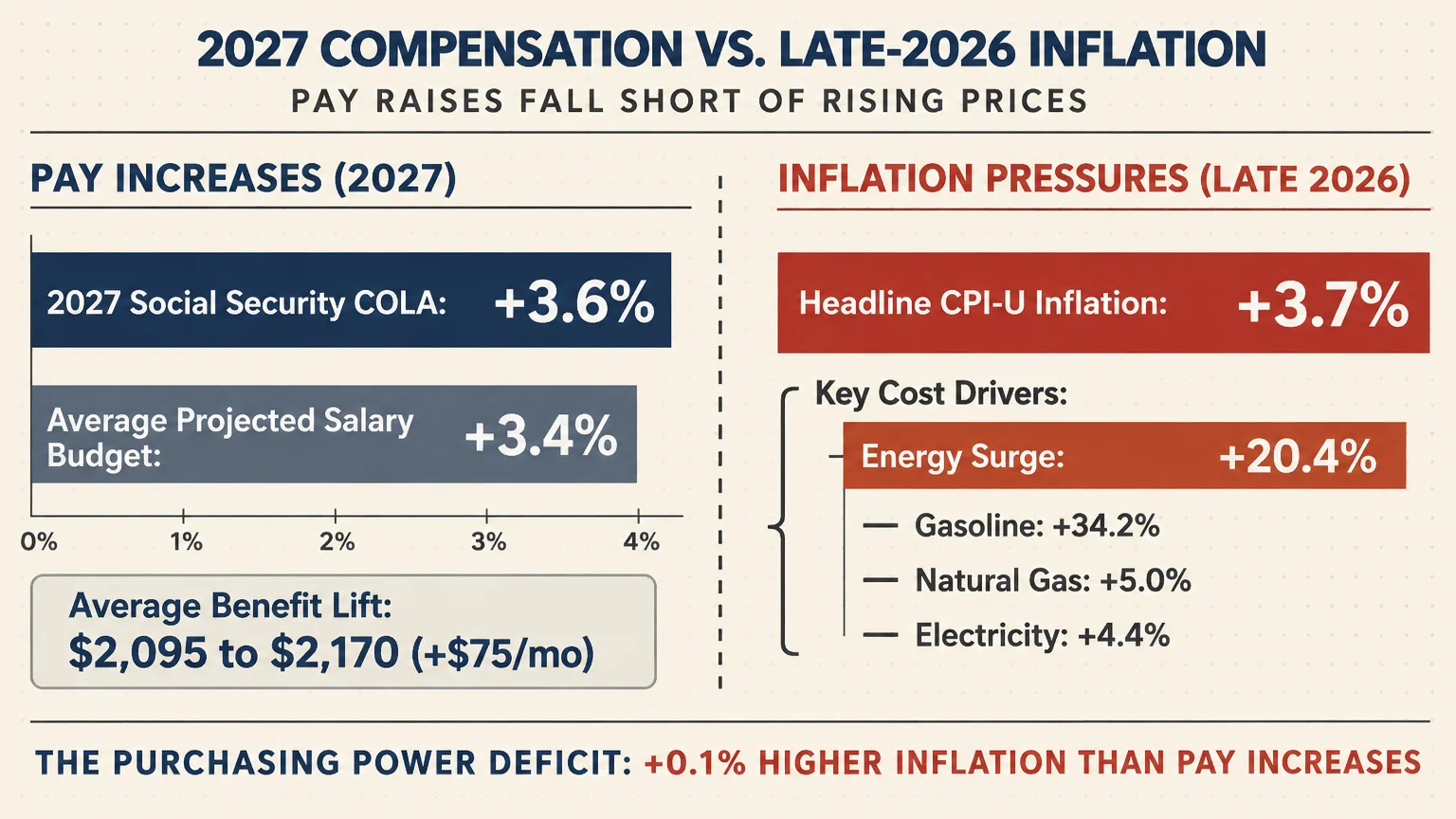
On October 14, 2026, the Social Security Administration (SSA) announced a 3.6% cost-of-living adjustment for 2027. That Social Security raise for 2027 improves on 2026’s 2.8% adjustment and marks the largest boost since 2023’s 8.7% increase.
Roughly 76 million Americans receive that 3.6% bump across two schedules. Nearly 72 million Social Security beneficiaries see higher payments starting in January 2027, while about 7.3 million Supplemental Security Income (SSI) recipients see increases starting December 31, 2026.
For an average retired worker, SSA estimates the 3.6% adjustment adds about $75 per month, or $900 per year. That lifts the average monthly benefit from $2,095 to $2,170 before deductions.
Working households face an even tighter squeeze on headline pay. July 2026 compensation surveys show WTW projecting average 2027 salary increase budgets at 3.4%, down from 3.5% in 2026, while Mercer projects 3.2% for merit raises and 3.5% for total pay budgets.
Those modest raises run straight into accelerating consumer prices. According to the U.S. Bureau of Labor Statistics (BLS), annual CPI-U inflation climbed from 3.4% in August 2026 to 3.7% in September 2026—already outpacing the 3.6% COLA before 2027 even begins.
Energy costs drove much of that late-2026 acceleration. BLS data showed a 20.4% 12-month surge in energy prices in September 2026, led by a 34.2% jump in gasoline, 5.0% in natural gas, and 4.4% in electricity.
Price pressure carried directly into the fall heating and shopping season. In its November 10, 2026 report, BLS recorded a 0.4% seasonally adjusted monthly jump in October CPI-U, beating 0.3% forecasts, with core CPI-U rising 0.3%.
Everyday essentials accounted for most of those October increases:
- Food prices: Overall food rose 0.5% in October 2026, with groceries up 0.4% and dining out up 0.5%.
- Housing and utilities: Shelter climbed 0.3%, driving over 30% of the monthly inflation gain, while electricity jumped 0.9%.
- Medical care: Overall medical costs increased 0.3%, pushed by hospital services rising 0.8%, physicians’ services up 0.4%, and prescription drugs up 0.3%.
- Auto insurance and recreation: Motor vehicle insurance climbed 0.7% and recreation rose 0.8% in a single month.
The way Washington calculates the annual COLA widens this gap further for older adults. Under federal law, SSA ties the adjustment to third-quarter year-over-year changes in the Consumer Price Index for Urban Wage Earners and Clerical Workers (CPI-W).
In 2026, CPI-W rose 3.4% in July, 3.5% in August, and 3.9% in September, averaging out to 3.6%. However, CPI-W tracks spending patterns of younger working households rather than the true cost of living for retirees.
The Senior Citizens League (TSCL) notes that an experimental senior index called CPI-E—which weights housing and healthcare more heavily—regularly runs about 0.2 percentage points higher than CPI-W. Over a decade, small annual misses compound into serious erosion of COLA buying power.
According to TSCL’s 2026 Loss of Buying Power report, Social Security benefits lost 13.7% of their purchasing power between 2016 and 2026, leaving each dollar worth roughly 86 cents. Restoring 2016 value would require a 15.8% boost, or $295.85 per month ($3,550.20 annually).
In TSCL’s 2026 Senior Survey, 89% of respondents reported that their prior COLA failed to keep pace with actual inflation. You can review official benefit calculation details directly on the Social Security Administration website.
How the Medicare Part B Deduction Shrinks Your Social Security Check
Even when a 3.6% raise hits your benefit statement, automatic healthcare withholding takes an immediate bite. On November 17, 2026, the Centers for Medicare & Medicaid Services (CMS) confirmed higher premiums and deductibles across Medicare for 2027.
The standard Medicare Part B deduction rises by $6.50 per month, or 3.2%, moving from $202.90 in 2026 to $209.40 in 2027. That totals $2,512.80 for the year, an extra $78 out of pocket.
Because SSA deducts Part B premiums directly from monthly benefits for most enrollees, your net deposit grows less than expected. On an average $75 monthly COLA gain, the higher Part B premium trims your raise to $68.50 before taxes or drug plan changes.
Out-of-pocket medical bills also reset higher every January, which is why March budgets often feel squeezed after winter doctor visits. CMS raised the 2027 Part B annual deductible by $9, from $283 in 2026 to $292.
Combined, baseline Part B premiums and the deductible reach $2,804.80 in 2027 before you pay standard 20% Original Medicare coinsurance. Meanwhile, the Part A inpatient hospital deductible climbs $40, from $1,736 to $1,776 per benefit period covering days 1 through 60.
Higher-income retirees face a sharper hit through Income-Related Monthly Adjustment Amounts (IRMAA). CMS calculates 2027 IRMAA surcharges using your 2025 modified adjusted gross income (MAGI), meaning a two-year-old bonus, property sale, or Roth conversion can reduce your 2027 checks.
For 2027, CMS lifted IRMAA entry thresholds to above $112,000 for single filers and $224,000 for married couples filing jointly, up from $109,000 and $218,000 in 2026. Roughly 9% of Part B enrollees fall above these lines.
Those affected pay total Part B premiums ranging from $293.10 to $711.80 per month, plus Part D IRMAA surcharges between $15.40 and $96.40 monthly. Top IRMAA brackets remain frozen by statute at $500,000 single and $750,000 joint through 2027.
The largest shock for millions of retirees in early 2027 comes from Medicare Part D prescription drug plans. CMS terminated the Medicare Part D Premium Stabilization Demonstration—which subsidized stand-alone plans by $10 per member monthly and capped hikes at $50 in 2026—effective December 31, 2026.
Without that federal cushion, plan pricing jumped sharply for 2027. The Part D National Base Beneficiary Premium rose the maximum statutory 6% from $38.99 to $41.33, while the National Average Monthly Bid Amount surged 24% to $296.05.
KFF estimates that among non-low-income enrollees in stand-alone Part D plans who stayed put during Open Enrollment (October 15 through December 7, 2026), 76%—or 10.4 million of 13.6 million people—will pay more in 2027. Roughly 2.4 million face monthly premium hikes exceeding $50.
Furthermore, zero-premium stand-alone Part D plans disappear entirely in 2027, affecting about 4 million enrollees who paid $0 premiums in 2026. If your drug plan premium rises by $40 or $50 a month, it can erase nearly all of your net COLA raise.
Drug cost-sharing limits are moving up as well. CMS raised the maximum standard Part D deductible from $615 in 2026 to $700 in 2027, while the annual Part D out-of-pocket spending cap climbs from $2,100 to $2,400.
You can compare plan rules and cost-sharing tiers using official tools on Medicare.gov. Reviewing the year-over-year changes side by side reveals how quickly fixed costs compound.
| Benefit or Cost Category | 2026 Amount | 2027 Amount | Annual Impact on Budget |
|---|---|---|---|
| Social Security COLA | 2.8% | 3.6% | +$75/month average ($2,095 to $2,170) |
| Medicare Part B Standard Premium | $202.90/month | $209.40/month | +$78/year (+$6.50/month) |
| Medicare Part B Deductible | $283/year | $292/year | +$9/year before 20% coinsurance |
| Medicare Part A Hospital Deductible | $1,736/period | $1,776/period | +$40 per inpatient benefit period |
| Medicare Part D Max Deductible | $615/year | $700/year | +$85/year initial prescription outlay |
| Medicare Part D Out-of-Pocket Cap | $2,100/year | $2,400/year | +$300/year maximum drug cap |
| Workplace Merit / Total Pay Budget | 3.5% (WTW avg) | 3.2%–3.5% | Trails 3.7% Sept. 2026 CPI-U inflation |
| Social Security Payroll Tax Cap | $184,500 | $192,300 | Up to +$483.60 extra 6.2% tax |

Workplace Health Costs and ACA Premiums Eating Into Paychecks
Retirees are not the only ones watching a 2027 raise disappear before spring. Working households often receive merit raises between January and March, only to see higher health insurance premiums and deductibles swallow the extra take-home pay.
Marsh (formerly Mercer) projects employer health benefit costs will jump 8.2% per employee in 2027, marking the steepest rise since 2003. Other major forecasts confirm the pressure, with WTW projecting 9.7% growth after plan changes, Aon projecting 9.5%, and Business Group on Health projecting 9.2%.
Employers are actively passing part of that surge directly onto workers. Marsh reports that 59% of employers plan cost-cutting adjustments like higher deductibles in 2027, while roughly two-thirds of large employers with 500 or more workers plan to raise employees’ premium shares.
Workers already started from an expensive baseline. According to KFF in 2026, average employer-sponsored family coverage reached $28,303, with workers paying $7,471—a 9% jump ($621) that ran more than double wage growth—alongside average single deductibles of $1,955.
Add an 8% to 9% premium increase onto a $7,471 worker contribution, and your paycheck deduction can rise by roughly $50 a month or more. On a $60,000 salary with a 3.2% merit raise, healthcare hikes and inflation easily cancel out your raise.
Self-employed workers and early retirees buying coverage on the ACA Marketplace face an even steeper climb. Insurers proposed a median 15% premium increase for 2027 ACA Marketplace plans, delivering a second straight double-digit hike after enhanced premium tax credits expired after 2025.
Higher earners also lose an extra slice of gross pay to Social Security payroll taxes starting in January 2027. Per SSA’s October 14, 2026 announcement, the maximum earnings subject to the 6.2% Social Security tax increases from $184,500 to $192,300.
For anyone earning at or above the new cap, maximum employee payroll taxes rise by $483.60, moving from $11,439 to $11,922.60. Workers who collect Social Security before full retirement age also face updated earnings-test limits.
In 2027, you can earn up to $25,560 (up from $24,480) before SSA withholds $1 for every $2 above the limit if you are under full retirement age all year. In the year you reach full retirement age, the limit rises from $65,160 to $67,920, withholding $1 per $3 earned above that cap before your birthday month.
Tax Bracket Creep and Frozen Social Security Thresholds
Tax rules create a quieter, slower leak that shows up when you calculate your true net income. Under IRS Revenue Procedure 2026-35, published November 5, 2026, the seven federal income tax rates stay at 10% through 37%, with bracket thresholds widened roughly 3% for inflation.
Standard deductions rise for 2027 as well. Single filers and married individuals filing separately get $16,600 (up $500), married couples filing jointly get $33,200 (up $1,000), and heads of household receive $24,925 (up $775).
Older taxpayers receive extra relief that helps offset part of the squeeze. The inflation-adjusted additional standard deduction for age 65 and older rises to $2,100 for unmarried taxpayers (up from $2,050) and $1,700 per qualifying married spouse (up from $1,650).
On top of that, the temporary $6,000 senior deduction per person age 65 and older—enacted under the One Big Beautiful Bill Act for tax years 2025 through 2028—remains active in 2027 whether you take the standard deduction or itemize. However, it phases out at 6% of MAGI above $75,000 for single filers and $150,000 for joint filers.
Notice the subtle tension for retirees with moderate savings: tax brackets widened roughly 3%, whereas your Social Security COLA rose 3.6% and September CPI-U hit 3.7%. When nominal income grows faster than tax brackets, a slightly larger slice can edge into higher marginal territory.
Even more punishing is the permanent freeze on Social Security benefit taxation thresholds. The IRS measures something called provisional income—your adjusted gross income excluding Social Security, plus tax-exempt municipal bond interest, plus half of your Social Security benefits.
Those provisional income thresholds were not repealed by the 2025 tax law and have never been indexed for inflation since taking effect decades ago:
- Up to 50% of benefits taxable (frozen since 1984): $25,000 for single filers and $32,000 for married couples filing jointly.
- Up to 85% of benefits taxable (frozen since 1994): $34,000 for single filers and $44,000 for married couples filing jointly.
Every annual COLA pushes nominal benefits higher against those 1984 and 1994 dollar lines. According to SSA’s MINT model, more than half of Social Security beneficiaries now owe federal income tax on their benefits, up from under 10% in 1984.
If your 2027 COLA pushes your provisional income over $25,000 or $34,000 (single), each extra benefit dollar can trigger tax on up to 85 cents of previously untaxed benefits. For workers age 50 and older, retirement contribution rules bring another paycheck shift in 2027.
Employee 401(k) deferral limits rise $1,000 to $25,500 for workers under age 50, $34,000 for ages 50–59 and 64+ (up $1,500), and $37,250 for ages 60–63 (up $1,500). However, workers age 50+ whose prior-year 2026 employer wages exceeded $155,000 must direct all 2027 catch-up contributions into an after-tax Roth account, raising current-year tax withholding.
You can verify official bracket thresholds, standard deductions, and retirement limits directly on IRS.gov.
Focus on your net spendable dollars after healthcare, taxes, and essential price increases rather than the percentage printed on your January raise notice.

Seven Practical Ways to Protect Your 2027 Buying Power
You cannot stop winter utility spikes or rewrite federal Medicare formulas, yet you can keep more of your raise inside your own bank account. Taking a structured approach during the first quarter prevents small leaks from draining your emergency fund.
- Audit your January deposit and pay stub line by line: Compare your final December 2026 check against January 2027 so you spot exact dollar changes in Part B, Part D, employer health premiums, and tax withholding right away.
- Re-evaluate Medicare drug coverage if premiums spiked: Because zero-premium stand-alone Part D plans disappeared for 2027 and most plans raised rates, check whether you qualify for Medicare Savings Programs, state pharmaceutical assistance, or a Special Enrollment Period through USA.gov Benefits.
- Model your 2027 provisional income before taking IRA withdrawals: Coordinate Traditional IRA distributions with Roth conversions or qualified charitable distributions if you are age 70.5 or older so you avoid pushing extra Social Security dollars into the 85% taxable tier or shrinking your $6,000 senior deduction.
- Buffer your checking account for Q1 deductible resets: Set aside cash specifically for January through March medical bills—covering the $292 Part B deductible, up to $700 Part D deductible, or $1,955 average single workplace deductible—so you do not rely on high-interest credit cards.
- Re-shop auto insurance and trim winter energy waste: With motor vehicle insurance up 0.7% in October 2026 alone and electricity up 4.4% year-over-year in September, collecting three competing auto quotes and lowering thermostat setbacks can help offset those increases.
- Use pre-tax accounts to lower taxable wages: If you are under the $155,000 wage threshold or under age 50, raising 401(k) deferrals toward the $25,500 limit or maxing out a Health Savings Account cuts federal taxable income while building future reserves.
- Adjust voluntary tax withholding early: File an updated Form W-4 (for paychecks) or Form W-4V (for Social Security) in January if your 2027 COLA or Roth catch-up shift changes your projected tax liability.
If your budget already feels strained by medical bills or debt, free, accredited budgeting help is available through the Consumer Financial Protection Bureau.

Pitfalls to Watch For in Early 2027
Many households lose hundreds of dollars between January and March simply because they assume 2026 settings still work in 2027. Watching out for four common mistakes helps you avoid painful surprises.
First, do not assume your prescription drug costs will mirror last year’s totals. Even if your medications did not change, the end of the Part D Premium Stabilization Demonstration, the higher $700 maximum deductible, and the $2,400 out-of-pocket cap mean January pharmacy visits can cost sharply more.
Second, avoid ignoring the two-year lookback behind Medicare IRMAA brackets. A one-time capital gain or large IRA withdrawal taken in 2025 triggers higher Part B and Part D premiums in 2027—yet you can appeal using Form SSA-44 if you experienced a qualifying life-changing event such as retirement or loss of a spouse.
Third, watch your part-time earnings closely if you claim Social Security before full retirement age. Earning above $25,560 in 2027 triggers automatic benefit withholding, which can interrupt cash flow mid-year when you expect steady checks.
Fourth, high-earning workers age 50 and older should not overlook mandatory Roth catch-up rules. If your 2026 employer wages topped $155,000, your payroll team will switch catch-up deferrals to after-tax Roth dollars, reducing net paychecks even if your gross salary rose.
Getting Expert Help
While basic budget audits work well as a do-it-yourself project, complex tax and healthcare intersections often pay back the cost of professional guidance. Consider consulting a Certified Financial Planner (CFP), Certified Public Accountant (CPA), or licensed Medicare counselor in these situations:
- Navigating IRMAA cliffs and the $6,000 senior deduction phase-out: A CPA can map multi-year IRA withdrawals so crossing $112,000 single ($224,000 joint) for IRMAA or $75,000 single ($150,000 joint) for the senior deduction does not trigger an unexpected marginal tax spike.
- Coordinating work income with Social Security claiming: If you plan to work while collecting benefits in 2027, a planner can calculate whether delaying benefits beats triggering the $25,560 earnings test and 85% provisional income taxation.
- Managing high prescription drug spending: A State Health Insurance Assistance Program (SHIP) counselor can review plan formularies and mail-order tiers under the new $2,400 Part D cap at no cost.
- Handling mandatory Roth catch-up tax planning: If your 2026 wages exceeded $155,000, a tax advisor can balance your 2027 Roth 401(k) catch-up contributions against other deductions and estimated tax payments.
Frequently Asked Questions
How much is the Social Security raise for 2027, and when does it start?
The Social Security COLA for 2027 is 3.6%, adding roughly $75 per month ($900 annually) to the average retired-worker benefit. SSI recipients see the boost on December 31, 2026, while regular Social Security beneficiaries receive higher checks starting in January 2027.
Why is my net 2027 Social Security check smaller than a 3.6% increase?
Your net check reflects automatic deductions taken before funds reach your bank account. In 2027, the standard Medicare Part B premium increases $6.50 to $209.40 per month, and many retirees also face higher stand-alone Part D drug premiums or federal tax withholding.
Will my 2027 raise push me into a higher Medicare IRMAA bracket?
No, your 2027 COLA or 2027 pay raise will not affect 2027 IRMAA surcharges because CMS bases 2027 brackets on your 2025 tax return. However, higher income in 2027 could affect your IRMAA tier two years later in 2029 if you cross the thresholds.
Do I have to pay federal income tax on my 2027 Social Security COLA?
You may owe tax on part of your increase if your provisional income exceeds frozen IRS thresholds of $25,000 (single) or $32,000 (joint). While the $6,000 senior deduction for age 65+ helps lower overall taxable income through 2028, it does not eliminate the provisional income formula.
Your Next Step Before January Checks Arrive
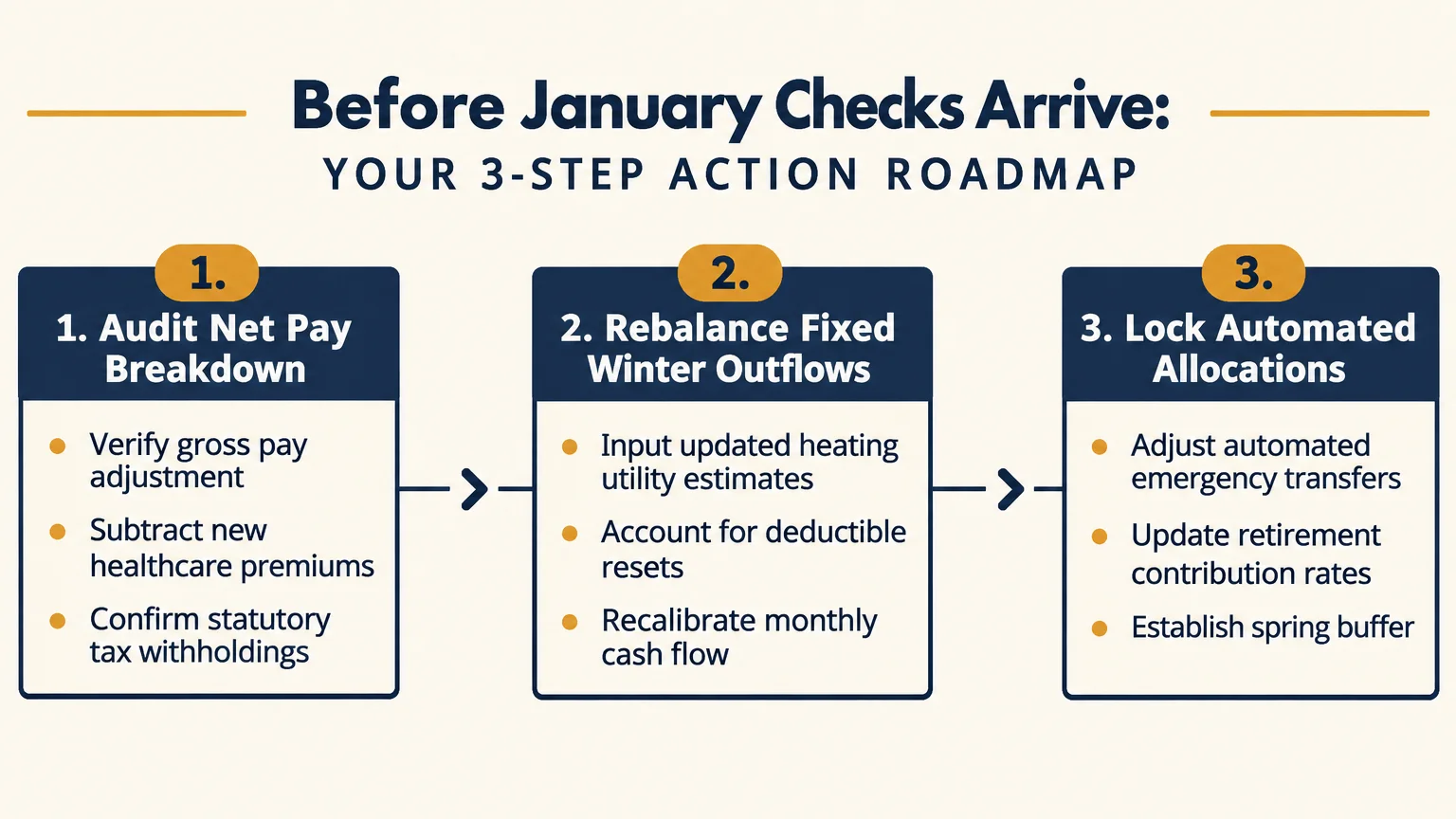
A 3.6% Social Security COLA or 3.4% workplace raise offers real help, yet rising Medicare premiums, 3.7% inflation, and frozen tax rules claim a sizable share fast. Reviewing your January deductions, locking in smart tax withholding, and setting aside a small Q1 deductible buffer keeps you in control well past March.
This article provides general financial education and information only. Everyone’s financial situation is unique—what works for others may not work for you. For personalized advice, consider consulting a qualified financial professional such as a CFP or CPA.
Last updated: November 2026. Financial regulations and rates change frequently—verify current details with official sources.