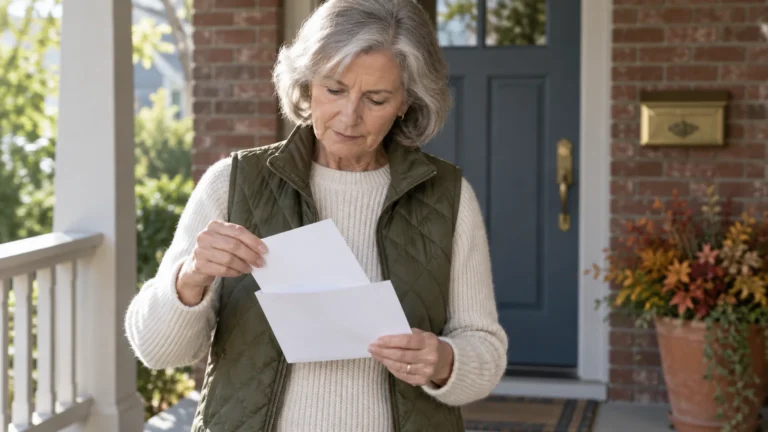
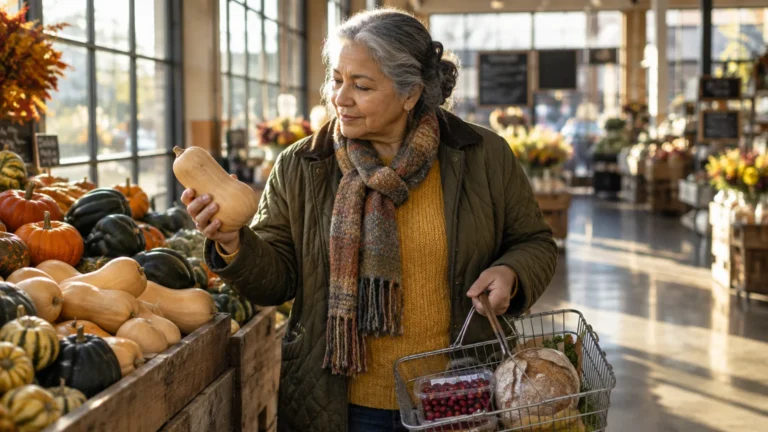
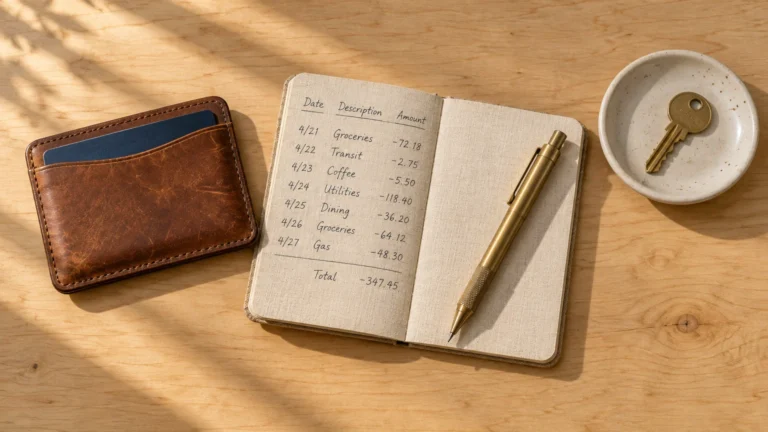
Rising grocery prices stretch fixed retirement budgets thin, leaving many older adults looking for reliable ways to cover monthly essentials. If you are age 60 or older, the Commodity Supplemental Food Program offers a free monthly supply of nutritious staples.
Run by the USDA, these senior food boxes add roughly $50 worth of shelf-stable groceries to your pantry every month. You can receive them alongside SNAP benefits without losing any other federal support.
Knowing the 2026 income limits, box contents, and waitlist rules helps you claim your share smoothly. Here is how to check your eligibility and apply in your area.
How the Commodity Supplemental Food Program Works
Authorized under Sections 4(a) and 5 of the Agriculture and Consumer Protection Act of 1973, CSFP operates under federal regulations in 7 CFR Parts 247 and 250. It is the only USDA nutrition program focused exclusively on low-income adults age 60 and older.
Previously eligible women, infants, and children transitioned to WIC, and USDA removed WIC references from Part 247 in late 2024. Today, the program focuses entirely on senior food boxes and nutrition referrals.
You may notice a recent federal agency name change when researching USDA food assistance. On June 1, 2026, USDA renamed its Food and Nutrition Service (FNS) to the Food and Nutrition Administration (FNA).
Although a federal court stayed planned FNA office closures on October 13, 2026, USDA confirms this reorganization will not eliminate or disrupt any of its 16 nutrition programs. Local food distribution continues without interruption.
CSFP operates in parts of all 50 states, Washington, D.C., Puerto Rico, and through seven Indian Tribal Organizations (ITOs). Participating tribes include the Oglala Sioux, Seminole Nation, Shingle Springs Band of Miwok Indians, Spirit Lake Tribe, Mississippi Band of Choctaw Indians, Wichita and Affiliated Tribes, and Winnebago Tribe of Nebraska.
Under the 2024 Final Rule, state agencies must keep an annually updated public webpage listing every local distribution site, street address, and phone number. This directory makes finding a site near you much simpler.
2026 Eligibility and Income Guidelines
To qualify for CSFP, you must be at least 60 years old and meet local residency and income rules. State agencies and ITOs may require you to live inside a local service area, though they cannot impose a minimum residency duration.
Adults living in nursing homes do not qualify for monthly boxes because institutional meal services cover their nutrition. However, seniors living in independent apartments, houses, or with relatives can apply.
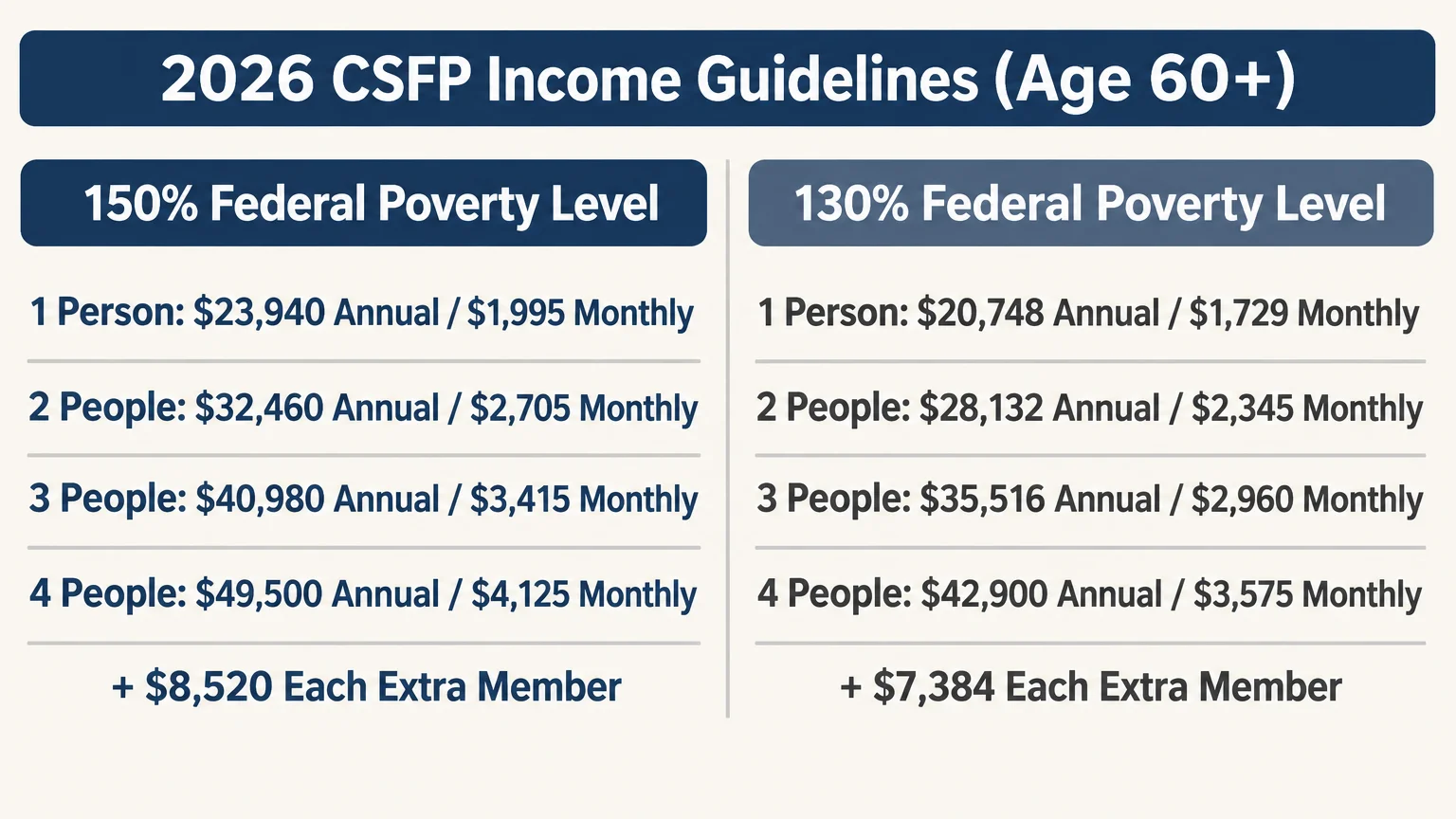
Under a USDA Final Rule effective December 30, 2024, the maximum federal income ceiling rose from 130% to 150% of the Federal Poverty Guidelines. State agencies and ITOs still have the option to keep their local threshold at 130%.
On February 10, 2026, USDA released the official 2026 CSFP income limits based on the 2026 HHS Poverty Guidelines. The table below lists both tiers for the contiguous 48 states, Washington, D.C., and Puerto Rico.
| Household Size | 150% FPL (Annual / Monthly / Weekly) | 130% FPL (Annual / Monthly / Weekly) |
|---|---|---|
| 1 person | $23,940 / $1,995 / $461 | $20,748 / $1,729 / $399 |
| 2 people | $32,460 / $2,705 / $625 | $28,132 / $2,345 / $541 |
| 3 people | $40,980 / $3,415 / $789 | $35,516 / $2,960 / $683 |
| 4 people | $49,500 / $4,125 / $952 | $42,900 / $3,575 / $825 |
| Each extra member | +$8,520 / +$710 / +$164 | +$7,384 / +$616 / +$142 |
Residents of Alaska and Hawaii qualify under higher guidelines to reflect local living costs. In Alaska, the 2026 limit at 150% FPL is $29,925 per year ($2,494 monthly) for one person and $40,575 per year ($3,382 monthly) for two people, adding $10,650 per extra member.
At the 130% tier, Alaska’s limits are $25,935 per year ($2,162 monthly) for one person and $35,165 per year ($2,931 monthly) for two people. Hawaii’s 2026 baseline poverty guideline sits roughly 15% above the contiguous states at $18,360 for one person and $24,890 for two.
Agencies measure your gross cash income before deductions like income taxes, insurance premiums, or bonds. Countable money includes wages, pensions, self-employment earnings, cash assistance, and benefits from the Social Security Administration.
Local staff may evaluate either your current monthly income or your prior 12-month average, whichever reflects your situation more accurately. You can also qualify automatically through adjunctive eligibility.
Under federal rules, state agencies can accept documented enrollment in SNAP, FDPIR, SSI, the Medicare Part D Low-Income Subsidy (LIS), or Medicare Savings Programs as proof of income eligibility. Check your benefit letters through Medicare.gov before applying.
Eligibility belongs to each individual senior rather than one box per street address. According to Washington State Department of Agriculture guidance, two adults age 60 or older sharing an income-eligible home can each receive their own monthly box.
What Comes Inside Your Monthly Senior Food Box
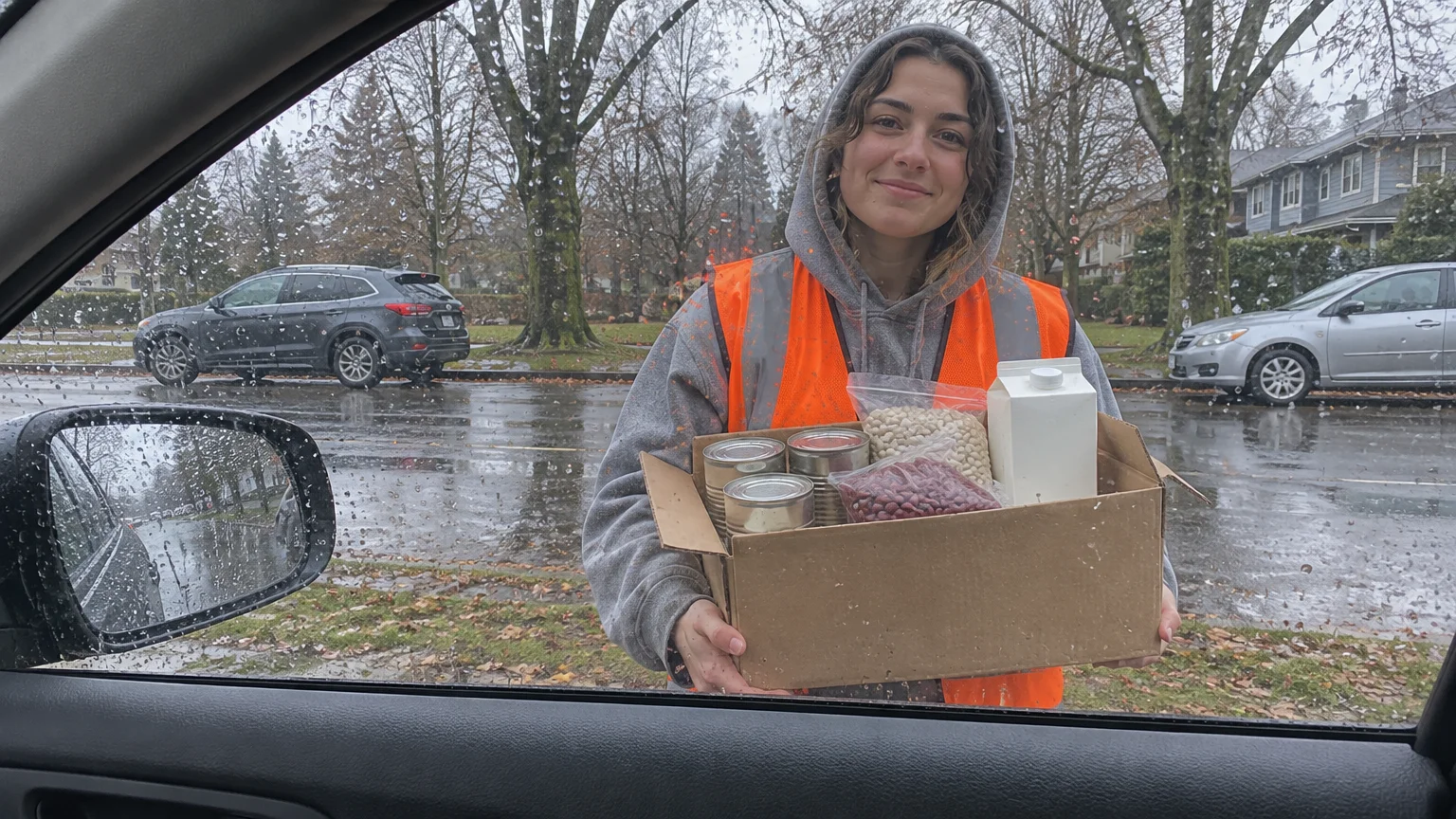
Per Feeding America, USDA spends about $27 in commodity costs to assemble a monthly box with an average retail value of $50. Senior program guides note that each package typically weighs 30 to 40 pounds.
These csfp food boxes provide supplemental nutrition and do not supply a complete monthly diet. Instead, they fill pantry gaps with shelf-stable staples and cheese that pair easily with fresh produce.
Under updated USDA distribution rates effective September 1, 2025, a full monthly package contains items across eight food categories:
- Fruits and juice: 4 items total from 15.5 oz canned fruit, 64 oz juice, and 15 oz raisins.
- Vegetables: 8 cans of vegetables or soup (10.5 to 15.5 oz each), or 6 cans plus 1 pound of dehydrated potatoes.
- Cheese: 1 two-pound package of cheese.
- Milk: 2 cartons (32 oz each) of 1% UHT shelf-stable milk, or 1 carton plus a 12.8 oz pouch of instant nonfat dry milk.
- Meat, poultry, or fish: 3 shelf-stable packages (10 to 15 oz each) in any combination of beef, poultry, or fish.
- Plant-based protein: 3 units in any mix of canned beans, 1-pound dry beans or lentils, and 16 oz peanut butter.
- Cereals: 2 units of ready-to-eat cereal (10 to 20 oz), farina (18 oz), rolled oats (18 oz), or grits (2 lb).
- Pasta and rice: 2 one-pound units in any combination of pasta and rice.
Local agencies cannot break boxes down into partial packages unless USDA grants the state a specific waiver. When you qualify and secure a slot, you receive the full standard package each month.
How to Apply, Certify, and Designate a Proxy
Applying for free food seniors can rely on takes just a few straightforward steps. Follow this process to find a local provider and keep your enrollment active:
- Find your nearest provider using your state’s public CSFP webpage or by browsing USA.gov Benefits for state nutrition contacts.
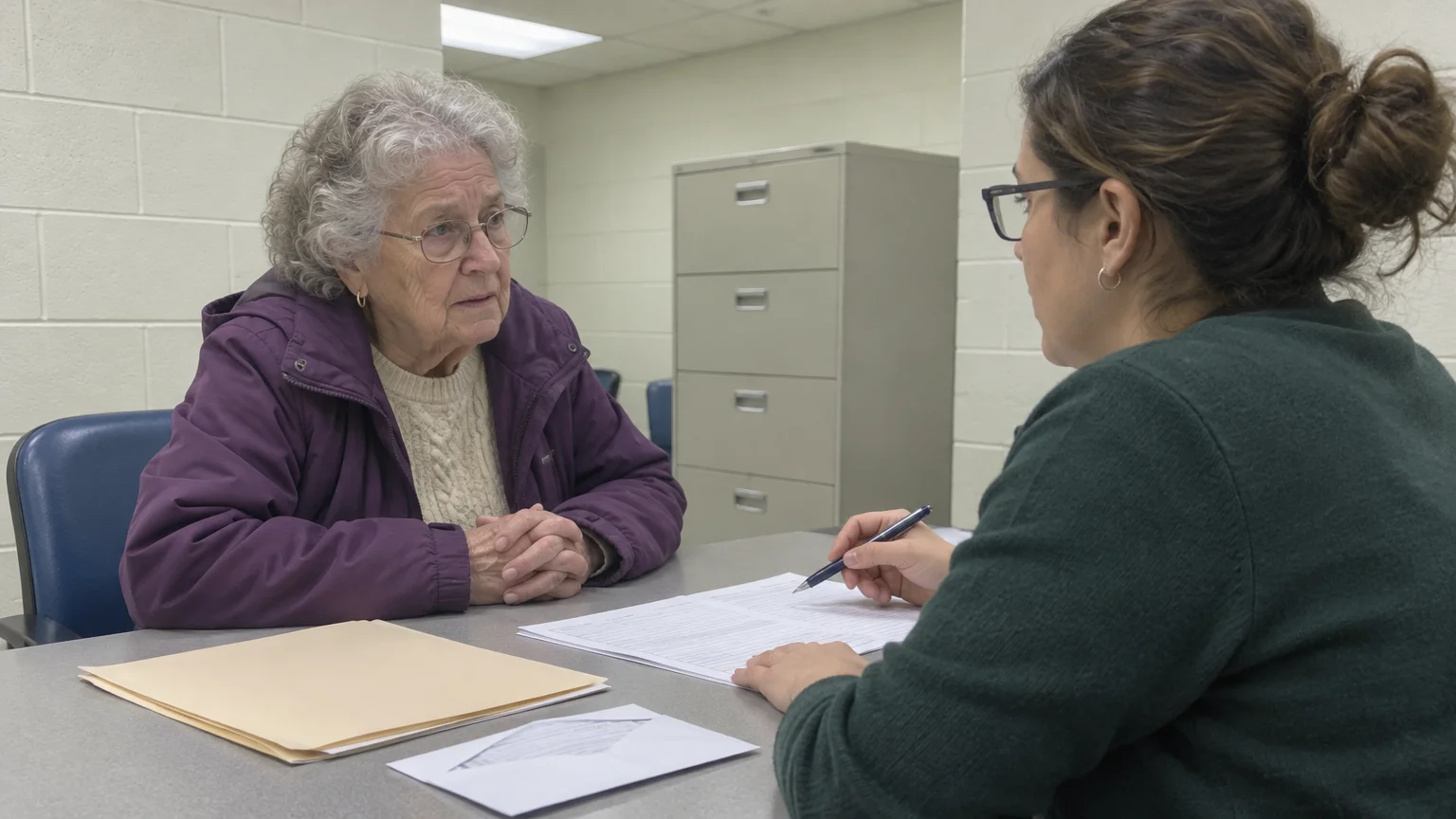
- Complete a signed application showing proof of age, local address, and gross household income—or your SNAP, SSI, or Medicare LIS approval letter.
- Watch for your written decision, because local agencies must notify you of approval, waitlist status, or denial within 10 days of receiving a completed application.
- Pick up your box each month at your assigned site, or name a trusted proxy to collect it for you.
Your initial CSFP certification lasts 12 months. Local agencies can extend your enrollment for two extra 12-month periods—keeping you certified for up to 36 months total—before requiring a brand-new application.
During those annual check-ins, agencies only need to verify your address, ongoing interest, and continued eligibility. Staff can complete that verification by phone, mail, email, or a virtual visit.
Under the 2024 Final Rule, USDA removed the federal mandate requiring physical ID at pickup. Instead, local sites follow state-approved verification procedures so you or your proxy can collect your food smoothly.
If a local agency denies or ends your benefits, you have a federal right to request a fair hearing. Ask the site coordinator for the appeal form right away if you disagree with a decision.
Avoiding Common Errors
Small misunderstandings can delay your approval or cause you to miss out on benefits. Watch out for these frequent mistakes when applying for CSFP:
- Counting net Social Security deposits instead of gross income: Agencies look at your gross benefit before Medicare Part B premiums or tax withholdings are subtracted.
- Assuming married couples share one box: If both spouses are 60 or older and meet household income rules, each spouse qualifies for a separate monthly box.
- Missing annual recertification calls: Failing to answer a phone, mail, or email check-in can drop you from an active slot back onto a waitlist.
- Paying anyone to apply: CSFP is completely free, and you should consult the Consumer Financial Protection Bureau if anyone demands payment or banking details for government food aid.
Waitlists, Funding, and Combining Other Benefits
Unlike SNAP, which funds every eligible applicant, CSFP is a discretionary program with fixed annual funding from Congress. Local agencies cannot enroll more seniors than their assigned caseload slots allow, which creates waitlists in high-demand areas.
For fiscal year 2026, Congress appropriated $460 million under P.L. 119-37, up from $430.531 million in FY 2025. That budget funds 707,000 national caseload slots—matching 2025 levels, though down from 731,933 slots in 2024—alongside a $106.03 annual administrative grant per slot.
Pay attention to federal budget debates if you rely on senior nutrition programs. While White House budget proposals for FY 2026 and FY 2027 recommended eliminating CSFP, Congress protected FY 2026 funding in law.
In an October 27, 2026 oversight letter, U.S. House members highlighted that elimination proposal alongside roughly $187 billion in CBO-estimated SNAP cuts through 2034 under P.L. 119-21. Meanwhile, the proposed Delivering for Rural Seniors Act of 2026 (S. 3718) seeks $10 million yearly from FY 2027 to FY 2029 for rural home-delivery grants, though it is not yet enacted.
Participating in CSFP never disqualifies you from other assistance. USDA confirms you can receive SNAP or FDPIR at the same time, and local CSFP sites must provide referrals to SNAP, Medicaid, and Medicare.
Frequently Asked Questions
Can I receive CSFP food boxes if I already get SNAP?
Yes, you can participate in both programs simultaneously without reducing your SNAP monthly benefit. In fact, your SNAP approval letter often qualifies you automatically for CSFP income eligibility.
What should I do if my local agency has a waitlist?
Submit your completed application anyway so you secure a place in line. Agencies update caseloads constantly as participants move or leave the program, and staff will contact you within 10 days to confirm your waitlist status.
Can a family member pick up my monthly box for me?
Yes, CSFP allows you to designate a proxy—such as an adult child, neighbor, or caregiver—to pick up your monthly box. Ask your local distribution site how to list your proxy on your file.
Your Next Steps
Gathering your age and gross income records takes less than an hour and can bring roughly $600 worth of groceries into your kitchen over a full year. Check your state’s CSFP directory this week to apply or claim a spot on your local waitlist.
This is educational content based on general financial principles. Individual results vary based on your situation. Always verify current tax laws, investment rules, and benefit eligibility with official sources.
Last updated: November 2026. Financial regulations and rates change frequently—verify current details with official sources.