
You can build extra financial security and stay intellectually active in retirement without settling for minimum wage jobs. Across the country, older adults leverage decades of accumulated professional skills into flexible, well-compensated positions.
The federal minimum wage remains at $7.25 per hour, yet high-quality retirement jobs pay substantially more. Meaningful part-time work delivers dependable cash flow to safeguard your nest egg against inflation.
Discover nine practical roles offering solid compensation, manageable schedules, and minimal physical strain. Learn how these opportunities align with current Social Security earnings rules and senior tax deductions.

Why Post-Retirement Work Can Transform Your Finances
Returning to work on your own terms provides benefits that extend far beyond a regular paycheck. Generating modest earned income reduces how much you must pull from personal retirement accounts each month.
Lower withdrawals protect your nest egg against sequence-of-returns risk during market downturns. Leaving your principal intact allows your investments to compound undisturbed over longer periods.
Working part-time also keeps your social circle active and sharpens daily cognitive function. Structured work environments offer purposeful engagement without the grueling grind of forty-hour workweeks.
The national median wage across all occupations stands at $24.51 per hour, according to the U.S. Bureau of Labor Statistics. You do not need to accept entry-level retail or fast-food wages when your career experience holds genuine value.
“The best investment you can make is an investment in yourself. The more you learn, the more you’ll earn.” — Warren Buffett, Chairman and CEO of Berkshire Hathaway
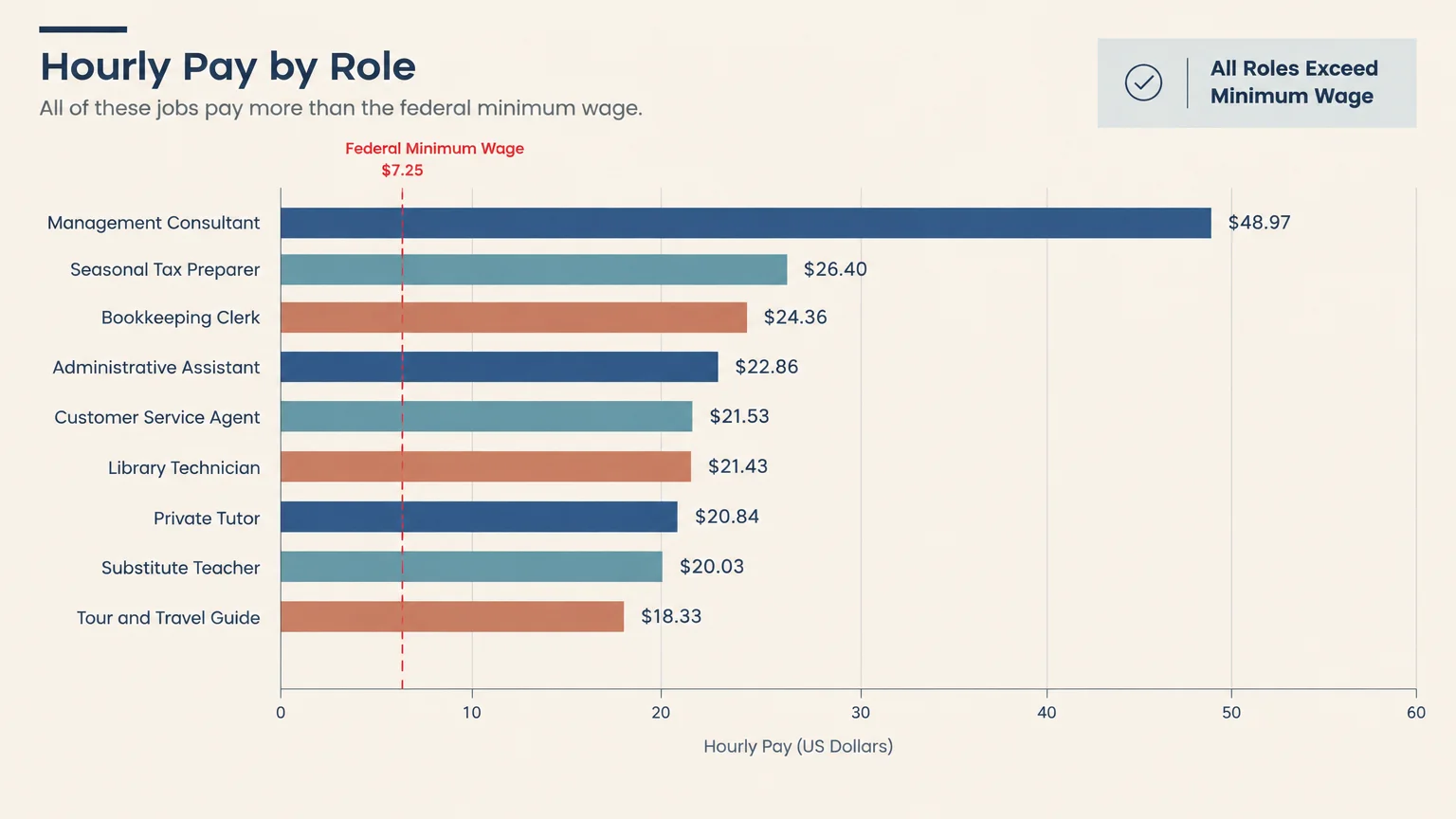
At a Glance: Top Retirement Jobs Compared
The following table outlines hourly earnings and flexibility across nine roles that exceed federal and state minimum wage standards.
| Job Title | Median Hourly Wage | Mean Hourly Wage | Work Setting | Key Asset Needed |
|---|---|---|---|---|
| Management Consultant | $48.97 | $54.71 | Remote / Hybrid | Executive experience |
| Seasonal Tax Preparer | $26.40 | $29.30 | Office / Remote | Tax code knowledge |
| Bookkeeping Clerk | $24.36 | $25.75 | Remote / Hybrid | Accounting software |
| Administrative Assistant | $22.86 | $23.73 | On-site / Hybrid | Organizational skills |
| Customer Service Agent | $21.53 | $22.40 | Remote | Active listening |
| Library Technician | $21.43 | $21.88 | On-site | Information research |
| Private Tutor | $20.84 | $23.10 | Remote / In-person | Subject mastery |
| Substitute Teacher | $20.03 | $22.32 | On-site | Classroom leadership |
| Tour and Travel Guide | $18.33 | $21.02 | On-site | Local storytelling |

9 Rewarding Jobs for Retirees That Pay Above Minimum Wage
1. Management Consultant and Industry Analyst
Management consulting lets you monetize decades of executive, project management, or specialized trade insight. Companies regularly hire external consultants to solve operational problems without taking on expensive permanent payroll.
According to the Bureau of Labor Statistics, management analysts earn a median hourly wage of $48.97, with a mean hourly rate of $54.71. That equates to an annual mean wage of $113,790 for full-time equivalents.
You can set your own project scope, dictate hourly consulting fees, and work entirely from a home office. Many retirees partner with past employers or connect with boutique advisory firms seeking niche technical expertise.
This role demands clear communication, data evaluation, and targeted strategy. You maintain full control over client selection, allowing you to pause engagements whenever you travel or take time off.
2. Seasonal Tax Preparer
If you have an affinity for numbers and strict processes, seasonal tax preparation offers lucrative temporary work. Accounting firms and tax franchises experience massive demand surges between January and April each year.
Tax preparers command a median wage of $26.40 per hour, while the mean hourly wage reaches $29.30. Working concentrated hours for four months lets you fund personal travel goals for the rest of the year.
To begin, you will register for an active Preparer Tax Identification Number (PTIN) through the Internal Revenue Service. Many nationwide tax preparation chains provide free training programs in exchange for seasonal staffing commitments.
The work keeps your analytical skills razor sharp while helping community members navigate complicated filings. Once the April filing deadline passes, your calendar clears completely until the following winter.
3. Bookkeeper and Auditing Clerk
Small businesses, non-profit groups, and medical practices often need reliable recordkeeping but lack the budget for full-time accountants. Retirees with methodical organizational habits excel in part-time bookkeeping roles.
Bookkeeping, accounting, and auditing clerks earn a median hourly wage of $24.36, alongside a mean hourly rate of $25.75. Experienced clerks operating independent practices can charge even higher rates for specialized reporting.
Modern cloud accounting software makes remote bookkeeping straightforward and secure. You can reconcile general ledgers, process client payroll, and prepare quarterly financial summaries from your laptop.
This position provides predictable monthly routines that fit easily around family commitments. You decide how many accounts to accept, ensuring your workload never interferes with your preferred retirement pace.
4. Administrative Assistant and Office Coordinator
Local businesses, community colleges, and medical offices constantly look for mature, dependable professionals to manage daily desk operations. Reliable organizational and communication abilities make older candidates stand out for these openings.
General administrative assistants earn a median wage of $22.86 per hour, with an average hourly rate of $23.73. These wages rise notably in corporate departments and specialized public agencies.
Daily tasks include managing digital calendars, answering client inquiries, drafting memos, and ordering supplies. Many employers gladly split full-time positions into shared part-time shifts to accommodate reliable workers.
This role offers steady hours, clear workplace boundaries, and minimal physical strain. You interact with supportive colleagues without having to carry heavy management burdens home at night.
5. Remote Customer Service Representative
Customer service provides one of the most accessible work-from-home options for retirees wanting flexible schedules. Major retail brands, financial firms, and software companies routinely staff distributed help desks across every time zone.
Customer support agents earn a median hourly rate of $21.53, while the mean rate stands at $22.40 per hour. Premium pay rates often apply to evening hours, weekend shifts, or bilingual capabilities.
Employers typically provide headsets and secure software platforms; you supply a quiet workspace and high-speed internet. Your role involves resolving billing questions, handling shipping inquiries, and assisting clients through chat or phone calls.
Older workers bring empathy and de-escalation skills that younger hires often lack. You can sign up for split shifts or weekend blocks to preserve your weekday mornings.
6. Library Technician and Assistant
Public and university libraries offer calm, intellectual environments that match the lifestyle preferences of many retirees. Library technicians assist patrons, organize specialized digital databases, and coordinate community reading programs.
Library technicians earn a median wage of $21.43 per hour, with mean hourly earnings reaching $21.88. Many municipal library positions also provide modest local government benefits for part-time schedules.
Your responsibilities center on cataloging new acquisitions, managing interlibrary loans, and helping visitors conduct research. You will also assist seniors and students with accessing public computers and digital book applications.
Physical demands remain light, consisting primarily of shelving materials and walking through quiet stacks. The position allows you to surround yourself with books while supporting local community literacy.
7. Private or Online Academic Tutor
Tutoring lets you translate a career in teaching, engineering, finance, or foreign languages into immediate hourly income. Students of all grade levels need targeted support in mathematics, reading comprehension, science, and test preparation.
Academic tutors earn a median wage of $20.84 per hour, with an overall mean hourly wage of $23.10. Independent tutors specializing in advanced SAT or ACT prep frequently command $40 to $75 per hour.
You can tutor neighborhood students in person or connect with learners globally through digital video platforms. Online tutoring eliminates transportation costs and allows you to work from anywhere with internet access.
Tutoring lets you mentor the next generation directly while seeing clear academic improvements. You choose your own students, select your subject areas, and work as few as four hours weekly.
8. Short-Term Substitute Teacher
School districts nationwide face ongoing staffing shortages and enthusiastically recruit responsible retirees for substitute teaching. Most states require only an undergraduate degree and a basic background check for daily classroom coverage.
Short-term substitute teachers earn a median hourly wage of $20.03, alongside a mean wage of $22.32 per hour. Many school districts also offer supplemental daily bonuses for high-need subjects or Friday shifts.
Automated scheduling apps allow substitutes to accept or decline teaching assignments day by day. You can review available grade levels the evening before and choose only the schools you prefer.
The job keeps you connected to your local school community without requiring unpaid lesson planning or grading papers. When the final school bell rings at mid-afternoon, your workday finishes completely.
9. Tour and Travel Guide
If you love local history, architecture, or regional parks, serving as a tour guide offers paid outdoor engagement. Historical sites, riverboat operators, art museums, and culinary walking groups hire energetic guides throughout the year.
Tour guides earn a median hourly wage of $18.33, with a mean hourly wage reaching $21.02. Direct tips from appreciative tourists often increase your actual take-home earnings well past these baseline numbers.
This position keeps you physically active by walking through scenic landmarks and sharing entertaining stories with visitors. Shifts align with peak weekend and holiday tourism, leaving your regular weekdays open for leisure.
Tour guiding suits extroverted seniors who enjoy public speaking and answering diverse questions. You get paid to share local culture while getting your daily steps in fresh air.
Navigating Social Security Earnings Limits While Working
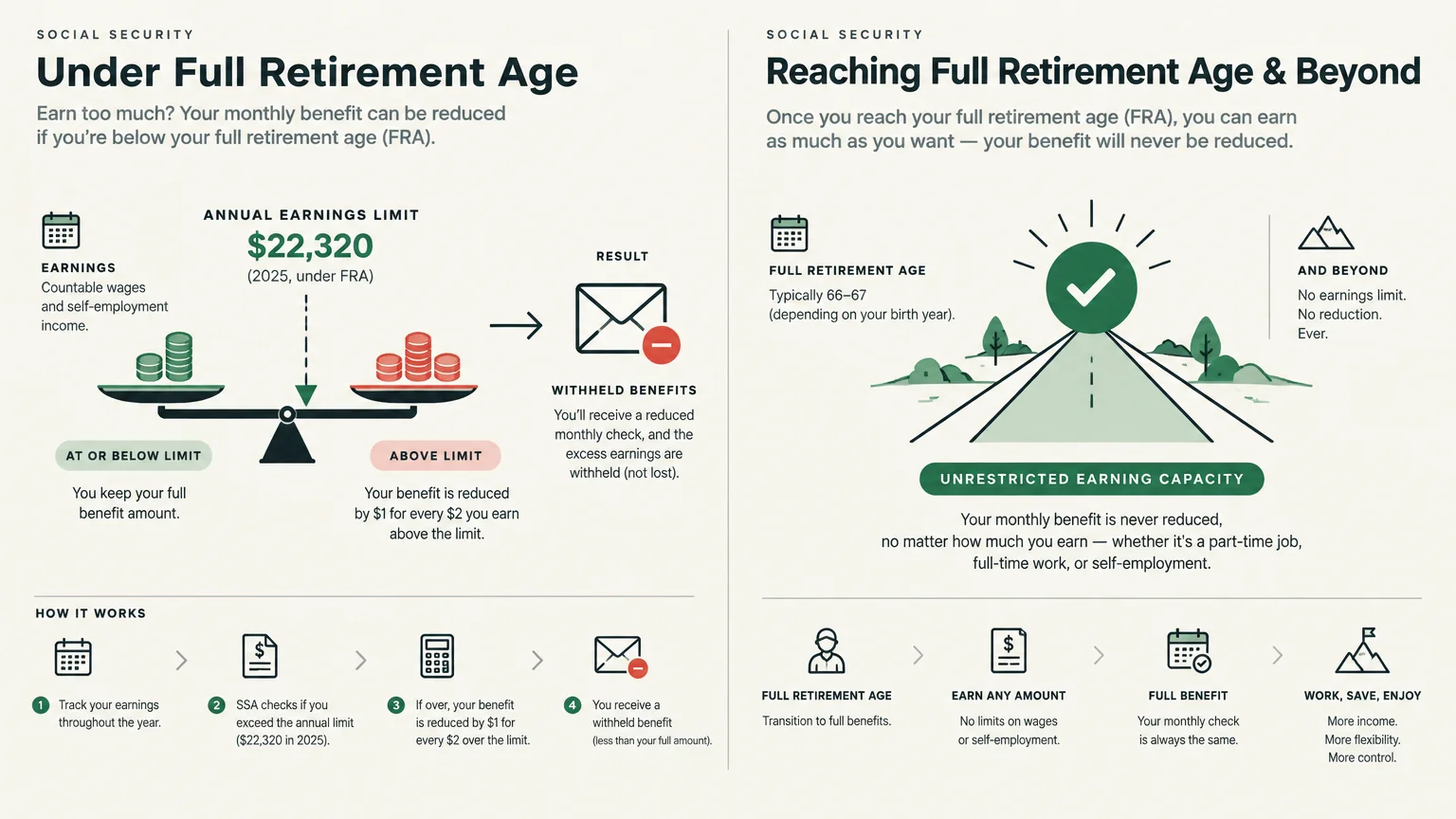
Earning an active income in retirement requires careful coordination with your monthly Social Security benefit checks. If you have already attained your Full Retirement Age (FRA), you can earn unlimited wages without penalty.
For anyone born on January 2, 1960, or later, your Full Retirement Age is 67. The Social Security Administration imposes no earnings cap once you reach that milestone.
If you claim benefits before Full Retirement Age, the Retirement Earnings Test applies to your wages. Retirees under FRA for the entire year can earn up to $24,480 annually ($2,040 monthly) before benefit reductions begin.
The SSA withholds $1 in benefits for every $2 earned above the $24,480 threshold. Fortunately, withheld benefits are not permanently forfeited; the agency recalculates your future monthly check higher once you hit FRA.
Different rules apply during the calendar year you reach Full Retirement Age. In the months prior to your birth month, you can earn up to $65,160 ($5,430 monthly) before the SSA withholds $1 for every $3 above the cap.

Tax Rules and Deductions for Working Seniors
Active earnings alter your adjusted gross income, which may influence your tax bracket and Medicare premiums. Every senior worker should understand current deduction thresholds to minimize unnecessary tax liability.
The standard deduction sits at $16,100 for single filers and $32,200 for married couples filing jointly. Head-of-household filers receive a standard deduction of $24,150.
Taxpayers age 65 and older qualify for an additional standard deduction. Single seniors claim an extra $2,050, while married seniors claim an extra $1,650 per qualifying spouse.
Under the Working Families Tax Cuts, seniors age 65 and older receive an Enhanced Senior Bonus Deduction through 2028. You can claim an additional $6,000 deduction per person ($12,000 for married couples filing jointly) on Schedule 1-A.
This temporary bonus stacks with standard deductions, providing up to $24,150 for single seniors and $47,500 for married couples. The deduction phases out at $75,000 modified adjusted gross income for singles and $150,000 for joint filers.
Remember that all working retirees must pay FICA taxes on earned wages. W-2 employees pay 7.65% for Social Security and Medicare, while 1099 independent contractors pay the full 15.3% self-employment tax rate.

Professional vs. Self-Guided: Choosing Your Employment Path
Working in retirement requires deciding between traditional W-2 employment and independent 1099 contracting. Each path brings distinct trade-offs regarding flexibility, tax complexity, and administrative effort.
Scenario 1: The Predictable W-2 Role
Taking an administrative or library position guarantees predictable hours and automatic payroll tax withholding. The employer manages tax filings and supplies your equipment, making this structure ideal if you want zero administrative overhead.
Scenario 2: The Independent 1099 Consultant
Operating as a freelance management consultant allows you to charge premium rates and select your clients. However, you must track business expenses, submit quarterly estimated tax payments, and purchase your own software tools.
Scenario 3: The Hybrid Seasonal Worker
Working as a seasonal tax preparer delivers concentrated earnings during winter followed by total freedom during summer. This model suits retirees who prefer intense work windows balanced by extended stretches of travel and relaxation.
Review your personal financial goals and technological comfort before choosing an employment arrangement. Selecting the right structure protects your leisure time while delivering the supplemental cash you need.

Common Mistakes to Avoid When Working in Retirement
Many retirees jump back into the workforce without examining how new earnings affect their broader financial picture. Avoiding a few common mistakes keeps your supplemental income rewarding and stress-free.
- Breaching Social Security Limits Unintentionally: If you collect benefits before age 67, track your cumulative monthly wages. Exceeding $24,480 triggers benefit clawbacks that can disrupt your expected cash flow.
- Overlooking Quarterly Estimated Taxes: Independent contractors and tutors must pay estimated taxes four times a year. Failing to make quarterly payments to the IRS leads to avoidable interest penalties.
- Triggering Medicare IRMAA Surcharges: Significant consulting income can push your modified adjusted gross income across Income-Related Monthly Adjustment Amount thresholds, raising your Medicare Part B and Part D premiums.
- Taking on Physically Draining Schedules: Choose roles that respect your physical stamina and personal energy. Overcommitting to rigid early-morning shifts quickly drains the enjoyment from semi-retirement.
- Failing to Track Legitimate Business Deductions: If you work as an independent 1099 contractor, track business miles, home office space, and supplies. Deductions lower your taxable net profit and reduce self-employment taxes.
Monitor your overall household income closely through the Consumer Financial Protection Bureau tools and educational guides. Careful income planning ensures your part-time wages support your lifestyle rather than creating tax complications.
Frequently Asked Questions
Can I collect Social Security and work a part-time job at the same time?
Yes, you can work while collecting Social Security benefits. Once you attain Full Retirement Age (age 67 for those born 1960 or later), there is no limit on your earnings.
If you are younger than 67, earnings above $24,480 reduce your benefits temporarily. The withheld funds are credited back to increase your monthly benefit once you reach Full Retirement Age.
Do I have to pay Medicare and Social Security taxes on retirement earnings?
Yes, all earned income remains subject to FICA taxes regardless of your age or retirement status. W-2 employees pay 7.65% in payroll taxes, while self-employed contractors pay 15.3%.
These contributions can actually increase your future Social Security payout. The SSA reviews your earnings annually and recalculates your benefit if your current wages rank among your highest 35 earning years.
What is the easiest high-paying job for older adults to start quickly?
Substitute teaching and seasonal tax preparation offer the quickest entry pathways with minimal upfront expense. Most school districts only require background screening and a bachelor’s degree, while commercial tax chains offer free preparatory courses.
Both positions offer strong hourly wages that substantially beat the $7.25 federal minimum wage. They also grant complete calendar flexibility once their respective active seasons conclude.
Will my part-time job push me into a higher tax bracket?
In the United States, marginal tax brackets only apply to income earned within each specific tier. Moving into a higher bracket never reduces your net income across prior earnings.
However, increased earned income can cause a larger percentage of your Social Security benefits to become taxable. Consult the IRS calculation formulas to forecast your total liability accurately.
Building Your Ideal Semi-Retirement Schedule
Retirement no longer represents an all-or-nothing departure from productive work. Choosing high-paying, flexible roles allows you to fund personal passions, preserve retirement savings, and maintain professional confidence.
Start by auditing your greatest professional strengths, preferred schedule, and physical comfort levels. Reach out to local networks or browse remote job listings to find an opportunity that complements your lifestyle.
The information in this guide is meant for educational purposes. Your specific circumstances—including income, debt, tax situation, and goals—may require different approaches. When in doubt, consult a licensed professional.
Last updated: October 2026. Financial regulations and rates change frequently—verify current details with official sources.


