High-earning workers will notice slightly smaller paychecks beginning January 1, 2027. The Social Security taxable wage cap climbs to $192,300, which exposes an extra $7,800 of earned compensation to federal payroll withholding.
If you earn at or above that updated limit, your annual payroll deduction will increase by up to $483.60. Self-employed professionals face twice that burden, paying up to $967.20 more in self-employment taxes.
This adjustment affects corporate executives, self-employed consultants, and working seniors earning high wages. Understanding these updated thresholds ensures you can balance your monthly cash flow before the new tax year arrives.
The 2027 Maximum Taxable Earnings Limit
The Social Security Administration (SSA) adjusts the maximum wage base each autumn to reflect national wage growth. On October 14, 2026, the agency confirmed that the 2027 wage cap will rise to $192,300.
This change represents a 4.2% jump from the 2026 limit of $184,500. By comparison, the ceiling sat at $176,100 in 2025 and $168,600 in 2024.
The federal government uses this threshold to cap both tax contributions and future benefit credits. Once your earned wages cross $192,300 during 2027, your employer stops withholding the 6.2% Social Security tax for the year.
How the $484 Tax Increase Works for Employees
W-2 employees pay a mandatory 6.2% Old-Age, Survivors, and Disability Insurance (OASDI) tax on their earned wages. Your employer contributes an identical 6.2% match on your behalf.
Because the taxable ceiling expands by $7,800, high earners must pay that 6.2% rate on a larger slice of income. Multiplying $7,800 by 6.2% produces an exact annual increase of $483.60.
Workers earning at or above $192,300 will pay the maximum annual employee deduction of $11,922.60 in 2027. That represents a direct step up from the $11,439.00 maximum cap set in 2026.
If your compensation falls between $184,500 and $192,300, you will absorb only a partial tax increase. For example, earning $188,400 adds $3,900 in taxable earnings, resulting in an extra $241.80 in payroll deductions.
Employees earning under $184,500 will see zero tax increase from this cap adjustment. Their payroll deduction rate remains flat at 6.2% on all earned wages.

What Self-Employed Workers Will Pay
Freelancers, sole proprietors, and business partners carry both halves of the payroll obligation under the Self-Employed Contributions Act (SECA). This structure creates a combined 12.4% Social Security tax rate on net self-employment earnings.
When the wage ceiling expands by $7,800, self-employed professionals pay up to $967.20 more in 2027. Their maximum annual Social Security tax climbs from $22,878.00 in 2026 to $23,845.20 in 2027.
Fortunately, tax regulations allow you to deduct the employer-equivalent portion—equal to 50% of your self-employment tax—when determining your adjusted gross income. You can verify deduction guidelines directly on the Internal Revenue Service (IRS) website.
Independent contractors should account for this bump when calculating quarterly estimated tax payments for 2027. Underestimating these payroll amounts can trigger underpayment penalties when filing federal returns.
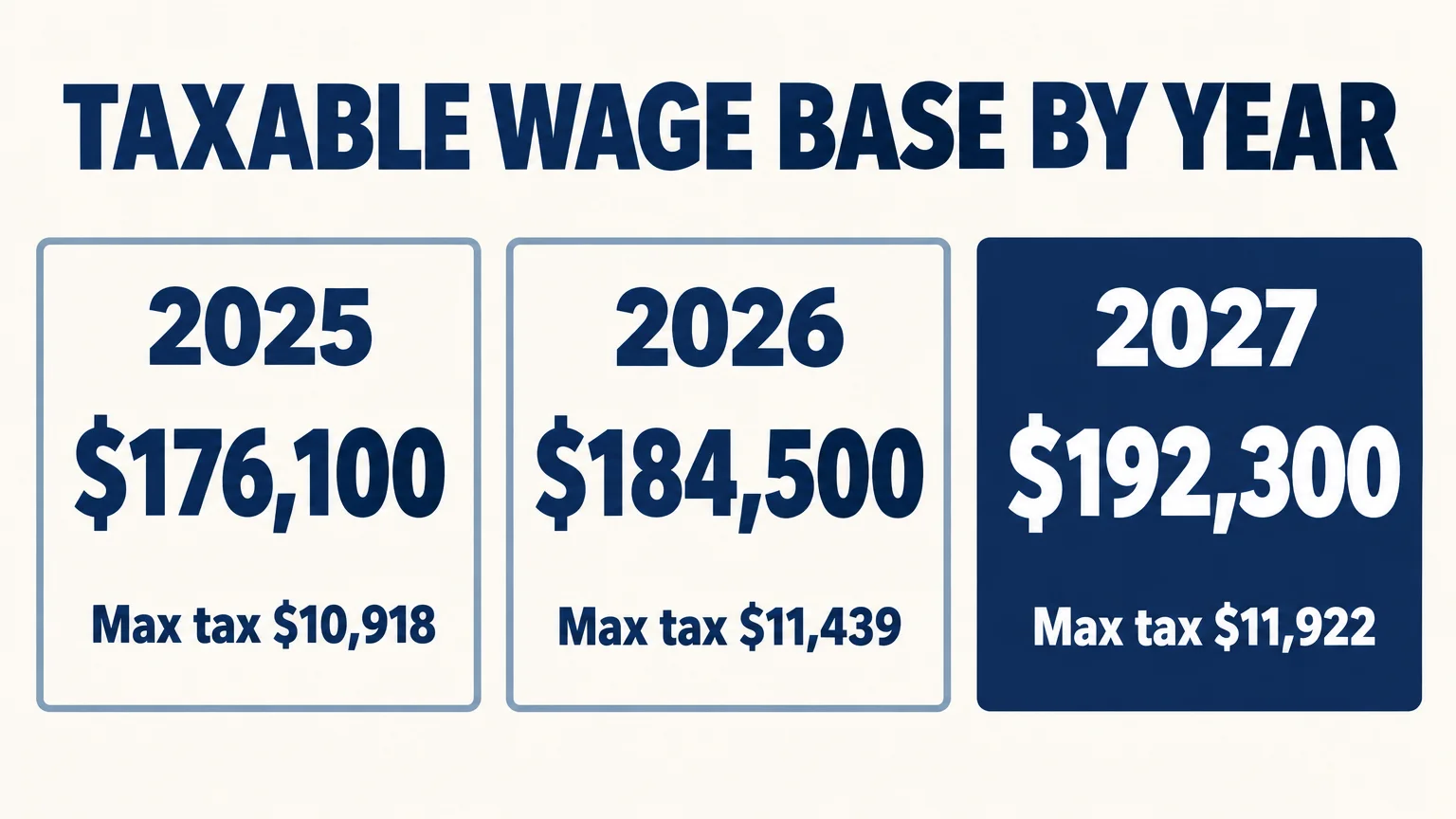
Social Security Tax Limits: 2025 to 2027 Comparison
Reviewing annual threshold adjustments helps you plan multi-year personal tax strategies. The following table illustrates how the maximum wage base and payroll obligations have shifted across recent calendar years.
| Tax Year | Taxable Wage Base | Max Employee Tax (6.2%) | Max Self-Employed Tax (12.4%) | Max Annual Increase (W-2) |
|---|---|---|---|---|
| 2025 | $176,100 | $10,918.20 | $21,836.40 | +$465.00 |
| 2026 | $184,500 | $11,439.00 | $22,878.00 | +$520.80 |
| 2027 | $192,300 | $11,922.60 | $23,845.20 | +$483.60 |
Remember that Medicare payroll taxes operate independently from these limits. The 1.45% Medicare tax applies to all earned wages without any income cap whatsoever.
Additionally, single taxpayers earning over $200,000 and married joint filers above $250,000 remain subject to the 0.9% Additional Medicare Tax.

Working Retirees and Seniors: Understanding What Gets Taxed
Many seniors assume that exceeding the wage base triggers new taxes on their entire retirement portfolio. However, the Social Security payroll tax applies strictly to earned income, such as salaries, hourly wages, and net business profits.
The IRS explicitly exempts unearned income sources from FICA payroll deductions. These exempt revenue streams include the following categories:
- Monthly distributions from 401(k), 403(b), and traditional IRA accounts
- Defined-benefit private, corporate, or civil service pension checks
- Social Security retirement, spousal, or survivor benefit payments
- Taxable brokerage dividends, capital gains distributions, and savings bond interest
If you work while collecting early Social Security benefits, you must also monitor the Retirement Earnings Test. In 2027, the exempt earnings limit for beneficiaries below full retirement age all year rises to $25,560.
The SSA withholds $1 in benefits for every $2 earned above that threshold. If you reach full retirement age during 2027, the cap rises to $67,920, with $1 withheld per $3 earned above the limit.
Pitfalls to Watch For
Changing employers or managing multiple income sources can lead to expensive payroll errors. Watch out for these three pitfalls during 2027.
Excess Withholding Across Multiple Employers: Each employer must withhold Social Security taxes up to $192,300 regardless of your other earnings. If your combined wages from two or more jobs exceed that threshold, payroll systems will overwithhold tax.
You do not forfeit this overpaid money. You can reclaim the excess withholding directly as a refundable tax credit on Form 1040, Schedule 3.
Confusing 401(k) Deductions with FICA Relief: Traditional 401(k) contributions reduce your taxable income for federal income taxes. However, they do not reduce your wages for Social Security or Medicare payroll calculations.
Even if you max out the 2027 employee 401(k) limit of $25,500, those deferred dollars remain fully subject to the 6.2% OASDI deduction.
Single-Employer Overwithholding Errors: If a single employer withholds more than $11,922.60 in error, you cannot claim the credit on Schedule 3. You must request a reimbursement directly from your employer’s payroll department or file IRS Form 843.
Expert Insight on Social Security and Solvency
The annual taxable wage adjustment reflects a statutory formula rather than a sudden policy decision by Congress. The wage base tracks the National Average Wage Index to keep pace with changing economic conditions.
“Do not save what is left after spending, but spend what is left after saving.” — Warren Buffett, Chairman and CEO of Berkshire Hathaway
This principle applies directly to managing automated payroll deductions. When statutory tax adjustments absorb a larger share of your gross earnings, proactive budgeting prevents unexpected shortfalls in your monthly cash flow.
Long-term solvency debates continue to focus heavily on the taxable maximum limit. According to the 2026 Social Security Trustees Report, the Old-Age and Survivors Insurance trust fund reserves face depletion in late 2032.
Currently, roughly 83% of aggregate national wages fall below the cap, down from 90% in 1983. Reviewing educational materials on Investopedia can help you stay informed on potential future legislative changes.
Getting Expert Help
While standard single-job withholding requires little intervention, complex earnings profiles often benefit from professional tax analysis. Consider consulting an advisor vetted by the Certified Financial Planner Board in the following situations:
- Dual-Earner Households with Multiple W-2s: A professional can ensure you properly track excess payroll tax credits across separate and joint returns.
- Executive Compensation Packages: Supplemental wages, bonuses, and equity vesting schedules can disrupt withholding timelines throughout the year.
- Transitioning into Active Retirement: An adviser can help you balance earned consulting income against benefit withholding thresholds and portfolio withdrawals.
- Independent Business Structuring: An expert can evaluate whether electing S-corporation tax status helps optimize reasonable salary versus distribution allocations under current laws.
Frequently Asked Questions
Will my monthly Social Security benefits increase because of this cap rise?
Paying taxes on higher earnings can gradually increase your future retirement benefit. The SSA calculates your primary insurance amount using your highest 35 years of indexed earnings.
When does the 2027 wage base take effect?
The $192,300 taxable ceiling applies to all covered compensation earned on or after January 1, 2027. Wages paid in late December 2026 follow 2026 limits.
What happens to my paycheck once I hit the cap?
Once your cumulative earnings reach $192,300 within 2027, your employer stops deducting the 6.2% Social Security tax. Your net take-home pay will increase for the remainder of that calendar year.
Does the wage cap apply to Medicare taxes as well?
No, the standard 1.45% Medicare tax applies to all earned wages without limit. Higher earners also pay an extra 0.9% once their wages cross statutory thresholds.
Preparing for the 2027 Payroll Shift
Review your expected 2027 compensation now to determine if the $7,800 wage cap increase impacts your paycheck. Adjusting your savings transfers and checking your quarterly tax projections ensures your household budget stays on track.
The information in this guide is meant for educational purposes. Your specific circumstances—including income, debt, tax situation, and goals—may require different approaches. When in doubt, consult a licensed professional.
Last updated: November 2026. Financial regulations and rates change frequently—verify current details with official sources.