When you owe unpaid taxes, the Internal Revenue Service starts the collection process by sending an official letter through the U.S. Postal Service—never with an unexpected phone call, text, or social media message.
Knowing how the IRS contacts taxpayers helps you protect your rights before penalties grow. It also makes spotting fake collection demands effortless.
Below, you can walk through every official contact channel, the exact notice timeline, current 2026–2027 interest and fee rules, and practical ways to settle your balance.
How the IRS Actually Contacts Taxpayers
Understanding how the agency reaches out eliminates panic when a message arrives. Per IRS guidance updated on October 22, 2026, the agency follows strict communication rules across every channel.
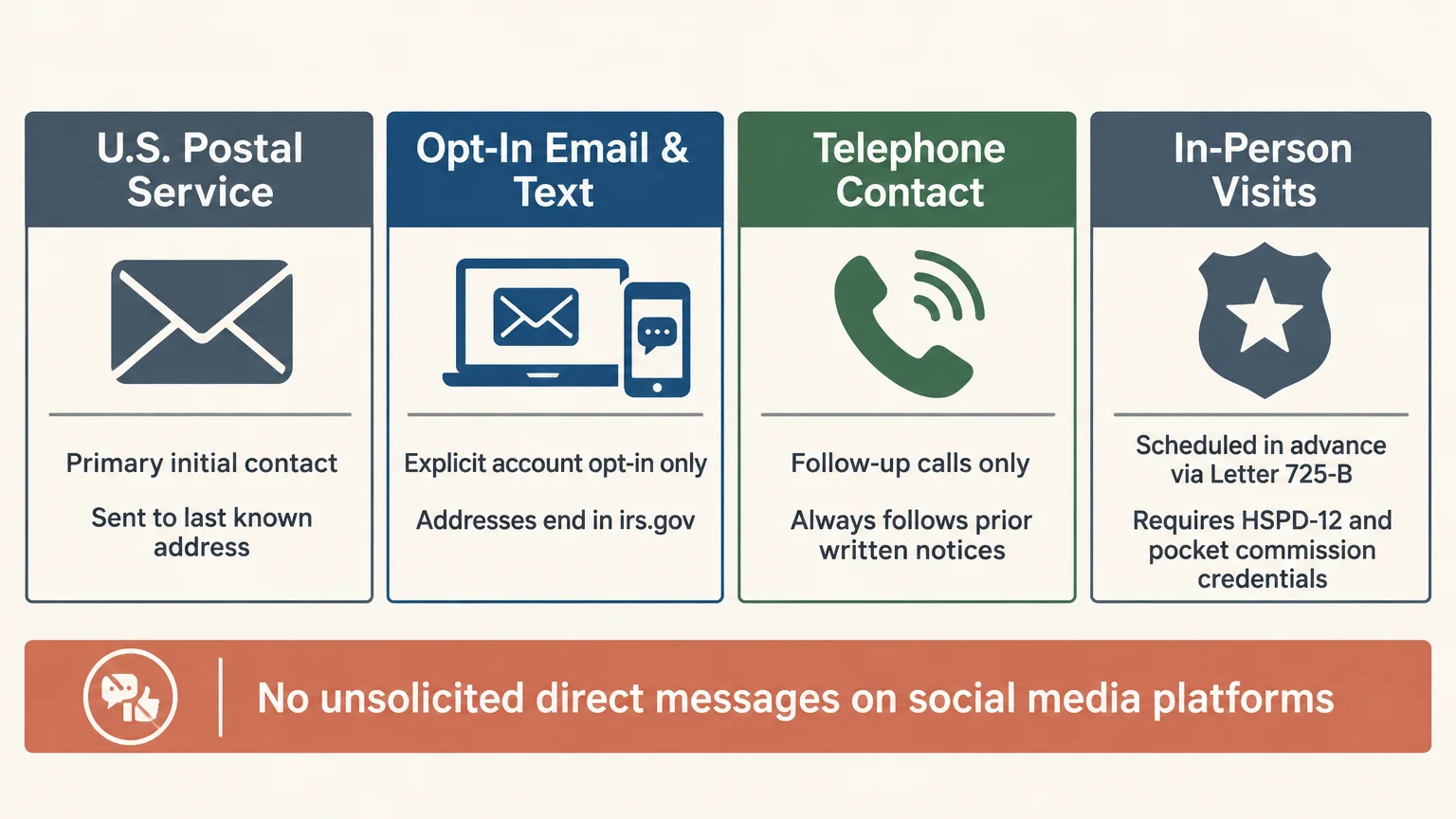
Your first notice regarding a tax balance or return issue normally arrives as a physical letter in your mailbox. The IRS uses the U.S. Postal Service to deliver official notices to your last known address.
Electronic messages remain limited to taxpayers who choose to receive them. The IRS sends emails or text messages only when you have explicitly opted in through your account settings or a subscription service.
Legitimate IRS account email notifications always come from addresses ending in irs.gov, while IRS News Bulletin emails arrive from irs@service.govdelivery.com. Official IRS text messages originate only from specific government short codes.
Phone calls do happen later in the collection cycle, though rarely out of the blue. IRS employees or contracted private collection agencies may call about open account matters after prior written contact.
The IRS also occasionally places automated phone calls. Those recorded messages simply direct you to visit IRS.gov and never share private tax or balance details over the line.
Social media outreach from the agency does not exist for individual tax issues. The IRS explicitly states that it will never send direct messages on any social media platform.
Rare In-Person Visits and Mandatory Credentials
Unannounced home or business visits used to happen regularly, but federal policy has changed. Following a July 2023 policy shift that ended most unannounced Revenue Officer visits, unscheduled appearances are now rare.
According to October 2026 IRS guidance, officers generally mail a letter—such as Letter 725-B—or call to schedule an appointment before arriving. Unannounced visits occur only in specific enforcement situations.
Only four categories of IRS personnel have authority to visit a taxpayer’s home or workplace:
- Revenue Agents: Civil examiners who conduct tax audits.
- Revenue Officers: Field collection specialists handling unresolved tax debts.
- Criminal Investigation Special Agents: Armed law enforcement officers investigating potential tax crimes.
- Fuel Inspectors: Specialists verifying compliance with federal dyed-fuel tax laws.
You always have the right to verify an agent’s identity at your door before speaking with them. Revenue Officers, Revenue Agents, and Fuel Inspectors must carry two forms of official identification displaying a photo and serial number.
Those two credentials are an IRS pocket commission and an HSPD-12 federal identity card. Criminal Investigation Special Agents carry law enforcement credentials instead, which you can also inspect before answering questions.
The IRS Collection Notice Timeline and Critical Deadlines
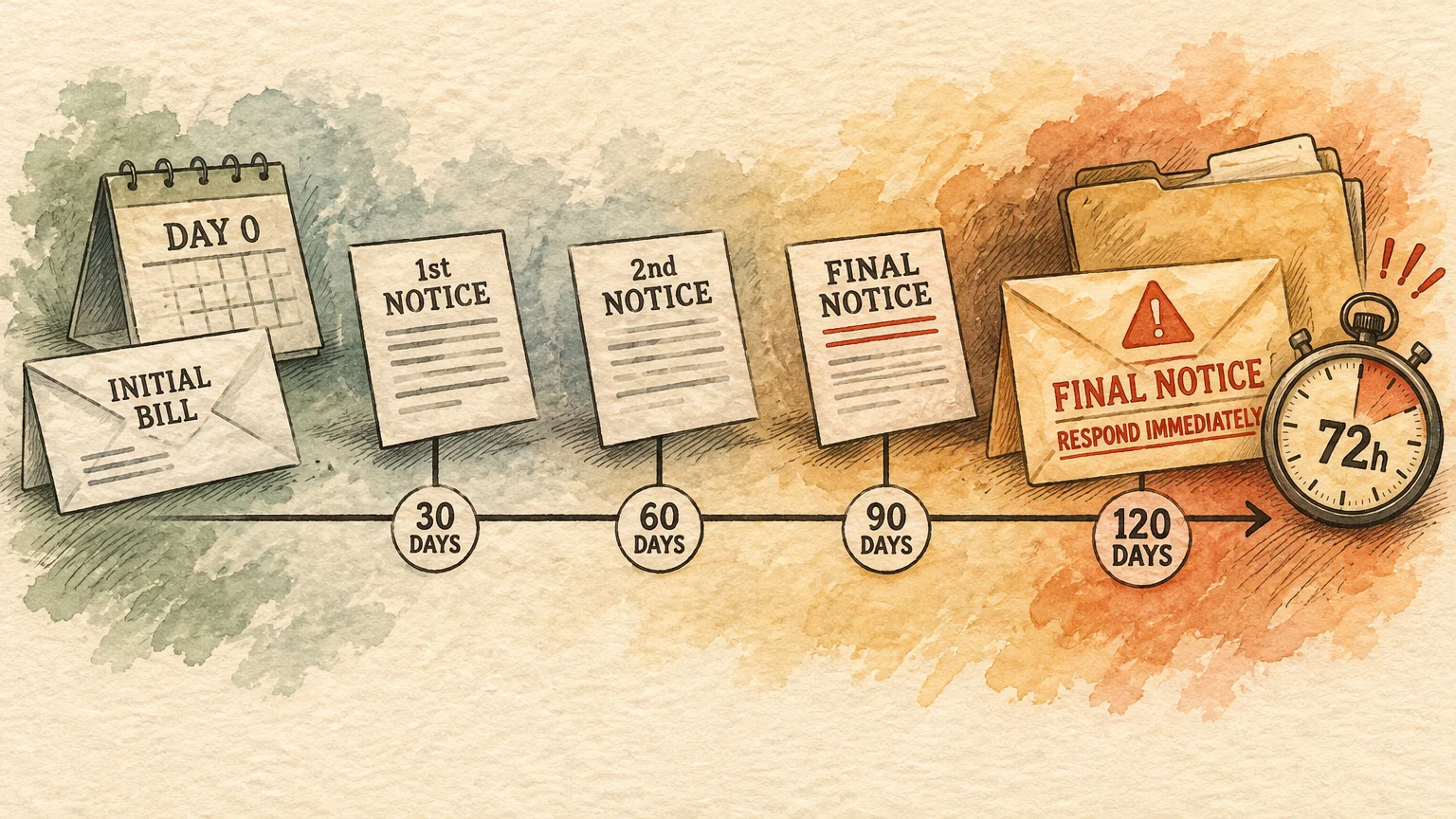
The IRS collection process moves through an automated sequence of written notices rather than jumping straight to asset seizures. Each notice carries a distinct code in the upper right corner and triggers specific legal timelines.
While certain accounts skip intermediate reminders depending on your filing history or balance size, most individual tax debts follow a standard progression. Reading that notice code immediately tells you how urgent your situation is.
| Notice Code | Stage in Process | What the Notice Means | Key Timing or Action |
|---|---|---|---|
| CP14 | Initial demand | Official notice and demand for unpaid tax, penalties, and interest. | Sent within 60 days of tax assessment under IRC §6303(a). |
| CP501 | First reminder | Follow-up reminder that your tax balance remains unpaid. | Mailed weeks after CP14; pay or arrange a plan to slow penalties. |
| CP503 | Second reminder | Urgent balance reminder warning of a possible Notice of Federal Tax Lien. | Signals escalating collection risk if left unanswered. |
| CP504 | State refund levy notice | Notice of intent to seize your state tax refund. | Does not yet authorize wage garnishment or bank levies. |
| LT11 / Letter 1058 / CP90 | Final levy notice | Final Notice of Intent to Levy and Notice of Your Right to a Hearing. | Strict 30-day window to request a Collection Due Process hearing. |
Your first official IRS notice letter is usually Notice CP14. Under Internal Revenue Code Section 6303(a), the agency must send this notice and demand for payment within 60 days of assessing a tax.
If you cannot pay the CP14 balance in full, reminders labeled CP501 and CP503 typically arrive several weeks apart. Notice CP503 adds an explicit warning that the IRS may file a public Notice of Federal Tax Lien.
Notice CP504 marks a sharper turn in tone, though its reach stays narrow. It authorizes the IRS to intercept a state income tax refund, not your paycheck or checking account.
The 30-Day Final Notice Window
Before the IRS can garnish wages, seize bank funds, or take up to 15% of Social Security benefits, it must send a Final Notice of Intent to Levy. Individuals typically receive Letter 1058 or LT11, while Social Security recipients receive CP90.
Under IRC §6330, you have exactly 30 days from the date printed on that final notice to request a Collection Due Process (CDP) hearing. You submit this request using Form 12153.
Filing Form 12153 within 30 days generally pauses levy action while the IRS Independent Office of Appeals reviews your case. It also preserves your right to petition the U.S. Tax Court if you disagree with the outcome.
Missing the 30-day deadline still leaves a fallback option called an Equivalent Hearing for up to one year. However, an Equivalent Hearing does not stop active levies and forfeits your right to Tax Court review.
Bank Levies, Collection Limits, and 2026 Passport Rules
When a bank levy does take effect, your money does not disappear the same afternoon. Federal rules require your bank to freeze the funds for 21 days before sending them to the IRS.
That 21-day hold gives you a narrow window to contact the IRS, fix identity errors, or prove severe economic hardship. Acting within those three weeks can still result in a levy release.
The IRS also faces an outer time limit on how long it can pursue unpaid balances. Generally, the agency has 10 years from the date of tax assessment—known as the Collection Statute Expiration Date—to collect a tax debt.
Large balances carry an extra consequence tied to international travel. Under IRC §7345 and IRS guidance updated July 28, 2026, the IRS certifies seriously delinquent tax debts to the U.S. State Department.
For 2026, that inflation-adjusted certification threshold sits at more than $66,000 in legally enforceable unpaid tax, penalties, and interest. That figure rose from $64,000 in 2025 and $62,000 in 2024.
Certification applies only if the IRS has already filed a federal tax lien or issued a levy. Once certified, you receive Notice CP508C, and the State Department can deny a new passport application or refuse renewal.
If the State Department denies your application, you get 90 days to resolve the debt or enter a payment plan before the application closes. For existing passports, the IRS sends Letter 6152 before referring your passport for revocation.
When Private Debt Collectors Enter the Picture
Receiving a call from a private collection agency about federal taxes often looks like a scam at first glance. Yet federal law requires the IRS to assign certain older, inactive tax debts to private contractors.
According to IRS guidance updated August 21, 2026, only three private collection agencies hold federal authorization—a lineup in place since September 23, 2021. Any other company claiming to collect federal taxes is fraudulent.
- CBE Group Inc.: 800-910-5837
- Coast Professional, Inc.: 888-928-0510
- ConServe: 844-853-4875
Private collectors cannot call you out of nowhere. Under IRS rules updated in February and August 2026, a strict two-letter rule applies before any phone contact begins.
First, the IRS mails you Notice CP40 explaining that your account is moving to a named agency. Second, that assigned agency mails an initial confirmation letter introducing itself.
Both letters contain a unique Taxpayer Authentication number. When the agency calls, that number is used for two-party identity verification.
Federal law sharply limits what these contractors can do. They may arrange installment plans lasting up to seven years or until the 10-year collection expiration date, whichever comes first.
Private collectors cannot issue levies, file tax liens, accept an Offer in Compromise, or grant hardship status. Most importantly, you always send payments directly to the U.S. Treasury or IRS—never to the collection agency itself.

2026–2027 Interest Rates, Penalties, and Payment Plan Options
Leaving a tax bill unresolved grows expensive fast because both interest and monthly penalties stack together. Even if you cannot pay everything today, understanding the numbers helps you choose the cheapest path forward.
Under IRS Revenue Ruling 2026-15, the individual underpayment interest rate for the fourth quarter of 2026 (October 1 through December 31) is 7% per year, compounded daily. Earlier in 2026, rates stood at 7% in Q1, 6% in Q2, and 7% in Q3.
On November 25, 2026, reporting confirmed that the IRS is raising rates by one percentage point for the first quarter of 2027. From January 1 through March 31, 2027, individual underpayment interest climbs from 7% to 8% annually, compounded daily.
Large corporate underpayments exceeding $100,000 also increase by one percentage point in Q1 2027, moving from 9% to 10%. Daily compounding means every week you delay adds measurable cost.
Penalties run alongside interest and depend heavily on whether you filed on time. The failure-to-file penalty is 5% of unpaid tax per month, capped at 25%.
By contrast, the failure-to-pay penalty starts at 0.5% per month, also capped at 25%. If you filed your return on time and set up an approved installment agreement, that monthly penalty drops in half to 0.25%.
Waiting too long triggers a stiff penalty hike. Ten days after the IRS issues a Final Notice of Intent to Levy, the failure-to-pay penalty jumps to 1% per month.
Always file your tax return by the deadline even when your checking account cannot cover the bill; cutting the monthly penalty from 5% to 0.5% immediately buys you breathing room at a fraction of the cost.
Short-Term vs. Simple Payment Plans
Most taxpayers resolve balances through online payment plans rather than waiting for collection notices to escalate. Your total debt and payoff timeline determine which 2026 option fits best.
| Plan Type | Balance Limit | Timeframe | 2026 Setup Fee |
|---|---|---|---|
| Short-Term Payment Plan | Less than $100,000 combined | Up to 180 days | $0 |
| Simple Payment Plan (Online Direct Debit) | $50,000 or less combined | Up to 10-year collection limit (up to 120 months) | $29 (effective July 5, 2026) |
| Simple Payment Plan (Online Non-Direct Debit) | $50,000 or less combined | Up to 10-year collection limit (up to 120 months) | $69 (effective July 5, 2026) |
| Low-Income Long-Term Plan | Varies by eligibility | Long-term installment schedule | $0 with direct debit; $43 without |
If you can pay within six months and owe less than $100,000 in combined tax, penalties, and interest, apply online for a short-term plan. It gives you up to 180 days with a $0 setup fee.
For longer timelines, the IRS replaced older streamlined installment agreements with Simple Payment Plans in March 2025. Individuals owing $50,000 or less with all required returns filed generally qualify without submitting a detailed Form 433-A or 433-F financial statement.
Simple Payment Plans let you stretch monthly payments up to the 10-year collection expiration date, or up to 120 months. On balances between $25,000 and $50,000, the IRS also removed the mandatory direct debit requirement to avoid a federal tax lien.
Long-term setup fees adjusted on July 5, 2026, under Internal Revenue Manual 5.14.1.2. Applying online with direct debit costs $29 (up from $22 previously), while paying online without direct debit costs $69.
Setting up a long-term plan by phone, mail, or in person costs far more: $107 with direct debit or $178 without it. Revising an existing agreement later costs $6 online or $89 offline, though modifying a direct-debit plan remains $0.
Low-income taxpayers—defined as having adjusted gross income at or below 250% of federal poverty guidelines—qualify for waived or reduced fees. They pay $0 with direct debit, or $43 without direct debit with potential reimbursement once the plan finishes.
If balancing a tax plan alongside rent, groceries, and high-interest credit cards feels tight, nonprofit counseling can help you map out cash flow. Resources from the National Foundation for Credit Counseling (NFCC) and the Consumer Financial Protection Bureau (CFPB) explain how to prioritize essential living expenses and debt obligations safely.
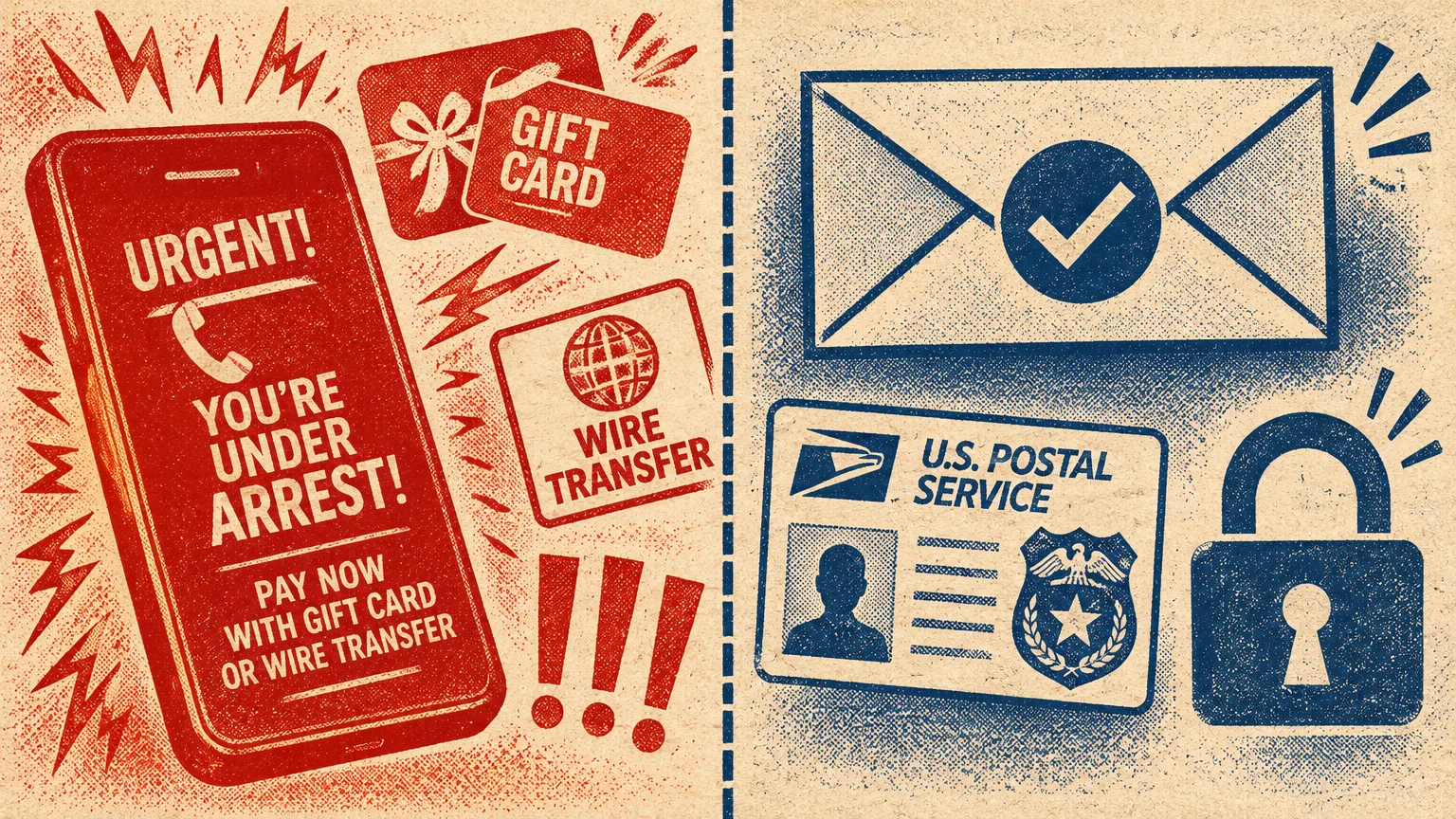
How to Spot IRS Scam Calls, Texts, and Phishing Attempts
Tax anxiety makes people vulnerable to criminals posing as federal agents. Federal Trade Commission data released in June 2026 shows imposter scams ranked as the number-one fraud category in 2025, accounting for nearly one in three reports.
Consumers reported $3.5 billion in total imposter losses in 2025, including roughly $920 million lost specifically to government impersonators. That government-impersonator figure jumped sharply from $789 million in 2024.
In its 2026 Dirty Dozen campaign, the IRS warned taxpayers about rising artificial intelligence phone scams using robocalls, voice mimicry, and spoofed caller IDs. The agency also flagged growing QR-code phishing and reported identifying more than 600 social media impersonators in fiscal year 2025.
Tax-related identity theft remains an equally stubborn risk. A May 2026 report from the Treasury Inspector General for Tax Administration (TIGTA) found IRS identity filters flagged about 7.5 million returns across 2024 and 2025, stopping roughly $7 billion in fraudulent refunds.
Unfortunately, real victims face slow recovery timelines when thieves strike. The National Taxpayer Advocate reported that identity theft victim cases took an average of 20 months to resolve in fiscal year 2026.
Non-Negotiable IRS Scam Red Flags
The IRS states clearly that it will never cross certain lines. Hang up, close the message, and refuse to pay if a caller or sender does any of the following:
- Demands unusual payment methods: Legitimate IRS payments never use gift cards, prepaid debit cards, or wire transfers.
- Threatens immediate arrest: The IRS cannot call local police or immigration authorities to arrest you over a tax bill.
- Denies your right to question or appeal: Real notices always explain how to dispute the balance or request a hearing.
- Pushes unsolicited links or QR codes: Unexpected texts or emails telling you to verify a refund or pay immediately are phishing traps.
How to Verify and Report Suspicious Contact
Never call back the phone number left in a suspicious voicemail or click links inside an unexpected message. Instead, follow IRS verification guidance reviewed in July 2026:
- Check your official balance directly: Log in to your IRS Online Account at
IRS.govor call the IRS directly at800-829-1040. - Report phishing emails: Forward suspicious emails as an attachment without clicking links to
phishing@irs.govwith the subject line “IRS.” - Report scam text messages: Email the sender’s number, exact text, and date and time to
phishing@irs.govwith the subject line “Text,” and forward the message to7726(SPAM). - Report phone scams or collector misconduct: Contact TIGTA at
800-366-4484ortigta.gov, and file a report with the FTC atReportFraud.ftc.gov.
Common Mistakes to Avoid
Even well-intentioned taxpayers accidentally make an IRS balance much harder to resolve. Steering clear of five common errors keeps penalties low and preserves your legal protections.
Ignoring early CP14 or CP501 letters: Leaving envelopes unopened does not pause interest or penalties. Responding during the early notice stage lets you choose an affordable payment plan before liens or levies enter the picture.
Skipping your tax filing because you lack the cash: Filing late triggers a 5% monthly penalty compared to 0.5% for paying late. Always file your return—or an extension accompanied by whatever partial payment you can manage—on time.
Missing the 30-day LT11 or Letter 1058 deadline: Waiting past day 30 forfeits your automatic levy freeze and Tax Court appeal rights. Mark that mailing date on your calendar the moment a Final Notice arrives.
Paying a private debt collector directly: Authorized agencies like CBE Group, Coast Professional, and ConServe only help set up arrangements. Every dollar you owe goes straight to the U.S. Treasury.
Confirming an incoming call using the caller’s number: Spoofed caller IDs routinely mimic local IRS offices or Washington area codes. Hang up and look up the official number on IRS.gov yourself.
Professional vs. Self-Guided
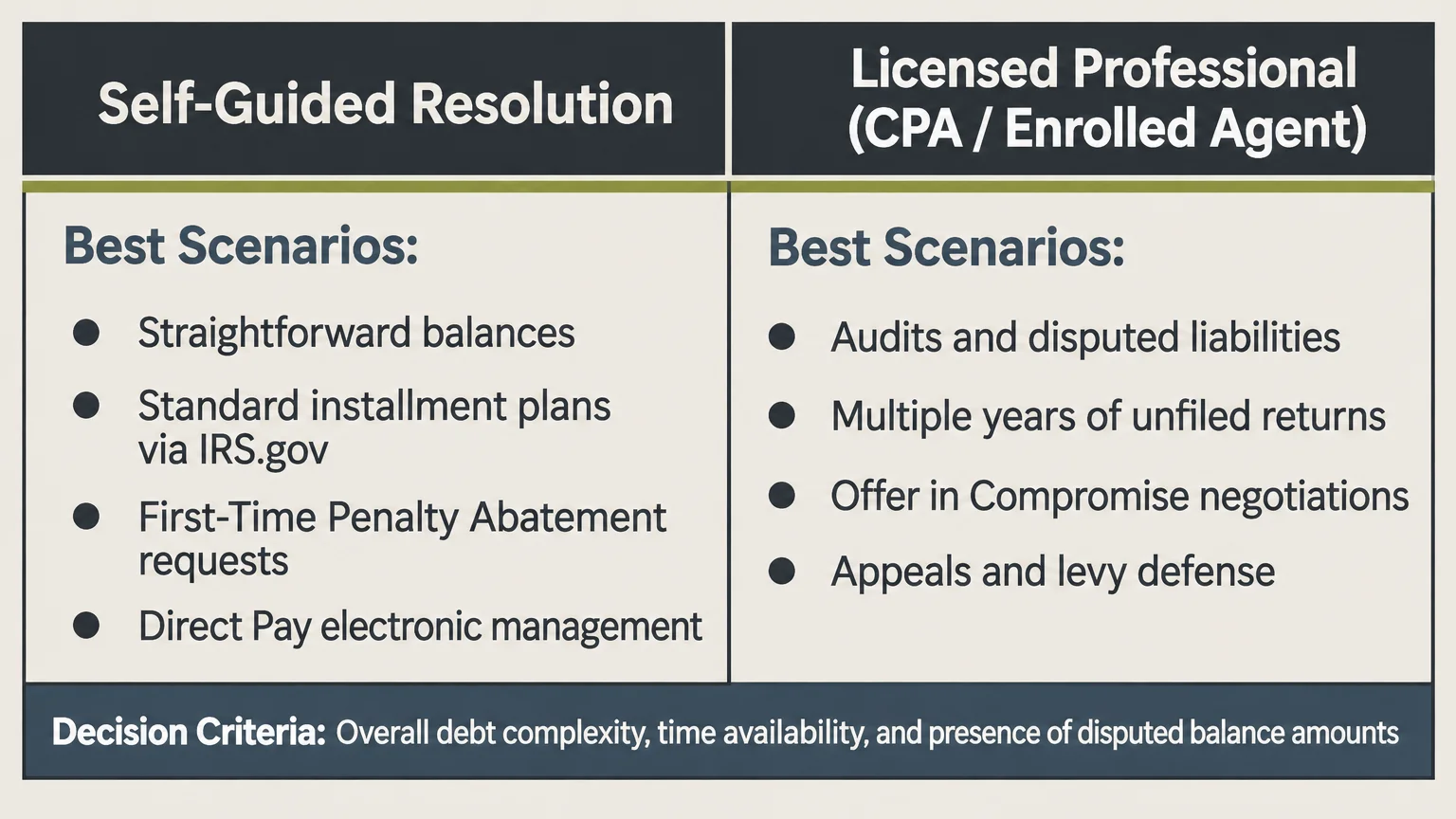
You do not automatically need to hire a tax professional just because you owe the IRS money. Simple balances are designed for self-service, while complex enforcement notices warrant expert backup.
Self-guided resolution makes sense when you owe $50,000 or less and have filed all returns: Applying online for a Simple Payment Plan takes minutes and carries a $29 direct-debit fee. You avoid phone hold times and keep your budget intact.
Self-guided resolution works well for short-term cash gaps under $100,000: If a bonus, home sale, or savings transfer will clear your balance within 180 days, an online short-term plan costs $0 to set up.
Hire a CPA, Enrolled Agent, or tax attorney when facing an LT11 deadline or active bank levy: Missing a Form 12153 deadline or failing to document hardship within a 21-day bank freeze can cost your paycheck or savings. A licensed representative knows how to communicate directly with IRS Collections and Appeals.
Seek professional guidance if you owe more than $66,000, face passport restrictions, or need an Offer in Compromise: Settling a debt for less than you owe, handling multi-year unfiled returns, or clearing a 20-month identity theft case requires careful documentation and legal precision. For help comparing tax resolution options and understanding tax-relief red flags, consumer guides from NerdWallet offer clear starting points before you hire anyone.
Frequently Asked Questions About IRS Contact
Does the IRS ever call before sending a letter?
Normally, no. Per October 2026 IRS guidance, initial contact arrives via U.S. mail; phone calls from IRS employees or authorized private agencies generally happen only after written notices have already been mailed.
How do I know if an IRS notice letter in my mailbox is real?
Real letters include a notice code such as CP14, CP501, or LT11 in the upper corner, explain your balance and appeal rights, and instruct you to pay the U.S. Treasury. You can verify any notice immediately inside your IRS Online Account or by calling 800-829-1040.
What happens if I ignore a Final Notice of Intent to Levy (LT11)?
After the 30-day response window passes, the failure-to-pay penalty rises to 1% per month after 10 days, and the IRS can legally garnish wages, levy bank accounts for 21 days before transfer, or seize up to 15% of Social Security benefits.
Can I set up an IRS payment plan online without talking to anyone?
Yes, if all required tax returns are filed and your combined balance is under $100,000 for a 180-day short-term plan or $50,000 or less for a long-term Simple Payment Plan. Applying online also cuts long-term setup fees to $29 with direct debit or $69 without it.

Your Next Step When an IRS Notice Arrives
Open any IRS mail the day it reaches your mailbox, verify the notice inside your IRS Online Account, and compare what you owe against the 180-day or Simple Payment Plan options. Taking action before penalties climb to 1% per month or Q1 2027 interest hits 8% puts you back in control.
The information in this guide is meant for educational purposes. Your specific circumstances—including income, debt, tax situation, and goals—may require different approaches. When in doubt, consult a licensed professional.
Last updated: November 2026. Financial regulations and rates change frequently—verify current details with official sources.