Leaving an unpaid balance with the Internal Revenue Service will cost you more starting January 1, 2027. Under Revenue Ruling 2026-25, the IRS is raising its quarterly interest rate on individual tax underpayments to 8%.
This one-point increase directly hits filers who carry overdue balances or underwithheld on their retirement income. Interest compounds daily on unpaid tax assessments, which causes total liabilities to accelerate quickly.
If you rely on pension checks or Social Security benefits, understanding these calculations helps you protect your nest egg from compounding charges. Here is what you need to know about the new rates and how to minimize your costs.

The Q1 2027 Interest Rate Increase Explained
On November 24, 2026, the agency issued IR-2026-144, confirming that individual underpayment rates will jump from 7% to 8% per year. This adjustment takes effect January 1, 2027, and remains in place through March 31, 2027.
Federal law ties this charge directly to the federal short-term rate plus three percentage points. Because the Treasury recalculates rates quarterly, this 8% figure applies strictly to the first quarter of 2027 rather than the full tax year.
If you carry an existing balance from prior tax years, your account automatically adjusts to the higher rate on January 1. Filers who pay their taxes in full by the standard April due date will avoid this interest charge entirely.
How Daily Compounding Differs From Estimated-Tax Penalties
Not all IRS charges accrue the same way, and understanding the legal distinction can save you hundreds of dollars. Under Internal Revenue Code Section 6622(a), interest on unpaid tax assessments compounds daily until your account balance reaches zero.
This daily compounding applies to the original unpaid tax, accumulated monthly penalties, and previously accrued interest. Over several months, interest building on top of prior interest causes your total balance to expand at an accelerating pace.
In contrast, estimated-tax underpayment penalties calculated on Form 2210 operate under different mechanics. While the penalty formula adopts the 8% annual rate during the first quarter of 2027, Section 6622(b) specifically excludes estimated-tax penalties from daily compounding.

Why Retirees Face Higher Underpayment Risks
Retirees often experience unexpected tax bills because their income flows from several distinct sources. Unlike standard employer paychecks, retirement distributions do not automatically withhold federal income tax unless you actively elect adequate withholding.
Pensions, traditional IRA withdrawals, and taxable benefits can easily push you into a higher marginal bracket. You can coordinate your benefit deductions by filing Form W-4V with the Social Security Administration.
If your withholding falls short, you could trigger underpayment penalties when filing your annual return. Safe-harbor rules protect you if you owe under $1,000, or pay at least 90% of your current tax or 100% of your prior-year tax.
Taxpayers whose prior adjusted gross income exceeded $150,000 must satisfy a higher 110% prior-year safe harbor threshold. When required minimum distributions spike your taxable income, missing these thresholds leads directly to quarterly penalty assessments.
Comparing IRS Charges and Penalties for Q1 2027
Interest represents only one component of what you pay when an unpaid balance sits with the government. The table below outlines the primary rates and calculation methods filers encounter during the first quarter of 2027.
| Charge Type | Q1 2027 Rate | Compounding & Structure |
|---|---|---|
| Individual Underpayment Interest | 8% annually | Compounds daily under IRC § 6622(a) on tax, penalties, and accrued interest |
| Failure-to-Pay Penalty | 0.5% per month | Accrues monthly up to 25%; drops to 0.25% with an approved installment agreement |
| Failure-to-File Penalty | 4.5% to 5% per month | Accrues monthly up to 25%; minimum penalty of $535 if return is over 60 days late |
| Estimated Tax Underpayment Penalty | 8% annually | Calculated quarterly on Form 2210; exempt from daily compounding under IRC § 6622(b) |
Combining these monthly penalties with daily compounding interest rapidly inflates an unresolved tax liability. Settling outstanding balances as quickly as possible keeps your overall financing costs to a minimum.
“You must gain control over your money or the lack of it will forever control you.” — Dave Ramsey, Personal Finance Author
Relief Options and Simple Payment Plans
If you cannot pay your tax balance immediately, formal payment options prevent aggressive collection actions. Establishing an approved agreement also lowers your ongoing failure-to-pay penalty from 0.5% down to 0.25% per month.
Filers owing less than $100,000 in combined tax, penalties, and interest can request a short-term payment plan lasting up to 180 days with a $0 setup fee. While interest still accrues, this window allows you to reallocate funds without formal tax liens.
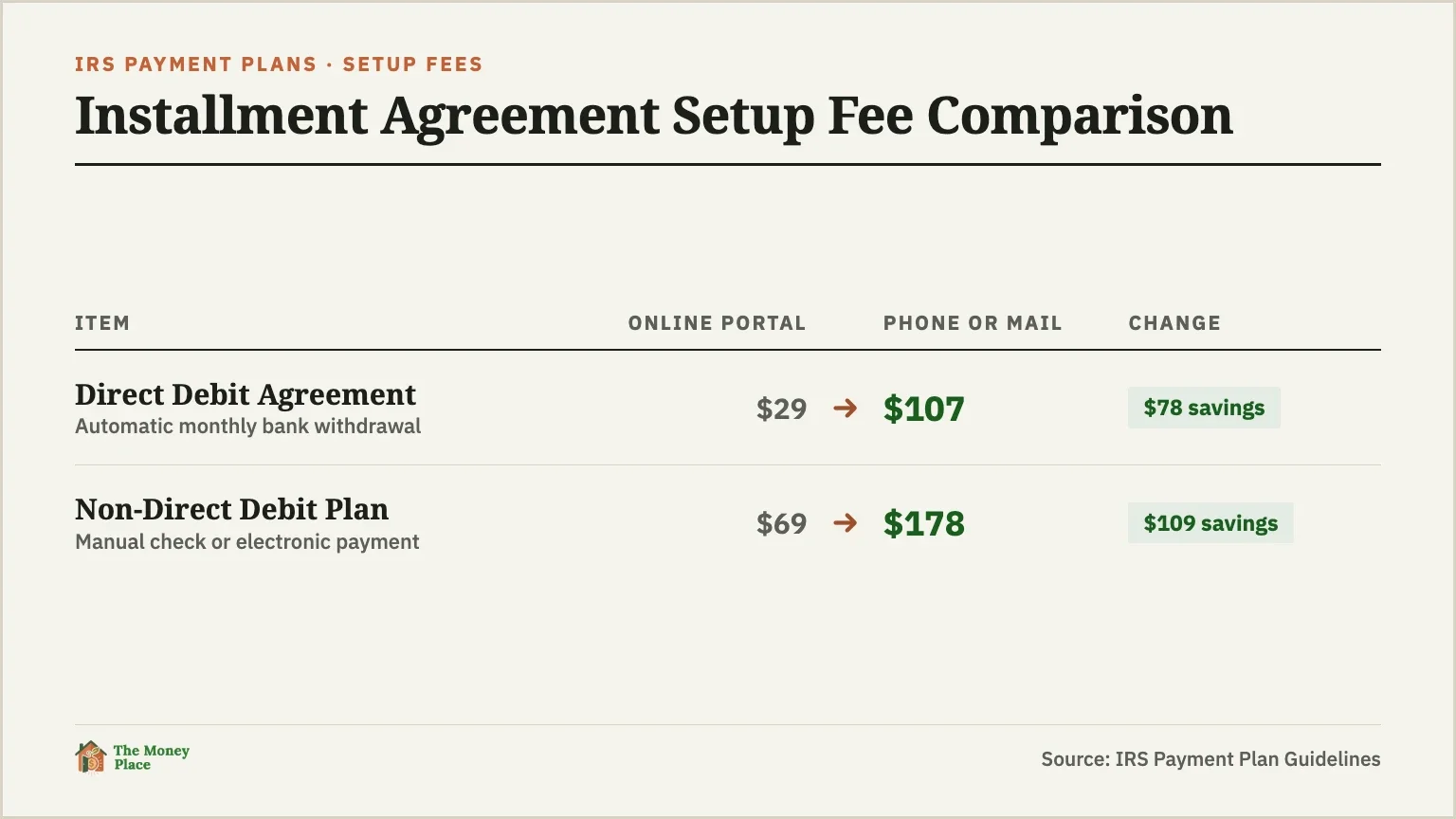
For longer periods, you can set up an installment agreement through the Internal Revenue Service online portal if you owe $50,000 or less. Setup fees are $29 for direct debit agreements established online, compared to $107 by phone or mail.
Qualifying low-income filers receive a complete fee waiver for direct debit installment agreements. Non-direct debit plans cost $69 online or $178 by phone, though eligible low-income filers pay a reduced fee of $43.
Starting January 1, 2027, the IRS is phasing in the Automatic Exemption from Penalty under IR-2026-83. This policy automatically waives failure-to-file and failure-to-pay penalties for eligible filers who maintained clean tax compliance over the preceding three years.

Pitfalls to Watch For
- Assuming filing extensions extend payment deadlines: Form 4868 moves your paperwork deadline to October 15, 2027, but payment remains due April 15. Interest begins accruing on unpaid tax immediately after April 15.
- Missing the January 15 estimated tax deadline: Your fourth-quarter 2026 estimated tax payment is due January 15, 2027. Missing it exposes you to the 8% penalty rate unless you file and pay your full return by February 1, 2027.
- Neglecting withholding adjustments: Retirees frequently forget to increase withholding after selling taxable assets or taking retirement distributions. Adjusting your Form W-4P or W-4R prevents unexpected underpayment penalties before they start.
Avoiding these common oversights keeps your household savings safe from unnecessary surcharges and compounding fees.

Getting Expert Help
Navigating tax balances requires careful attention, especially when penalties compound daily. Professional guidance proves particularly valuable in several specific situations:
- Multiple years of unfiled returns: A certified tax professional can reconstruct records, secure historical documentation, and negotiate structured settlements before collection notices escalate.
- Disputing erroneous balance notices: If the agency miscalculates your pension income or omits deductions, an enrolled agent can file formal administrative disputes.
- Qualifying for debt settlements: You can explore an Offer in Compromise if your retirement assets and fixed income cannot realistically cover your total assessed liability.
For broader debt management strategies, consider speaking with an accredited counselor through the National Foundation for Credit Counseling. The Consumer Financial Protection Bureau also provides educational guides to help you evaluate debt solutions.
Frequently Asked Questions
Will the 8% interest rate last throughout all of 2027?
No. The IRS adjusts interest rates quarterly based on federal economic indicators; this 8% rate legally applies only to the first quarter, ending March 31, 2027.
Can the IRS abate or waive the 8% interest charge?
The IRS cannot waive statutory interest unless the underlying tax or penalty is removed, or if agency errors caused unreasonable procedural delays.
How can retirees prevent unexpected underpayment penalties?
Retirees can submit Form W-4V to withhold taxes from Social Security, file Form W-4P for pensions, or submit quarterly estimated payments using Form 1040-ES.
Taking Action on Your Tax Account
Facing a tax balance can feel daunting, but proactive communication gives you immediate control over your outcome. Log into your IRS online account to verify your balance and choose a payment strategy that protects your household budget.
This is educational content based on general financial principles. Individual results vary based on your situation.
Always verify current tax laws, investment rules, and benefit eligibility with official sources.
Last updated: November 2026. Financial regulations and rates change frequently—verify current details with official sources.